
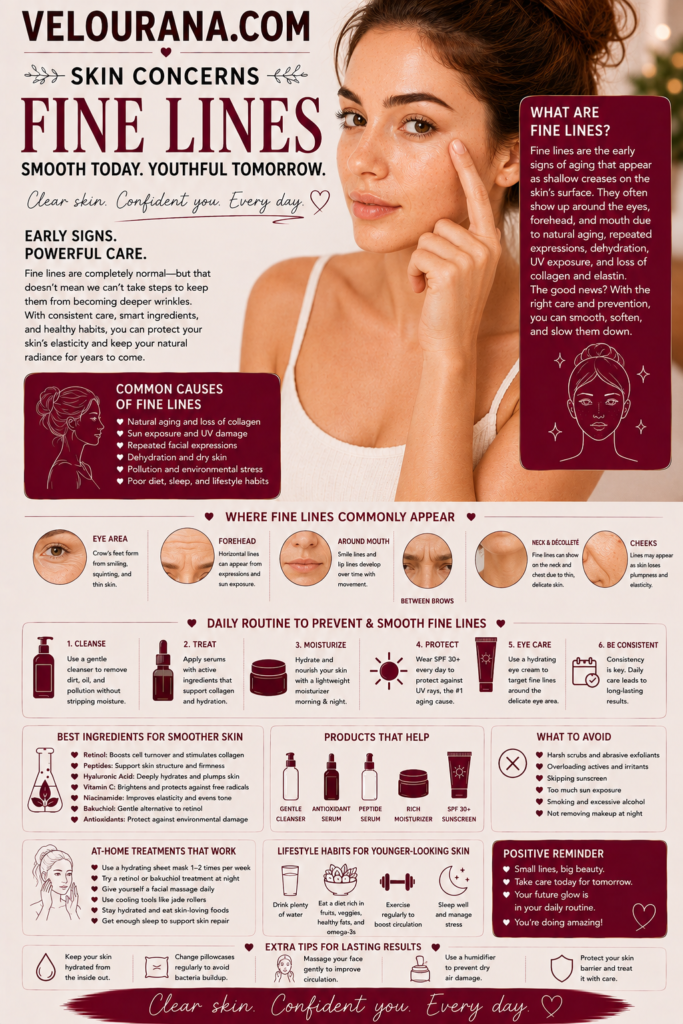
CATEGORY: Fine Lines
Fine lines create a peculiar problem in skincare because they are easy to see but difficult to interpret.
A faint crease beneath the eye may be partly structural, partly dehydrated and partly emphasized by concealer. A forehead line may reflect decades of repeated expression, accumulated ultraviolet exposure and the gradual decline in the skin's ability to spring back after movement. A network of tiny lines appearing suddenly during winter may have far more to do with surface dryness than with rapid biological aging.
All of these changes can look superficially similar in the mirror.
That similarity encourages a simple response: treat everything more aggressively.
A stronger retinoid is introduced. Exfoliation becomes more frequent. Several serums are layered together. Special treatments are added for the eyes, lips, forehead and neck. The routine grows until nearly every evening becomes an attempt to force visible change.
Yet aging skin does not necessarily respond well to constant intervention.
Fine-line care presents a paradox. Some of the ingredients capable of improving photoaged skin can also irritate it. Exfoliating too much can make surface texture appear worse. A highly complicated routine can make consistency almost impossible. Continually changing products prevents any meaningful evaluation of what is helping.
The pursuit of smoother skin can therefore become one of the things preventing the skin from looking its best.
A more sophisticated routine works differently. It separates the processes that can change quickly from those that require months or years. It protects the skin before trying to correct it. It maintains barrier function so that active treatment remains tolerable. It accepts that hydration, prevention and structural improvement are different objectives rather than different strengths of the same objective.
Most importantly, it stops measuring success by whether every line has vanished.
The aim becomes to improve the quality of the skin surrounding those lines: its hydration, smoothness, resilience, luminosity and resistance to unnecessary environmental damage.
That shift may sound modest.
In practice, it changes almost everything.
Fine-Line Treatment Begins with Diagnosis, Even Outside the Clinic
The word diagnosis belongs properly to medicine, and a cosmetic routine should never attempt to replace medical assessment. But there is still value in learning to identify what kind of visible problem one is actually trying to improve.
A line that appears only when smiling is not behaving like a line that remains permanently visible at rest.
A cluster of fine creases that suddenly becomes prominent when the skin is dry is not necessarily equivalent to a deeply established forehead wrinkle.
Rough texture created by irritation is not the same thing as structural aging.
These distinctions determine what skincare can realistically accomplish.
The simplest observation begins with movement.
When the face is fully relaxed, does the line remain?
If it disappears almost completely until a facial expression recreates it, movement is playing a dominant role. Improving skin quality may soften the appearance, but a topical product cannot prevent the underlying muscle from folding the skin.
If the line remains visible at rest but changes substantially after moisturizing, hydration and surface condition are contributing strongly.
If the line remains prominent despite good hydration and appears increasingly established over time, deeper structural aging is probably playing a larger role.
This does not produce a medical diagnosis.
It produces a more accurate skincare objective.
The difference is important because the beauty industry frequently treats all lines as though they exist on one continuous scale. A light moisturizer is marketed as an entry-level anti-wrinkle product, a serum as a stronger version, a retinoid as stronger again, and professional treatment as the final step.
But these interventions do not simply differ in strength.
They differ in mechanism.
A moisturizer improves the surface environment.
A sunscreen reduces future ultraviolet exposure.
A retinoid can influence biological processes associated with photoaging.
A neuromodulating injectable changes muscle activity.
A resurfacing procedure deliberately creates controlled injury to stimulate repair and remodeling.
A filler alters volume.
These are not successive doses of the same treatment.
They are different tools addressing different components of visible aging.
Understanding that difference is the beginning of rational fine-line care.
The Morning Routine Is Primarily About Preservation
Many people imagine that the serious work of anti-aging happens at night.
The evening routine contains the impressive products: retinoids, exfoliating acids, concentrated serums and rich creams. The morning routine can seem almost administrative by comparison.
For fine lines, that hierarchy deserves reconsideration.
The morning is when the skin is prepared to encounter ultraviolet radiation, visible environmental exposure, changing humidity, heat, cold, pollution and repeated cleansing or makeup removal later in the day.
The primary objective is therefore preservation.
A morning routine does not need to contain many steps to be effective. The skin should be cleansed only as much as necessary, hydrated according to its needs and protected from ultraviolet exposure.
Each of those apparently simple decisions matters.
Over-cleansing can increase tightness and dryness. Insufficient hydration can make shallow texture more visible. Inconsistent sunscreen leaves the skin exposed to one of the principal preventable contributors to premature visible aging.
The elegance lies in the sequence rather than the number of products.
Someone with dry or mature skin may discover that a full foaming cleanse every morning is unnecessary and leaves the face uncomfortable. Another person with oilier skin may prefer a gentle cleanser.
There is no universal requirement to make the skin feel stripped before skincare begins.
Clean skin should feel clean, not punished.
After cleansing, hydration can be adapted to the skin rather than to marketing trends. Some people need only a light moisturizer. Others benefit from a richer cream containing a mixture of humectant, emollient and barrier-supportive components.
A hydrating serum can be useful, but it is not mandatory simply because fine lines exist.
The final protective layer is sunscreen.
This is where preservation becomes most important.
Sunscreen Is Not a Wrinkle Eraser, and That Is Precisely Why It Matters
The cosmetic market naturally favors interventions that produce visible results.
Prevention is harder to sell because its success is partly invisible.
A moisturizer can soften surface lines within hours. Makeup can immediately blur them. A professional procedure can create noticeable change.
Sunscreen works largely by helping reduce additional damage that would otherwise accumulate.
There is no photograph of the wrinkle that never formed as deeply because ultraviolet exposure was reduced.
Yet chronic ultraviolet radiation is one of the major environmental drivers of photoaging. It contributes to collagen degradation, abnormal changes in elastic tissue, pigment irregularity and the progressive development of wrinkles.
This makes sunscreen foundational rather than optional for someone concerned about premature fine lines.
The purpose should be understood correctly.
Applying sunscreen this morning does not remove the line beside the eye this afternoon.
It changes the future exposure environment of that skin.
This difference between treatment and prevention is crucial because people often abandon sunscreen when they fail to see an immediate anti-aging effect.
The absence of immediate correction is not evidence of failure.
Protection works on a different timescale.
Daily use also requires practicality.
A sunscreen that feels unpleasant, pills beneath makeup, leaves an unacceptable cast or makes the skin excessively oily may be theoretically excellent but practically difficult to use consistently.
The best formulation is therefore not always the one with the most sophisticated marketing language.
It is one that provides appropriate broad-spectrum protection and is comfortable enough to become routine.
Consistency has biological value.
A perfect sunscreen left unused in a bathroom cabinet does not.
Antioxidants Can Support a Routine Without Becoming Its Center
Morning routines frequently include antioxidant serums, particularly vitamin C.
The logic is attractive. Ultraviolet exposure and other environmental stressors generate oxidative processes within skin, and antioxidants can participate in defenses against oxidative damage.
Yet this category also illustrates the gap between ingredient reputation and finished-product performance.
Vitamin C exists in multiple chemical forms. Pure ascorbic acid has formulation challenges because it is unstable and sensitive to environmental conditions. Derivatives may offer improved stability but differ in conversion and biological activity.
Packaging, formulation, pH, concentration and storage therefore matter.
The phrase "contains vitamin C" is not enough to determine performance.
This does not make antioxidants irrelevant.
It means they should occupy a proportionate position within the routine.
An antioxidant serum can complement sunscreen.
It does not replace sunscreen.
This hierarchy matters.
A consumer may spend considerable money on an elaborate antioxidant formula while using sun protection inconsistently. From the perspective of photoaging prevention, the priorities have been reversed.
Fine-line care improves when supporting ingredients remain supporting ingredients.
The routine does not need every potentially useful mechanism operating simultaneously.
Evening Care Is Where Correction Becomes More Relevant
If morning care emphasizes protection, evening care provides more opportunity for targeted treatment.
The skin is no longer about to encounter daylight exposure, makeup has been removed and active ingredients can be used within a relatively controlled environment.
Yet the evening routine is also where over-treatment most commonly begins.
Cleansing is often the first point of unnecessary aggression.
Removing sunscreen, makeup, oil and environmental residue is useful. Scrubbing until the face feels squeaky is not.
For people wearing substantial makeup or water-resistant sunscreen, a two-step cleansing method can sometimes improve removal. But double cleansing should not become a rule imposed on everyone regardless of need.
The objective remains adequate cleansing with minimal unnecessary disruption.
Once the skin is clean, the temptation is to layer every treatment associated with aging.
This is where restraint becomes especially valuable.
A routine containing several strong active ingredients may be scientifically interesting but biologically chaotic.
Retinoids, exfoliating acids and other potentially irritating treatments can each influence the skin in useful ways. Used together without attention to tolerance, they can produce a cycle of redness, dryness, flaking and inflammation.
That cycle does not accelerate rejuvenation.
It often interrupts it.
Retinoids Reward Patience More Than Ambition
Among topical approaches to photoaged skin, retinoids deserve serious attention.
They also deserve careful use.
Prescription tretinoin has established evidence for improving features of photoaging, including fine wrinkling, with continued treatment. Cosmetic retinoids such as retinol and retinaldehyde are used widely in non-prescription skincare, although formulations and evidence vary.
What all effective retinoid routines share is time.
The biological changes associated with long-term treatment do not happen overnight.
This can be frustrating because irritation can happen much faster.
A person may begin a retinoid on Monday and experience dryness by Friday.
Visible improvement may require months.
This imbalance encourages overuse.
If one application is good, perhaps nightly application immediately is better. If a pea-sized amount is recommended, perhaps twice as much will work faster.
Skin biology does not necessarily reward this logic.
Irritation can increase while long-term benefit does not accelerate proportionately.
The better strategy is often to begin at a frequency the skin can tolerate, then increase gradually if appropriate.
Moisturizer can be used to support comfort. Some people find applying moisturizer before or after a retinoid helps reduce irritation, although the optimal approach depends on the formulation and individual skin.
The underlying principle is more important than the exact technique.
Treatment should remain sustainable.
A retinoid applied aggressively for ten days and then abandoned for two months because the skin became intolerable is not an effective long-term strategy.
A milder routine continued steadily may accomplish considerably more.
The Retinoid Adjustment Period Should Not Become a Badge of Honor
Skincare communities sometimes romanticize the "retinization" period.
Peeling and dryness are described almost as proof that transformation is underway.
This can encourage people to tolerate irritation that has moved beyond what is reasonable.
Some initial dryness or mild irritation can occur when retinoids are introduced.
Persistent burning, severe redness, marked swelling or significant dermatitis is different.
Pain is not evidence of efficacy.
The distinction matters because irritated skin can look dramatically older temporarily.
The surface becomes rough.
Fine lines appear deeper.
Makeup applies poorly.
The skin loses luminosity.
Someone may interpret this as evidence that more anti-aging treatment is required, creating a self-reinforcing cycle.
Fine-line care should make the skin increasingly manageable over time, not trap it in permanent recovery.
When irritation persists, reducing frequency, simplifying the routine or obtaining professional advice can be more productive than continuing through discomfort.
The skin does not become more sophisticated because its routine is difficult.
Exfoliation Has a Role, but It Should Not Compete with the Barrier
Exfoliation can improve the appearance of roughness and uneven surface texture.
That makes it appealing for fine lines because smoother surfaces reflect light more evenly and may make shallow creases appear less conspicuous.
Alpha-hydroxy acids such as glycolic or lactic acid are widely used for this purpose. Depending on concentration and formulation, they can influence epidermal exfoliation and, at higher professional strengths, deeper remodeling processes.
But exfoliation exists on a spectrum.
A gentle cosmetic acid is not equivalent to a dermatologist-administered chemical peel.
This distinction is often lost when consumers attempt to reproduce professional treatment intensity at home by combining multiple products.
A strong exfoliating toner is added to a retinoid routine.
Then an acid mask is used weekly.
A scrub is applied because flaking appears.
The skin becomes increasingly compromised.
The desire for a smoother surface has produced a rougher one.
Fine-line skincare should therefore distinguish between planned exfoliation and compulsive resurfacing.
If the skin already tolerates a retinoid and looks smooth, frequent additional acids may provide little benefit relative to their irritation potential.
If dullness and rough surface accumulation are prominent concerns, carefully introduced exfoliation may have a clearer role.
The routine should be built around the condition of the skin, not around the assumption that every effective category must be represented.
Moisturizer Is Not Merely the Step That Comes After the Important Products
Moisturizer is frequently treated as supportive rather than active.
In fine-line care, that distinction is misleading.
Maintaining hydration can directly change the appearance of shallow lines.
A well-formulated moisturizer improves the properties of the outer skin surface, reduces water loss and supports flexibility. Dry skin tends to show texture more clearly; hydrated skin often appears smoother and more luminous.
As people age, this function can become increasingly important because dryness tends to become more common.
The best moisturizer is not necessarily the richest one.
It should correspond to the skin's actual needs.
A person living in a humid environment with combination skin may prefer a lighter formulation. Someone with mature dry skin during winter may need considerably more occlusion.
Ingredients such as glycerin, hyaluronic acid, ceramides, fatty acids, cholesterol and various emollients may contribute to hydration or barrier support in different ways.
Again, the entire formulation matters more than the presence of one fashionable ingredient.
An expensive jar containing hyaluronic acid is not inherently superior to a simpler moisturizer with a coherent blend of humectants, emollients and occlusives.
Fine-line care often improves when products are judged by performance rather than status.
The Eye Area Needs Gentleness More Than Marketing Drama
Fine lines around the eyes deserve special consideration because the region is highly mobile and relatively delicate.
Yet this has produced an enormous category of products whose claims often exceed what topical skincare can realistically accomplish.
The first objective around the eyes should be maintaining comfort.
A dry, irritated eye area will display texture more strongly.
A moisturizer suitable for the region can soften dehydration lines and improve makeup application.
If a dedicated eye cream provides the desired texture or tolerability, it can be worthwhile.
But the idea that every facial moisturizer becomes biologically ineffective the moment it crosses the orbital area is not credible.
The need for a separate eye product depends on formulation and individual sensitivity.
Retinoid use around the eyes requires particular caution because irritation can be pronounced. Some products are specifically formulated for periocular use at lower strengths or with delivery systems intended to improve tolerability.
More is not better in this area.
The skin moves constantly.
A certain amount of folding during blinking and smiling will remain regardless of how expensive the eye cream is.
The goal should be healthier-looking tissue, not immobile tissue.
Lip Lines Demonstrate Why Anatomy Eventually Outgrows Topical Skincare
Fine vertical lines around the mouth can be among the most frustrating aging concerns because they occur in an area of continuous movement.
Speaking, eating, smiling, drinking and subtle habitual expressions repeatedly deform the surrounding skin.
Over time, structural changes in skin combine with changes in deeper facial tissues.
At that point, moisturization and topical actives can still improve surface quality, but they cannot recreate lost volume or fundamentally alter the architecture beneath the skin.
This illustrates a critical boundary in cosmetic skincare.
Not every visible line is primarily a surface problem.
The deeper the anatomical contribution becomes, the smaller the proportional effect of topical treatment may appear.
Someone attempting to correct established lip lines exclusively with exfoliation may therefore create irritation without addressing the major cause.
Professional treatments may offer additional options for people seeking greater correction, but those interventions carry their own risks, costs and suitability considerations.
Recognizing the limitation of cosmetics is not pessimistic.
It prevents misuse.
The Neck and Chest Age Differently from the Face
Fine-line routines frequently focus exclusively on the face even though the neck and upper chest may receive substantial cumulative ultraviolet exposure.
These regions can develop fine wrinkling, uneven pigmentation and visible photodamage.
But they may not tolerate the same treatments as the face.
The neck in particular can be more reactive to retinoids and exfoliating acids.
Someone who uses a strong facial treatment comfortably may experience significant irritation when applying the same quantity to the neck.
This is another reason universal instructions such as "apply everything down to the chest" require nuance.
Extending sunscreen and moisturizer beyond the face is generally sensible when those areas are exposed.
Extending strong active treatment requires greater caution.
Skincare should respect regional differences in tolerance.
The body is continuous, but the skin is not identical everywhere.
Fine Lines and Sensitive Skin Require a Different Pace
People with sensitive or reactive skin sometimes feel excluded from anti-aging care because the most discussed ingredients can be irritating.
This can create pressure to endure treatments that the skin repeatedly rejects.
But fine-line care does not need to follow one universal formula.
Sensitive skin may benefit particularly from focusing first on barrier stability and sun protection.
A retinoid, if appropriate, may need to be introduced more slowly or at a lower strength.
Exfoliation may need to be less frequent or absent.
Fragrance and other personally irritating components may need to be avoided.
The routine may look less dramatic than one designed for highly tolerant skin.
That does not make it inferior.
A treatment that cannot be tolerated consistently has limited practical value.
There is no medal for using the strongest concentration.
The correct strength is the strength that produces a favorable balance between benefit and irritation for the individual.
Oily Skin Can Still Develop Fine Lines
The idea that oily skin ages more slowly contains enough observation to persist but too little precision to become a rule.
Oilier skin may appear less dry and therefore show superficial dehydration lines less readily.
Sebum can contribute to surface lubrication, and some oily skin types may maintain a visually smoother surface for longer.
But oil does not provide immunity from intrinsic aging or ultraviolet damage.
An oily forehead can still develop expression lines.
Sun-exposed oily skin can still become photoaged.
Collagen and elastic structures still change.
This matters because people with oily skin may avoid moisturizer entirely or assume anti-aging protection is unnecessary.
The better approach is to choose textures appropriate to the skin.
A lighter moisturizer or hydrating lotion may provide sufficient support without feeling heavy.
Modern sunscreens exist in formulations designed for oilier complexions.
Again, skincare should adapt to the person rather than impose a universal texture.
Dry Skin Does Not Necessarily Mean Faster Biological Aging
The opposite misconception is equally common.
Dry skin often looks more lined.
This can create the impression that it is biologically aging faster.
Sometimes the visual difference is predominantly surface-related.
When the stratum corneum lacks sufficient water and lipids, fine creases become more visible. Restoring hydration can soften them dramatically.
This does not mean deeper aging has reversed.
It means the appearance was partly amplified by dryness.
The distinction is reassuring because it identifies a component that can often be improved relatively quickly.
It also prevents over-treatment.
Someone seeing sudden lines during a dry winter may assume they need a stronger retinoid when what the surface needs first is more effective barrier support.
Climate Can Change the Face Without Changing Its Age
Fine lines often appear different after travel or seasonal changes.
A person leaving a humid coastal environment for a cold, heated indoor climate may notice dramatically more texture within days.
This is not rapid aging.
Low environmental humidity can increase water loss from the skin surface, particularly when the barrier is already vulnerable.
Air conditioning can create similar effects.
Heat, wind and prolonged sun exposure introduce different forms of stress.
The routine should therefore have some flexibility.
A moisturizer sufficient in summer may be inadequate in winter.
An occlusive night cream that feels excellent in a dry climate may feel intolerably heavy in humid weather.
Fine-line routines fail when they are treated as fixed prescriptions independent of environment.
Skin exists within climate.
Sleep Creases Are Another Mechanical Category
Not every line is primarily created by facial expression.
Sleep position can compress facial skin against a pillow for extended periods.
Temporary sleep creases often disappear after waking, particularly in younger skin.
With age and reduced tissue resilience, some compression patterns may linger longer.
This phenomenon is sometimes used to sell specialized pillows, tapes or elaborate anti-wrinkle sleeping systems.
The mechanical principle is real: pressure and deformation occur during sleep.
But the importance of sleep position should not overshadow more established contributors such as ultraviolet exposure and intrinsic aging.
A person should not sacrifice comfortable, restorative sleep in an attempt to maintain a perfectly uncreased face.
Fine-line strategy benefits from proportionality.
Not every theoretical contributor deserves equal attention.
Facial Exercises Occupy an Uncertain Territory
Fine-line advice increasingly includes facial yoga, massage and exercise.
The appeal is easy to understand.
If body exercise improves muscle tone, perhaps exercising the face can lift the skin.
But facial aging does not behave like body conditioning.
Repeated facial muscle activity is itself involved in the formation of dynamic expression lines.
This does not automatically mean facial exercise worsens aging, but claims that specific movements reliably erase wrinkles should be treated cautiously.
Massage may feel relaxing and can temporarily influence fluid movement or create a sense of improved circulation.
It should not be assumed to rebuild dermal collagen or permanently lift facial tissues.
The broader rule applies again: distinguish temporary effects from structural change.
Enjoyment can be enough reason to use a technique.
It does not need an exaggerated biological explanation to be worthwhile.
Makeup Strategy Can Be as Important as Skincare Strategy
Fine lines become particularly visible when makeup settles into them.
The solution is often approached through skincare alone, but cosmetic application deserves equal attention.
Thick foundation creates a film over moving skin.
Every expression compresses that film.
Concealer beneath the eyes experiences constant blinking and smiling.
Powder can reduce shine but can also make dry texture more apparent.
Trying to hide fine lines with greater product quantity can therefore produce the opposite effect.
A more refined approach uses makeup to correct color and create overall evenness without attempting to physically fill every shallow crease.
Hydrating preparation can improve the surface.
Allowing skincare time to settle reduces excessive mixing between layers.
Thin applications tend to move more naturally.
Powder can be placed selectively rather than across every finely lined area.
The goal is not to create an artificial sheet over the face.
It is to allow the complexion to look even while still behaving like skin.
How Long Should a Fine-Line Routine Be Given Before It Is Judged?
Skincare is often abandoned too quickly.
This happens because products operate on different timescales.
A moisturizer can be judged relatively rapidly for basic comfort and hydration.
If it consistently leaves the skin tight or irritated, waiting six months is unnecessary.
A sunscreen can also be evaluated quickly for wearability, although its preventive anti-aging value requires long-term consistency.
Retinoids and other treatments intended to influence structural aspects of photoaging require much longer.
Expecting a profound change in established fine lines after two weeks is unrealistic.
The same applies to most interventions aimed at gradual remodeling.
This makes routine stability valuable.
Constantly switching products introduces new variables before the previous ones can be evaluated.
A disciplined skincare routine is almost experimental in its logic.
Change one important variable.
Observe.
Allow sufficient time.
Adjust if necessary.
This approach lacks the excitement of frequent product discovery.
It produces better information.
Photographs Can Help, but Only When They Are Standardized
People often rely on photographs to assess fine-line improvement.
This can be useful if the photographs are taken under similar conditions.
Without standardization, they can be deeply misleading.
Different lighting angles change the visibility of texture dramatically.
A smiling photograph cannot be compared meaningfully with a relaxed one.
Different camera distances and lenses alter facial proportions.
Makeup can obscure or emphasize lines.
Even hydration level can change the appearance.
A dramatic before-and-after image therefore proves less than consumers often assume unless conditions are carefully controlled.
For personal tracking, consistency is more useful than photographic beauty.
Similar lighting.
Similar facial expression.
Similar camera position.
No intentional smoothing filters.
The objective is information rather than presentation.
Fine-line improvement is subtle enough that honest comparison requires discipline.
Professional Procedures Belong to a Different Level of the Conversation
At some point, a person may decide that the degree of improvement achievable through topical skincare is not enough.
That is when professional treatment becomes relevant.
The important transition is conceptual.
A professional procedure should not be approached simply as a stronger cream.
Different treatments target different components of aging.
Neuromodulators reduce activity in selected muscles and can therefore influence dynamic expression lines.
Resurfacing lasers and chemical peels alter the skin through controlled injury and remodeling.
Microneedling creates controlled micro-injury intended to stimulate repair processes.
Fillers address volume-related concerns.
Other energy-based devices use different mechanisms.
Each treatment has specific indications, limitations and risks.
The practitioner, product, device, technique and patient characteristics all matter.
No procedure should be interpreted as a permanent victory over aging.
Results change with time because the face continues to age.
The same realistic philosophy that improves cosmetic skincare should extend into professional treatment.
Choose the intervention according to the mechanism and desired degree of correction.
Do not chase an abstract promise of timelessness.
The Most Expensive Routine Is Not Necessarily the Most Advanced
Fine-line products occupy every price category.
Luxury creams can cost hundreds of euros.
Serums may be sold in elaborate packaging with proprietary ingredient complexes and language suggesting advanced biotechnology.
Some expensive products are beautifully formulated.
Others are primarily expensive.
Price alone provides little information about clinical effectiveness.
A basic moisturizer can perform its primary function extremely well.
An affordable sunscreen used consistently can be far more important for photoaging prevention than a luxury night cream used irregularly.
A well-formulated retinoid product does not become biologically inferior because its packaging is simple.
This matters because aging anxiety makes consumers particularly vulnerable to premium pricing.
The stakes feel personal.
If a more expensive product might preserve youth more effectively, spending becomes emotionally easier to justify.
A rational routine asks a harder question.
What does this product add that the existing routine does not?
If there is no clear answer, the additional cost may be purchasing novelty rather than meaningful function.
A Fine-Line Routine Should Become Calmer as It Becomes Better
The early stages of skincare enthusiasm often involve constant action.
New products.
New combinations.
New percentages.
New devices.
New routines.
But an effective fine-line routine often moves in the opposite direction.
It becomes quieter.
The cleanser is chosen because it leaves the skin comfortable.
The moisturizer is chosen because it maintains hydration reliably.
The sunscreen is chosen because it is pleasant enough to use every day.
The principal active is chosen because the evidence and tolerance justify it.
Additional products are added only when they serve a distinct purpose.
Nothing feels dramatic.
That is not a weakness.
A calm routine can be maintained for years.
And years are the timescale on which aging unfolds.
Healthy-Looking Mature Skin Is More Than the Absence of Lines
The final mistake in fine-line care is making lines the sole measure of success.
Healthy-looking skin has many qualities.
It can be well hydrated.
Comfortable.
Evenly textured.
Luminous.
Relatively even in tone.
Protected from unnecessary environmental damage.
Free from persistent irritation.
Capable of tolerating an appropriate routine.
A face can possess all of these qualities while showing unmistakable lines.
That face is not a failed skincare result.
The idea that successful anti-aging should produce an entirely smooth surface creates an impossible standard because living skin is attached to a moving face and exists within time.
Every smile folds it.
Every year changes it.
Every season affects it.
Skincare can influence the quality of that process.
It cannot cancel the process itself.
The Best Fine-Line Strategy Is Ultimately an Exercise in Restraint
Fine lines invite action because they provide visible evidence of change.
Yet the most intelligent response is not maximum intervention.
It is selective intervention.
Protect the skin from ultraviolet exposure because photoaging is partly preventable.
Maintain hydration because dryness can substantially exaggerate shallow texture.
Support the barrier because irritated skin cannot tolerate effective long-term treatment comfortably.
Use evidence-based actives when their expected benefits justify their irritation potential.
Give them time.
Do not combine every strong ingredient simply because each has an independent scientific rationale.
Recognize the mechanical component of expression lines.
Recognize the anatomical component of deeper aging.
Recognize when topical skincare has reached its limit.
And recognize that a line remaining visible does not mean the routine has accomplished nothing.
The goal is not to force the face back toward an earlier biological state.
It is to influence the future condition of the skin from the point at which care begins.
That may mean fewer dehydration lines next week.
Better tolerance of a retinoid next month.
Improved photoaged texture over the coming year.
Less accumulated ultraviolet damage over the coming decade.
These outcomes occur on different timescales, yet all belong to the same strategy.
The texture of time cannot be removed completely from a living face.
It can, however, be treated with intelligence.
The most successful fine-line routine is therefore not the one that attacks the skin most aggressively. It is the one that understands which changes require hydration, which require prevention, which require patience, which require professional intervention and which simply belong to the natural movement of human skin.
Once those distinctions become clear, anti-aging care stops being an endless search for stronger products.
It becomes a long-term practice of preservation, correction and restraint.
And that is ultimately how fine lines are best approached: not as defects demanding immediate erasure, but as visible information about what the skin needs now and how thoughtfully it will be cared for next.
The End Velourana
 Discover More From Our Family of Websites
 ZodiacBearing (Astrology, Tarot, Numerology, Angel Numbers & Spiritual Guidance)
 Velourana (Beauty, Makeup, Hair Care, Skincare & Beauty Tips)
 HavenBearing (Home, Living, Organization, Décor & Everyday Inspiration)
 PawBearing (Pet Care, Dog Breeds, Animal Health, Training & Pet Products)
 PsyCatherine (Notes From the Journal of a Psychologist on Real Life)

