
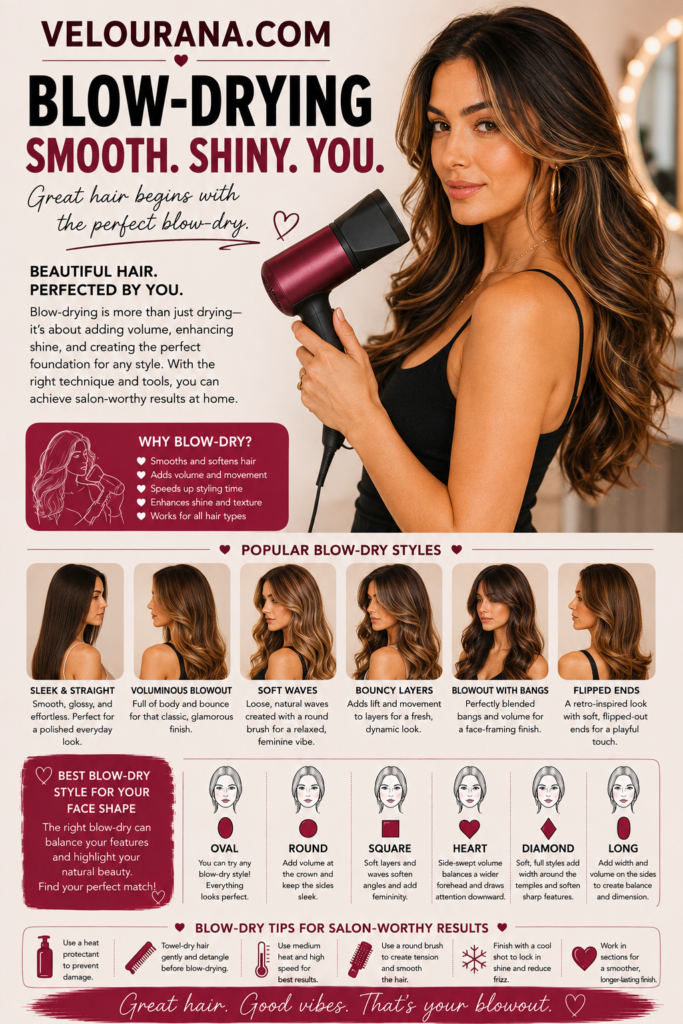
CATEGORY: Blow-Drying
A smooth blow-dry is often described as though its purpose were simply to make the hair straight. That description misses much of what makes the style attractive. Smoothness is primarily about the quality of the surface: strands look controlled, the lengths flow together, the ends appear deliberate, and the hair reflects light without seeming rigid or excessively flattened.
The finished hair may be quite straight, but it does not have to be. A smooth blow-dry can contain gentle curves through the lengths, a slight inward bend at the ends, soft movement around the face and enough lift at the crown to prevent the hairstyle from appearing pressed against the scalp. In fact, preserving some movement is often what separates a polished blow-dry from hair that merely looks stretched.
The technique is built gradually. Preparation determines how easily the hair can be controlled. Sectioning determines whether the drying is even. The direction of the airflow influences the surface. Brush tension helps organize the strands, while the shape created at the roots and ends determines whether the final result feels elegant, full or overly flat.
The objective is therefore not to overpower the hair with heat. It is to create a consistent direction while the hair dries and to stop working each section once that job has been accomplished.
Smoothness Begins With an Organized Foundation
The condition of the hair before detailed blow-drying has a significant influence on everything that follows. Hair that is dripping wet requires considerable time simply to lose water, while hair that has already dried chaotically may need additional work to redirect. The useful middle ground is hair that remains damp enough to respond to styling but has already lost the excess moisture that does not contribute to shaping.
After washing, moisture can be pressed or squeezed gently from the lengths rather than removed through aggressive rubbing. Detangling can then be completed carefully before the hair is divided into sections. This means the styling brush will not have to encounter hidden knots while tension is being applied.
Heat protection, when used, belongs at this preparation stage and should be applied according to the product instructions. The product should complement the hair rather than become the dominant feature of the finished style. Fine hair can lose movement under excessive product, while thicker or coarser-feeling hair may respond differently to richer formulations. There is no advantage in using more than the hair requires.
The dryer can then remove some additional moisture before detailed brush work begins. Fingers are useful during this stage because they can separate the hair and expose damp areas without repeatedly placing the lengths under brush tension.
Even during this preliminary drying, direction matters. If the intended finish is smooth, constantly blasting the hair upward from the ends toward the roots creates unnecessary disorder. The airflow can broadly follow the direction in which the hair will eventually lie, while the roots that need volume can be lifted separately.
Once the hair has reached a manageable dampness, detailed styling becomes much more efficient.
Why Airflow Direction Changes the Finish
One of the defining features of a smooth blow-dry is controlled airflow.
A concentrator nozzle can narrow the stream of air and make it easier to direct the dryer toward the specific section being worked. Rather than disturbing surrounding hair, the airflow follows the brush through the lengths.
The brush establishes tension and direction. The dryer follows it.
This relationship is more important than repeatedly passing very hot air over the section. When the tools move together, the hair is organized while moisture is removed. The process becomes predictable.
The dryer does not need to touch the hair. The nozzle is designed to control the airflow, not to be pressed against the strands. Maintaining sensible distance and keeping the dryer moving prevents one small area from receiving concentrated heat unnecessarily.
For a sleek finish, the air generally travels from the upper portion of the section toward the ends. The hair is being encouraged to lie in one consistent direction rather than being disturbed from several angles.
This is particularly noticeable on straight and lightly wavy hair, where inconsistent airflow can leave the surface looking less controlled even when the hair is technically dry.
Smoothness therefore comes partly from organization. The strands have been guided together instead of repeatedly scattered and corrected.
Sectioning Is What Creates Consistency
A polished blow-dry can easily become uneven when too much hair is handled at once.
The outer portion of a large section may dry beautifully while the hair hidden underneath remains damp. The brush may grip the visible strands but fail to control the entire thickness. The result can look finished initially and then change as the remaining moisture continues to evaporate.
Smaller, manageable sections solve this problem.
The exact size depends on density. Fine hair may not require many divisions, while very thick hair can need considerably more. What matters is that the brush can control the complete section and the airflow can reach through it.
Beginning at the lower back of the head is a practical approach because the upper hair can remain clipped away. Each finished section is then released from the working area rather than constantly becoming mixed with damp hair.
This method also prevents unnecessary reheating. Once a section has been dried, smoothed and shaped, it can be left alone while attention moves elsewhere.
The process may look slower because it is systematic, but it often saves time. Large uncontrolled sections frequently require correction. Smaller controlled sections are more likely to be completed properly the first time.
Sleek Hair Still Needs Root Shape
One of the easiest mistakes when creating smooth hair is concentrating so heavily on straightness that all root movement disappears.
The result can be technically sleek yet visually flat.
A more sophisticated smooth blow-dry treats the roots and lengths as related but distinct areas. The lengths can remain controlled while selected roots retain enough lift to support the shape of the haircut.
The crown is especially important. A small amount of elevation here can change the side profile dramatically without making the hairstyle look voluminous in an exaggerated way.
The section can be lifted while the roots are drying and then allowed to fall naturally. This creates space beneath the hair rather than forcing it completely against the scalp.
The sides may require less lift. If every section is elevated equally, the hairstyle can become wider rather than more elegant.
This selective placement allows smoothness and volume to coexist.
A sleek hairstyle does not need to be flat. It needs to be controlled.
Choosing the Brush According to the Desired Shape
A smooth blow-dry can be created with different brushes depending on how much movement is wanted.
A paddle-style brush can support a straighter finish through longer sections. The hair is guided under tension while the dryer follows, producing relatively little curvature. This can be useful when the objective is clean, flowing lengths rather than the rounded movement of a traditional blowout.
A round brush introduces more shape.
A larger barrel produces broad curves and can keep long hair smooth while creating movement through the ends. It can also help elevate roots without making the lengths appear tightly curled.
Smaller barrels create more pronounced bends and are useful for shorter layers, bangs and areas where stronger shaping is required.
The brush should suit both the haircut and the section being styled. There is no requirement to use one brush for the entire head. Curtain bangs may need a different size from the longest layers. A bob may require more precise control around its perimeter than long hair needs through the middle of its lengths.
What matters is that the brush can move continuously.
A round brush should not become a place where large amounts of hair are repeatedly wound and held under concentrated heat. Its purpose is to guide, tension and shape the section while the dryer moves with it.
Tension Should Control the Hair, Not Punish It
Brush tension is important in smooth blow-drying because it keeps the strands aligned. But stronger tension does not automatically produce a smoother finish.
If the section is too large, the instinct may be to pull harder because the brush cannot control it. The better solution is often reducing the section.
Once the amount of hair is manageable, moderate consistent tension can guide it effectively.
This becomes especially important around the temples and hairline. These areas should not need to be pulled aggressively to create a polished result.
A comfortable scalp and a controlled finish are compatible.
The hair should move through the brush rather than feeling as though it is being dragged through it.
The Ends Prevent Sleek Hair From Looking Severe
A smooth blow-dry often becomes most attractive in its final few centimeters.
Perfectly straight ends create a clean, sharp result, but they are only one possibility. A subtle inward bend can make the hair appear softer. A slight outward movement can reveal layers and open the hairstyle around the face. Broad alternating curves can give long hair a natural flowing finish.
This small amount of shaping prevents smoothness from becoming stiffness.
The brush can guide the ends during the final part of each pass. Once they are dry and sitting correctly, there is little reason to continue heating them.
This is particularly important because ends may dry earlier than roots. Long hair, for example, can remain damp near the scalp while the lowest lengths are already dry. Repeatedly directing heat toward those ends simply because another part of the section still contains moisture is inefficient.
The dryer should follow the moisture rather than automatically treating every centimeter equally.
Face-Framing Sections Need Their Own Direction
The front of the hairstyle has an outsized effect on the finished appearance.
A beautifully smooth back cannot compensate completely for face-framing pieces that sit awkwardly.
These sections should therefore be considered independently.
Long layers can be directed inward toward the cheekbones for a softer frame or outward for a more open, sweeping appearance. A side fringe can be encouraged across the forehead. Curtain bangs can be separated and shaped away from the center.
Because these pieces are shorter, they often dry faster than the rest of the hair. Allowing them to dry without direction and attempting to correct them much later can require unnecessary additional styling.
They can instead be addressed while enough moisture remains for them to respond easily.
The transition into the longer hair should remain natural. Face-framing pieces should not look like isolated curls attached to an otherwise straight hairstyle. Their curve can soften gradually as they meet the lengths.
Smooth Blow-Drying Makes Layers More Visible
Layered hair does not need large curls to show its structure.
When the surface is smooth and the ends are shaped carefully, the different lengths become visible through movement.
Shorter layers may lift slightly around the crown. Mid-length sections can create body. Longer pieces provide weight and continuity underneath. The haircut becomes easier to read because the sections no longer collapse into one undifferentiated mass.
This is one reason a smooth blowout can look particularly effective on long layered hair. The style remains polished while the haircut supplies movement.
The layers should not all be forced into identical curves. A little variation makes the result feel more natural.
Around the face, sections can move outward. Farther back, the lengths can remain straighter. The longest ends can carry only a gentle bend.
The result is still sleek, but it has dimension.
Straight Hair Can Become Polished Without Becoming Motionless
Naturally straight hair may require less stretching than other textures, but technique still determines the quality of the finish.
Root direction matters.
The crown can be lifted.
The surface can be controlled.
The ends can be shaped.
Fine straight hair often benefits from avoiding excessive product and unnecessary repeated passes because both can reduce movement. The goal is to create polish while preserving enough body that the hairstyle responds naturally when the head moves.
Thicker straight hair may require more careful sectioning because density can hide moisture. The outer surface may appear finished long before the interior is actually dry.
The same smooth appearance can therefore require very different working methods depending on density.
Wavy Hair Can Become Smooth Without Losing Its Character
Wavy hair does not always need to be transformed into perfectly straight hair for a polished blow-dry.
The natural pattern can be stretched into broader movement.
Roots can be smoothed.
Stronger bends can be softened.
The lengths can retain a gentle curve.
This often creates a finish that looks natural because some of the hair's original movement remains present.
A round brush can be particularly useful here. Instead of attempting to eliminate every bend, it reorganizes the pattern into larger, more deliberate curves.
The result can feel smoother without appearing unnaturally rigid.
If the objective changes and the natural wave itself is meant to remain prominent, a diffuser would make more sense. Smooth blow-drying and diffusing use the same basic appliance but pursue fundamentally different results.
Curly and Coily Hair Require a Deliberate Styling Decision
For curly and coily textures, a smooth blow-dry usually involves some degree of stretching. The objective should be clear before the process begins.
If the natural curl or coil pattern is meant to remain, diffusing or another texture-preserving approach is more appropriate. If a stretched, smoother finish is wanted, the hair can be divided carefully and worked through under controlled tension.
This does not mean using excessive force.
Smaller sections, steady direction and appropriate airflow can create more control than simply pulling harder.
The roots and interior of dense textured hair require particular attention because moisture can remain hidden. Rushing through large sections can leave the outside dry while the interior is still damp.
A smooth result becomes easier when the drying itself is complete and consistent.
Long Hair Needs Efficiency More Than Endless Brush Work
Long hair can make a smooth blow-dry feel unnecessarily difficult if detailed brush styling begins while the lengths are still saturated.
Much of the water can be removed before the round brush becomes important.
Once the hair is damp rather than wet, the styling phase becomes more purposeful. Each section can be tensioned, dried and shaped without requiring endless passes.
Long hair also makes moisture differences more obvious. The ends can dry considerably faster than the roots. The stylist needs to respond to those differences rather than treating the entire length as though it were at the same stage.
A large round brush can create broad movement without making long hair overly curled. If an even straighter finish is wanted, a flatter brush can guide the lengths while maintaining direction.
The key is allowing the hair to remain fluid.
Long smooth hair is often most attractive when it moves rather than hanging as one rigid sheet.
Medium Hair Can Carry More Visible Shape
Medium-length hair often has enough weight to remain controlled but not so much that every curve is immediately pulled downward.
This makes it particularly responsive to smooth blow-drying.
The crown can gain subtle volume.
The ends can turn inward.
Face-framing layers can move outward.
A shoulder-length cut can therefore appear dramatically different depending on how the final bend is created.
The same smooth surface can support several silhouettes without changing the haircut itself.
Short Hair Is Defined by Direction
With short hair, there is less length available to create flowing movement, so root direction becomes central.
A short bob can be rounded, straight or flicked outward simply by changing the way the ends are dried.
A pixie can be lifted at the crown, swept sideways or kept close to the head according to the direction established while drying.
Fingers can perform much of the early work. A smaller brush can then refine longer sections and fringe.
The technique becomes less about repeatedly drawing a brush through long lengths and more about deciding where each area should sit.
A Smooth Finish Does Not Require Maximum Heat
It can be tempting to associate a sleek result with very high temperature.
The connection is not that simple.
Temperature is only one part of heat exposure. Distance, duration, airflow, section size and repetition also matter.
A very large damp section may encourage repeated high-heat passes because the air cannot reach the interior effectively. Dividing it into smaller sections can make the process faster without simply increasing temperature.
Similarly, a dryer held stationary near one spot creates a different exposure from one that remains in controlled motion.
The most useful setting is the one that allows the hair to dry and respond effectively without using more heat than the job requires.
Technique can replace a surprising amount of unnecessary repetition.
Cooling Helps Complete the Shape
When a section is fully dry and has been given its final curve, allowing it to cool briefly can help preserve the intended movement.
A cool-shot setting can be useful here.
This is especially relevant around the crown and ends. A lifted root section can remain elevated for a moment. A curved end can stay around the brush briefly before being released.
The objective is not freezing the hair into an artificial shape.
It is simply allowing the finished section to settle before it is disturbed.
The Blow-Dry Should Be Allowed to Become One Hairstyle
Once every section has been completed, the hair may initially appear more separated than the final result should be.
The temptation is to brush through everything immediately.
It can be better to allow the hair to settle first.
The individual sections begin falling together naturally. Broad curves soften. Layers overlap. The crown relaxes slightly.
The hair can then be blended gently with the fingers or an appropriate brush.
This final integration matters because the finished hairstyle should not reveal every section used to construct it.
Finishing Products Should Remain Secondary
A smooth blow-dry should obtain most of its appearance from the drying technique itself.
Finishing products can refine the result, but they should not be expected to repair inconsistent drying.
A small amount of an appropriate smoothing product may help the lengths look more polished. Fine hair may need very little. Dense or dry-feeling lengths may respond differently.
Application should remain deliberate.
Heavy product concentrated at the roots can remove the lift that was created during drying. Too much through the lengths can make sections separate or appear weighed down.
The goal is enhancement rather than coating.
Smooth Hair Still Has to Live in the Real World
The moment a blow-dry is finished, the hair begins interacting with the environment again.
Humidity can influence it.
Natural texture can gradually reappear.
The hair moves against clothing and shoulders.
The roots respond to the scalp and weather.
A smooth blow-dry should therefore not be judged by whether every strand remains frozen in its original position.
Natural movement is part of the hairstyle.
A little softness developing through the day does not automatically mean the blow-dry has failed.
Refreshing Can Be More Sensible Than Starting Again
The following day, the hairstyle may still be largely intact even though a few areas have changed.
Bangs may have lost direction.
The crown may need some lift.
The ends may no longer curve as neatly.
Those areas can be addressed selectively rather than automatically recreating the entire blow-dry.
This approach avoids unnecessary work and repeated heat on sections that still look good.
The same principle applies whenever the style begins to change: identify what actually needs correction before restyling everything.
The Most Polished Blow-Dry Is Not Necessarily the Flattest
There is an important difference between sleekness and absence of volume.
Sleekness describes control.
The surface looks smooth.
The strands flow together.
The shape is intentional.
Volume describes the space occupied by the hairstyle.
A smooth blow-dry can still have crown lift, broad movement through the lengths and curved ends.
In many cases, those features make the smoothness more attractive because they prevent the style from looking severe.
The objective is balance.
When Smoothness Still Looks Like Hair
The most successful smooth blow-dry does not erase everything distinctive about the hair.
It organizes it.
Straight hair can retain body.
Wavy hair can keep broad movement.
Curly or coily hair can be stretched into a smoother form when that is the chosen style without requiring the final result to become lifeless.
Fine hair can preserve precious root lift.
Thick hair can become controlled without being compressed into a flat silhouette.
Layers can remain visible.
Curtain bangs can open around the face.
The ends can curve rather than hanging stiffly.
All of these details depend on the same underlying principle: smoothness is created through controlled direction while the hair dries.
Preparation removes unnecessary moisture. Sectioning makes the process consistent. The brush establishes tension and shape. The dryer follows that direction. The roots are positioned according to the volume required, and the ends are finished according to the haircut.
Once a section is dry and shaped, it is allowed to rest rather than being heated indefinitely.
That restraint is part of the technique.
A polished blow-dry does not need to announce how much effort went into creating it. The surface looks controlled, but the hair still moves. The roots have shape, but they do not look artificially inflated. The ends are deliberate, but they do not appear rigid.
The result is sleekness with life still inside it—the kind of smooth blow-dry that looks finished precisely because it never stops looking like natural, movable hair.
The End
Velourana.
 Discover More From Our Family of Websites
 ZodiacBearing (Astrology, Tarot, Numerology, Angel Numbers & Spiritual Guidance)
 Velourana (Beauty, Makeup, Hair Care, Skincare & Beauty Tips)
 HavenBearing (Home, Living, Organization, Décor & Everyday Inspiration)
 PawBearing (Pet Care, Dog Breeds, Animal Health, Training & Pet Products)
 PsyCatherine (Notes From the Journal of a Psychologist on Real Life)

