
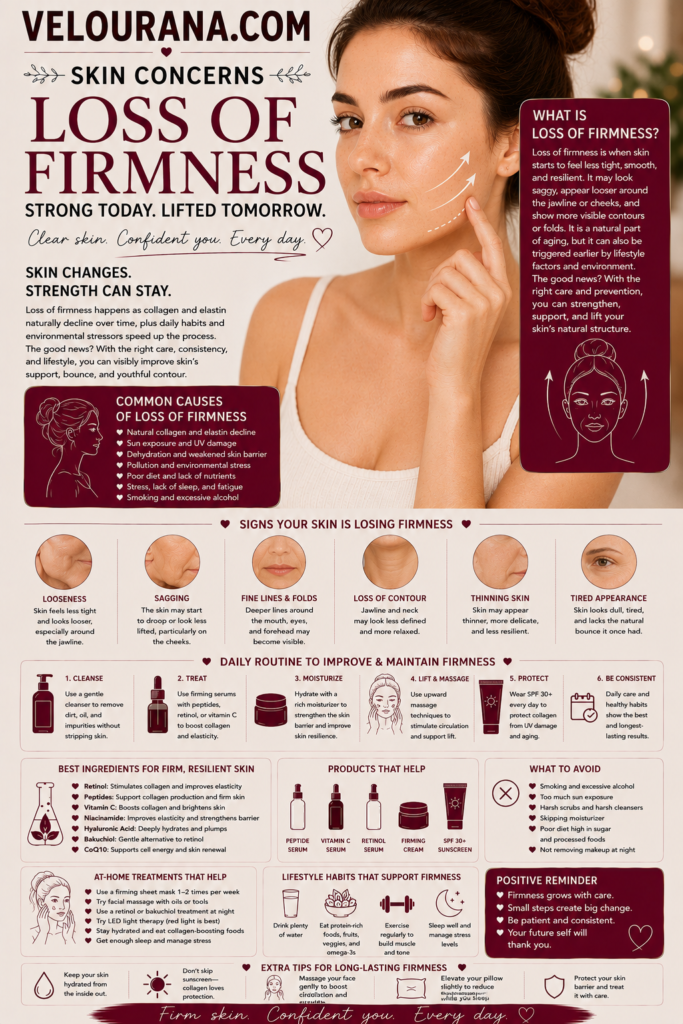
CATEGORY: Loss of Firmness
One of the most frustrating truths about loss of firmness is that the skin does not respond to treatment at the speed that beauty marketing encourages us to expect.
A product may be purchased in the evening, applied before bed, and judged the following morning. A new serum may be abandoned after two weeks because the jawline has not changed. A retinoid may be declared ineffective after a month because the cheeks do not appear lifted. Meanwhile, products promising a visible transformation in days seem more attractive because they appear to offer certainty and speed.
But the biology involved in firmness does not operate on those terms.
Collagen remodeling is slow. Changes in the extracellular matrix are slow. The accumulation of photodamage is slow. The decline in elastic resilience is slow. Even when a treatment genuinely influences skin biology, the visible consequences often emerge gradually because the structures being affected are not superficial decorations that can simply be polished overnight.
This is one reason loss of firmness becomes such fertile territory for exaggerated claims.
The consumer wants an immediate answer to a slow problem.
The skin, however, continues working according to its own timetable.
Understanding that timetable changes the way a firmness-focused routine should be built. It changes how products are judged, how progress is measured and how expectations are managed. It also reveals why some of the most valuable interventions in aging skincare are not the ones producing the most dramatic immediate sensation.
Firmness is not a quick cosmetic event.
It is the visible outcome of long-term structural biology.
Collagen Is Living Architecture
Collagen is often spoken about as though it were a passive material stored inside the skin.
In reality, the collagen-rich dermal matrix exists within a dynamic biological system.
Fibroblasts manufacture collagen and other extracellular matrix components. Enzymes participate in matrix degradation and remodeling. Mechanical forces influence cellular behaviour. Oxidative stress, ultraviolet exposure, inflammation and age-related signalling can all alter the balance between the creation and breakdown of structural proteins.
Young skin maintains this environment more efficiently.
Collagen fibres are densely organized and provide substantial tensile strength. Fibroblasts interact with this surrounding matrix, helping preserve its architecture.
As skin ages, that organization deteriorates.
Existing collagen becomes increasingly fragmented. Fibroblasts experience a different mechanical environment. Collagen production declines, while processes that break down matrix components can become more influential.
This produces a gradual weakening of dermal architecture.
None of these changes occurs in a single evening.
Likewise, reversing or improving aspects of them cannot realistically happen in a single evening.
This is why the language of "instant collagen rebuilding" should immediately attract skepticism.
A cream can alter hydration quickly. It can smooth the surface. Film-forming ingredients can temporarily change the way the skin feels. Optical effects can reduce the appearance of fine texture.
But rebuilding or reorganizing dermal structure belongs to a much slower category of change.
Why Skin Can Look Better Before It Becomes Structurally Different
A firmness product can still make skin look better quickly.
The important question is why.
Hydration is one explanation.
When the stratum corneum contains adequate water, it becomes smoother and more flexible. Fine surface irregularities become less prominent. Light reflects more evenly. The skin may appear plumper and healthier.
Emollients can further improve smoothness by filling microscopic spaces between surface cells. Occlusive ingredients can reduce water loss and help maintain that effect.
Within hours, the face can look refreshed.
This is useful cosmetic improvement.
It is simply not the same as collagen remodeling.
Some products also contain polymers that form a thin film as they dry. This may temporarily produce a feeling of tightness or alter the appearance of very fine surface lines.
Again, the effect can be real.
But when the product is washed away, the mechanical film disappears.
Understanding these rapid mechanisms makes it easier to appreciate them without confusing them with long-term structural treatment.
A moisturizer does not need to rebuild the dermis to be valuable.
A serum does not need to lift the jawline overnight to be worthwhile.
The difficulty appears when immediate hydration is used as proof that substantial collagen restoration has occurred.
Those are different biological events operating on very different timescales.
The Epidermis Moves Faster Than the Dermis
Part of the confusion surrounding anti-aging timelines comes from treating every layer of the skin as though it behaves identically.
It does not.
The epidermis continually renews itself. Cells generated deeper within the epidermis gradually move toward the surface, undergo differentiation and eventually become part of the stratum corneum before being shed.
This turnover makes the outer skin relatively responsive to certain interventions.
Changes in hydration, exfoliation and surface texture can sometimes become visible relatively quickly.
The dermis is different.
Its structural proteins turn over more slowly. Collagen fibres can persist for long periods. Elastic fibres are especially long-lived.
The deeper architecture therefore carries a biological history that cannot simply be replaced every few weeks.
This distinction helps explain why a treatment may improve smoothness before it improves deeper signs associated with photoaging.
The surface may appear brighter within weeks while changes in the dermal matrix require considerably more time.
A person evaluating firmness should therefore avoid assuming that all benefits arrive together.
Texture, pigmentation, hydration, fine lines and resilience may each respond on different timelines.
This is one reason long-term consistency matters more than dramatic short-term experimentation.
Retinoids Teach an Important Lesson About Patience
Retinoids provide perhaps the clearest example of why anti-aging treatment must be judged over time.
Vitamin A derivatives influence several processes relevant to aging skin. Depending on the specific compound and formulation, retinoids can affect epidermal turnover, pigmentation and collagen-related biology.
They have therefore become central to evidence-based anti-aging skincare.
Yet they are not instant firming treatments.
Early in treatment, the most noticeable change may actually be irritation.
Dryness, peeling, sensitivity or redness can appear before meaningful cosmetic improvement. This sometimes creates the illusion that a stronger reaction must mean stronger anti-aging activity.
That is a mistake.
Irritation is not a measurement of collagen synthesis.
Persistent inflammation can make a routine intolerable and may ultimately reduce consistency.
The better strategy is usually to introduce retinoids gradually, allowing the skin to adapt.
A product used several times per week for years can be more useful than a stronger product used aggressively for ten days and abandoned.
The same principle applies to concentration.
Consumers often assume that the highest available percentage must produce the fastest improvement.
But the best concentration is not necessarily the maximum concentration.
It is the concentration that produces meaningful biological activity while remaining tolerable enough for long-term use.
Firmness-related improvement requires that long-term use.
This is a particularly important shift in mindset because anti-aging routines are often designed around intensity rather than sustainability.
Skin does not reward enthusiasm alone.
It rewards consistency.
Collagen Remodeling Is Not the Same as Collagen Replacement
The word "replace" sounds simple.
If aging skin has less collagen, perhaps treatment should simply add more.
But collagen biology is not analogous to refilling an empty container.
The dermal matrix has organization. Fibres differ in structure and orientation. Fibroblasts interact mechanically with their surroundings. Enzymatic processes continuously remodel the matrix.
A meaningful improvement therefore involves more than increasing the presence of collagen molecules.
It involves improving the functional environment in which the matrix exists.
This is one reason topical collagen itself should not be confused with newly synthesized dermal collagen.
Collagen molecules applied at the surface can contribute to hydration or film-forming properties in a cosmetic formulation, but they do not simply travel through the skin and install themselves as new structural fibres in the dermis.
The skin barrier exists precisely to limit the penetration of large external molecules.
That does not mean products containing collagen are useless.
They may be pleasant moisturizers.
But their cosmetic benefit should not be described as replacing lost dermal architecture.
The distinction between topical collagen and collagen stimulation is fundamental.
One concerns an ingredient sitting primarily within or upon the superficial skin environment.
The other concerns biological signalling that influences the skin's own cells and matrix.
Marketing often blurs these categories because the word collagen carries emotional value.
Biology is less impressed by the label on the bottle.
Why Prevention Can Be More Powerful Than Repair
One of the most important ideas in firmness-focused skincare is also one of the least visually exciting.
Preventing damage may be easier than repairing it.
Ultraviolet exposure contributes to the deterioration of collagen and elastic architecture. Over years, repeated exposure accumulates.
This means sunscreen is not merely protection against sunburn or pigmentation.
It is part of structural preservation.
A person using an excellent retinoid while repeatedly exposing the skin to substantial ultraviolet radiation without adequate protection is trying to repair one side of the equation while damage continues on the other.
The routine becomes internally contradictory.
Photoprotection helps reduce that ongoing pressure.
The benefit can be difficult to appreciate because prevention rarely produces dramatic before-and-after photographs.
If collagen degradation is reduced, the result is partly something that did not happen.
There is no visible comparison face showing the additional damage that might otherwise have occurred.
This makes preventive skincare psychologically less satisfying than corrective skincare.
A serum appears to be doing something.
Sunscreen appears merely to stop something.
Yet slowing future deterioration may be one of the most powerful ways to preserve firmness over decades.
A good anti-aging strategy therefore does not begin with stimulation.
It begins with preservation.
The Elastic Fibre Problem
Collagen receives most of the attention in discussions about firmness, but elasticity depends heavily on the skin's elastic fibre network.
These fibres allow skin to stretch and recover.
They are also extraordinarily long-lived.
Unlike epidermal cells, which are regularly replaced, much of the elastic architecture of the skin persists for extremely long periods.
This has major consequences for aging.
Damage to elastic structures can accumulate because the body does not continuously rebuild them with the same efficiency that characterized early development.
Ultraviolet exposure is particularly important here.
Chronically sun-exposed skin can develop abnormal elastic material and disorganization of the normal elastic fibre network.
The result may be skin that contains abundant elastin-related material yet functions less elastically.
This is another example of why simple ingredient logic can fail.
If elastin contributes to elasticity, one might assume that putting elastin into a cream should restore elastic behaviour.
But functional elastic architecture is not created by merely depositing protein at the surface.
It requires complex biological assembly within the appropriate tissue environment.
The same principle applies to collagen.
The skin's architecture is organized, not poured.
Why Peptides Attract So Much Attention
Peptides occupy an interesting position in firming skincare.
They are small chains of amino acids, and different peptides may serve very different biological functions.
Some are designed to act as signalling molecules. Others may influence neurotransmission, pigmentation, inflammation or barrier-related processes.
Certain peptides are marketed specifically around collagen support.
The underlying idea is plausible: if particular molecular signals can influence fibroblast behaviour, perhaps topical formulations can encourage aspects of matrix production.
But peptide skincare is a broad category.
The existence of one well-studied peptide does not validate every peptide serum.
Penetration matters. Stability matters. Concentration matters. Vehicle matters. The specific sequence matters.
This is why ingredient names alone are not enough to judge a product.
A formula containing a fashionable peptide may be excellent.
Another may include only a trace amount primarily for marketing purposes.
Consumers rarely have access to all the information necessary to distinguish these cases.
The most rational approach is therefore to view peptides as potentially supportive rather than automatically transformational.
A peptide serum may complement a well-designed routine.
It should not replace sunscreen, adequate moisturization or better-supported treatments merely because its marketing language sounds more advanced.
Novelty is not the same as evidence.
Vitamin C Works Best When Expectations Are Precise
Vitamin C is another ingredient frequently included in routines designed to support firmness.
Its biological importance is real.
Vitamin C functions as an antioxidant and participates in biochemical processes involved in collagen synthesis.
Yet turning that biological role into a successful topical treatment requires careful formulation.
Ascorbic acid can be unstable. Light, oxygen, water and formulation conditions affect degradation.
A bottle containing vitamin C on its ingredient list therefore does not automatically guarantee effective delivery.
Different derivatives are often used to improve stability or tolerability, but these derivatives can differ in the amount and quality of evidence supporting their conversion and activity within skin.
The sensible expectation is not that vitamin C will visibly lift the face.
Its value belongs within a broader strategy.
Antioxidant protection may complement sunscreen.
A well-formulated vitamin C product may help address photoaging and pigmentation while supporting skin biology relevant to collagen.
This makes it useful.
It does not turn it into a replacement for deeper structural intervention.
Precision in expectations allows effective ingredients to remain credible.
When every useful ingredient is required to perform miracles, the entire conversation becomes distorted.
The Barrier Determines Whether a Routine Can Survive
A firmness routine can contain excellent active ingredients and still fail if the skin barrier is repeatedly damaged.
This is especially common when anti-aging enthusiasm produces excessive layering.
A retinoid is applied at night.
An exfoliating acid follows.
A strong antioxidant serum is added in the morning.
A scrub is used twice weekly.
A peel is introduced for additional resurfacing.
Soon the skin becomes dry, red and reactive.
The response is often to add even more products intended to repair the irritation created by the original products.
This is not efficiency.
The barrier should be considered part of the anti-aging strategy from the beginning.
Healthy barrier function reduces water loss, improves comfort and makes continued use of active treatments more realistic.
This matters because collagen-focused treatment is not an event.
It is a long-term habit.
A routine that cannot be tolerated cannot deliver long-term benefit.
Moisturizer therefore plays a surprisingly strategic role in firmness care.
It may not rebuild facial architecture.
But it can help create the conditions that allow evidence-supported treatments to be used consistently.
The humble moisturizer is often doing more for the success of the routine than a collection of aggressive treatments competing for attention.
Why Stronger Is Not Always Faster
Modern skincare encourages escalation.
When 0.2 percent seems useful, 0.5 percent feels better.
If one exfoliation night is good, three may appear more effective.
If mild tingling feels active, burning may seem even more productive.
But biological systems do not always respond linearly.
Increasing intensity can cross the point where benefit is outweighed by irritation.
This is particularly important with retinoids, acids and other treatments capable of disrupting barrier function.
A person may tolerate a moderate routine for years.
They may tolerate an aggressive routine for three weeks.
Which one is more likely to contribute to meaningful long-term improvement?
The answer is usually obvious.
The skincare industry sometimes treats tolerability as though it were a compromise.
In reality, tolerability is part of efficacy.
A theoretically powerful product that cannot be used consistently has limited practical value.
The most effective firmness routine is therefore not necessarily the most intense one.
It is the one that can continue quietly.
Facial Firmness Does Not Change in Isolation
Another reason firmness takes time to evaluate is that the face itself is constantly changing.
Hydration fluctuates.
Body weight changes.
Hormonal environments change.
Sleep affects puffiness.
Inflammation alters appearance.
Lighting changes the way facial contours are perceived.
Even the time of day can influence how the face looks.
This makes daily inspection unreliable.
Someone may believe a new serum tightened the face because photographs taken after two weeks happened to be captured under more flattering lighting.
Another person may believe a retinoid failed because their face looked temporarily more tired during a period of poor sleep.
Neither conclusion necessarily reflects structural change.
Long-term assessment requires more disciplined observation.
Photographs taken under similar lighting, angles and facial expressions can help.
Comparisons should be separated by months rather than days.
Even then, subtle improvement should be expected.
The goal is not to detect whether the face looks different every morning.
It is to determine whether the overall direction of skin quality is improving across meaningful periods of time.
The Psychology of Before-and-After Images
Before-and-after photographs are powerful because visual evidence feels objective.
But photographs are exceptionally easy to influence.
Lighting from slightly above can sharpen the jaw.
Lighting from the side can deepen shadows.
Turning the face a few degrees changes the contour of the cheek.
Holding the chin differently alters the neck.
Hydrated skin reflects more light.
Makeup changes texture.
Camera focal length changes perceived proportions.
Even facial expression can dramatically affect folds and contours.
A credible firmness result should therefore be interpreted carefully.
This is especially important when an intervention claims dramatic lifting without explaining how such an anatomical effect would be produced.
The stronger the visual transformation, the more carefully the conditions should be examined.
Has the lighting changed?
Is the subject standing closer to the camera?
Is the chin raised?
Has body weight changed?
Was the photograph taken immediately after a treatment that temporarily altered swelling?
None of this proves dishonesty.
It simply reminds us that images are not self-explanatory evidence.
The same discipline should be applied to personal progress photographs.
Consistency makes comparison more meaningful.
Firming Masks and Temporary Tightening
Firming masks occupy an interesting place in skincare because they can produce exactly the kind of immediate result people naturally want.
A mask may leave the skin feeling smoother, cooler and tighter.
This can be enjoyable and cosmetically useful.
But the sensation should be interpreted correctly.
Clay-based formulas may absorb oil and create a tightening feeling as they dry.
Hydrating masks may temporarily plump the outer layers of skin.
Film-forming masks can create a mechanical sensation of tautness.
None of these mechanisms necessarily indicates long-term structural remodeling.
This does not make the mask deceptive unless it is marketed as producing permanent lifting.
Temporary cosmetic improvement has legitimate value.
A hydrating mask before an event may make skin look smoother under makeup.
A cooling treatment may reduce the appearance of transient puffiness.
A nourishing mask may improve comfort during dry weather.
The problem arises only when a pleasant short-term effect is confused with biological reconstruction.
A ritual can be worthwhile without pretending to be medicine.
What Professional Treatments Do Differently
When topical skincare reaches its limits, professional procedures sometimes produce more substantial changes because they operate through different mechanisms.
Some create controlled thermal injury.
Some use needles to trigger wound-healing responses.
Some target particular tissue depths with energy.
Others restore volume.
Surgical procedures can physically reposition tissue.
These mechanisms differ fundamentally from applying a cream to the surface.
This is why comparing a moisturizer with a procedure purely on the basis of cost makes little sense.
They are not trying to accomplish the same thing.
A topical retinoid may improve photoaged skin over time.
A resurfacing procedure may produce a stronger remodeling stimulus.
A filler may replace volume.
A surgical lift can reposition tissue.
Each belongs to a different category.
The greater the intervention, however, the greater the importance of appropriate professional assessment.
Energy-based devices and invasive procedures can cause complications.
Individual anatomy, skin type, medical history, practitioner skill and treatment parameters matter.
The decision should never be based solely on a social media trend.
Understanding the mechanism is more valuable than memorizing the brand name of the device.
The First Year of a Firmness Routine
A useful way to understand long-term firmness treatment is to imagine the first year as a sequence of adaptation rather than a race toward immediate lifting.
In the beginning, the priority is establishing a stable foundation.
Sun protection becomes consistent.
Cleansing is adjusted so the skin is not repeatedly stripped.
Moisturization is sufficient.
If a retinoid is appropriate, it is introduced gradually.
The objective is not maximum intensity.
It is creating a routine that can survive.
During the following months, the skin may become smoother. Hydration may improve. Fine surface lines may become less noticeable. Pigmentation may begin to look more even depending on the treatments being used.
Structural changes associated with long-term treatment remain gradual.
By the end of a year, the most meaningful outcome may not be a dramatically lifted jawline.
It may be better texture, fewer signs of photodamage, improved resilience and a routine that can realistically continue for another year.
This may sound less exciting than advertising.
But aging itself is measured in years.
It makes sense that effective long-term care should be judged on a similar scale.
Why Switching Products Too Often Can Sabotage Progress
Frequent product switching creates another problem.
If a new active is introduced every two weeks, no individual treatment receives enough time to be evaluated properly.
The routine becomes a sequence of experiments without controls.
A serum is replaced before it has had a reasonable opportunity to work.
A moisturizer is changed because the texture seems boring.
A new trend appears online and suddenly the entire routine is reorganized.
This creates two difficulties.
First, long-term biological effects cannot be distinguished from short-term fluctuations.
Second, irritation becomes difficult to trace because several variables are changing simultaneously.
A simpler routine produces clearer information.
If an active is added while everything else remains stable, its tolerability can be observed.
If improvement occurs over several months, it becomes easier to judge whether the routine is useful.
Firmness care therefore benefits from a certain resistance to novelty.
New does not automatically mean better.
Sometimes the most sophisticated decision is to continue using the same effective product.
Aging Continues While Treatment Is Working
There is another subtle difficulty in evaluating anti-aging skincare.
Treatment does not take place while aging pauses.
If someone begins a firmness routine at forty-five and uses it for five years, they will be fifty at the end of the experiment.
Chronological aging has continued throughout that period.
This creates an unusual definition of success.
A routine might be beneficial even if the face does not look younger after five years.
If the skin has aged more slowly than it otherwise would have, the intervention has still produced value.
This is almost impossible to prove for an individual because there is no untreated duplicate available for comparison.
The idea nevertheless matters.
Anti-aging skincare is often judged according to whether it visibly reverses time.
A more realistic standard includes slowing future deterioration.
Protection and maintenance become meaningful outcomes rather than consolation prizes.
The philosophy changes from chasing youth to preserving function.
Firmness Is a Long Game
Loss of firmness develops through accumulated structural change.
It rarely originates from one missing ingredient.
The collagen matrix becomes less organized.
Elastic architecture deteriorates.
Ultraviolet damage accumulates.
Hormonal environments shift.
Facial fat and deeper structures change.
These processes unfold across years.
The most rational response therefore also unfolds across years.
Protect the skin consistently.
Maintain the barrier.
Use evidence-supported treatments where appropriate.
Introduce active ingredients gradually enough to preserve tolerability.
Judge progress over months rather than mornings.
Be skeptical of claims that promise anatomical changes from superficial products.
Understand which improvements are temporary, which are cumulative and which require professional intervention.
Most importantly, stop expecting the skin to behave like an advertisement.
Firmness does not return because a product created an impressive sensation.
It improves, where improvement is biologically possible, because the skin has been protected and supported consistently enough for slow processes to matter.
That may be less dramatic than an overnight lifting claim.
But it is far closer to the way living tissue actually works.
And once the timescale of firmness is understood, patience stops looking like passive waiting.
It becomes part of the treatment itself.
The End Velourana
 Discover More From Our Family of Websites
 ZodiacBearing (Astrology, Tarot, Numerology, Angel Numbers & Spiritual Guidance)
 Velourana (Beauty, Makeup, Hair Care, Skincare & Beauty Tips)
 HavenBearing (Home, Living, Organization, Décor & Everyday Inspiration)
 PawBearing (Pet Care, Dog Breeds, Animal Health, Training & Pet Products)
 PsyCatherine (Notes From the Journal of a Psychologist on Real Life)

