
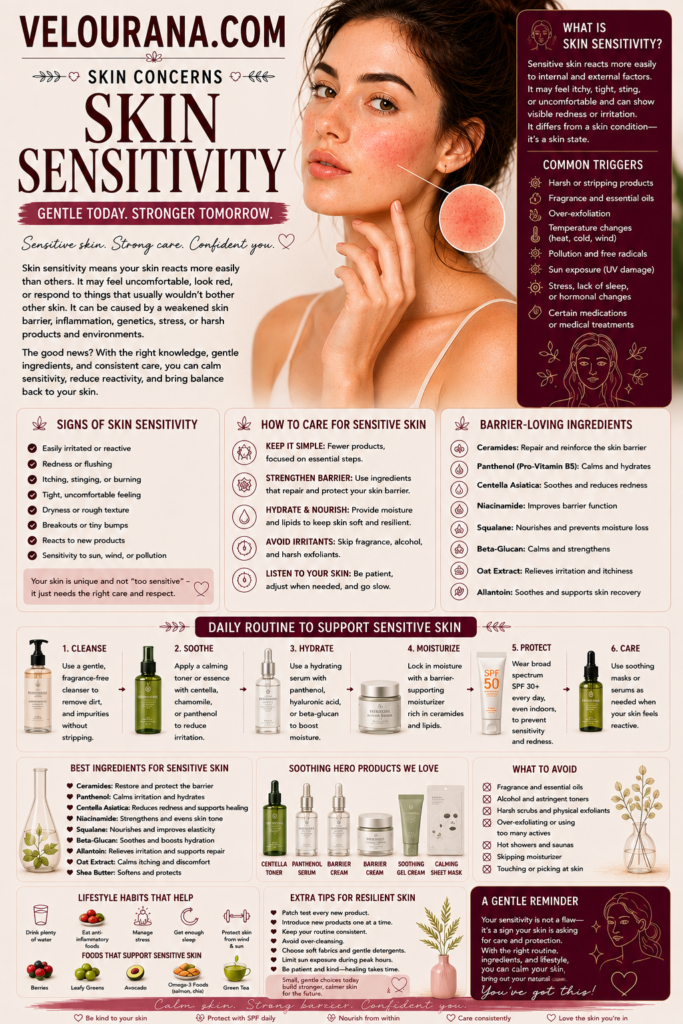
CATEGORY: Skin Sensitivity
One of the most confusing experiences in skincare is discovering that a familiar product suddenly feels wrong. A moisturiser used comfortably for months begins to sting. A cleanser that once seemed gentle leaves the face tight and warm. Makeup that previously disappeared effortlessly into the skin now feels irritating before the day is over. Nothing obvious has changed in the bottle, yet the skin seems to have rewritten its rules.
This apparent contradiction becomes easier to understand when sensitivity is viewed not as a fixed identity but as a changing threshold.
Skin is constantly responding to its surroundings. Weather changes. Humidity rises and falls. Sun exposure varies. Cleansing habits shift. New treatments are introduced. Sleep, stress, friction, shaving, hair removal and dozens of other everyday influences alter the conditions under which the skin functions. At the same time, its outer protective structures continually renew themselves.
Tolerance is therefore dynamic.
A product that sits comfortably within the skin's tolerance threshold today may become uncomfortable when several other pressures have already pushed that threshold downward. The formula has not necessarily become harsher. The skin receiving it has changed.
This idea offers a more useful way to think about sensitivity because it replaces the question “Why has my skin suddenly become sensitive?” with a more precise one: “What has changed the amount of stimulation my skin can comfortably tolerate?”
The answer is rarely found in one dramatic event. More often, sensitivity develops through accumulation.
The Skin Has a Tolerance Budget
The idea of a tolerance budget is not a medical diagnosis, but it is a useful way of visualising how reactive skin behaves.
Imagine that healthy, comfortable skin can accommodate a certain amount of environmental and cosmetic stress without producing obvious symptoms. Cleansing uses a little of that capacity. Cold wind uses some more. An exfoliating treatment creates another challenge. Retinoids, shaving, prolonged sun exposure, low humidity and friction may each add additional demands.
None of these influences necessarily creates a problem independently.
The difficulty begins when their combined effect exceeds what the skin can comfortably manage at that particular moment.
This explains why identifying one culprit can be surprisingly difficult. A person may blame the final product applied before burning developed, although that product may simply have been the last addition to an already overloaded system.
Consider a routine that has gradually expanded. An exfoliating acid is used several evenings each week. A retinoid is introduced on alternate nights. A strong cleanser is used morning and evening. An occasional peel is added because the skin looks dull. Then winter arrives and indoor heating reduces environmental humidity.
For weeks, everything may appear manageable.
Eventually, the same moisturiser used throughout the entire period begins to sting.
The moisturiser is an obvious suspect because it produces the immediate sensation. Yet removing only that moisturiser may not solve the underlying problem if the skin's tolerance has been reduced by everything surrounding it.
Sensitive skin frequently requires us to examine the entire environment rather than prosecute the last product that touched the face.
Why Sensitivity Can Appear Suddenly
The word “suddenly” can be misleading when describing skin.
The symptom may appear suddenly even when the process producing it has developed gradually.
Barrier disruption, for example, does not always announce itself immediately. The skin may tolerate repeated exfoliation or aggressive cleansing for some time before dryness, tightness or burning becomes obvious. Small disturbances accumulate until a threshold is crossed.
Once that happens, the change can feel dramatic.
Water stings. Products burn. The face becomes flushed after cleansing. Areas around the nose or mouth begin to feel particularly uncomfortable. Makeup emphasises roughness that was not noticeable a few days earlier.
This pattern can create panic because the reaction appears disproportionate to whatever happened immediately before it.
But skin is not a simple on-off system. Its ability to maintain hydration, regulate inflammatory responses and protect itself against environmental exposure depends on multiple interacting processes. When enough of those processes are under strain, symptoms may become visible all at once.
This is why the history of the preceding days or weeks can matter more than the final hour before a reaction.
What products were introduced recently? Has exfoliation become more frequent? Has the weather changed? Has the skin experienced more sun than usual? Has shaving or hair removal increased? Has cleansing become more aggressive? Have several new products been tested simultaneously?
The answers often reveal a pattern that the individual reaction cannot.
Barrier Disruption Changes the Rules
The skin's outermost barrier is frequently discussed as though it were simply a wall, but it is better understood as a highly organised biological structure.
Its job includes reducing excessive water loss and limiting the entry of potentially irritating substances. When it functions effectively, the skin can interact with its environment without constantly becoming inflamed or uncomfortable.
When that barrier becomes impaired, several things can change simultaneously.
Water may escape more readily, contributing to dehydration and tightness. Irritating substances may interact more easily with vulnerable tissue. The skin may become rougher or flaky. Sensory responses can become more noticeable.
Products that once felt neutral may then produce stinging because they are being applied to skin in a fundamentally different condition.
This is one reason a compromised barrier can create the impression that someone has suddenly become intolerant to everything.
The problem may not be that every product is unsuitable. The common denominator is the surface to which they are being applied.
Recognising this can prevent an unproductive cycle of replacement. Someone experiences burning, buys a new moisturiser, experiences another sensation, replaces the cleanser, adds a soothing serum, tries a barrier mask and introduces several products marketed for sensitive skin.
Within days, the routine contains more variables than it did before the irritation began.
Even products designed for sensitive skin can become difficult to evaluate when five of them are introduced simultaneously.
Recovery requires enough consistency to understand what the skin is actually doing.
Over-Exfoliation Is Not Always Obvious
Exfoliation occupies an unusual position in contemporary skincare. Used appropriately, exfoliating ingredients can improve the appearance and feel of the skin. Used excessively, they can contribute to exactly the roughness, redness and sensitivity people are trying to correct.
The problem is not always one exceptionally strong peel.
Cumulative exfoliation can be much less obvious.
An acid toner may seem mild. A cleanser contains another exfoliating ingredient. A serum encourages cell turnover. A weekly mask adds further exfoliation. None of the individual products feels particularly aggressive, so the routine appears reasonable when each step is considered separately.
The skin, however, experiences the routine as a whole.
Frequency matters as much as individual strength.
Signs of excessive treatment can include unusual tightness, persistent warmth, increased redness, shiny-looking yet dehydrated skin, flaking, sensitivity around the nose and mouth, or products suddenly beginning to sting.
Continuing to exfoliate because the resulting roughness looks like a problem requiring more exfoliation can intensify the cycle.
This is where visual interpretation becomes unreliable. Flaking does not automatically mean dead skin that needs to be removed. Roughness does not always indicate insufficient exfoliation. Sometimes these signs reflect a surface that needs time to recover.
The distinction is crucial.
Sensitive skin often improves not when another corrective step is added, but when the frequency of correction is reduced.
Active Ingredients Need Context, Not Fear
When sensitivity develops, active ingredients are sometimes divided into simplistic categories of good and bad.
This is rarely useful.
Retinoids, exfoliating acids and other active ingredients are not inherently incompatible with sensitive skin, but their use requires attention to concentration, formulation, frequency and individual tolerance.
The same ingredient can be perfectly manageable in one routine and overwhelming in another.
A person who tolerates a retinoid twice weekly may become irritated when increasing to nightly application. Another person may tolerate frequent use without difficulty. Someone may use an exfoliating acid comfortably during humid summer months but need to reduce its frequency during a cold, dry winter.
The lesson is not that sensitive skin should fear active ingredients.
It is that dosage in skincare includes frequency.
Consumers naturally focus on the percentage printed on a bottle, yet the number of applications over time can be equally important. A modest treatment applied too frequently may create more irritation than a stronger treatment used carefully.
Sensitive skin benefits from gradual introduction because gradual introduction produces information.
If one product is introduced while the rest of the routine remains stable, its effects are easier to observe. If five products begin simultaneously, both success and failure become difficult to interpret.
Skincare experimentation works best when it resembles a controlled investigation rather than a complete renovation.
The Hidden Influence of Cleansing
When people review a routine for potential irritants, treatment serums often receive the greatest scrutiny. Cleansing can escape attention because it is considered basic rather than active.
Yet cleansing happens frequently, often twice every day, and therefore has enormous cumulative influence.
A cleanser does not need to produce immediate burning to be contributing to sensitivity. If the skin consistently feels tight after washing, requires immediate moisturiser to restore comfort or becomes progressively drier over several weeks, the cleansing process may deserve examination.
Technique matters too.
Long cleansing sessions, repeated washing, very hot water, cleansing brushes, rough washcloths and vigorous towel drying can increase stress on already reactive skin.
Even the desire to remove every trace of oil can become counterproductive.
Sebum is often discussed only as something undesirable that contributes to shine or blemishes. But the skin's surface lipids participate in maintaining its protective environment. Sensitive skin does not generally benefit from being repeatedly stripped to an extreme state of degreasing.
The goal is sufficient cleansing rather than maximum cleansing.
This distinction can transform the experience of a routine.
Instead of judging success by how dramatically different the skin feels after washing, success becomes the absence of unnecessary disturbance.
Weather Can Expose Sensitivity That Was Already Developing
Seasonal sensitivity is common because environmental conditions alter the demands placed on the skin.
Cold outdoor air often contains less moisture than warm humid air. Indoor heating can further reduce humidity. Wind increases physical exposure. Moving repeatedly between cold and heated environments can encourage flushing in people whose facial blood vessels react easily.
A skincare routine that seemed perfectly balanced during summer may therefore become too demanding in winter.
The reverse can also happen. Heat, perspiration and increased sun exposure can create their own forms of irritation during warmer months.
This seasonal variation demonstrates why routines should not be treated as permanent formulas.
Consistency is valuable, but consistency does not mean refusing to adapt.
It means making deliberate adjustments rather than reacting chaotically.
If winter consistently makes the skin tight and reactive, reducing unnecessary exfoliation and using more protective moisturisation may be sensible. If heavy products become uncomfortable during humid weather, textures can be adjusted while the basic principles of gentle cleansing, hydration and protection remain intact.
Sensitive skin often benefits from this distinction between stable principles and flexible products.
The principles remain steady.
The implementation changes with circumstances.
Friction Is Skincare Too
Not every influence on sensitive skin comes from a cosmetic ingredient.
Physical friction can be surprisingly important.
Towels, pillowcases, masks, shaving, facial hair removal, repeated touching, makeup brushes and cleansing devices all interact mechanically with the skin. None is automatically harmful, but irritated skin may tolerate physical contact differently from healthy skin.
Rubbing becomes particularly problematic when it accompanies other stressors.
Imagine skin that has recently been exfoliated, exposed to cold weather and cleansed with hot water. Drying the face vigorously with a rough towel adds another challenge to a surface whose tolerance is already reduced.
Again, the problem is cumulative.
Gentleness therefore applies not only to formulas but to movement.
Patting or lightly drying rather than scrubbing, avoiding unnecessary picking and reducing repeated manipulation of inflamed areas can make a meaningful difference.
This principle becomes especially important around naturally vulnerable areas such as the sides of the nose, lips and eyes, where repeated wiping or rubbing can contribute to irritation.
Skincare is everything that happens to the skin, not merely everything that comes from a bottle.
Why Constant Product Switching Can Keep Sensitivity Alive
When skin becomes unpredictable, experimentation feels rational.
Something is wrong, so something must be changed.
The difficulty is that repeated change makes cause and effect increasingly difficult to understand.
A new cleanser is introduced on Monday. A soothing serum arrives on Wednesday. By Friday, a different moisturiser has been added. The following week, an exfoliant is removed and a recovery mask introduced.
If the skin improves, which change helped?
If it worsens, which product caused the problem?
There may be no way to know.
This uncertainty encourages further experimentation, and the cycle continues.
A stable routine provides a reference point. Once the skin has settled into predictable behaviour, carefully introducing one variable at a time becomes much more informative.
Patch testing a new cosmetic on a limited area before broader use can also be useful for assessing obvious intolerance, although home patch testing cannot diagnose allergies and should not be confused with professional dermatological patch testing.
The broader principle is experimental simplicity.
The fewer variables changed simultaneously, the more clearly the skin can communicate what it tolerates.
Stress and Sensation Are Connected Without Making Sensitivity Imaginary
Discussions of sensitive skin occasionally become dismissive when stress is mentioned, as though acknowledging psychological influences means physical symptoms are not real.
That is a false distinction.
The nervous system, immune system and skin communicate continuously. Emotional stress can influence physiological processes throughout the body, and some inflammatory skin conditions are known to fluctuate during stressful periods.
At the same time, visible or uncomfortable skin can itself become a source of stress.
This creates a bidirectional relationship rather than a simplistic claim that sensitivity exists “in the mind.”
Someone experiencing persistent facial burning may become hyperaware of every sensation. That attention can increase anxiety around skincare, which may encourage more checking, touching and product switching.
The practical response is not to dismiss symptoms.
It is to reduce unnecessary uncertainty.
A predictable routine, clear understanding of triggers and professional assessment when symptoms persist can remove some of the constant decision-making that surrounds reactive skin.
Calm skincare is not merely an aesthetic concept.
Predictability has practical value.
Recovery Is Not Always Linear
When irritated skin begins improving, it is easy to assume the problem has ended.
A few comfortable days pass, so every treatment that was removed is immediately restarted.
Sensitivity returns.
This does not necessarily mean recovery failed. It may mean the skin was challenged before tolerance had sufficiently stabilised.
Improvement in visible redness can occur before every aspect of barrier function and sensitivity has returned to baseline. The absence of obvious discomfort for a day or two is therefore not always an invitation to resume an intensive routine immediately.
Gradual reintroduction provides a safer way to test recovery.
One treatment can return at a reduced frequency while the rest of the routine remains unchanged. If the skin remains comfortable, frequency can be reconsidered later.
This slower approach may feel frustrating, particularly when someone is eager to continue treating acne, pigmentation or signs of ageing.
But irritation can interfere with those goals as well.
An ambitious routine that repeatedly has to be stopped may accomplish less over several months than a moderate routine that can be maintained consistently.
Long-term skincare rewards sustainability.
When a Product Really Is the Problem
Understanding cumulative sensitivity should not lead to the opposite mistake of assuming products are never responsible.
Sometimes a particular formula genuinely causes irritation or an allergic reaction.
A reaction that repeatedly appears after using the same product and resolves when that product is discontinued deserves attention. Significant itching, swelling, rash-like changes or reactions that extend beyond the immediate application area may warrant professional assessment.
Certain reactions can also develop after a product has been used successfully for some time. Allergic sensitisation is not necessarily present from the first exposure.
This is another reason the phrase “I have used it for years, so it cannot be the product” is not always reliable.
At the same time, self-diagnosis has limitations.
Facial redness can arise from many conditions, and repeatedly eliminating ingredients without knowing the cause can result in an unnecessarily restrictive routine.
When reactions are severe, persistent, recurrent or difficult to explain, dermatological evaluation becomes more valuable than continued cosmetic detective work.
The objective is not to identify a villain at all costs.
It is to understand what the skin needs.
A More Intelligent Way to Restart a Routine
After a period of sensitivity, restarting skincare can be approached methodically.
The foundation is usually uncomplicated: a tolerated cleanser when cleansing is necessary, a moisturiser appropriate for the skin and reliable sun protection. The exact products will vary because sensitive skin is not identical from one person to another.
Once this foundation remains comfortable, additional treatments can be considered according to actual priorities.
This is an important moment because skincare routines often become complicated through accumulation rather than intention. A serum is purchased for brightness, another for texture, another for hydration and another because it was recommended online. Eventually, several products address overlapping goals without anyone asking whether all of them remain necessary.
Rebuilding after sensitivity creates an opportunity to reconsider the architecture of the routine.
What problem is each product solving?
Is another product already addressing the same concern?
Does the benefit justify the irritation risk?
Is the product enjoyable and practical enough to use consistently?
These questions transform a routine from a collection into a strategy.
Sensitive skin often thrives when every step has a reason to exist.
The Goal Is Resilience, Not Invulnerability
There is no prize for making skin tolerate everything.
Some people naturally flush more easily. Some experience greater sensitivity to particular ingredients. Others need to adjust their routines frequently with seasonal changes.
Healthy skin does not have to be completely unresponsive.
The more useful objective is resilience: the ability to maintain comfort and function through ordinary environmental changes without repeatedly entering cycles of significant irritation.
Resilience develops partly through protecting what the skin already knows how to do.
The barrier renews itself. The skin regulates water. Inflammatory responses resolve. Cells continually replace themselves. Skincare can support these processes, but it cannot improve them indefinitely simply by increasing the number of interventions.
Sometimes the smartest action is allowing biology enough space to work.
This idea runs against the excitement of constant optimisation, but it offers a more sustainable relationship with sensitive skin.
The routine becomes less about controlling every visible fluctuation and more about maintaining conditions in which the skin behaves predictably.
Learning the Skin's Personal Threshold
Sensitive skin becomes easier to manage when patterns replace assumptions.
Perhaps exfoliation is tolerated once weekly but not three times. Perhaps winter requires a richer moisturiser. Perhaps hot showers consistently trigger prolonged facial flushing. Perhaps one fragranced product causes no difficulty while another does. Perhaps shaving and retinoid use need to occur on different days.
These observations gradually create an individual map of tolerance.
No universal routine can provide that map because sensitivity exists within the interaction between a person's skin, environment and habits.
This is why copying someone else's routine can be particularly unreliable for reactive skin. Two people may share the same cosmetic concern while having very different tolerance thresholds.
The best routine is not necessarily the one containing the most celebrated ingredients.
It is the one that delivers useful benefits without repeatedly pushing the skin beyond what it can comfortably manage.
Once sensitivity is understood as a threshold rather than a permanent state of fragility, skincare becomes less mysterious. Sudden reactions begin to have context. Seasonal changes become easier to anticipate. Product introductions become more deliberate. Recovery periods stop looking like failures.
Most importantly, discomfort becomes meaningful information rather than an obstacle to be ignored.
Skin does not need to tolerate everything we are capable of applying to it.
It needs enough stability to perform the work it was designed to do.
The End Velourana
 Discover More From Our Family of Websites
 ZodiacBearing (Astrology, Tarot, Numerology, Angel Numbers & Spiritual Guidance)
 Velourana (Beauty, Makeup, Hair Care, Skincare & Beauty Tips)
 HavenBearing (Home, Living, Organization, Décor & Everyday Inspiration)
 PawBearing (Pet Care, Dog Breeds, Animal Health, Training & Pet Products)
 PsyCatherine (Notes From the Journal of a Psychologist on Real Life)

