
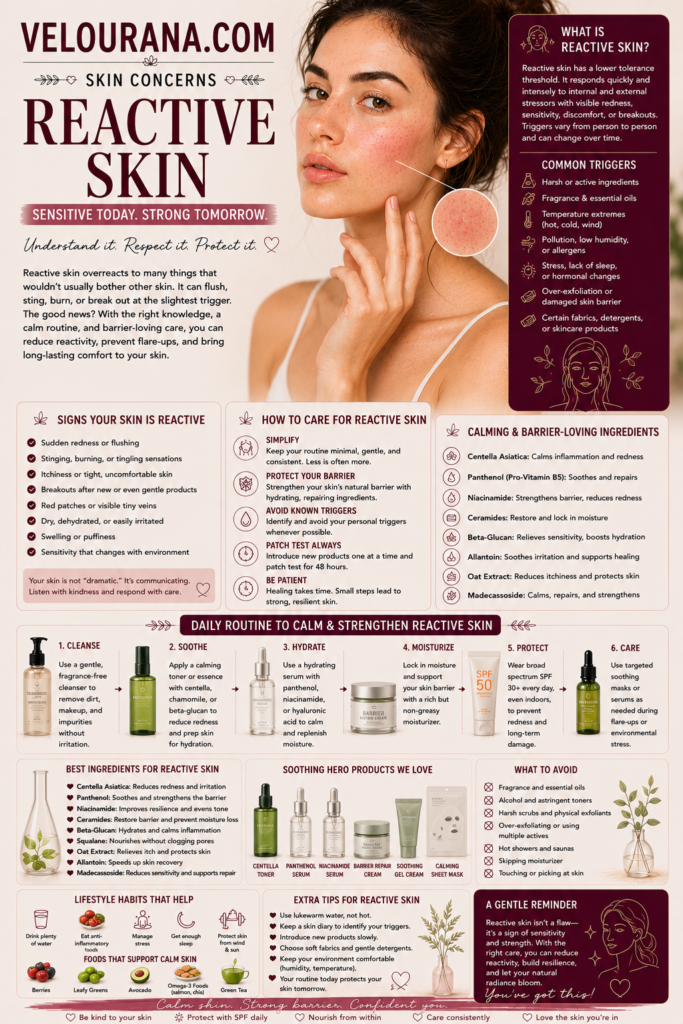
CATEGORY: Reactive Skin
Redness is one of the most visible expressions of reactive skin, but what appears in the mirror rarely tells the entire story.
A complexion can become pink after cleansing and return to normal within minutes. Cheeks can flush intensely when moving from cold air into a heated room. A new cosmetic can create warmth and redness that disappear shortly after application. At another time, seemingly similar redness can remain for hours, arrive with burning or tightness, and leave the skin noticeably more sensitive the following day.
These experiences may look superficially alike, yet they do not necessarily mean the same thing.
Reactive skin becomes easier to understand when redness is viewed not as a single condition but as part of a changing biological response. Blood vessels, sensory nerves, the skin barrier, inflammation, environmental exposure and individual susceptibility can all influence what becomes visible on the surface. Sometimes the response is brief and physiological. Sometimes repeated provocation creates a cycle in which the skin becomes increasingly uncomfortable and less tolerant of ordinary skincare.
The practical challenge is learning the difference.
Not every flush needs treatment. Not every episode of redness should be ignored. And persistent redness should not automatically be classified as cosmetic sensitivity when an underlying dermatological condition may be involved.
For reactive skin, the appearance of redness is therefore only the beginning of the investigation.
Redness Is a Sign, Not an Explanation
It is tempting to treat facial redness as though it were a diagnosis.
It is not.
Redness describes an appearance. Many different processes can produce it.
The face naturally changes colour when superficial blood flow increases. Heat, physical exertion, emotional responses and rapid temperature changes can all produce temporary flushing. Some people simply display these vascular changes more visibly than others.
Irritation can also produce redness.
So can sun exposure.
So can allergic reactions.
Dermatological conditions including rosacea, eczema, seborrhoeic dermatitis and contact dermatitis can all involve facial redness.
This variety explains why two people with similarly pink cheeks may need entirely different approaches.
One may simply flush easily.
Another may have irritated the skin through excessive exfoliation.
Another may be experiencing rosacea.
Another may have developed contact dermatitis from something in a cosmetic product.
Looking only at colour cannot distinguish these possibilities reliably.
Context matters.
How long does the redness remain?
Does it burn?
Does it itch?
Is there swelling?
Does the skin scale?
Are there bumps or pustules?
Are visible blood vessels becoming noticeable?
Do the eyes feel irritated?
Does the reaction consistently follow a particular product?
Does heat trigger it?
Does it occur without an obvious trigger?
These questions begin to transform redness from a vague cosmetic complaint into a pattern that can be understood.
The Difference Between Flushing and Persistent Redness
Flushing is temporary.
The face becomes redder because blood flow near the skin surface changes, then gradually returns toward its usual colour.
For many people, this is completely ordinary.
Exercise can cause it.
Heat can cause it.
Embarrassment can cause it.
Spicy food or alcohol may trigger flushing in susceptible individuals.
Rapid temperature changes can produce it.
Reactive skin may make these episodes more noticeable or uncomfortable.
Persistent redness is different.
When facial colour does not return to its usual baseline, or when flushing episodes become increasingly frequent and prolonged, the situation deserves closer attention.
Rosacea is particularly important here because frequent flushing can be an early feature. Over time, some people develop more persistent facial redness, visible blood vessels, sensitive skin or acne-like eruptions.
This does not mean everyone who flushes has rosacea.
It means that the pattern matters.
A single red face after exercise tells us very little.
Repeated unexplained flushing combined with persistent central facial redness tells us considerably more.
Reactive-skin care therefore requires resisting two extremes.
The first is catastrophizing every temporary flush.
The second is dismissing persistent redness indefinitely as “just sensitive skin.”
Both approaches lose useful information.
Why Heat Is Such a Powerful Trigger
Heat is one of the most familiar triggers of facial redness.
The mechanism is partly vascular. When the body needs to release heat, blood flow near the skin surface can increase. On the face, this can become immediately visible.
For someone prone to reactivity, the sensation may be as noticeable as the colour.
The cheeks feel warm.
The face begins to sting.
Skincare suddenly feels heavier.
Sweat may add another source of discomfort.
This is why hot showers can be surprisingly problematic for redness-prone skin.
The person may use an exceptionally gentle cleanser yet expose the face to very hot water every morning and evening. The skincare products receive all the scrutiny while temperature is ignored.
Saunas, steam rooms and very hot baths can create similar challenges for people whose redness is easily triggered.
Indoor heating can matter too, particularly when someone moves rapidly from cold outdoor conditions into a very warm room.
The lesson is not that reactive skin must live in a perfectly controlled temperature.
That would be unrealistic.
It is that environmental temperature belongs in the same conversation as cosmetic ingredients.
If redness repeatedly appears after heat exposure, buying another serum without addressing the trigger may accomplish very little.
Cold Weather Creates a Different Kind of Stress
Cold is often discussed as the opposite of heat, but for reactive skin the two can cooperate.
Cold outdoor air may contribute to dryness and discomfort.
Wind increases exposure.
Then the person enters a warm building and the face flushes.
The skin experiences both environments within minutes.
Winter can therefore create a distinctive pattern: dryness outside, flushing inside.
Someone may notice that products tolerated throughout summer suddenly sting during December. This does not necessarily mean the formulation has changed or that a new allergy has developed.
The skin's condition and environment have changed.
A routine that was adequate in warm, humid weather may provide insufficient support in cold, dry conditions.
This is one reason seasonal adjustment is particularly important for reactive complexions.
Skincare should respond to the environment rather than pretending the environment does not exist.
When Cleansing Starts the Redness Cycle
For many people with reactive skin, redness begins at the sink.
The face looks relatively calm before cleansing.
After washing, the cheeks are pink.
The skin feels tight.
Then toner or serum stings.
Moisturizer produces warmth.
By the end of the routine, the entire face seems irritated.
The immediate conclusion may be that several products are unsuitable.
But the first event deserves attention.
How was the skin cleansed?
Water temperature matters.
Cleanser formulation matters.
Duration matters.
Pressure matters.
Frequency matters.
The way the face is dried matters.
A mild cleanser used briefly with lukewarm water and fingertips creates a very different experience from the same cleanser massaged vigorously under hot water and removed with a rough washcloth.
Reactive skin often reveals the importance of technique because it has less tolerance for unnecessary friction.
Cleansing should remove what needs to be removed.
It does not need to produce a sensation of absolute sterility.
If the face routinely becomes tight and uncomfortable immediately after washing, that is useful information.
The rest of the routine may be starting from an already disadvantaged position.
The Invisible Stage Before Visible Irritation
Significant irritation rarely arrives completely without warning.
Reactive skin often provides subtle signals first.
A moisturizer tingles slightly.
The skin feels tighter than usual.
There is mild warmth around the nose.
Foundation begins clinging to areas that normally look smooth.
A cleanser feels stronger.
Sunscreen produces a faint sting near the cheeks.
None of these changes may seem important enough to justify altering the routine.
So everything continues.
The exfoliant is used on schedule.
The retinoid is applied the following evening.
The new serum remains in rotation.
Then visible redness appears.
This sequence creates the impression that the final product caused the problem.
Sometimes it did.
But sometimes the skin had been moving toward irritation for several days.
Learning to recognize the invisible stage is one of the most effective ways to manage reactive skin.
The objective is to respond while the warning signs are small.
Reducing optional treatments for several days can be far easier than recovering from a significant episode of irritation.
How Repeated Irritation Changes Product Tolerance
One of the strangest experiences with reactive skin is discovering that almost everything suddenly stings.
Even water.
Even moisturizer.
Even products labelled for sensitive skin.
This can happen when the complexion has already become significantly irritated.
The problem is that people often begin evaluating products during precisely this period.
A moisturizer is applied and burns.
It is discarded.
A replacement is purchased and also burns.
That is discarded.
A third product is introduced.
The skin remains uncomfortable.
Soon the person concludes that they are allergic to virtually every moisturizer.
The interpretation may be wrong because the testing environment is unstable.
Compromised, inflamed skin can respond differently from comfortable skin.
This is why it is useful to distinguish between a product that repeatedly provokes irritation on otherwise stable skin and a product that stings only during periods when everything feels uncomfortable.
The distinction cannot always be made at home, particularly when allergy or a dermatological condition is possible.
But it prevents premature conclusions.
A reaction tells you that something is wrong.
It does not always tell you exactly what.
Why Redness and Dryness Frequently Appear Together
Reactive redness often arrives with dryness.
The skin feels tight.
Fine flakes appear.
The surface looks rough.
Makeup becomes difficult to apply.
This combination can create conflicting impulses.
Redness encourages soothing.
Roughness encourages exfoliation.
Dryness encourages richer products.
If all three impulses are followed aggressively, the routine can become complicated very quickly.
The more useful interpretation is that these symptoms may be connected.
When barrier function is impaired, water loss can increase and irritants may penetrate more readily. The skin may consequently feel both dry and unusually sensitive.
This is why roughness during an irritated period should not automatically be treated as excess surface buildup.
Sometimes those flakes are evidence that the skin needs gentler treatment, not stronger exfoliation.
Once comfort returns, persistent texture can be reassessed.
Timing matters.
The correct treatment used at the wrong moment can still be a poor decision.
The Relationship Between Redness and Friction
Reactive skin can turn ordinary physical contact into a trigger.
The face is rubbed with a towel.
Redness appears.
A cleansing pad is dragged across the cheeks.
They become warm.
Makeup is removed with repeated wiping.
The skin begins to sting.
These reactions can seem trivial because there is no dramatic ingredient to blame.
But friction is still an exposure.
This becomes particularly relevant when several forms of mechanical treatment are combined.
Someone may use a facial scrub twice weekly, a cleansing brush daily and cotton pads for toner every evening. Each practice may appear harmless individually.
Together they create repeated physical stimulation.
Reducing friction is therefore one of the simplest experiments someone with reactive skin can perform.
Use fingertips rather than abrasive tools.
Pat rather than rub.
Let cleansing products do their job without excessive pressure.
Avoid repeatedly touching areas that already feel irritated.
These changes cost nothing and remove variables from the routine.
That makes them particularly valuable.
Why Makeup Can Feel Different on Reactive Days
Makeup is often blamed when reactive skin becomes uncomfortable, but the relationship can be complicated.
On a stable day, foundation may feel completely normal.
On a reactive day, the same product feels heavy or irritating.
This does not automatically mean the makeup has suddenly become unsuitable.
The skin underneath has changed.
Dryness may cause foundation to catch on flakes.
Heat may make occlusive formulas feel uncomfortable.
An already irritated barrier may make application itself unpleasant.
Removing long-wearing makeup can also add friction at the end of the day.
This is why evaluating makeup tolerance requires looking at the entire process: preparation, application, wear and removal.
Sometimes the product is the problem.
Sometimes the method is.
Sometimes the skin was already reacting before makeup entered the picture.
Again, context matters more than assumptions.
When Trying to Hide Redness Makes It Worse
Visible redness naturally creates a desire to conceal it.
Colour correctors, foundation and concealer can help create a more even-looking complexion.
There is nothing inherently problematic about this.
The difficulty arises when increasingly heavy makeup requires increasingly aggressive removal.
A person may cover irritation during the day, then scrub extensively at night to remove long-wearing products. The removal process contributes additional irritation, which creates more redness the following morning.
More makeup is then used.
The cycle continues.
For reactive skin, successful camouflage should therefore include consideration of removal.
A cosmetic that looks perfect but requires uncomfortable scrubbing every evening may not be ideal during a reactive period.
The best makeup routine is not only the one that looks good after application.
It is one the skin can comfortably complete from beginning to end.
Sun Exposure and the Redness-Prone Complexion
Ultraviolet exposure deserves particular attention when skin flushes or reddens easily.
Sun exposure can contribute to inflammation and can aggravate rosacea in susceptible individuals. It also affects pigmentation, photoageing and overall skin health.
Daily sun protection therefore has a role beyond preventing sunburn.
The challenge is that some reactive complexions find sunscreens difficult to tolerate.
A formula may sting around the eyes.
Another feels too heavy.
Another leaves the face warm.
This can lead to sunscreen avoidance.
A more useful strategy is finding a formulation that the individual can realistically use consistently.
For some people, mineral sunscreens containing zinc oxide or titanium dioxide are better tolerated. Others prefer modern organic filters in carefully formulated products.
There is no universally perfect sunscreen for every reactive complexion.
Tolerance, adequate protection and consistent application matter more than allegiance to one category.
Sun protection can also include behaviour.
Shade.
Hats.
Avoiding unnecessary intense exposure.
Protective clothing where appropriate.
Skincare does not need to make a bottle responsible for everything.
Stress, Emotion and the Visible Face
The face is unusually expressive biologically as well as emotionally.
Embarrassment can produce flushing.
Anxiety can make the cheeks warm.
Stressful situations may intensify awareness of skin sensations.
For someone already self-conscious about facial redness, this can create an uncomfortable feedback loop.
They notice the face becoming warm.
They worry that other people can see it.
The worry intensifies.
The flushing becomes more noticeable.
This does not mean the redness is imaginary or “just psychological.”
The vascular response is real.
It means that emotional and physiological responses can interact.
This is particularly important because telling someone simply to “stop worrying” is rarely useful.
A better approach is understanding that some triggers cannot be eliminated completely.
The goal becomes reducing the factors that can be controlled while refusing to interpret every flush as evidence that the skin has been damaged.
Why Cooling Must Be Gentle
When the face feels hot, cooling seems obvious.
But reactive skin does not necessarily benefit from extremes.
Applying ice directly to irritated skin can create another intense temperature exposure.
Very cold water may feel relieving temporarily but can be uncomfortable for some people.
The objective is not to shock the skin into becoming less red.
It is to reduce discomfort gently.
A cool environment, avoiding further heat and allowing the skin to settle may be more sensible than aggressive temperature manipulation.
This reflects a broader rule for reactive skin.
When the complexion is already overstimulated, another extreme is rarely the ideal answer.
Recognizing the Difference Between Sensitivity and Allergy
A product that causes redness is often immediately described as an allergy.
Sometimes that may be correct.
Often it is not possible to know without proper evaluation.
Irritant contact dermatitis occurs when something directly damages or irritates the skin.
Allergic contact dermatitis involves an immune response to a substance to which the person has become sensitized.
The two can overlap visually.
Redness, itching, swelling and discomfort can occur in contact reactions, making self-diagnosis difficult.
Timing can provide clues, but it is not definitive.
This is where professional patch testing becomes useful when allergic contact dermatitis is suspected.
The practical message is simple: do not build an enormous personal allergy list based solely on isolated episodes of stinging.
Repeated patterns deserve attention.
Significant reactions deserve medical assessment.
But irritation and allergy should not be treated as interchangeable words.
When Rosacea Should Enter the Conversation
Reactive skin and rosacea can overlap in experience.
Both may involve burning, stinging, flushing and intolerance of certain products.
But rosacea is a chronic inflammatory skin condition and deserves proper recognition.
Frequent flushing can be an early sign.
Persistent central facial redness may develop.
Visible blood vessels can appear.
Some people develop papules and pustules that resemble acne.
The eyes may also become involved.
Because symptoms vary, rosacea can be mistaken for ordinary sensitivity, acne or other skin conditions.
This is why persistent redness should not be managed indefinitely through cosmetic trial and error.
If flushing is becoming more frequent, redness remains between episodes, bumps develop, visible vessels appear or the eyes become persistently irritated, dermatological evaluation becomes increasingly important.
A diagnosis changes the conversation.
Instead of endlessly searching for products that “calm sensitive skin,” treatment can address the actual condition.
The Problem with Constantly Checking the Mirror
Reactive skin can create hyper-awareness.
The face feels warm.
The mirror is checked.
A small red patch appears.
It is checked again ten minutes later.
Then under different lighting.
Then with the phone camera.
Repeated checking rarely improves the skin.
It often increases anxiety and encourages unnecessary intervention.
Minor fluctuations in facial colour are normal. Lighting changes their appearance dramatically. Bathroom lighting, daylight and phone cameras can make the same complexion look surprisingly different.
A more useful approach is observing trends rather than moments.
Is redness becoming more persistent over weeks?
Are episodes occurring more frequently?
Are symptoms becoming more uncomfortable?
Are new areas becoming involved?
These questions provide more useful information than inspecting the face every few minutes.
Giving the Skin Time to Settle
One of the hardest skills in reactive skincare is waiting.
When redness appears, the instinct is to correct it immediately.
Yet temporary flushing may resolve naturally.
Mild irritation may improve after the triggering exposure is removed.
Applying several new products during this period can obscure what is happening.
Allowing the skin to settle does not mean ignoring severe symptoms.
It means recognizing that not every temporary change requires aggressive treatment.
Time itself provides diagnostic information.
If redness disappears quickly after a known trigger, that tells us something.
If it persists for days, that tells us something else.
Observation is an active part of skincare.
Building a Redness-Conscious Routine
A routine for reactive skin does not need to become elaborate.
Its foundation is predictability.
Cleansing should accomplish what is necessary without leaving the skin consistently tight.
Moisturizer should support comfort.
Sun protection should be tolerable enough for regular use.
Optional treatments should be introduced according to the skin's actual tolerance.
Friction should be minimized.
Temperature extremes should be recognized as potential triggers.
New products should be introduced gradually enough that reactions can be interpreted.
Most importantly, the routine should be adjustable.
When the skin feels stable, targeted treatments may have a place.
When early irritation appears, intensity can decrease.
The routine follows the skin rather than forcing the skin to follow the routine.
Redness Is Information
Reactive skin becomes less frightening when redness stops being interpreted automatically as disaster.
Redness is information.
Sometimes it says the room is hot.
Sometimes it says the cleanser was too aggressive.
Sometimes it says several active products have been combined too frequently.
Sometimes it says the skin needs time to recover.
Sometimes it indicates a pattern that deserves medical assessment.
The challenge is learning which message is being delivered.
That understanding develops through consistency, observation and restraint.
A person who changes five products after every reaction will struggle to recognize patterns.
A person who maintains a stable baseline and introduces changes deliberately has a much better chance of identifying what the skin accepts.
From Fighting Redness to Understanding It
The desire to eliminate redness completely is understandable.
A perfectly even complexion is presented constantly as the visual standard of healthy skin.
Real skin is more dynamic.
It changes colour.
It responds to temperature.
It responds to emotion.
It responds to touch.
It responds to products.
The objective should not necessarily be a face that never becomes pink.
The more meaningful objective is skin that spends most of its time comfortable, returns toward its normal baseline after ordinary flushing, tolerates necessary skincare and does not remain trapped in repeated cycles of irritation.
That requires a different relationship with redness.
Instead of immediately attacking what appears in the mirror, ask what happened before it appeared.
Instead of adding several calming products, consider whether reducing stimulation would provide more useful information.
Instead of assuming that every reaction proves permanent intolerance, consider the condition of the skin at the time.
And instead of dismissing persistent redness as cosmetic sensitivity, recognize when professional diagnosis has become appropriate.
Reactive skin does not become understandable through one perfect ingredient.
It becomes understandable through patterns.
The temperature that repeatedly triggers flushing.
The treatment frequency that becomes too much.
The cleansing technique that consistently leaves the face uncomfortable.
The moisturizer that remains dependable through changing seasons.
The subtle warning signs that appear before a larger reaction.
These patterns gradually replace unpredictability with knowledge.
The redness may not disappear forever.
But the confusion surrounding it can.
And for someone living with reactive skin, understanding why the complexion reacts is often the first step toward helping it react less.
The End
Velourana
 Discover More From Our Family of Websites
 ZodiacBearing (Astrology, Tarot, Numerology, Angel Numbers & Spiritual Guidance)
 Velourana (Beauty, Makeup, Hair Care, Skincare & Beauty Tips)
 HavenBearing (Home, Living, Organization, Décor & Everyday Inspiration)
 PawBearing (Pet Care, Dog Breeds, Animal Health, Training & Pet Products)
 PsyCatherine (Notes From the Journal of a Psychologist on Real Life)

