
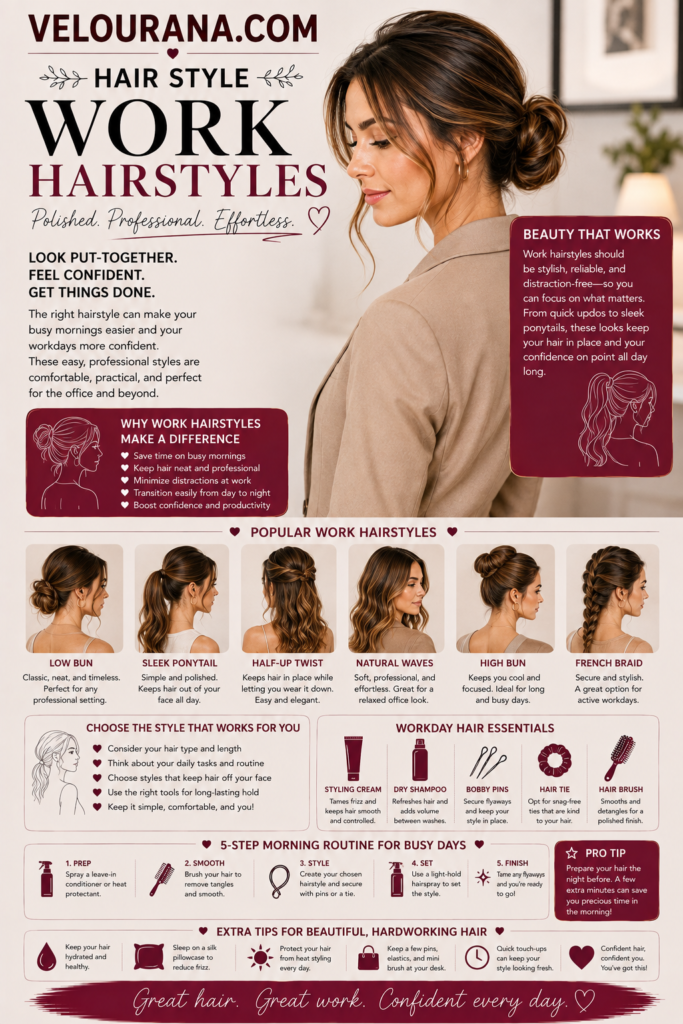
CATEGORY: Work Hairstyles
There is a particular kind of confidence in knowing exactly what works.
It is visible in people who seem to have developed an effortless relationship with their appearance. Their hair may change subtly from one day to another, yet there is continuity. The proportions remain familiar. The texture feels intentional. Nothing appears to have been chosen randomly that morning, and nothing looks as though it required a dramatic reinvention simply because another working day has begun.
This is the territory of the signature work hairstyle.
A signature does not mean wearing precisely the same arrangement every day. It is not a uniform, nor does it require choosing one ponytail, one part or one particular finish and repeating it indefinitely. It is better understood as a recognizable visual language: a way of wearing the hair that consistently suits the person, respects the natural behavior of the hair and functions reliably within her professional life.
The idea is valuable because modern beauty culture often encourages constant novelty. There is always another hairstyle to attempt, another trend to reproduce and another transformation promising to make familiar hair feel new. Experimentation can be enjoyable, but professional life rewards a different quality as well: mastery.
When someone understands her own hair deeply, she no longer needs to solve it from the beginning every morning. She knows where volume works, how the front should sit, what degree of texture feels most natural and which shapes remain comfortable after many hours. She knows what survives the commute and what collapses before lunch. She understands which version of her hair makes her feel prepared without making her feel disguised.
That accumulated knowledge eventually becomes style.
And style, unlike novelty, becomes stronger through repetition.
A Signature Begins With Recognition Rather Than Reinvention
The most convincing professional hair identity usually develops from something that already feels natural to the wearer.
This does not necessarily mean natural texture must remain completely untouched or that familiar habits should never change. It means that a signature tends to emerge when styling works with recognizable characteristics rather than attempting to replace them every morning.
Someone whose hair naturally carries significant volume may discover that her strongest professional image retains that presence while refining its shape. Someone with very straight hair may find that clean movement and a precise perimeter feel more convincing than repeatedly creating curls that require substantial maintenance. A person with natural waves may eventually stop trying to decide whether her hair should be considered straight or curly and instead make the movement itself central to her look.
Recognition also applies to personality.
Some people feel most comfortable with hair away from the face. Others prefer softness around it. Some enjoy precision. Others feel more themselves when texture has freedom. There are people who love a strong center part and others who immediately feel better when the hair moves asymmetrically.
These preferences are not trivial. They influence whether a hairstyle feels inhabited or merely worn.
A professional signature becomes possible when the wearer stops asking what work hair is supposed to look like and begins noticing which qualities repeatedly make her own hair feel right.
The answer is rarely a single technique.
It is usually a combination of proportion, texture and placement that can then be interpreted in several different ways.
Repetition Becomes Sophisticated When It Is Based on Knowledge
Repeating a successful hairstyle is sometimes treated as evidence of limited imagination.
In reality, repetition can be a sign that the wearer has stopped experimenting blindly.
Fashion itself is full of recognizable signatures. Certain people become associated with a particular silhouette, part, length or texture precisely because they understand its relationship to their appearance. The effect becomes memorable through consistency.
Professional hair can benefit from the same principle.
The working week already contains enough repeated decisions. There is little advantage in turning hairstyling into a daily test of creativity unless that process is genuinely enjoyable.
A familiar structure can instead become the foundation.
The wearer knows how to create it efficiently. She understands how it behaves several hours later. She knows which products or tools genuinely contribute and which merely complicate the process. If something changes because of weather or time pressure, she knows how much correction is actually necessary.
This familiarity creates efficiency without necessarily creating sameness.
A signature based around natural curls may appear more defined one day and fuller another. A person known for a clean bob can move between sleek and textured interpretations while retaining the recognizable shape. Long hair can alternate between loose and gathered forms while preserving the same relationship around the face.
The repetition lies in the visual identity, not in mechanical duplication.
That distinction allows professional style to become both dependable and alive.
The Hairline and Part Often Become the Anchor of Personal Style
When hairstyles change but a person still looks unmistakably like herself, the continuity often begins around the face.
The part establishes direction. The hairline determines how open or framed the face appears. The first few sections influence the balance of the entire hairstyle.
These details can become surprisingly powerful elements of a signature.
A consistent center part creates a strong sense of symmetry even when the lengths change from straight to wavy or from loose to gathered. A characteristic side part creates recognizable asymmetry across multiple hairstyles. Someone who usually leaves softness around the face can preserve that quality whether the rest of the hair is in a bun, ponytail or loose shape.
This is why changing the front dramatically can sometimes make a hairstyle feel more unfamiliar than changing everything behind it.
The face has lost its usual frame.
For professional styling, this knowledge can be useful. The wearer does not need to recreate the entire hairstyle to preserve a sense of continuity. If the familiar framing remains, substantial variation can happen elsewhere without disrupting the personal identity of the look.
The front becomes an anchor.
This also makes rushed mornings easier. Attention can be concentrated where it matters most visually while the rest of the hairstyle remains comparatively simple.
A signature is often built through these small recurring decisions rather than through an elaborate trademark style.
Texture Gives a Signature Its Emotional Character
Texture affects more than the physical appearance of hair. It changes the mood of the complete professional image.
Smooth hair can create clarity and visual discipline. Waves introduce movement. Curls bring dimension and energy. Coils can create extraordinary sculptural presence. Short textured hair can communicate ease and precision simultaneously.
A signature work style becomes stronger when texture is treated consistently as part of its character.
This does not mean the texture can never change.
Someone may alternate between straightened and naturally wavy hair. Curls may be more defined on one day and softer on another. The important question is whether the wearer understands what each finish does to her professional presence and chooses it deliberately.
Natural texture can be particularly powerful as a signature because it already contains individuality that does not need to be manufactured.
No two heads of curls or coils form precisely the same architecture. Density, pattern, length and shrinkage combine into something inherently personal. Shaping that texture intelligently can therefore create a professional identity that feels distinctive without requiring elaborate styling.
This is one reason the modern idea of professional polish benefits from becoming broader.
When polish is separated from uniform smoothness, considerably more personal style becomes possible.
Texture can remain texture and still look completely resolved.
A Signature Hairstyle Simplifies the Relationship With Trends
Hair trends can provide inspiration, but a strong personal style changes how trends are consumed.
Instead of asking whether a fashionable hairstyle should be adopted completely, the wearer can ask whether any part of it belongs naturally within her established visual language.
Perhaps a new parting direction feels right.
Perhaps a particular finish gives familiar hair a fresher surface.
Perhaps a contemporary accessory integrates beautifully with an existing style.
Perhaps the trend has nothing useful to offer.
This selective relationship is more sustainable than repeatedly rebuilding the professional image around whatever happens to be current.
Trends move quickly.
A work identity benefits from greater continuity.
That continuity does not make the hair dated. In fact, a strong signature can often appear more sophisticated because it is not visibly dependent on a single moment.
The underlying style remains while smaller details evolve.
A haircut may become slightly shorter. Layers may change. The finish may become softer. Accessories may become more contemporary.
The person remains recognizable through all of it.
This is the difference between having a hairstyle and having a hair identity.
Professional Authority Becomes More Natural When Appearance Feels Familiar
An unfamiliar hairstyle can create a subtle form of self-consciousness.
The wearer may like what she sees in the mirror but still remain unusually aware of the hair because it does not feel like her normal visual self. During an ordinary day, this may not matter. During an important professional situation, unnecessary self-awareness can become distracting.
A signature hairstyle provides the opposite experience.
There is recognition.
The person knows how she looks from different angles. She understands how the hair moves when she speaks or turns her head. She knows whether the front will remain comfortable during a long meeting. She has already seen the style survive ordinary working days.
That familiarity can be particularly useful when professional pressure increases.
An interview, presentation or important negotiation does not necessarily require a dramatic beauty transformation. Often the most convincing choice is the strongest version of the established professional identity.
The hair receives more attention without becoming different in essence.
This creates continuity between everyday competence and high-stakes competence.
The wearer is not visually becoming someone else in order to appear more authoritative.
She is simply presenting herself with greater precision.
There is psychological strength in that.
Efficiency Is One of the Hidden Luxuries of Personal Style
A signature work hairstyle can save a remarkable amount of mental and practical effort.
Once the routine is understood, fewer decisions are required.
The necessary tools are known. The amount of product becomes predictable. The styling sequence develops naturally. The wearer understands what can be skipped when time is limited and what actually makes a visible difference.
This is not merely convenience.
It can improve the quality of the result because repetition develops skill.
Someone who has created the same general front shape hundreds of times becomes extremely efficient at it. She understands the angle that works. She knows how much volume is enough. She can recognize when to stop manipulating the hair.
That final ability is particularly valuable.
Uncertain styling often leads to overworking. Another adjustment is made, then another. More product is added. A section is restyled even though it was already acceptable.
Familiarity reduces this tendency.
The wearer knows what finished looks like.
The morning routine becomes shorter not because less care is taken, but because less effort is wasted.
The Signature Must Still Be Able to Evolve
Consistency becomes restrictive only when it refuses to respond to change.
Hair itself changes over time. Density can shift. Texture can behave differently. Length changes the way weight is distributed. A fringe grows out. Gray hair may introduce new visual texture. Lifestyle changes alter how much time is available in the morning.
Professional environments change too.
Someone may move from a highly formal workplace to a creative one, begin working remotely, take on a more public-facing position or spend more time travelling.
A genuine signature can accommodate these changes because it is based on principles rather than one frozen hairstyle.
If the defining quality is a clean frame around the face, that can survive several different lengths.
If natural volume is central to the person's identity, the exact shape can evolve.
If simplicity is the signature, a longer haircut can remain simple without copying the shorter style that came before it.
The identity persists because the reasoning persists.
This makes a signature flexible enough to mature with the wearer rather than trapping her inside an image established years earlier.
Personal style is strongest when it contains continuity without nostalgia.
Gray Hair Can Become Part of the Architecture Rather Than Something to Hide
As hair changes color naturally, the visual structure of a familiar hairstyle can change with it.
Gray and white strands interact with light differently from darker hair. Mixed tones can make texture more visible. Curls may appear more dimensional. Individual sections can create natural highlights without color being added.
For someone developing a signature professional style, this change can be incorporated rather than treated automatically as a disruption.
The haircut may benefit from adjustment because the visual texture has changed. A part may reveal an interesting concentration of lighter strands. Natural variation can become part of the hairstyle's identity.
Coloring remains an entirely personal choice.
The important point is that professional polish does not require concealing age.
A mature professional image can be contemporary, expressive and visually strong without attempting to imitate an earlier version of the same person.
In fact, allowing the hairstyle to evolve with natural changes can make the signature more distinctive.
The hair tells a continuous story rather than repeatedly trying to return to a previous chapter.
A Signature Can Reduce Dependence on Excessive Product and Tools
When the objective is unclear, hairstyling can accumulate equipment.
One product promises volume, another smoothness, another hold, another shine. Multiple tools become part of the routine because each appears to solve a separate problem.
A clear signature can simplify this.
Once the wearer understands the actual result she wants, products and tools can be judged according to whether they contribute to that result consistently.
Unnecessary steps become easier to identify.
This can make the routine less expensive as well as faster.
More importantly, it reduces the tendency to treat every natural characteristic of the hair as a problem requiring another intervention.
If some texture is part of the signature, it does not need to be eliminated.
If the hairstyle is intended to move, extreme fixation is unnecessary.
If natural volume is welcome, there is less reason to flatten the hair only to rebuild volume artificially afterward.
A coherent aesthetic often produces a coherent routine.
The fewer contradictory objectives the hairstyle contains, the easier it becomes to create.
Other People Eventually Recognize Consistency as Part of Personal Presence
A signature hairstyle is not created for other people's approval, but consistency inevitably becomes recognizable.
Colleagues become familiar with a person's silhouette and overall presentation. Clients who see someone repeatedly may associate that appearance with her professional identity. The hairstyle becomes one small part of a larger visual memory that includes clothing, voice, manner and behavior.
This does not mean hair should be engineered as branding.
The idea can easily become artificial if taken too literally.
The more interesting point is that authenticity itself creates recognizability.
When someone repeatedly chooses styles that genuinely suit her, a coherent visual identity emerges without needing to be manufactured.
This is why distinctive professional style often appears effortless from the outside.
The observer sees consistency.
The wearer experiences familiarity.
Neither requires a rigid formula.
The Signature Should Survive an Imperfect Morning
A professional hair identity is only truly useful if it can tolerate ordinary disruption.
There will be mornings when there is less time.
Weather will occasionally refuse cooperation.
Hair will sometimes behave differently after sleep.
A signature dependent on one exact finish can become fragile under these conditions.
A stronger identity has a range.
The hair may be smoother one day and more textured the next while retaining the same broad character. The crown may have less volume without destroying the silhouette. Natural curls may be less defined but still beautifully shaped.
This tolerance is important because it separates personal style from perfectionism.
The wearer does not need to achieve the ideal version every morning before she can recognize herself.
There is a polished version, a quick version, a humid-weather version and perhaps a later-in-the-week version.
They all belong to the same family.
This is one of the greatest practical advantages of developing a signature.
The hairstyle becomes adaptable without becoming arbitrary.
A Personal Professional Style Creates Room for Better Decisions
Once the foundation of work hair is understood, new decisions become easier.
A haircut can be evaluated according to whether it strengthens the established shape.
A product can be judged by whether it contributes something genuinely necessary.
An accessory can be chosen because it belongs naturally with the existing aesthetic.
A trend can be accepted or ignored without anxiety.
Even salon communication becomes clearer because the wearer can explain what she values rather than simply presenting an isolated photograph and hoping to reproduce someone else's hair.
This clarity develops gradually.
It comes from observing which mornings feel easiest, which hairstyles survive the day and which versions consistently produce the feeling of being well put together.
The process is less glamorous than dramatic makeover culture suggests.
It is also considerably more useful.
Style is often discovered through repetition rather than revelation.
Professional Hair Becomes Most Convincing When It Stops Trying to Prove Professionalism
The deepest advantage of a signature work hairstyle is that it removes the need to perform an abstract idea of professional appearance every morning.
The wearer has already established what professionalism looks like on her.
It may contain volume.
It may contain natural curls or coils.
It may involve long hair.
It may involve a very short cut.
It may be sleek, soft, textured or deliberately simple.
The hairstyle is convincing because it is maintained, intentional and appropriate to the practical requirements of the environment, not because it conforms to one narrow visual tradition.
This allows hair to return to a healthier role within professional life.
It becomes part of personal presentation rather than evidence offered in support of competence.
The distinction matters.
Competence is demonstrated through work.
Authority develops through knowledge, judgment and behavior.
Hair does not need to carry those responsibilities.
What it can do is create continuity between how someone sees herself and how she chooses to appear in professional spaces.
A signature makes that continuity easier.
There is less morning negotiation.
Less uncertainty.
Less temptation to reinvent.
The wearer knows the broad silhouette that feels right, understands the texture she wants to preserve and has developed enough familiarity to adapt the hairstyle when circumstances change.
That confidence is visible precisely because it is no longer concentrated on the hair.
The person is not entering the workplace wondering whether she looks professional enough.
Her hairstyle has become familiar territory.
And familiar territory creates freedom.
Freedom to experiment occasionally without losing identity.
Freedom to embrace natural changes in texture, length or color.
Freedom to ignore trends that contribute nothing useful.
Freedom to simplify the routine when life becomes busy.
Freedom to refine it when the occasion matters.
Eventually, the signature hairstyle becomes less about one recognizable arrangement and more about mastery of a personal visual language.
That language can evolve for years.
A bob becomes longer.
Long hair becomes shorter.
Color changes.
Texture changes.
The workplace changes.
Fashion changes.
Yet something remains recognizable because the wearer has learned what belongs to her.
That is the quiet power of signature work hair.
It does not demand attention every morning.
It does not need constant novelty to remain interesting.
It does not attempt to turn professionalism into a costume.
It simply creates a reliable, individual framework in which the person wearing it can feel composed, recognizable and completely herself.
And once that framework exists, getting ready for work stops being a daily search for the right hairstyle.
It becomes the far simpler act of returning to a style that already knows who it belongs to.
The End
Velourana.
 Discover More From Our Family of Websites
 ZodiacBearing (Astrology, Tarot, Numerology, Angel Numbers & Spiritual Guidance)
 Velourana (Beauty, Makeup, Hair Care, Skincare & Beauty Tips)
 HavenBearing (Home, Living, Organization, Décor & Everyday Inspiration)
 PawBearing (Pet Care, Dog Breeds, Animal Health, Training & Pet Products)
 PsyCatherine (Notes From the Journal of a Psychologist on Real Life)

