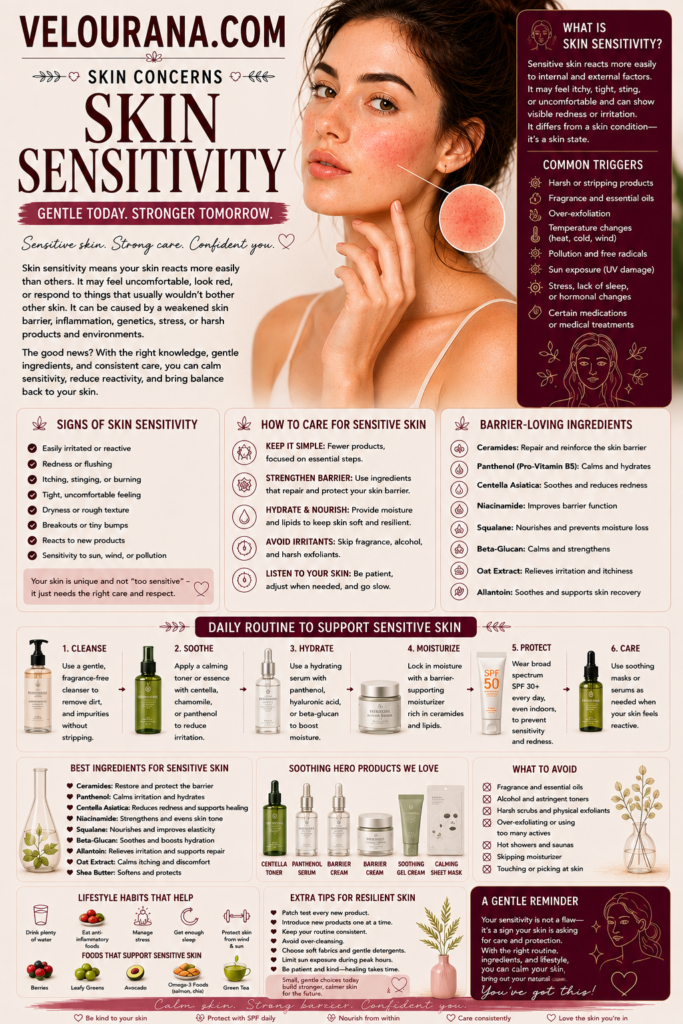
CATEGORY: Skin Sensitivity
There is a particular kind of frustration that belongs to sensitive skin. It is not simply that certain products cause discomfort, or that redness appears more easily than expected. It is the uncertainty. A routine can feel perfectly comfortable for days and then suddenly become difficult. A serum praised for being gentle produces warmth. A carefully chosen moisturiser stings around the nose. A cold morning, a hot shower or an unusually long day outdoors seems capable of changing the skin's behaviour without warning.
This unpredictability often encourages people to become increasingly active in their skincare. They search for soothing ingredients, barrier serums, redness treatments, recovery masks and products specifically labelled for sensitive skin. The routine grows precisely because the skin appears to need more help.
Yet calm skin is rarely built through accumulation alone.
For genuinely sensitive or temporarily sensitised skin, a successful routine depends on architecture: understanding which steps are essential, which are optional, how frequently they should occur and how the products interact with one another over time. A beautifully formulated product can still become part of an unsuccessful routine if it is unnecessary, poorly timed or layered into a system that already asks too much of the skin.
The central challenge is therefore not finding the greatest number of gentle products. It is creating an environment in which the skin encounters fewer unnecessary reasons to react.
That distinction changes everything.
A Routine Is a System, Not a Collection of Products
Skincare is usually marketed one product at a time.
A cleanser promises one benefit. A serum promises another. Moisturiser addresses something else. An exfoliant improves texture, an eye product targets the eye area and a mask offers intensive treatment. Viewed individually, each purchase can appear reasonable.
The skin never experiences these products individually.
It experiences the complete routine.
This is particularly important for sensitive skin because small sources of irritation can accumulate. A cleanser may be only slightly drying. A serum may be mildly stimulating. An exfoliant may be perfectly tolerable when used occasionally. A retinoid may cause only minimal dryness. Applied within the same routine or repeatedly across the same week, however, their combined effect may become considerably more significant.
Thinking systemically means asking how the entire routine affects the skin rather than evaluating each product in isolation.
It also means recognising that every additional step introduces another variable. If eight products are used every evening and sensitivity develops, identifying the cause becomes much harder than it would be within a simpler routine.
Complexity is not automatically sophistication.
For reactive skin, a sophisticated routine is often one in which each product has a clear purpose and the combined system remains comfortably below the skin's irritation threshold.
The Foundation Should Be Boring in the Best Possible Way
There is little glamour in a routine that simply works.
A suitable cleanser removes what needs to be removed without leaving the skin painfully tight. A moisturiser maintains comfort without provoking stinging. Sunscreen provides protection without turning every morning into an endurance test.
Nothing dramatic happens.
That is precisely the point.
For sensitive skin, these foundational products should ideally become so predictable that they require little thought. Their reliability creates a stable background against which other treatments can eventually be assessed.
This is different from expecting every foundational product to actively correct every concern. A cleanser does not necessarily need to brighten pigmentation, exfoliate texture, treat blemishes and provide anti-ageing benefits simultaneously. Asking basic products to perform multiple treatment functions can make the entire routine more difficult to control.
Sometimes cleansing should simply cleanse.
Sometimes moisturising should simply maintain comfort and support the skin's protective environment.
The desire to extract maximum performance from every step can inadvertently turn an ordinary routine into continuous treatment.
Sensitive skin often benefits when treatment is concentrated into carefully selected steps while the foundation remains deliberately uncomplicated.
Morning Skin Does Not Always Need an Aggressive Reset
The assumption that every morning must begin with a thorough cleanse is deeply embedded in skincare culture, yet individual needs vary.
Someone with very oily skin, heavy overnight products or particular dermatological requirements may prefer or need morning cleansing. Another person with dry, reactive skin may find that extensive cleansing twice daily contributes to tightness.
The important principle is not that sensitive skin should never be cleansed in the morning. It is that cleansing frequency should respond to actual need rather than habit alone.
When cleansing is appropriate, water temperature and technique matter. Extremely hot water can intensify flushing and discomfort, while prolonged rubbing introduces unnecessary mechanical stress.
The morning routine is also a useful place to resist overcomplication.
Skin does not need to begin each day with a sequence of powerful interventions simply because those products exist. Hydration, moisturisation when needed and sun protection may form the central structure, with additional treatments included only when they serve a clear purpose and are well tolerated.
Sensitive skin frequently becomes easier to understand when mornings stop being another opportunity for experimentation.
Sunscreen Is Protection, but Tolerability Determines Whether It Works in Real Life
Sun protection is particularly important when skin is sensitive, inflamed or using treatments that can increase vulnerability to ultraviolet exposure.
Yet sunscreen presents a practical challenge: the best theoretical protection is of little value if the formula is so uncomfortable that it is avoided.
Sensitive skin may react differently to different sunscreen formulations. Stinging around the eyes, warmth, dryness, excessive heaviness or irritation can discourage adequate application.
This makes sunscreen selection a matter of real-world compatibility rather than abstract perfection.
A formulation that provides appropriate broad-spectrum protection and can be applied consistently is more useful than one that appears ideal on paper but is intolerable in practice.
Sun avoidance strategies also contribute. Shade, hats and reducing unnecessary exposure during intense sunlight can complement topical protection rather than expecting sunscreen to carry the entire burden alone.
This broader approach is especially relevant to redness-prone skin because heat and sun exposure can sometimes overlap as triggers.
Protection works best as a system too.
Evening Is Where Sensitive Routines Often Become Overloaded
Morning skincare tends to be restrained by practical necessity. People need to dress, work, travel and apply makeup. Evening, by contrast, has become the ceremonial centre of skincare.
This is where routines often expand.
Double cleansing is followed by toner, essence, exfoliant, serum, treatment, eye cream, moisturiser and sometimes facial oils or sleeping masks. Each step can be defensible in isolation, yet sensitive skin may not appreciate the cumulative experience.
Evening routines deserve particular scrutiny because this is also when many potentially irritating active ingredients are used.
The objective should not be to remove every enjoyable ritual. Skincare can be pleasurable. But pleasure and biological necessity are different things.
A person with reactive skin may benefit from identifying which steps materially improve the routine and which primarily exist because they have become habitual.
This does not require minimalist ideology.
It requires intentionality.
If a toner adds hydration and is consistently comfortable, it may have a place. If an essence makes the routine enjoyable without causing problems, there is no universal rule demanding its removal. But if sensitivity develops, optional layers are logical places to simplify while the skin settles.
The routine should be capable of contracting when circumstances demand it.
Moisturiser Is Often the Structural Centre
Sensitive skin is frequently associated with impaired barrier function and increased water loss, although not every sensitive person has clinically dry skin.
Moisturisation remains important because the outer skin layers function best when their physical environment is adequately maintained.
A moisturiser may combine several types of ingredients that help attract water, reduce evaporation and improve the feel of the skin's surface. The exact balance differs among formulations, which is why one moisturiser may feel light and comfortable while another feels occlusive or heavy.
There is no universally correct texture for sensitivity.
Dry, reactive skin may prefer a richer cream, particularly during colder weather. Combination or oily sensitive skin may be more comfortable with lighter textures. Seasonal adjustments are entirely reasonable.
What matters is the outcome.
Does the skin remain comfortable for a meaningful period after application? Does the moisturiser reduce tightness? Can it be used consistently without persistent burning, itching or worsening redness?
Sensitive skin does not need a moisturiser chosen for prestige or complexity. It needs one that performs its function without becoming another source of conflict.
“Soothing” Ingredients Cannot Rescue an Irritating Routine
The skincare market contains numerous ingredients associated with hydration, soothing or barrier support. Many can be useful within well-designed formulations.
The mistake is expecting them to cancel out excessive irritation elsewhere.
Adding a calming serum after aggressive exfoliation does not necessarily make the exfoliation appropriate. Applying a barrier cream after repeatedly overusing a retinoid does not transform the overall routine into a gentle one.
This is an important conceptual shift.
Supportive skincare should not become permission to continue behaviour the skin is clearly struggling to tolerate.
If a routine repeatedly causes burning, persistent redness or peeling, the first question should not always be which soothing ingredient can be added. It may be more useful to identify what can be reduced.
This resembles trying to heat a room while leaving every window open. Increasing the heating may help temporarily, but addressing the source of the loss is more efficient.
Sensitive skincare becomes much more coherent when calming products support an already sensible routine rather than functioning as emergency compensation for excessive treatment.
Introducing New Products Should Be Deliberately Uneventful
A new skincare purchase creates understandable enthusiasm. There is a temptation to begin using it immediately and frequently, particularly when the product promises visible results.
Sensitive skin benefits from a less exciting introduction.
Using one new product at a time allows the skin's response to be observed against a relatively stable background. If several products are introduced together and discomfort follows, determining responsibility becomes difficult.
Frequency should also reflect the nature of the product.
A basic moisturiser may be incorporated differently from a strong treatment. Potentially irritating active ingredients are generally easier to evaluate when introduced gradually rather than immediately used at maximum frequency.
This approach is sometimes interpreted as excessive caution.
In reality, it is efficient.
A controlled introduction produces clearer information. Clear information prevents unnecessary product elimination and reduces the likelihood of dismantling an entire routine because one variable caused difficulty.
Patch testing a cosmetic on a limited area before widespread use may reveal obvious intolerance, though home testing cannot diagnose allergic contact dermatitis. When true allergy is suspected, professional assessment is more appropriate.
The objective is not to create fear around new products.
It is to make experimentation readable.
Makeup and Sensitive Skin Need to Be Considered Together
Skincare discussions often stop at sunscreen, as though everything applied afterwards exists in a separate universe.
The skin does not recognise that distinction.
Primer, foundation, concealer, powder, setting spray and makeup removers all participate in the daily experience of the face. For someone with sensitive skin, the compatibility of makeup and skincare can be just as important as either category alone.
A foundation that requires vigorous removal every evening may indirectly influence sensitivity even if the foundation itself feels comfortable. Long-wearing products can be valuable, but their removal process should be considered within the overall routine.
Brushes and sponges also matter. Repeated pressure, rough application or inadequately cleaned tools can contribute to discomfort.
This does not mean sensitive skin must abandon makeup.
It means makeup should be included when investigating patterns.
If the skin is comfortable on makeup-free days but consistently irritated after certain cosmetic routines, the entire sequence—from preparation through application to removal—deserves attention.
Sensitivity rarely respects marketing categories.
The Eye Area Has Its Own Tolerance
The skin surrounding the eyes often behaves differently from the rest of the face.
It is thinner and can be particularly vulnerable to irritation from products that migrate during application, perspiration or sleep. A treatment applied to the cheeks may eventually reach the eye area even if it was never deliberately placed there.
This can produce puzzling reactions.
Someone may insist that an exfoliant or retinoid never touches the eyes, yet the eyelids become dry or irritated. Product movement, transfer from fingers or pillows and the simple spread of formulations across the skin can all contribute.
The solution is not necessarily a specialised eye product.
Sometimes it is greater control over where potentially irritating products are applied.
Persistent eyelid irritation deserves particular caution because allergic contact dermatitis is among the possible causes. Repeated experimentation around such a delicate area may worsen the situation.
When eye-area redness, swelling, scaling or discomfort persists, professional evaluation is preferable to increasingly complicated cosmetic treatment.
Sensitive Skin and Acne Can Pull a Routine in Opposite Directions
Managing sensitivity becomes more difficult when another concern demands active treatment.
Acne is a classic example.
Blemish-prone skin may benefit from ingredients that can also cause dryness or irritation, particularly during the adjustment period. The understandable response is sometimes to choose between treating acne and protecting sensitivity.
That binary approach is often unnecessary.
The more useful challenge is finding an intensity the skin can sustain.
A treatment that theoretically works quickly but repeatedly causes enough irritation to require long interruptions may be less useful over time than a carefully managed approach that can be maintained.
This is where frequency, concentration, application technique and supportive moisturisation become important.
Dermatological guidance can be especially valuable when significant acne coexists with sensitive skin because treatment can be adjusted according to both concerns rather than relying on endless cosmetic trial and error.
The same principle applies to pigmentation and signs of ageing.
Sensitivity does not make other goals irrelevant.
It changes how aggressively those goals should be pursued.
Skin Cycling and Scheduled Rest Are Tools, Not Rules
Structured routines in which active ingredients are alternated across different evenings have become popular because they offer an intuitive way to avoid using everything simultaneously.
For some people, this can be helpful.
But sensitive skin should not be forced into a schedule simply because the schedule is fashionable.
If the skin remains irritated when an exfoliant is used according to a predetermined calendar, the calendar is not more authoritative than the skin.
Rest days can be valuable because they reduce cumulative treatment exposure. Yet the number of rest days needed varies enormously.
The useful principle behind scheduled routines is separation and recovery, not obedience to a universal timetable.
Sensitive skincare works best when structure serves tolerance rather than replacing observation.
The Difference Between Temporary Sensitisation and Persistent Sensitivity
Not every period of reactive skin means someone permanently has sensitive skin.
Temporary sensitisation can occur after excessive exfoliation, sun exposure, harsh cleansing, certain cosmetic procedures or other forms of irritation. Once the precipitating factor is removed and the skin recovers, normal tolerance may gradually return.
Other people experience sensitivity as a longstanding characteristic.
They may have always flushed easily, reacted to numerous products or experienced recurring discomfort in response to environmental changes.
Distinguishing between these patterns influences expectations.
Someone recovering from temporary irritation may eventually return to a broader range of products. Someone with persistently reactive skin may benefit from maintaining a more conservative routine long term.
There is also a third possibility: what appears to be cosmetic sensitivity may reflect an underlying dermatological condition.
Rosacea, eczema and contact dermatitis can all produce symptoms that overlap with everyday descriptions of sensitive skin.
This is why persistent problems should not be endlessly normalised as simply “my sensitive skin.”
Sometimes the correct skincare decision is to stop guessing.
A Calm Routine Should Still Have Ambition
Gentle skincare is sometimes portrayed as a permanent retreat from meaningful results.
That is unnecessary.
Once sensitive skin is stable, treatment goals can still be pursued. Pigmentation can be addressed. Acne can be managed. Texture can be improved. Signs of ageing can be targeted.
The difference lies in sequencing.
Stability comes first because a constantly irritated surface makes almost every other goal harder to pursue. Once the foundation is reliable, targeted treatments can be introduced strategically.
This approach is slower in appearance but often faster in practice.
Repeated irritation creates interruptions. Products are stopped, restarted and replaced. Weeks are spent recovering from routines that were supposed to accelerate improvement.
A sustainable routine may produce less drama but more continuity.
And continuity is one of the most underestimated forces in skincare.
Knowing When Simplicity Has Reached Its Limit
There is a tendency to assume that every sensitivity problem can be solved by simplifying the routine.
Many mild irritation episodes do improve when unnecessary triggers are removed.
But simplicity is not a medical treatment for every condition.
Persistent redness, substantial itching, swelling, recurrent rashes, cracking, painful skin, significant scaling or eye involvement should not simply be endured while waiting for a minimalist routine to work.
Likewise, if almost every product produces intense burning despite careful simplification, the situation deserves proper assessment.
Dermatologists can distinguish between several conditions that may look superficially similar and can investigate possible allergic contact dermatitis when appropriate.
Knowing when skincare has reached its diagnostic limits is part of responsible skin management.
Cosmetics are extraordinarily useful for maintaining and improving the appearance and comfort of healthy skin.
They should not be expected to explain every disease process occurring within it.
The Most Successful Routine May Eventually Become Invisible
Sensitive skin can dominate attention.
Every sensation is monitored. Every patch of redness is inspected. Every product application becomes a test.
A well-designed routine gradually reduces that vigilance.
The cleanser works.
The moisturiser feels comfortable.
Sun protection becomes habitual.
Treatments are used at frequencies the skin can tolerate.
Seasonal adjustments are made before discomfort becomes severe.
Eventually, skincare occupies less mental space because the skin behaves more predictably.
This may be the clearest sign that the architecture is working.
The objective of sensitive skincare is not to create a face that never reacts to anything. Human skin responds to temperature, environment, hormones, friction and countless other influences because it is living tissue.
The objective is to remove unnecessary instability.
When the routine becomes coherent, products stop competing for attention. Each has a defined role. Optional steps remain optional. Treatment intensity is adjusted rather than endured. Discomfort is treated as information instead of an unavoidable price for results.
Calm skin is not necessarily achieved by finding one extraordinary product.
More often, it emerges from hundreds of ordinary decisions made consistently: cleansing without stripping, moisturising without unnecessary complication, protecting against environmental stress, introducing treatments patiently and recognising when the skin needs recovery rather than another intervention.
That is the quiet architecture of sensitive skincare.
Its success is measured not by how much the routine does, but by how little unnecessary disturbance it creates.
The End Velourana
 Discover More From Our Family of Websites
 ZodiacBearing (Astrology, Tarot, Numerology, Angel Numbers & Spiritual Guidance)
 Velourana (Beauty, Makeup, Hair Care, Skincare & Beauty Tips)
 HavenBearing (Home, Living, Organization, Décor & Everyday Inspiration)
 PawBearing (Pet Care, Dog Breeds, Animal Health, Training & Pet Products)
 PsyCatherine (Notes From the Journal of a Psychologist on Real Life)