
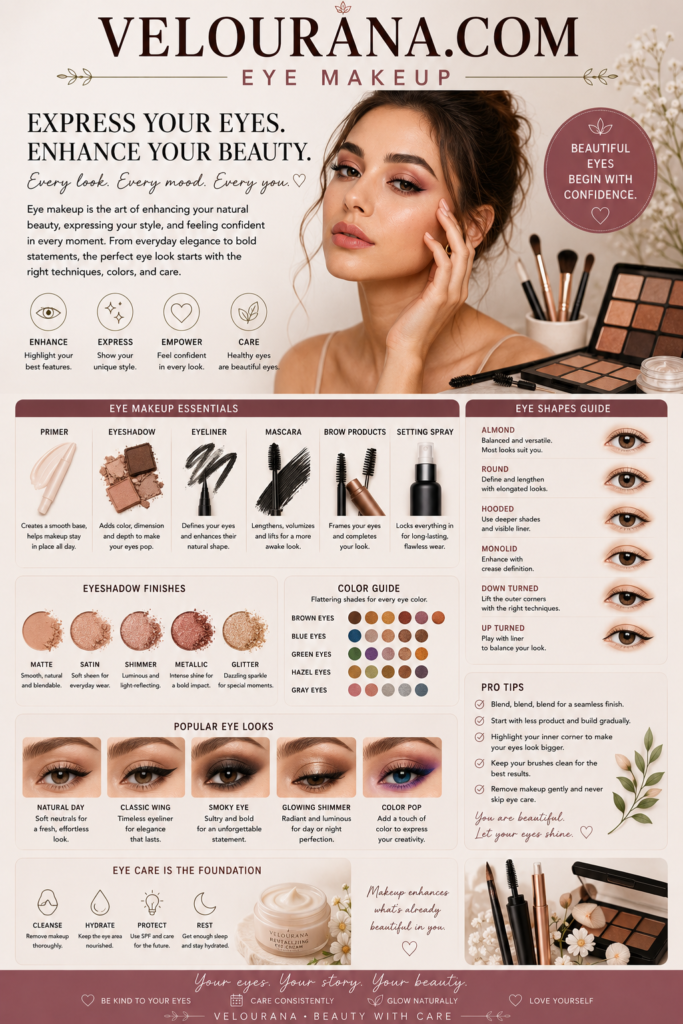
CATEGORY: Pencil Eyeliner
There is a particular quality to pencil eyeliner that distinguishes it from almost every other form of eye definition. Liquid liner tends to celebrate precision. Gel liner often emphasizes saturation and structure. Pencil, by contrast, can make the boundary between liner and shadow almost disappear. It can produce a recognizable line, but it is equally capable of creating the impression that the lashes are naturally darker, the outer eye naturally deeper or the entire eye area subtly more sculpted.
That ambiguity is part of its beauty. Pencil eyeliner does not demand that the makeup announce its technique. A few carefully placed strokes can change the visual weight of the lash line without revealing exactly how the effect was created. At the opposite extreme, the same format can produce dense black rims, elongated smoky shapes and richly colored accents. The difference lies not merely in the pencil selected but in the interaction between formula, pressure, placement and blending.
This makes pencil eyeliner particularly interesting from an editorial beauty perspective. It is often categorized as a basic product, yet its simplicity conceals considerable complexity. The diameter of the tip changes the character of the mark. The temperature and softness of the formula affect how pigment moves across skin. The amount of time before the formula sets determines how extensively it can be shaped. Even the direction in which a line is smudged can influence the perceived proportions of the eye.
Pencil eyeliner therefore rewards a more thoughtful approach. Instead of treating it as a preliminary version of liquid liner, it can be understood as its own medium: one built around gradation, controlled imperfection and the strategic manipulation of depth.
Eyeliner Is Really an Exercise in Visual Weight
The human eye is highly responsive to contrast. Darkening one part of the eye area makes that region visually heavier, while leaving another area lighter allows it to recede or appear more open. Eyeliner exploits this relationship. The placement of a few millimeters of pigment can alter the apparent direction, width and intensity of the eye.
A dark pencil placed uniformly around the entire eye creates a strong frame. This can be beautiful and dramatic, particularly when intentionally paired with smoky shadow. Yet a frame is only one possibility. Concentrating pigment primarily along the upper lashes gives the upper eye greater visual weight. Extending darkness toward the outer corner encourages the gaze to travel outward. Deepening the lower outer lashes connects the lower and upper structure, creating a more enveloping effect.
The intensity of the pencil matters as much as its location. Pure black creates a decisive boundary because the contrast is strong. Brown, gray or muted plum can establish similar structure while producing a gentler transition into the surrounding skin and shadow. A metallic bronze may define through both darkness and reflected light, creating an entirely different form of emphasis.
Width also changes perception. A narrow line keeps most of the eyelid visible and places attention close to the lashes. A broad line occupies more visual territory and becomes part of the eye-shadow design. With pencil, the transition between these two states can be gradual. A thin application can be expanded selectively rather than uniformly.
This is where the format becomes especially expressive. The wearer is not simply choosing whether to use eyeliner. They are deciding where the eye should carry visual weight, where contrast should begin and where it should dissolve.
The Difference Between Drawing a Line and Building One
Many difficulties associated with eyeliner come from the assumption that a successful line should be created in one continuous movement. Pencil rarely requires this. In fact, building the shape gradually often produces a more controlled and sophisticated result.
The lash line itself is not a perfectly flat surface. It curves around the eye, moves with every blink and may contain folds or changes in texture. Attempting to drag a pencil continuously across this landscape can result in uneven pressure. Shorter strokes allow the hand to respond to the changing surface.
Beginning close to the lash roots establishes the most important area first. The pigment can then be connected and refined. If greater thickness is desired, it can be added above the original line rather than created immediately. This preserves control over proportion.
The outer corner benefits particularly from gradual construction. A small amount of pigment can first establish direction. Once the angle is judged with the eye open, the shape can be lengthened or thickened. Pencil allows this exploratory process because the edge can usually be adjusted with a brush before it becomes fully fixed.
The distinction between drawing and building also changes the emotional experience of eyeliner. There is less dependence on a single perfect gesture. Small inaccuracies become part of a process rather than failures requiring complete removal.
This incremental approach is especially useful when the two eyes differ slightly, as most pairs naturally do. Instead of attempting to reproduce identical geometric lines, the makeup can be developed while comparing how each eye appears in its normal open position. The objective becomes visual balance rather than mathematical duplication.
Soft Focus: Why Blended Pencil Can Look So Sophisticated
A sharp line has an obvious boundary. A blended pencil line operates differently because its boundary becomes a gradient. The darkest pigment remains near the lashes, while increasingly small amounts extend into the surrounding area. This gradient can mimic natural shadow and therefore appear integrated into the eye rather than placed on top of it.
The sophistication of smoky pencil comes from maintaining structure within softness. If all of the pigment is blended away from the lashes equally, the eye can lose definition. The most dimensional result usually preserves a dense core of color at the roots while allowing the outer edge to diffuse.
This technique is particularly effective at the outer corner. Pencil can be applied more generously there and then drawn outward with a small brush. The resulting shape may suggest an eyeliner wing without containing a hard upper or lower border. Because the edge fades gradually, slight differences in symmetry are less conspicuous than they would be with liquid liner.
The direction of blending influences the final impression. Moving pigment outward creates length. Moving it slightly upward introduces lift. Blending upward across the lid transforms liner into shadow and can create a compact smoky eye with surprisingly little product.
Texture becomes crucial during this process. A pencil that is too dry may resist movement and create patchiness. One that remains extremely slippery may blend beautifully but continue migrating throughout wear. Formulas designed with a workable setting period offer the best of both worlds: enough time to manipulate the pigment followed by sufficient stability to preserve the finished shape.
Layering powder over the softened pencil can further refine the gradient. Rather than covering the pencil, the shadow can merge with its edges. This produces a transition from dense cream pigment to softer powder, giving the eye a depth that appears almost airbrushed when executed carefully.
Upper, Lower and Inner Definition Create Different Moods
Where eyeliner is placed can change its character more dramatically than the shade itself. Upper lash-line pencil tends to emphasize the lashes and upper contour of the eye. Lower liner adds weight beneath the iris and can shift the makeup toward a smokier, more dramatic mood. Inner-rim definition creates still another effect, making the eye appear intensely framed.
Upper eyeliner is often the most adaptable because it can remain extremely discreet. Pigment pressed close to the lash roots may be nearly invisible as a separate cosmetic element. This makes it useful when the objective is to make mascara appear richer or to add depth beneath eye shadow.
Lower lash-line pencil is more visually assertive. A dark line beneath the entire eye creates a strong frame, while pigment concentrated toward the outer portion can provide balance without surrounding the eye completely. Softening lower liner is often important because a hard horizontal stripe can look disconnected from the rest of the makeup.
The waterline introduces additional considerations because it is a moist and sensitive area. Products used there should be specifically suitable for that placement according to their manufacturer. Even then, individual comfort varies. Some eyes tolerate waterline makeup easily, while others are prone to watering or irritation.
Dark waterline pencil produces a classic intensity associated with smoky and kohl-inspired looks. It visually reduces the amount of visible light surface around the iris, creating a concentrated, sultry effect. Lighter pencils can have the opposite visual effect, increasing apparent brightness along the inner rim, although the result depends greatly on shade and contrast with the natural complexion.
Tightlining the upper inner lash area can make the lash base appear exceptionally dense, but again suitability and comfort matter. The most important consideration is not adherence to a technique but whether the product is designed for the intended area and feels comfortable during wear.
These placements can also be combined selectively. A deep upper lash line, softly defined outer lower lashes and an otherwise open inner eye create a very different mood from continuous dark pigment surrounding the entire eye. Pencil makes these distinctions easy to explore because each area can be developed independently.
Color Can Be Quiet Even When It Is Not Neutral
The traditional eyeliner wardrobe has long revolved around black and brown, and both remain indispensable. Yet pencil formulas make color unusually accessible because the amount visible can be controlled so precisely. A shade does not need to dominate the makeup simply because it is blue, green, violet or burgundy.
Deep colored pencils are particularly effective in this respect. Navy can provide nearly the same structural depth as black while introducing cool chromatic richness. Aubergine can appear dark and neutral from a distance, revealing purple undertones only when viewed closely. Forest green, deep teal and burgundy can behave similarly.
This subtle use of color is often more sophisticated than treating colored liner exclusively as a bright accent. It allows chromatic variation to become part of the eye's depth. When combined with neutral shadows, the result can feel complex without becoming conspicuously colorful.
Brown itself contains enormous variation. A cool espresso creates a different impression from a warm chocolate, reddish chestnut or bronze-brown. On the eye, these undertones interact with skin, iris color and surrounding makeup. The distinction may be subtle, but subtle differences often determine whether a neutral look feels harmonious or slightly disconnected.
Metallic pencils introduce another dimension because their appearance changes with illumination. Bronze, pewter, copper and muted gold can define while reflecting enough light to keep the eye from appearing heavily framed. They are particularly effective when blended because the metallic particles spread into a luminous gradient.
Pastel or pale pencils can also be used creatively, although their visual behavior is almost the inverse of conventional dark eyeliner. Instead of creating depth, they attract light and attention. Their success depends on opacity and placement because lighter pigments need sufficient contrast with the skin to remain visible.
Bright shades offer the most overt experimentation. Cobalt, turquoise, emerald and violet can transform otherwise minimal makeup. A narrow stripe of saturated color near the lashes may be enough to create a focal point without requiring elaborate eye shadow.
The freedom of pencil lies in scale. Color can occupy the entire eye area or only a few millimeters. That makes experimentation less absolute and allows unconventional shades to become surprisingly wearable.
Pencil Eyeliner and the Architecture of a Smoky Eye
The smoky eye is often associated primarily with powder shadow, but pencil can provide the structure that makes the effect convincing. Smoke requires depth, and depth is strongest where pigment is most concentrated. Pencil naturally creates that concentration near the lashes.
A dark pencil base changes the way shadow appears over it. Powder applied directly to bare skin reflects and absorbs light according to its own pigmentation and finish. The same shadow layered over a dark cream base appears richer because the underlying depth alters the visible color.
This is especially useful with jewel tones and complex metallic shades. A black or deep brown pencil beneath emerald, sapphire or bronze shadow can intensify the result dramatically. The pencil need not cover the entire lid. Concentrating it close to the lashes and outer corner allows the shadow to transition from deep saturation into lighter color.
For a neutral smoky eye, pencil can almost replace multiple dark shadows. A creamy brown or charcoal formula worked around the lashes and diffused upward creates immediate dimension. A softer powder shade can then refine the edges rather than constructing the entire smoky effect from scratch.
The lower eye can be connected to this structure with restraint. Carrying a small amount of pencil around the outer corner and blending it into lower shadow creates continuity. The eye then appears enveloped rather than divided into separate upper and lower applications.
The most important quality is gradation. Traditional smoky makeup is not simply dark makeup. It depends on the controlled transition between concentrated depth and softer surrounding tones. Pencil is exceptionally useful because it establishes the darkest point quickly while remaining capable of diffusion.
This also explains why a smoky eye can be created with surprisingly few colors. Depth does not necessarily require a large palette. A single pencil and one or two compatible shadows can generate considerable complexity when texture and saturation are manipulated intelligently.
Working With Natural Texture Rather Than Against It
Eyelids are moving, dimensional surfaces. They contain folds, lash roots, changes in elasticity and natural variations in texture. Yet eyeliner tutorials sometimes present the lid as though it were a perfectly smooth sheet of paper. Pencil performs best when the technique acknowledges the reality of the skin.
On textured lids, short strokes can follow the surface more effectively than a long dragging motion. Slightly lifting the chin while looking downward into a mirror may expose more of the upper lash line without requiring the skin to be pulled aggressively. The exact position varies by individual anatomy, but the principle is to create access while preserving the natural structure of the eye.
Stretching the eyelid excessively can be misleading. A line drawn on tightly stretched skin may change shape when the skin is released. This is particularly relevant near the outer corner, where folds and movement can alter the apparent angle of an extension.
Assessing the liner with the eye open solves much of this problem. The makeup is ultimately viewed on an active face, not on a closed eyelid. Small adjustments made while looking straight ahead can ensure that the visible shape supports the intended effect.
Mature eyelids often benefit from this responsive approach. There is no reason to abandon eyeliner as skin texture changes. Instead, the medium can change. A softly smudged pencil may create richer, more flattering definition than an attempt to impose an extremely rigid line across a naturally varied surface.
This is not about hiding age or correcting anatomy. It is about choosing a technique compatible with the canvas. Makeup becomes more elegant when it responds to the face rather than fighting it.
When Longevity Becomes Part of the Design
A pencil eyeliner look is only successful if its wear characteristics suit the circumstances in which it will be used. A beautifully blended formula that migrates after an hour is not ideal for a long day, while an extremely fast-setting waterproof pencil may be unnecessarily difficult for someone who wants several minutes to perfect a smoky shape.
Long-wear formulas have changed the reputation of pencil eyeliner considerably. Earlier pencils were often expected to soften or fade during wear. Modern film-forming technology allows many products to glide initially and then become substantially more resistant.
The setting period is critical. Before setting, the formula behaves almost like a cream. Afterward, attempts to blend it may create unevenness rather than softness. Working one eye or one section at a time can therefore be more effective than applying all the pencil first.
Eyelid preparation also affects longevity. Heavy emollients, facial oils or rich eye creams can reduce friction between the pencil and skin, encouraging movement. Allowing skincare to settle before makeup creates a more predictable surface. People with naturally oily lids may find that a suitable primer changes pencil performance significantly.
Powder can reinforce the liner, but excessive powder around the eyes may create dryness or emphasize texture. The objective is stability rather than simply adding more product. A small amount of shadow pressed over the pencil is often enough.
Environmental conditions matter as well. Heat, humidity and physical activity can challenge makeup differently from cool, dry indoor conditions. Waterproof formulas may therefore be useful even when exposure to actual water is unlikely.
At the end of wear, durability should be matched by appropriate removal. Long-lasting pigments are designed to resist casual moisture and friction, so repeated rubbing is an inefficient strategy. A remover capable of dissolving the formula allows it to release more easily. Holding the remover against the closed eye briefly before wiping can give it time to break down resistant makeup.
Good wear is therefore not simply a property of the pencil. It emerges from the relationship between formula, skin preparation, environment, application and removal.
From Minimal Definition to Evening Drama
One reason pencil eyeliner remains so useful is that intensity can be increased without fundamentally changing technique. A daytime eye and an evening smoky look can begin with the same basic placement.
Minimal definition might consist almost entirely of pigment worked into the upper lash roots. From conversational distance, the liner may be difficult to detect. The eye simply appears more defined and the lashes denser.
Adding a narrow visible line creates the next degree of emphasis. Soft brown or charcoal can preserve subtlety, while black increases contrast. Extending the outer corner slightly changes the silhouette without requiring dramatic width.
For greater intensity, the pencil can be layered. Repeated application increases saturation, and blending expands the visual area occupied by the pigment. The lower outer lash line can then be connected, creating a more enveloping shape.
Evening makeup may deepen this structure further with powder shadow, metallic accents or darker waterline definition where suitable. The transformation does not require abandoning the original liner. It grows from it.
This scalability is particularly valuable for makeup that must transition through different settings. Pencil can be carried easily and used to deepen an existing eye look without reconstructing it. A small amount added to the outer corners and blended can change the mood considerably.
The reverse is also possible during application. If a line initially appears too intense, a brush can soften it rather than requiring complete removal. Pencil therefore accommodates adjustment in both directions: more pigment can be added, and existing pigment can be visually reduced through diffusion.
Why Pencil Eyeliner Remains Essential
Beauty products often become associated with the era that popularized them. Pencil eyeliner has escaped that limitation because it is not a trend-specific object. Its appearance is determined almost entirely by how it is used.
It can evoke the polished restraint of classic beauty, the darkness of rock-inspired makeup, the haze of a modern smoky eye or the playfulness of contemporary color. It can support elaborate eye shadow without competing with it or become the only eye product necessary beyond mascara.
Its practical advantages are equally durable. Pencil requires relatively little equipment, travels easily and permits gradual application. Traditional versions can be sharpened to restore precision, while mechanical formats offer convenience. Creamy formulas support diffusion, and setting formulas provide impressive durability.
More importantly, pencil eyeliner teaches one of the central principles of sophisticated makeup: edges matter. The same pigment can appear severe, soft, dramatic or almost invisible depending on what happens at its boundary. Learning when to preserve an edge and when to dissolve it is a skill that extends far beyond eyeliner.
Pencil also demonstrates that precision does not always mean sharpness. A carefully controlled smoky line can be every bit as intentional as a perfect liquid wing. Its precision lies in the placement of depth, the direction of diffusion and the balance between the two eyes.
Perhaps this is why pencil eyeliner remains present even as cosmetic technology becomes increasingly elaborate. It offers direct contact between hand, pigment and eye shape. There is very little separating the gesture from the result.
A pencil can make the lashes look subtly fuller in the morning and create a saturated smoky frame at night. It can introduce color without demanding an entire colorful eye look. It can adapt to changing skin texture, changing trends and changing personal style.
Its simplicity is genuine, but simplicity should not be confused with limitation. Pencil eyeliner endures because within that familiar form lies an unusually broad vocabulary of depth, softness, color and shape.
THE END VELOURANA
 Discover More From Our Family of Websites
 ZodiacBearing (Astrology, Tarot, Numerology, Angel Numbers & Spiritual Guidance)
 Velourana (Beauty, Makeup, Hair Care, Skincare & Beauty Tips)
 HavenBearing (Home, Living, Organization, Décor & Everyday Inspiration)
 PawBearing (Pet Care, Dog Breeds, Animal Health, Training & Pet Products)
 PsyCatherine (Notes From the Journal of a Psychologist on Real Life)

