
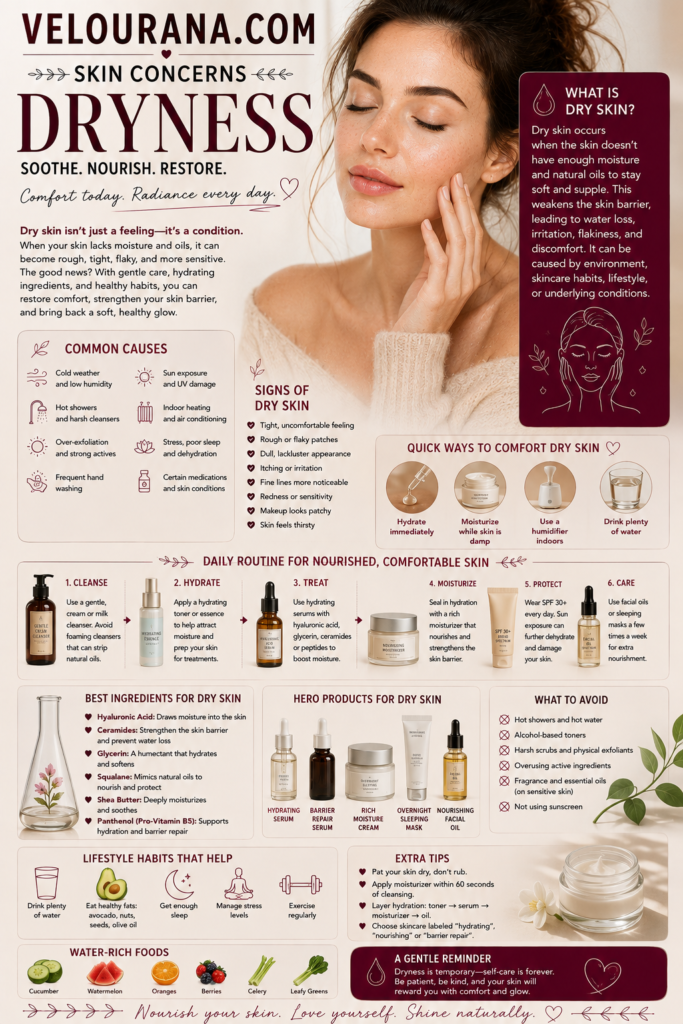
CATEGORY: Dryness
Choosing a moisturizer for dry skin should be simple. In theory, the task is straightforward: the skin lacks comfort, so apply a product that improves hydration and reduces moisture loss. In practice, the moisturizer aisle can make the decision feel unnecessarily technical. Gel creams promise weightless hydration. Rich creams promise barrier repair. Balms promise protection. Facial oils promise nourishment. Ceramides, glycerin, hyaluronic acid, squalane, urea, peptides, panthenol, fatty acids, cholesterol, and countless plant extracts compete for attention.
The result is that many people with dry skin end up evaluating moisturizers ingredient by ingredient while missing the larger question: what does this particular skin actually need the product to do?
A moisturizer is not valuable because it contains the greatest number of fashionable ingredients. It is valuable because its formulation creates a comfortable, flexible, well-supported outer skin layer for a meaningful period of time.
That requires more than simply adding water.
Dryness usually reflects an imbalance in the skin barrier. Water is escaping too readily, the outer layer may lack sufficient lipids, surface cells may be less flexible, and environmental exposure may continually reinforce the problem. A successful moisturizer therefore tends to work through several mechanisms at once. It can attract and hold water, soften roughness, support the lipid barrier, and reduce evaporation.
Understanding these functions makes moisturizer selection far less confusing.
The question becomes less about finding the “best” moisturizer in general and more about finding the right balance of hydration, emollience, and protection for the degree of dryness, the climate, the rest of the routine, and the way the skin behaves throughout the day.
A Moisturizer Is a Formulation, Not a Single Hero Ingredient
Skincare marketing often encourages people to choose products based on one headline ingredient.
A cream is described as a ceramide moisturizer.
Another is marketed around hyaluronic acid.
A third emphasizes squalane.
A fourth highlights peptides.
These ingredients may genuinely contribute to the formula, but no moisturizer can be understood accurately by looking at one ingredient in isolation.
The performance of a cream depends on the entire emulsion: its water phase, oil phase, humectants, emollients, occlusive components, emulsifiers, stabilizers, preservatives, pH, texture, and the proportions in which everything is combined.
Two products containing glycerin can feel completely different.
Two creams containing ceramides can have different levels of richness.
Two hyaluronic-acid products may vary enormously in their ability to keep dry skin comfortable for several hours.
This is one reason ingredient-list comparison can become misleading.
Ingredient knowledge is useful, but formulation determines the experience.
For someone with dry skin, the practical outcome remains the most important test.
Does the moisturizer reduce tightness?
Does the skin remain comfortable several hours later?
Does it reduce flaking over time?
Does makeup sit better on top?
Does it cause stinging or congestion?
Does it work in the climate where it is actually being used?
These observations reveal more about suitability than the presence of one fashionable ingredient.
Humectants Solve One Part of the Dryness Problem
Humectants are ingredients that attract and bind water.
Glycerin is one of the most established and effective examples. Hyaluronic acid is another familiar one. Urea, sodium PCA, certain sugars, amino acids, and other compounds can also contribute to water retention.
For dry skin, humectants are important because the outermost layer needs sufficient water to remain flexible.
When the stratum corneum is poorly hydrated, it becomes rougher and less supple. Fine surface lines become more visible. The skin may feel tight and look dull.
Adding humectants can improve these qualities.
But humectants do not always solve dryness by themselves.
If the barrier is allowing water to evaporate rapidly, attracting moisture without reducing water loss may provide only temporary relief.
This explains why some lightweight hydrating serums feel wonderful immediately after application but seem to disappear within an hour on severely dry skin.
They may be providing hydration.
They may simply not be providing enough protection to keep that hydration in place.
The most effective dry-skin moisturizers therefore usually combine humectants with ingredients that improve softness and reduce evaporation.
Emollients Create the Softness Dry Skin Is Often Missing
Emollients are ingredients that smooth and soften the surface.
Dry skin often contains microscopic irregularities between outer skin cells. Emollients help fill those spaces and improve flexibility, producing a smoother texture.
Many cosmetic oils, esters, fatty alcohols, silicones, and lipid-like ingredients can function as emollients.
This is where much of the immediate sensory pleasure of a moisturizer comes from.
A well-formulated emollient system can make rough skin feel softer within minutes.
Yet emollience should not be confused with hydration.
An oil can make the surface feel beautifully supple while contributing relatively little water itself.
This is why facial oils sometimes disappoint people with severe dryness when used alone.
Oil is not useless.
Far from it.
It can reduce roughness, improve flexibility, and contribute to water-loss reduction.
But if the skin also needs water-binding ingredients, an oil-only approach may leave part of the problem unaddressed.
This is another reason balanced formulations are often more effective than relying on one product category alone.
Occlusives Are About Keeping Moisture From Escaping
Occlusive ingredients form a surface layer that reduces evaporation.
Petrolatum is the classic example and remains one of the most effective occlusive materials used in skincare.
Silicones, waxes, mineral oil, certain plant butters, and various oils can also provide differing levels of occlusive protection.
For very dry skin, this function can be transformative.
Imagine applying a humectant-rich product to skin in a cold, low-humidity environment. Without enough protection, some of the added water may still be lost relatively quickly.
An occlusive layer reduces that loss.
This is why a cream that feels slightly heavier can provide longer-lasting comfort than a lightweight gel despite both containing effective humectants.
The objective is not to create an impermeable seal.
Skin does not need to be hermetically covered.
The goal is to slow excessive evaporation enough for the outer layer to remain flexible and hydrated.
This principle becomes particularly useful at night, when heavier textures are less cosmetically inconvenient and can remain undisturbed for several hours.
Ceramides Matter Because Dryness Is Often a Lipid Problem Too
Ceramides have become one of the most recognizable ingredients in barrier-focused skincare.
Their popularity has a strong biological basis.
Ceramides are naturally present in the lipid matrix of the stratum corneum, where they contribute to the organized structure that limits water loss and supports barrier function.
Dry or compromised skin may have alterations in this lipid environment.
Topical formulations containing ceramides can therefore be useful as part of a broader barrier-supportive system.
The important phrase is “as part of.”
Ceramides are not magic when added symbolically to an otherwise poorly suited product.
Their benefit depends on formulation, concentration, and how they are combined with other lipids and emollients.
Cholesterol and fatty acids are also important components of the skin barrier and are frequently included in formulations designed to mimic or support the skin's natural lipid structure.
For someone with persistent dryness, these ingredients can be especially relevant because they address more than immediate surface softness.
They support the architecture involved in moisture retention.
Hyaluronic Acid Is Useful, but It Is Not the Entire Answer
Few ingredients have been marketed as aggressively around hydration as hyaluronic acid.
Its reputation is not without merit.
Hyaluronic acid is capable of binding substantial amounts of water and can contribute to a plumper, more hydrated surface appearance.
The problem arises when it is treated as synonymous with moisturization itself.
A hyaluronic-acid serum may provide excellent hydration but still be insufficient for dry skin if used without an adequate moisturizer on top.
In low-humidity environments, people may also find that a purely humectant-focused routine does not provide enough lasting comfort.
The solution is not to avoid hyaluronic acid.
It is to place it in context.
If the product works well and the skin feels comfortable, there is no reason to reject it.
If dryness persists, however, adding more hyaluronic-acid layers may be less useful than increasing emollience or occlusion.
The correct question is not whether hyaluronic acid is good.
It is whether the complete routine is doing enough.
Glycerin Deserves More Attention Than Its Lack of Glamour Suggests
Glycerin has been used in skincare for decades and rarely generates the excitement given to newer ingredients.
That familiarity can make it easy to underestimate.
As a humectant, glycerin is exceptionally useful in moisturizers because it helps the stratum corneum retain water and contributes to softness and flexibility.
It is compatible with many formulation types and appears across products at very different price points.
This highlights an important truth about dry-skin care.
An ingredient does not need to be new to be effective.
In fact, some of the most reliable components of dry-skin formulations are comparatively old and unglamorous.
Glycerin, petrolatum, mineral oil, fatty alcohols, urea, ceramides, and simple emollients may lack exotic marketing narratives.
The skin does not care.
It responds to function.
Urea Can Be Especially Valuable for Rough, Persistent Dryness
Urea occupies an interesting place in skincare because its effects vary with concentration.
At lower concentrations, it functions primarily as a humectant and supports hydration.
At higher concentrations, it also has keratolytic properties, meaning it can help soften and loosen thickened outer skin.
This makes urea particularly useful for rough body areas such as heels, elbows, knees, and severely dry lower legs.
It can also be helpful in certain facial formulations at appropriate concentrations.
However, urea can sting on cracked, inflamed, or highly irritated skin.
This illustrates a broader principle: useful ingredients are not automatically appropriate for every stage of dryness.
When the barrier is acutely compromised, simple protective moisturization may be better tolerated.
Once the skin is stable, more active smoothing ingredients can be introduced where needed.
Facial Oils Can Support Dry Skin Without Replacing a Complete Moisturizer
Facial oils are often described as deeply hydrating, but technically they contain little or no water.
Their primary value lies in emollience and, depending on the oil and formulation, some degree of occlusion.
For certain dry skin types, this is extremely useful.
A few drops of oil over moisturizer can improve softness and reduce the feeling of exposure, particularly in cold weather.
Some people prefer oils because they create a flexible, luminous finish without the heaviness of an ointment.
Others find oils insufficient on their own.
Both experiences make sense.
If the skin's main problem is lack of lipid support, an oil can feel transformative.
If significant water deficiency is also present, a humectant-rich moisturizer underneath may be necessary.
Oil and moisturizer therefore should not be treated as competing categories.
They can perform different functions within the same routine.
Gel Cream, Lotion, Cream, Balm: Texture Is a Practical Clue
Texture provides useful information about how a moisturizer may behave, although it cannot reveal the entire formulation.
Gel creams usually feel light and contain a high proportion of water. They often suit humid conditions or people who dislike heavy finishes.
Lotions remain relatively fluid and can be convenient for mild dryness or body application.
Creams generally offer greater richness and are often better suited to persistent facial dryness or colder conditions.
Balms and ointments provide stronger surface protection and are particularly useful for localized severe dryness, lips, hands, or nighttime use.
The mistake is assuming one category is inherently superior.
A gel cream is not too weak by definition.
A balm is not automatically better because it is heavier.
The correct texture depends on how much protection the skin requires and what the user will actually apply consistently.
A technically perfect balm that feels so uncomfortable that it is used once a week is less useful than a cream used every morning and evening.
The Best Morning Moisturizer May Not Be the Best Night Moisturizer
Dry skin can benefit from different textures at different times of day.
During the morning, the moisturizer must usually coexist with sunscreen and perhaps makeup.
Too many heavy layers can cause pilling, excessive shine, or instability.
A medium-weight moisturizer may therefore be ideal even if the skin prefers something richer at night.
Evening provides more freedom.
After cleansing, a substantial cream can be applied without worrying about makeup performance. Additional occlusion can be used over vulnerable areas.
This does not mean everyone needs two separate moisturizers.
Many formulations work perfectly well morning and night.
The point is simply that product suitability depends partly on what comes next.
Skincare layering is a practical system.
A moisturizer should function within that system rather than being evaluated in isolation.
Moisturizer Under Sunscreen Requires Compatibility, Not Complexity
People with dry skin sometimes layer several hydrating products beneath sunscreen because they fear the sunscreen itself will be drying.
This can work, but too many layers can create another problem.
Products may pill, roll, or interfere cosmetically with one another.
A better approach is usually to find the minimum number of layers required for comfort.
For some people, a moisturizer followed by sunscreen is ideal.
For others, a moisturizing sunscreen alone provides enough support during humid weather.
The sunscreen must still be applied in an adequate amount.
The moisturizer should not be so heavy that it encourages underapplication of sunscreen or makes the final finish unbearable.
Again, balance matters more than theoretical completeness.
Makeup Performance Can Help Reveal Whether a Moisturizer Is Suitable
Dry skin often exposes moisturizer problems through makeup.
If foundation consistently separates over the moisturizer, the issue may be excessive richness or incompatible textures.
If makeup catches on flakes, the moisturizer may not be providing enough sustained hydration or the underlying barrier may still be compromised.
If primer and foundation pill, too many layers may be sitting on the surface.
A good daytime moisturizer for someone who wears makeup should leave the skin comfortable without creating instability.
This is partly about formulation chemistry and partly about timing.
Allowing moisturizer several minutes to settle before applying sunscreen or makeup can improve performance.
More product is not always better.
A thin, even layer may work more effectively than a thick coating that never fully integrates with the skin.
Dry Skin Does Not Automatically Need the Richest Product Available
This is one of the most common misconceptions.
Dry skin is a category, but severity varies enormously.
Someone with mild seasonal tightness may need only a modestly richer lotion.
Someone with naturally low sebum production may prefer creams year-round.
Someone with severe barrier impairment may benefit from ointment-like protection on certain areas.
Choosing the heaviest product by default can create unnecessary greasiness, discomfort, or congestion.
It can also make the user abandon moisturizer altogether because the experience feels unpleasant.
The best product is rich enough to solve the problem but not so rich that it creates a new one.
Extremely Rich Products Can Still Fail if the Routine Is Stripping the Skin
A heavy moisturizer can give the impression that it should be able to overpower any dryness.
It cannot.
If cleansing is aggressive, exfoliation frequent, showers very hot, and active treatments excessive, even a dense cream may provide only temporary comfort.
This often leads to escalation.
The user moves from lotion to cream, then balm, then petrolatum, while the underlying source of disruption remains unchanged.
The moisturizer is blamed for not being strong enough.
The routine should be examined as a whole.
Barrier support works best when the rest of the routine is not continually undoing it.
Fragrance-Free Can Be Useful Without Being Mandatory for Everyone
Many moisturizers designed for dry skin are fragrance-free, particularly those positioned for sensitive or eczema-prone skin.
This is sensible because fragrance can irritate or sensitize susceptible individuals.
But not every person with dry skin reacts to fragrance.
Someone with stable, resilient dry skin may use a fragranced cream comfortably for years.
Someone with reactive dryness may find even mild fragrance unpleasant.
The relevant principle is tolerance.
When the barrier is severely compromised or multiple products sting, simpler fragrance-free formulas reduce variables and are often a safer starting point.
Once the skin is stable, preferences can be reassessed.
There is no need to turn skincare into an ideological debate when individual response provides the most useful answer.
Expensive Does Not Automatically Mean Better for Dry Skin
Moisturizers occupy every price category imaginable.
Luxury creams may offer beautiful textures, elegant packaging, sophisticated fragrance, and pleasurable application.
Affordable pharmacy products may focus more heavily on barrier function.
Both can be excellent.
Price does not reliably predict how well a moisturizer will control dryness.
Many of the ingredients most useful for barrier support are inexpensive and well established.
What luxury pricing often buys is sensory experience, branding, packaging, proprietary complexes, or cosmetic elegance rather than a guarantee of superior barrier repair.
There is nothing wrong with paying for those qualities if they matter to the user.
The mistake is assuming higher price automatically means greater physiological benefit.
Dry skin can respond beautifully to a simple formula.
The Right Moisturizer May Change With Age
A product that felt perfect at twenty-five may become insufficient later.
Sebum production can decline with age.
Hormonal changes can affect skin dryness.
Barrier recovery may become slower.
The outer layer may require more lipid support.
This does not mean every older person needs a dramatically heavier cream.
It means moisturizer choice should evolve with current skin behavior rather than loyalty to an old skin-type label.
Someone who spent decades identifying as oily may eventually become combination or dry.
Skincare should follow the skin that exists now.
The Right Moisturizer May Change With Climate Too
Humidity, wind, heating, air conditioning, and travel all affect moisturizer needs.
A cream used in Athens during a humid spring may feel very different during a winter trip to northern Europe.
Likewise, a product that is perfect at home may become insufficient during a long flight or prolonged stay in an air-conditioned hotel.
This is why seasonal adjustment is rational.
The core product can remain the same while application amount changes, or a richer alternative can be kept for environmental extremes.
Product loyalty should not become rigidity.
How Long Should a Moisturizer Be Given Before Judging It?
Immediate comfort is important.
A moisturizer that burns intensely or causes obvious irritation should not be tolerated merely in the hope that the skin will adapt.
But other benefits take time.
Reduction in chronic roughness, improved barrier function, and more stable hydration may develop over days or weeks rather than one application.
Constant switching makes this difficult to judge.
If a moisturizer is comfortable, compatible with the routine, and appears suitable for the degree of dryness, consistency provides better information than rapid experimentation.
The skin needs enough time to establish a new baseline.
Signs the Moisturizer Is Probably Too Light
Dry skin usually makes insufficient moisturization obvious.
Tightness returns shortly after application.
Fine flakes persist.
The cheeks feel exposed by afternoon.
Makeup exaggerates roughness.
The face feels uncomfortable after spending time in heated or air-conditioned environments.
In these situations, several adjustments are possible.
Apply the same product more generously.
Use it on slightly damp skin.
Add a more emollient or occlusive layer.
Switch to a richer formulation.
The correct adjustment depends on how close the current moisturizer is to working.
A product that almost succeeds may require only a small modification.
Signs the Moisturizer May Be Too Heavy
Richness can also become excessive.
The product never seems to settle.
Sunscreen or makeup pills on top.
The skin feels uncomfortably greasy for hours.
Congestion appears in areas that previously remained clear.
The user begins skipping moisturizer because application feels unpleasant.
This does not mean dry skin should avoid rich products.
It means the formulation may be better reserved for nighttime or localized areas.
A lighter daytime cream can coexist with a richer evening product.
Localized Dryness Does Not Require Treating the Entire Face the Same Way
The face is not a uniform surface.
Cheeks may be dry while the nose remains oily.
The area around the mouth may become flaky while the forehead stays comfortable.
Treating every region identically can create imbalance.
A medium-weight moisturizer can be used across the face, with extra cream or balm added only where needed.
This targeted approach is especially useful for combination skin.
It also reduces unnecessary heaviness.
Skincare does not need to be symmetrical to be effective.
Moisturizer Can Support the Barrier, but It Cannot Diagnose Persistent Disease
A good moisturizer can improve ordinary dryness dramatically.
There are limits.
Persistent inflamed patches, severe itching, painful cracks, oozing, recurrent eyelid irritation, or areas that do not improve despite sensible care may indicate something beyond simple dryness.
Eczema, allergic contact dermatitis, psoriasis, fungal conditions, and other dermatological problems can mimic dry skin.
At that point, trying progressively richer moisturizers is not enough.
Professional evaluation becomes more useful than continued product experimentation.
The Simplest Way to Choose Is to Start With the Skin, Not the Label
The moisturizer market becomes far less confusing when the decision starts with a few observations.
How dry is the skin?
How long does comfort last after moisturizing?
Is the skin also sensitive?
What climate is the product being used in?
Is makeup worn over it?
Are strong active treatments being used?
Does the skin need more hydration, more lipid support, more occlusion, or all three?
These questions create a practical framework.
A mildly dry complexion in humid weather may need a lotion or gel cream with strong humectants.
Persistent dry skin may prefer a cream combining humectants, emollients, and barrier lipids.
Severely dry areas may benefit from an additional occlusive layer.
Reactive skin may need a simpler fragrance-free formula.
There is no single correct texture for everyone.
The Best Moisturizer Is the One That Makes the Skin Stop Asking for Attention
Moisturizers are often evaluated by first impressions.
Texture.
Fragrance.
Absorption.
Glow.
Packaging.
All of these can matter.
For dry skin, however, the most important test occurs hours later.
Does the skin still feel comfortable?
Does it remain flexible?
Has the familiar tightness returned?
Are flakes gradually reducing?
Does the barrier tolerate the rest of the routine better?
That is what moisturization is ultimately for.
A successful product should not create the need to constantly think about itself.
It should quietly support the skin well enough that dryness becomes less dominant.
This is why the search for the perfect moisturizer often becomes easier once perfection is abandoned.
The skin does not need the most celebrated formula, the longest ingredient list, or the richest possible texture.
It needs the appropriate balance of water-binding ingredients, emollience, lipid support, and protection for its current condition.
That balance may change with age, weather, treatment, and environment.
When it does, the moisturizer can change too.
The goal is not loyalty to a jar.
The goal is a barrier that remains comfortable enough that the jar becomes almost forgettable.
The End Velourana.
 Discover More From Our Family of Websites
 ZodiacBearing (Astrology, Tarot, Numerology, Angel Numbers & Spiritual Guidance)
 Velourana (Beauty, Makeup, Hair Care, Skincare & Beauty Tips)
 HavenBearing (Home, Living, Organization, Décor & Everyday Inspiration)
 PawBearing (Pet Care, Dog Breeds, Animal Health, Training & Pet Products)
 PsyCatherine (Notes From the Journal of a Psychologist on Real Life)

