CATEGORY: Pixie Cuts
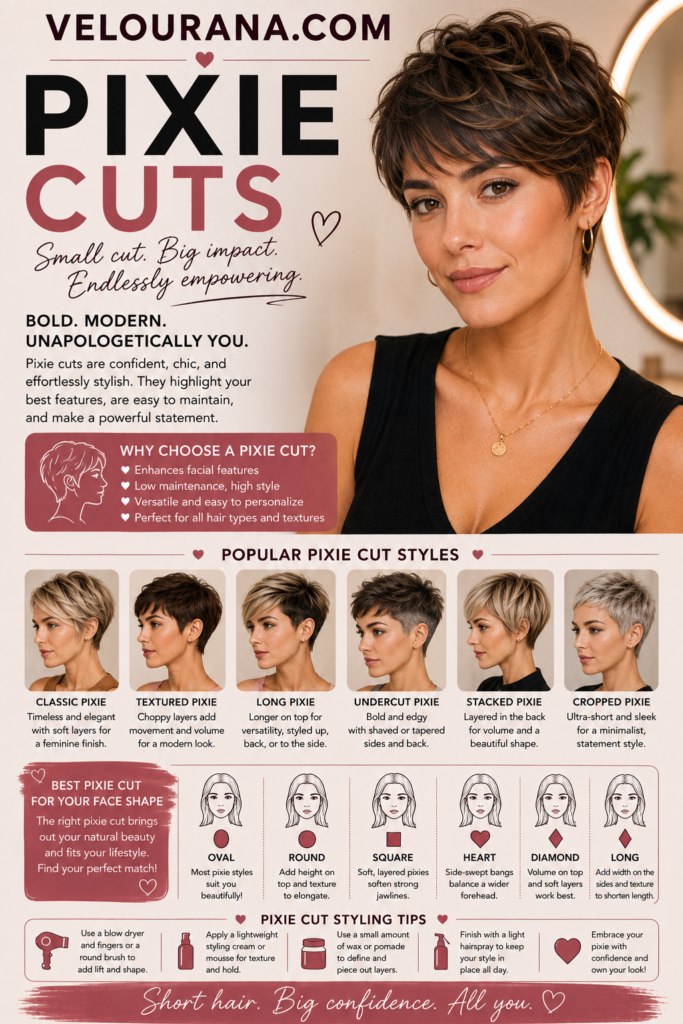
Few haircuts change the relationship between the hair and the face as decisively as a pixie cut. Long and medium styles create much of their visual identity through movement below the jaw, around the shoulders and down the back. A pixie removes that surrounding length and brings almost the entire design closer to the head.
Suddenly, details that were previously hidden become important.
The shape around the ears becomes visible. The nape becomes part of the haircut. The hairline contributes to the silhouette. Texture at the crown can determine whether the style feels sleek, soft, tousled or dramatically voluminous. A few centimeters at the front can completely change the character of the cut.
This is why a pixie should never be understood simply as “very short hair.”
There are pixies that sit close to the scalp and emphasize clean lines. Others preserve considerable length through the crown and fringe, creating softness and movement. Some expose the ears completely, while others leave delicate pieces around them. The nape can be tapered closely or kept slightly longer. Bangs can be cropped, swept sideways, worn forward or allowed to become the longest part of the haircut.
Two pixie cuts can therefore have almost nothing in common except their general short length.
What makes the style distinctive is the way it concentrates the haircut into a small area. With less length available, every decision becomes more visible. The proportions matter. The texture matters. The direction of growth matters. The transition between the sides, crown and fringe matters.
Done thoughtfully, this concentration can make a pixie extraordinarily expressive.
The Pixie Is a Shape Rather Than a Single Length
The familiar idea of a pixie usually involves short sides and back with somewhat greater length through the top. Within that description, however, there is enormous freedom.
A closely cropped pixie may keep almost everything short, producing a neat silhouette that follows the shape of the head.
A longer pixie preserves more hair through the crown and front. The fringe may reach the brows or sweep toward the cheekbone, while the sides remain comparatively compact.
A textured pixie can contain numerous small differences in length that encourage separation and movement.
A soft pixie may avoid obvious disconnection entirely, allowing the sections to blend gradually into one another.
The haircut can also borrow characteristics from neighboring styles. Grow the top and fringe and it begins approaching a bixie or very short bob. Shorten the sides dramatically while retaining length on top and the result moves toward an undercut or crop.
The category is broad because the defining feature is not one exact measurement. It is the balance between the shorter perimeter and the shape created through the upper sections.
Why Cutting Long Hair Into a Pixie Feels So Transformative
Going from long hair directly to a pixie is not simply a shorter version of the same hairstyle.
The entire visual structure changes.
Long hair extends the silhouette vertically. It moves across the shoulders and body. It can be gathered, braided and repositioned.
A pixie brings the silhouette upward.
The neck becomes visible. The jaw is no longer surrounded by long sections. Earrings and collars may become more noticeable because hair is no longer covering them. The forehead may become more visible depending on the fringe.
The physical sensation changes as well.
There is far less hair to wash and dry. Nothing becomes trapped beneath clothing or bags. There is no heavy ponytail and no long section lying against the back.
Yet the reduction in length does not automatically mean the haircut requires no attention.
Long hair can sometimes be tied away when it refuses to cooperate. A pixie cannot be hidden inside a ponytail. Its shape is always present.
This makes the quality of the haircut particularly important.
The Crown Often Determines the Personality
The crown is one of the most influential areas of a pixie.
Keep it short and the haircut can follow the head closely, producing a compact and controlled appearance.
Leave additional length and the crown can develop lift, texture and movement.
Fine hair may benefit from carefully positioned shorter sections that prevent excessive weight from flattening the top. Dense hair may require enough shaping to keep the crown from becoming bulky.
Natural growth patterns also become more noticeable here.
A cowlick that disappeared beneath long hair can suddenly influence the entire direction of the style once the surrounding weight has been removed.
Rather than automatically fighting that movement, a good pixie can incorporate it.
A section that naturally lifts may become part of the volume.
Hair that naturally travels toward one side can help establish the direction of the style.
The haircut becomes easier when the natural growth pattern participates instead of constantly being forced into another position.
The Fringe Can Completely Redefine the Cut
If the crown establishes much of the volume, the fringe often establishes the mood.
A short cropped fringe creates a very different effect from a long sweeping one.
Micro bangs can make the haircut feel graphic and deliberate.
A soft fringe around the forehead creates a gentler appearance.
A long side-swept fringe introduces movement and asymmetry.
Keeping the front substantially longer than the sides can create one of the most versatile forms of the pixie because the fringe can be styled in several directions.
It can fall forward.
It can sweep sideways.
It can be lifted away from the face.
It can be textured into separated pieces.
This is particularly useful for someone concerned that short hair will provide fewer styling options. Although the overall length is limited, a few extra centimeters through the front can produce surprisingly different finishes.
A Long Pixie Can Make the Transition to Short Hair Easier
Someone considering a pixie for the first time does not necessarily need to begin with the shortest possible version.
A long pixie preserves more hair around the crown, fringe and sometimes the ears.
This can make the transformation feel less severe.
The wearer experiences the lightness of short hair while retaining enough length to create softness and movement.
The front can still frame the face.
The crown can be tousled or smoothed.
The sides may be tucked behind the ears rather than cropped extremely close.
A longer version also provides a relatively convenient route back toward medium hair if the wearer later decides to grow it.
The haircut can gradually become a bixie and eventually a bob rather than requiring every area to grow from an extremely short starting point.
Straight Hair Can Make a Pixie Look Precise or Soft
Straight hair reveals the architecture of short cuts clearly.
A sleek pixie can emphasize clean lines around the ears and nape.
A side-swept fringe can create a smooth diagonal movement across the forehead.
Shorter textured sections can produce a more separated, piece-like finish.
Because the strands naturally fall without strong bends, small changes in length can be easy to see.
This means the blending between sections matters.
A soft pixie should transition naturally from the shorter sides into the crown.
A deliberately disconnected style can exaggerate those differences instead.
Straight hair offers both possibilities.
The haircut can be extremely polished or intentionally tousled depending on the structure and finish.
Fine Hair Does Not Automatically Need to Be Kept Long
There is a persistent assumption that fine hair needs length to create the impression of having more hair.
In reality, excessive length can sometimes pull fine hair downward and leave the ends looking increasingly sparse.
A pixie removes that weight.
The hair remaining near the scalp may appear more substantial because there is no long, thinning perimeter beneath it.
Short sections can also gain lift more easily.
This does not mean every fine pixie should contain aggressive layering.
Removing too much hair can still create unnecessary thinness.
The cut should use the available density strategically.
A slightly longer crown may create softness.
A controlled fringe can add visual interest.
The sides can remain neat without being reduced excessively.
The objective is not to manufacture density that does not exist. It is to use the existing hair where it has the greatest visual effect.
Thick Hair Gives a Pixie Enormous Possibilities
Dense hair can create spectacular short shapes because there is enough material to build volume, texture and contrast.
But abundance also needs control.
If thick hair is shortened without considering how it expands, the result may become much wider than expected.
Long hair may have been using its own weight to remain relatively flat. Remove that weight and the same strands can lift strongly away from the scalp.
This is especially important with coarse or textured hair.
A successful thick-hair pixie distributes the density rather than simply removing large amounts indiscriminately.
Some areas may remain fuller to create shape.
Others can be reduced to prevent unnecessary bulk.
The crown can carry volume while the sides remain more compact.
The haircut should still celebrate the natural thickness rather than treating it as something that needs to disappear.
Wavy Hair Can Give a Pixie Natural Movement
Natural waves become particularly visible when long weight is removed.
A section that appeared only mildly wavy at shoulder length may develop a much stronger bend once it becomes several centimeters long.
This can give a pixie immediate texture.
The crown may form soft movement without much styling.
A longer fringe can curve naturally across or away from the forehead.
The sides may develop small bends that soften the perimeter.
The exact result depends heavily on the wave pattern.
Some sections may be almost straight while others form strong movement.
A pixie can use this irregularity rather than demanding identical texture everywhere.
The finished style can feel more natural precisely because every section does not behave in the same way.
Curly Pixies Turn Texture Into the Main Structure
Curly hair can make a pixie extraordinarily dimensional.
Instead of relying primarily on cutting lines, the haircut is shaped through the distribution of curls and volume.
The sides can remain relatively close while the crown carries greater height.
The fringe can consist of short curls around the forehead or longer curls sweeping toward one side.
The back can taper gradually toward the nape.
Shrinkage becomes especially important.
A curl that appears several centimeters long while stretched may settle much closer to the scalp.
Removing weight can also strengthen the pattern, causing the hair to contract more than expected.
For this reason, the finished natural position matters more than the stretched measurement.
The goal is not to make every curl finish at precisely the same level.
It is to create a balanced silhouette in which the curls occupy the intended areas.
The Sides Determine How Open the Haircut Feels
The amount of hair left around the ears significantly changes a pixie.
Exposing the ears completely creates a cleaner, more open silhouette.
Leaving soft sections around them creates a gentler transition.
Longer side pieces can approach the cheekbones and provide a small amount of framing even when the rest of the haircut is very short.
This area also affects how dramatic the difference between the sides and crown becomes.
Closely tapered sides make a longer top appear even more voluminous.
Fuller sides create a rounder and more continuous silhouette.
The decision is not simply about whether the ears should be visible.
It determines the proportions of the entire haircut.
The Nape Is Part of the Design
Long hair usually covers the nape, allowing its shape to remain almost irrelevant to the visible haircut.
A pixie exposes it.
Suddenly the lower back becomes an important finishing point.
A closely tapered nape can create a clean transition into the neck.
A softer finish leaves slightly more length and creates a less severe boundary.
Some pixies maintain additional length through the back, particularly when approaching a bixie shape.
Natural hairlines matter here.
The nape may grow upward, downward or in several directions.
Working intelligently with those patterns can produce a finish that remains attractive as the hair begins to grow.
A Pixie Can Be Sleek Without Looking Severe
Short hair is sometimes associated with either extreme texture or rigid precision, but there is a large territory between them.
A soft sleek pixie can follow the shape of the head while retaining enough length for natural movement.
The fringe can sweep gently rather than forming a hard line.
The sides can remain smooth without being clipped extremely close.
The nape can taper gradually.
This creates a refined style without requiring the haircut to become severe or highly geometric.
Straight and slightly wavy textures can support this particularly well, although curly hair can create its own interpretation through controlled definition.
Texture Can Make the Same Pixie Look Completely Different
One of the most surprising qualities of a pixie is how dramatically styling can change it despite the limited length.
Smooth the hair and the silhouette becomes more compact.
Introduce separation and individual pieces become visible.
Lift the crown and the haircut becomes taller.
Direct the fringe sideways and the entire front changes.
Move it forward and the haircut can feel more cropped.
This flexibility comes from the fact that short sections respond strongly to small changes in direction.
Long hair may require substantial styling to alter its overall silhouette.
With a pixie, changing the direction of several centimeters of hair can transform the whole style.
Short Hair Can Reduce Drying Time but Increase Styling Visibility
A pixie usually requires dramatically less time to wash and dry than long hair.
There is simply less hair.
But reduced drying time should not automatically be confused with zero styling.
The shape is exposed.
If the crown dries in an unwanted direction, it remains visible.
If the fringe separates unexpectedly, there is no long section to hide it behind.
Some pixies genuinely work beautifully after washing and air-drying.
Others depend on a few minutes of deliberate direction.
The difference comes from texture, growth patterns and the chosen style.
A haircut designed around natural behavior can keep this daily work remarkably small.
The Morning Can Be Different With Very Short Hair
Short hair can react strongly to sleep.
A section pressed in one direction overnight may remain there.
The crown can flatten on one side and rise on the other.
This is not necessarily difficult to correct, but it is part of the everyday reality of the haircut.
A small amount of water may be enough to reset the affected sections.
For someone accustomed to simply tying long hair into a ponytail on an inconvenient morning, this is a different routine.
The advantage is that the amount of hair being managed is tiny by comparison.
The maintenance changes rather than disappearing.
A Pixie Makes Accessories More Visible
Removing length from around the face, ears and neck changes how accessories interact with the overall appearance.
Earrings that were previously hidden beneath long hair become visible.
Glasses can become a stronger part of the visual composition.
High collars no longer compete with hair resting across them.
Hair accessories change too.
Large clips and long-hair ties become less relevant, while smaller pins, headbands and decorative pieces can take on greater importance.
This is one of the broader changes created by a pixie.
The haircut alters not only the hair but also what becomes visible around it.
Hair Color Can Look Different on a Short Structure
A dramatic reduction in length can change the way color is perceived.
On long hair, balayage, ombré and other gradual transitions have considerable vertical distance in which to develop.
A pixie compresses everything.
Highlights become more concentrated.
Contrasting sections can appear stronger.
Color around the fringe or crown can become a major feature because those areas represent such a large proportion of the visible hair.
Natural variations can also become more noticeable.
Short hair exposes more of the newer growth and removes older lengths that may have changed through sun exposure, coloring or environmental wear.
The haircut can therefore create a visual color reset as well as a structural one.
The Pixie Has Its Own Maintenance Rhythm
A pixie changes visibly as it grows because even a small amount of additional length represents a significant proportion of the haircut.
A centimeter is relatively minor on waist-length hair.
On a short section around the ear or nape, it can noticeably alter the shape.
The sides begin covering more of the ears.
The nape becomes fuller.
The crown gains weight.
The fringe approaches the eyes.
Someone who wants to preserve a very precise pixie will therefore need to maintain the structure more actively than someone comfortable allowing it to evolve.
A softer or longer pixie can tolerate growth more gracefully.
It gradually changes personality rather than immediately appearing unfinished.
Growing Out a Pixie Is a Series of Haircuts
The prospect of growing out a pixie can discourage people from cutting one in the first place.
The process certainly takes time, but it does not need to mean waiting passively through one awkward stage.
The haircut can evolve.
A short pixie becomes a longer pixie.
The sides begin gaining softness.
The crown becomes heavier.
The fringe can be incorporated into a side-swept shape.
Eventually the hair approaches a bixie.
From there, it can move toward a short bob and then gradually beyond the jaw.
Strategic reshaping can maintain proportion while the overall length increases.
The objective is not necessarily to make every section identical immediately.
It is to keep creating intentional shapes as the hair moves toward the next stage.
A Longer Fringe Can Make Growing Out Easier
Someone who expects to return to longer hair eventually may choose a pixie that already preserves more length through the front.
This provides styling flexibility during the initial cut and can also help during growth.
The fringe can move sideways as it becomes longer.
It can eventually tuck behind the ear.
Later, it begins behaving like the front of a short bob.
The back and sides still need time to catch up, but the overall silhouette can remain deliberate throughout the process.
This is one reason a long pixie can be a particularly approachable version of the style.
Choosing a Pixie Should Not Be Reduced to Face-Shape Rules
Short hair is often surrounded by restrictive advice suggesting that only particular face shapes can wear it.
Such formulas underestimate the flexibility of the haircut.
A pixie can be altered through fringe length, crown volume, side fullness and the amount of hair around the ears.
Those variables change the proportions significantly.
More importantly, a haircut does not need to make every face appear closer to one standardized ideal.
Someone may enjoy emphasizing their jaw, forehead, cheekbones or other distinctive features.
The objective can simply be creating a haircut they like.
The face does not need to earn permission to wear short hair.
The Head Shape and Growth Pattern Deserve More Attention
Because the pixie sits close to the scalp, the underlying shape of the head and the direction of growth influence the haircut more than they do with many long styles.
A flat area at the crown can be balanced with additional length and volume.
A strong cowlick may determine the most natural direction for the front.
The nape hairline can influence how closely the back should be tapered.
These are not defects.
They are structural information.
The best pixie uses that information to decide where length should remain and where it can be reduced.
A Consultation Matters More When the Change Is Dramatic
When someone is removing a substantial amount of length, photographs are useful but incomplete.
The same pixie will not behave identically on different textures, densities and growth patterns.
A reference image may show the desired proportion between a long fringe and short sides.
Another may demonstrate the preferred amount of crown volume.
A third may show the desired softness around the ears.
Breaking inspiration into these individual elements can be more useful than attempting to reproduce one photograph exactly.
The haircut can then be adapted to the actual hair rather than forcing the hair to reproduce another person's result.
Shorter Does Not Automatically Mean Less Feminine, More Masculine or Any Other Fixed Identity
Hair length has accumulated many cultural associations, but the pixie itself does not belong to one personality or identity.
A sleek short cut can feel elegant.
A textured pixie can feel playful.
A cropped version can be minimalist.
A long fringe can create softness and movement.
Color, styling, clothing and individual presence alter the impression further.
The haircut provides a structure.
It does not dictate the person wearing it.
The Confidence of a Haircut With Nothing to Hide Behind
Perhaps the greatest visual difference created by a pixie is openness.
There is no curtain of long hair surrounding the face.
There is no heavy length across the shoulders.
The haircut exists close to the person.
That can feel unfamiliar at first, especially after years of long hair.
But it is also what gives the pixie its extraordinary clarity.
Every small choice contributes.
The curve around the ear, the texture at the crown, the direction of the fringe and the finish at the nape all become part of a compact design.
The style does not need enormous length to create interest because its interest comes from proportion, movement and shape.
Why the Pixie Remains One of Hairdressing's Most Distinctive Cuts
Hair trends repeatedly change, yet the pixie continues returning in different forms because its fundamental idea is remarkably adaptable.
It can be extremely short or surprisingly long.
It can be blunt, feathered, textured, curly or sleek.
It can contain a dramatic fringe or expose most of the forehead.
It can follow the head closely or build substantial volume through the crown.
It can look carefully polished or deliberately undone.
What unites these versions is the concentration of the haircut around the head and face.
Without long lengths to dominate the appearance, structure becomes visible.
Texture becomes important.
Small details matter.
That is not a limitation.
It is the reason the pixie can have so much personality despite using so little length.
A successful pixie does not simply remove hair.
It takes everything that remains and gives it a purpose.
The End
Velourana.
 Discover More From Our Family of Websites
 ZodiacBearing (Astrology, Tarot, Numerology, Angel Numbers & Spiritual Guidance)
 Velourana (Beauty, Makeup, Hair Care, Skincare & Beauty Tips)
 HavenBearing (Home, Living, Organization, Décor & Everyday Inspiration)
 PawBearing (Pet Care, Dog Breeds, Animal Health, Training & Pet Products)
 PsyCatherine (Notes From the Journal of a Psychologist on Real Life)