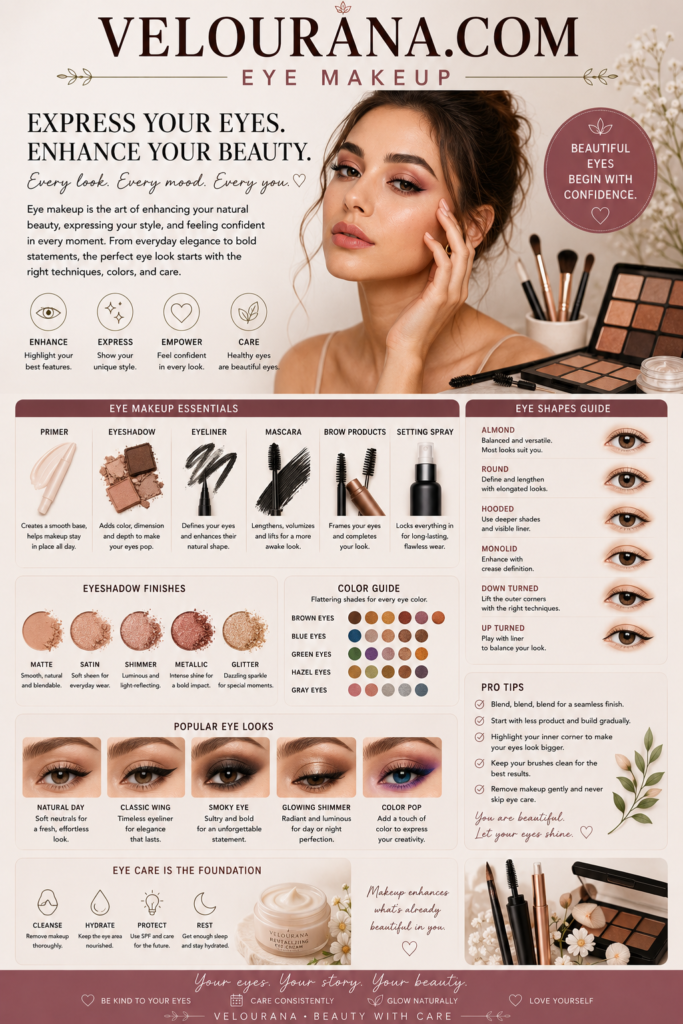
CATEGORY: Matte Eyeshadow
There is something unusually confident about an entirely matte eye. Without glitter or reflective pigment to create instant impact, every decision becomes visible through color, shape, and proportion. The makeup cannot depend on sparkle to catch attention. Instead, it relies on the relationship between the eyelid and the surrounding bone structure, the subtle movement from light to dark, and the way pigment changes as it travels across the eye.
This makes matte eyeshadow extraordinarily adaptable. The same finish can belong to an almost imperceptible daytime look, a polished professional eye, a romantic haze of muted color, or an intensely dramatic smoky design. What changes is not the fundamental nature of the product but the scale, saturation, placement, and contrast.
Modern matte formulas have also expanded far beyond the dry, chalky powders once associated with the category. Powder remains central, but cream and cream-to-powder textures have made matte color increasingly diverse. Formulators can manipulate slip, adhesion, pigment dispersion, softness, and oil absorption to create very different sensory experiences while preserving the absence of obvious shine.
As a result, choosing matte eyeshadow is no longer simply a question of finding a shade without shimmer. The way the product moves across the eyelid matters. So does the speed with which it sets, the degree of pigmentation, the compatibility between formula and skin, and the role the shade is expected to perform.
A matte eye succeeds when all of these qualities work together.
The Beauty of Color Without Reflection
Shimmer communicates through reflected light. Matte communicates primarily through color and depth.
That difference may sound small, but it changes how the eye perceives makeup. A reflective product naturally draws attention to the area where it is placed because illumination changes as the face moves. Matte color remains comparatively stable. Instead of flashing under light, it establishes a field of pigment whose visual effect depends strongly on its value, saturation, undertone, and surrounding contrast.
This gives matte eyeshadow an unusual ability to create believable dimension.
Natural shadows on the face are not filled with glitter. When makeup imitates or exaggerates those shadows using matte pigment, the effect can appear integrated with the facial structure. A taupe placed through the socket can resemble naturally increased depth. A brown concentrated near the lash line can make lashes appear visually denser. A muted skin-adjacent shade can even out the appearance of the eyelid while remaining almost undetectable as conventional eyeshadow.
But naturalism is only one possibility.
Remove shimmer from an intense color and something interesting happens: the color itself becomes more assertive. A matte red eyelid reads as red rather than as a sparkling red surface. An opaque blue becomes almost graphic. Black becomes shadow in its most dramatic form.
This is why matte finishes have equal relevance in understated and experimental makeup. Their visual vocabulary extends from illusion to abstraction.
The difference lies in contrast.
When matte shades remain close to the natural depth and coloring of the face, they can subtly strengthen existing anatomy. When they sharply contrast with the complexion or surrounding makeup, they become unmistakably decorative. A single formula category can therefore produce two completely different aesthetic languages.
Soft Matte Makeup and the Art of Restraint
Minimal eye makeup can be more technically sophisticated than it appears. When the objective is to create definition that does not immediately register as elaborate makeup, shade choice and placement become particularly important.
A matte color only slightly deeper than the surrounding skin can create enough contrast to make the eye appear more defined without producing an obvious line. Applied with a diffused edge, it can reinforce the socket or outer corner while maintaining softness.
The success of this approach depends on resisting unnecessary intensity.
It is tempting to keep adding pigment because a shade looks subtle during application. Yet natural-looking matte makeup often works precisely because some areas remain almost untouched. The visible eyelid does not need to be uniformly covered, nor does every section of the eye require contour.
Strategic emptiness is part of the design.
Leaving some natural skin visible allows the depth created by matte pigment to have context. A softly shaded outer eye appears deeper because it sits beside a lighter area. If the same depth is distributed everywhere, the contrast disappears.
This principle also explains why a one-shadow matte look can be so effective. A single color does not have to appear uniform. The brush can deposit more pigment near the lashes or outer corner and gradually diffuse what remains through the crease. The same shade then appears to possess several depths simply because its opacity changes.
Such makeup can be exceptionally elegant. There is no obvious boundary between colors because only one hue is involved, yet the gradient still gives the eye dimension.
Muted browns, taupes, peaches, terracottas, roses, mauves, and similar shades lend themselves naturally to this treatment, but there is no requirement to remain neutral. A softly diffused olive or dusty violet can be equally restrained when saturation and contrast are controlled.
Minimal matte makeup is therefore not defined by beige. It is defined by restraint.
Building a Smoky Eye Without Shimmer
The smoky eye demonstrates matte shadow's ability to create atmosphere through controlled darkness. Despite the name, a smoky eye is not simply dark pigment covering the eyelid. Its character comes from the way intensity dissolves into softness.
An all-matte interpretation makes this transition especially important.
The darkest area generally needs a clear visual purpose. It might hug the upper lash line, surround the outer corner, or envelop more of the eye for a deliberately dramatic effect. From that point, the color should become progressively softer rather than ending abruptly.
This is where intermediate tones become valuable. Trying to blend black directly into bare skin can produce a gray, uneven border, particularly when the deepest pigment is heavily applied. Introducing compatible medium shades creates a visual bridge between darkness and complexion.
Brown can soften black. Muted plum can transition from aubergine. Deep navy can diffuse into slate or muted blue. The exact combination matters less than the progression in depth.
An effective smoky eye also recognizes that darkness changes perceived eye shape. Extending pigment horizontally can create length. Concentrating it above the outer eye can suggest lift. Bringing deep color heavily around the entire eye produces a more enclosed, intense result.
The lower lash line plays a particularly important role. Leaving it relatively clean while concentrating darkness above can preserve openness. Connecting upper and lower shading creates greater continuity and drama. Neither choice is inherently more flattering; they communicate different intentions.
Matte formulas are exceptionally suited to this work because they create depth without introducing points of reflection. The resulting eye can look velvety and almost atmospheric, particularly when the boundaries are carefully softened.
The danger is over-blending. If every shade is repeatedly swept through every other shade, the gradient can collapse into a single muddy tone. The darkest areas must retain enough concentration to preserve dimension.
Smoke requires both diffusion and darkness. Remove either one and the effect changes completely.
Matte Eyeshadow Across Different Eye Structures
Generic placement diagrams often assume a particular eyelid structure. Real eyes are far more varied.
The amount of visible mobile lid differs enormously. Some people have a clearly defined crease and substantial lid space. Others have hooding that covers much of the crease when the eye is open. Deep-set eyes naturally contain strong socket shadows. Monolids provide different opportunities for gradients and graphic placement. Eyes can also be round, elongated, upturned, downturned, close-set, wide-set, or asymmetrical.
Matte shadow is particularly useful because it can visually alter these proportions, but it works best when placement responds to the actual eye rather than forcing every eye into the same pattern.
With hooded eyes, for example, beautifully blended crease work may disappear when the eye opens if all the pigment has been placed inside a fold. Bringing some depth into the area visible with the eyes open can make the intended shape readable in a normal expression.
Deep-set eyes already possess natural darkness around the socket. Intensifying that depth indiscriminately may create a heavier effect than expected. Strategic placement on the outer eye or lash line may provide definition while preserving balance.
On monolids, matte gradients can create extraordinary dimensional effects without relying on a conventional crease. Color can deepen toward the lash line, expand upward, extend outward, or form intentionally graphic shapes. The absence of a traditional visible crease is not a limitation; it simply changes the geometry.
Asymmetry deserves similar consideration. Human faces are not perfectly symmetrical, and eye folds frequently differ from one side to the other. Copying the exact physical placement from one eyelid to the other can sometimes emphasize those differences. Evaluating the eyes together while open allows the makeup to be balanced visually rather than anatomically.
This is one of the most important conceptual shifts in eye makeup: symmetry is judged by the finished appearance, not by whether pigment occupies mathematically identical coordinates.
Matte shadow gives the wearer the freedom to make those subtle corrections because it creates convincing apparent shadow.
When Matte Texture Becomes Difficult
Not every unsuccessful matte application is caused by poor blending technique. Sometimes the interaction between product, skin, and preparation is the real problem.
A dry matte powder applied over a dehydrated eyelid can cling to uneven areas. A strongly adhesive primer can cause pigment to lock into place before it has been distributed. An emollient base can allow color to move or crease. Natural eyelid oil can gradually alter both intensity and wear.
Recognizing the type of problem makes correction much easier.
Patchiness at the moment of application may indicate that the base is gripping unevenly or that too much pigment is being deposited at once. Patchiness that develops later may involve oil, friction, creasing, or insufficient adhesion. A chalky appearance can arise from formula texture, an unsuitable shade against the complexion, excessive product, or dryness beneath the makeup.
More powder is not always the answer.
When a matte looks heavy, repeatedly layering it can increase visible texture. Sometimes the better solution is to reduce the amount of product, work in thinner layers, or alter the base. Similarly, vigorous blending does not automatically repair a patch. It may lift pigment from one area while spreading excess into another.
Cream mattes introduce different considerations. They can offer beautifully smooth color and direct application, but their setting time varies. A formula that dries quickly requires decisive blending because an edge may become difficult to move once set. A more emollient formula provides longer working time but may behave differently on oily lids.
Cream-to-powder textures attempt to combine the flexibility of a cream with a drier final finish. When successful, they can create an elegant modern matte surface, particularly for monochromatic looks.
There is no universally superior texture. The best formula is the one whose behavior matches the wearer's technique, eyelid characteristics, and desired result.
Creating Dimension Through Tone Rather Than Product Quantity
A common misconception is that sophisticated eye makeup requires many shades. Matte makeup demonstrates why this is not necessarily true.
Dimension depends on visible differences in depth, not on the number of pans opened.
Three carefully chosen tones can create an extremely complex-looking eye when their values are sufficiently distinct and their transitions are controlled. Even two can be enough. As already noted, a single shade can create multiple apparent values when applied at different levels of opacity.
This becomes especially useful when working with monochromatic color.
Imagine a matte terracotta eye. The color may begin as a translucent haze above the crease, become richer across the outer lid, and reach its deepest saturation beside the lashes. The entire design remains chromatically unified, yet the eye does not appear flat.
A similar technique with plum produces a completely different mood. With gray-brown it becomes understated and sculptural. With cobalt it becomes contemporary and expressive.
The key is preserving variation.
If every layer is blended until it reaches the same opacity, dimension disappears. If the deepest area remains dense while surrounding pigment gradually thins, the eye retains structure.
This principle also encourages more thoughtful use of palettes. A large palette may offer dozens of matte shades, but a successful look does not need to demonstrate all of them simultaneously. Selecting colors according to function often creates greater coherence than trying to incorporate as many as possible.
A pale matte can soften or brighten. A medium matte can establish the main shape. A deep matte can anchor the design. Additional colors can certainly expand the story, but they should contribute something rather than merely occupy space.
Matte eyeshadow rewards editing.
The Role of Matte Shadow Beside Other Finishes
An article about matte eyeshadow does not need to treat shimmer as its opponent. Some of the most effective eye makeup depends on contrast between the two.
Matte creates recession; reflective finishes can create visual prominence. Used together, they exaggerate dimension.
A matte crease beside a luminous lid makes the lid appear brighter because the surrounding area is comparatively subdued. A matte outer corner can frame metallic pigment. A matte base can provide structure beneath strategically placed glitter. Even a tiny reflective accent can appear dramatically brighter when most of the surrounding makeup is matte.
The relationship works because finishes influence one another perceptually.
If everything reflects strongly, the eye has fewer quiet areas against which highlights can stand out. If everything is matte, the composition depends entirely on color and depth. Neither approach is wrong, but mixing finishes gives the wearer another dimension of control.
Matte shadow can also interact beautifully with eyeliner. Instead of drawing a conventional line, deep matte pigment can be pressed near the lashes and diffused outward. The result creates definition without the sharpness of liquid or gel liner. Black produces intensity, while dark brown, charcoal, navy, plum, or green can make the effect softer or more colorful.
This blurred approach is particularly compatible with matte makeup because it preserves the overall absence of shine while strengthening the lash area.
Conversely, sharply defined eyeliner over softly blended matte shadow creates a deliberate contrast between precision and diffusion. The matte provides atmosphere; the liner provides graphic structure.
The possibilities are broader than any single prescribed technique.
Matte Eyeshadow as Personal Style
The most useful stage in learning matte eyeshadow comes when technique stops being a collection of rules and becomes a way of making choices.
Some people discover that they prefer barely visible matte definition and rarely want anything darker than a medium taupe. Others love opaque black, burgundy, navy, or emerald surrounding the eye. Some enjoy softly blended gradients, while others prefer deliberately graphic blocks of matte color.
All are legitimate expressions of the finish.
Age does not impose a universal requirement to abandon shimmer and wear only matte, just as textured eyelids do not automatically demand one specific finish. Individual formulas behave differently, and personal aesthetic preference matters. A dry, opaque matte can emphasize surface dryness just as an unsuitable reflective formula can emphasize texture. The relevant question is how a particular product behaves on a particular eyelid.
The same freedom applies to color conventions. Eye color can inspire complementary choices, but it does not restrict them. Skin undertone can help explain why certain shades appear harmonious or contrasting, but it does not establish a compulsory palette.
Makeup becomes more interesting when technical knowledge expands choice instead of narrowing it.
Understanding that matte creates apparent depth allows the wearer to decide where that depth belongs. Understanding pigmentation makes it easier to choose between immediate intensity and gradual buildability. Understanding texture helps explain why one formula blends beautifully while another requires a different technique.
These insights remove some of the mystery from application while leaving all of the creativity intact.
A matte shadow can be quiet enough to resemble a natural facial shadow or bold enough to transform the entire expression. It can support another finish or become the complete look. It can be soft, severe, romantic, smoky, colorful, minimalist, classic, or experimental.
What connects all of these possibilities is the absence of obvious reflection and the extraordinary control that absence provides.
Matte eyeshadow does not merely color the eyelid. At its best, it redraws the relationship between light, depth, shape, and expression. That is why a finish that may appear simple in the pan remains one of the most sophisticated tools in eye makeup.
THE END VELOURANA
 Discover More From Our Family of Websites
 ZodiacBearing (Astrology, Tarot, Numerology, Angel Numbers & Spiritual Guidance)
 Velourana (Beauty, Makeup, Hair Care, Skincare & Beauty Tips)
 HavenBearing (Home, Living, Organization, Décor & Everyday Inspiration)
 PawBearing (Pet Care, Dog Breeds, Animal Health, Training & Pet Products)
 PsyCatherine (Notes From the Journal of a Psychologist on Real Life)