
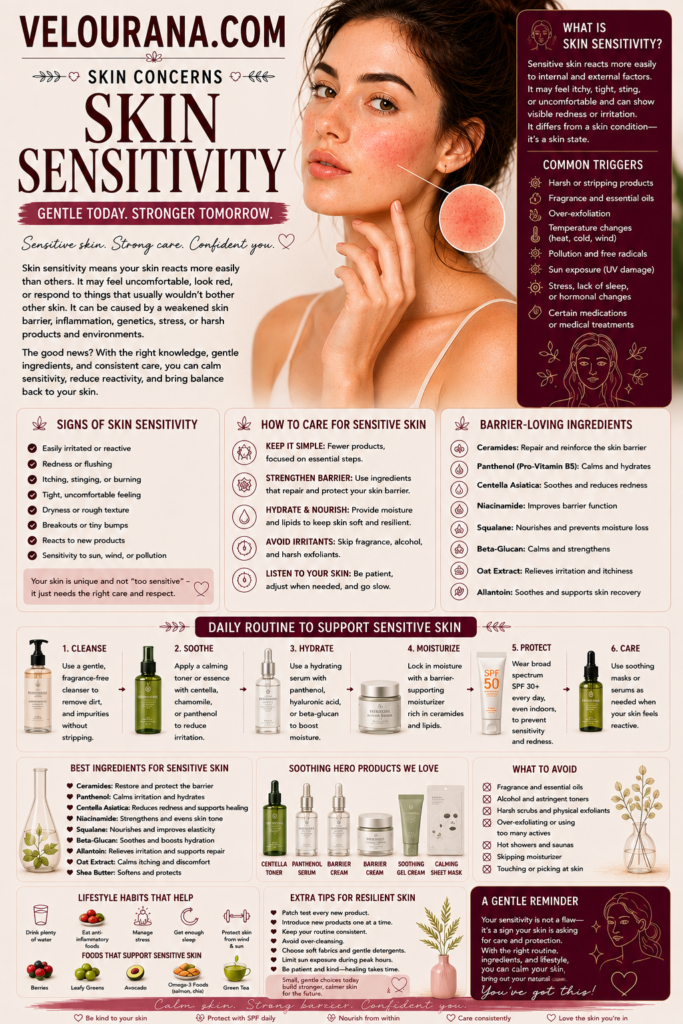
CATEGORY: Skin Sensitivity
Sensitive skin is often investigated inside the bathroom cabinet. When redness appears or the face begins to sting, attention turns immediately toward cleansers, serums, moisturisers and active ingredients. Bottles are examined, ingredient lists compared and recent purchases treated as likely suspects.
Sometimes that investigation identifies the problem.
Sometimes it misses half the story.
Skin spends only a small portion of its life interacting with skincare. For the remaining hours, it encounters sunlight, wind, temperature changes, perspiration, fabrics, hands, pillowcases, makeup, water, indoor heating, air conditioning and the physical movement of everyday life. These exposures may appear insignificant because they are familiar, yet sensitive skin can respond to their accumulation just as strongly as it responds to an unsuitable cosmetic.
This broader perspective is particularly useful when reactions seem inconsistent. A moisturiser may feel comfortable on Monday and sting on Thursday because Thursday's skin has already experienced a different sequence of events. A windy commute, prolonged sun exposure, repeated nose wiping, a hot shower or an intensive treatment used the previous evening can change the context in which that moisturiser is applied.
Sensitivity is therefore not simply a question of what touches the skin.
It is a question of what the skin has already experienced before that contact occurs.
The Environment Is Part of Every Skincare Routine
We tend to imagine a skincare routine as something deliberately performed morning and evening.
Biologically, the routine never stops.
The surrounding environment continuously influences the skin's surface. Temperature affects blood flow and sensation. Humidity influences water loss. Wind increases physical exposure. Ultraviolet radiation interacts with skin cells. Pollutants and airborne particles settle on exposed areas.
Most healthy skin accommodates ordinary environmental variation remarkably well. Sensitive skin may have a narrower tolerance range, making these changes more noticeable.
This is one reason a routine cannot be judged independently of geography, season and lifestyle.
A moisturiser that feels ideal in a humid coastal summer may provide insufficient comfort during a cold, dry winter. A treatment tolerated while someone spends most days indoors may become uncomfortable during a sunny holiday. A face that remains calm during moderate temperatures may flush intensely when moving between freezing outdoor air and heavily heated interiors.
The products have not necessarily failed.
The conditions have changed.
Good sensitive skincare therefore involves maintaining stable principles while allowing practical details to adapt.
Temperature Can Be a Powerful Trigger
Heat is one of the most immediate influences on facial appearance because blood vessels near the skin's surface respond to temperature.
A hot room, vigorous exercise, warm shower or intense sunlight can produce temporary flushing even in people who do not consider themselves sensitive. For someone who is redness-prone, the effect may be faster, stronger or more persistent.
Very hot water creates a particularly interesting problem because warmth is culturally associated with cleansing. Steam and heat can feel luxurious, and a long hot shower may seem harmless.
For reactive skin, however, extreme heat can increase discomfort and visible flushing. The problem can become more pronounced when hot water is followed by cleansing, exfoliation and vigorous towel drying.
Each individual action may seem ordinary.
Together they create a concentrated period of stimulation.
Cold presents a different challenge. Low temperatures and wind can leave exposed skin feeling dry, tight and uncomfortable, while repeated transitions into warm indoor environments may produce dramatic changes in facial colour.
The practical lesson is not that sensitive skin must live within a perfectly controlled temperature.
It is that unnecessary extremes can often be reduced.
Wind Creates Stress Without Leaving an Ingredient List
Wind is an excellent example of an invisible skincare influence.
There is no bottle to blame and no ingredient to analyse, yet prolonged exposure can leave the face feeling tight, dry or irritated. Cold wind can be especially uncomfortable because it combines physical exposure with environmental conditions that may encourage moisture loss.
The effects often appear later.
Someone spends several hours outdoors and feels relatively comfortable. That evening, cleansing stings. Moisturiser produces warmth. The cheeks look unusually red.
The immediate assumption may be that the evening products caused the reaction.
In reality, they may simply have revealed a surface that was already stressed.
This delayed relationship between exposure and sensation is one reason sensitive skin can seem unpredictable.
Remembering what happened to the skin during the entire day provides better context than considering only what was applied immediately before the reaction.
Humidity Changes What the Skin Needs
Humidity is rarely visible, yet it can dramatically change the way skincare feels.
In environments with low humidity, water can be lost from the skin more readily, particularly when barrier function is already compromised. Dry indoor heating can intensify this effect during winter.
Skin that normally feels balanced may become tight. Fine flaking appears around the nose or mouth. Makeup sits differently. Products that were previously sufficient no longer maintain comfort throughout the day.
High humidity presents a different experience. Rich formulations may feel heavier, perspiration increases and occlusive layers can become uncomfortable for some people.
Sensitive skin therefore does not always need the same moisturiser texture throughout the year.
Changing texture is not inconsistency.
It is adaptation.
The underlying goal remains stable: maintaining comfort and supporting the skin's protective environment. The method can change as external conditions change.
Sun Exposure Can Quietly Lower Tolerance
Sunburn is obvious.
Subtler ultraviolet exposure is easier to overlook.
Skin does not need to become dramatically red or peel before ultraviolet radiation has produced biological effects. Repeated exposure can contribute to inflammation and long-term skin damage, and already sensitive skin may feel particularly uncomfortable after spending substantial time outdoors.
This matters when interpreting evening sensitivity.
A person may apply an exfoliating treatment after a sunny day and experience unusual stinging. The treatment is blamed because the sensation occurs immediately after application, but the day's ultraviolet exposure may have contributed to reducing the skin's tolerance.
Sun protection should therefore be viewed as part of sensitivity management rather than only as an anti-ageing measure.
Broad-spectrum sunscreen, shade, protective clothing and sensible avoidance of unnecessary intense exposure work together.
No single product makes the skin immune to the environment.
Perspiration Can Sting Already Irritated Skin
Sweating is normal and essential for temperature regulation.
Yet perspiration can feel surprisingly uncomfortable on compromised skin.
After exercise or during hot weather, someone with irritated facial skin may notice stinging, particularly around areas that are already dry, recently shaved or over-treated.
The instinct may be to wash aggressively to remove sweat immediately.
That can create another problem if cleansing becomes excessively frequent.
Sensitive skin often requires a balance between removing what is uncomfortable and avoiding repeated stripping. Gentle rinsing or appropriate cleansing according to the situation may be sufficient, followed by careful drying rather than vigorous rubbing.
The broader principle is familiar: the response should be proportionate.
Sensitivity frequently worsens when every minor discomfort is answered with maximum intervention.
Towels Are More Important Than They Look
A towel contains no sophisticated active ingredients, yet it can influence reactive skin every day.
The issue is not the existence of towels. It is friction.
Rubbing the face vigorously after washing creates mechanical stress. Healthy skin may tolerate this without obvious consequences, but already irritated skin can respond with increased redness or discomfort.
The solution is remarkably simple: less force.
Gently pressing or patting away excess water can reduce unnecessary friction without adding another product to the routine.
This illustrates an important theme in sensitive skincare.
Some of the most useful changes are behavioural rather than cosmetic.
They cost nothing, require no new ingredient knowledge and can be repeated consistently.
The skincare industry naturally focuses on products because products can be sold. Skin, however, responds to behaviour whether or not that behaviour comes in packaging.
Pillowcases, Bedding and Repeated Contact
The face spends hours in contact with bedding.
For most people, this creates no meaningful problem. But when skin is persistently irritated, everything that repeatedly touches it becomes relevant to the investigation.
Detergent residue, fabric treatments, accumulated skincare, hair products and friction can all become part of the environment surrounding the face.
This does not mean every person with sensitive skin needs specialised bedding or elaborate laundering rituals. Such recommendations can quickly become excessive.
The useful principle is simpler.
If irritation consistently appears in areas that experience repeated contact, consider that contact as one possible variable rather than assuming every reaction originates from facial skincare.
The same reasoning applies to scarves, helmet straps, glasses, masks and anything else that repeatedly touches the same region.
Patterns of location can provide clues.
Hands May Be the Most Frequent Unrecorded Skincare Step
Most people touch their faces far more frequently than they realise.
Resting the chin in a hand, scratching an itch, rubbing tired eyes, adjusting glasses, checking a blemish and moving hair away from the face all create repeated contact.
When skin becomes irritated, touching often increases because discomfort draws attention.
This can create a feedback loop.
A rough patch is repeatedly felt to determine whether it has improved. A blemish is examined several times each day. Flaking is picked away. Redness is pressed to see whether it temporarily disappears.
Each action seems trivial.
Collectively, they can maintain irritation.
Sensitive skincare therefore sometimes involves reducing surveillance.
The face does not need to be physically checked every hour.
Observation is useful. Constant manipulation is not.
Hair Removal Can Temporarily Change Skin Tolerance
Shaving, waxing, threading and other hair-removal methods create mechanical or chemical challenges to the skin.
After hair removal, the treated area may temporarily become more reactive. Applying strong exfoliants or other potentially irritating treatments immediately afterwards can intensify discomfort.
This is particularly relevant when sensitivity appears predictably around the upper lip, jaw, eyebrows or other frequently treated areas.
Timing becomes important.
A product tolerated perfectly well on ordinary days may sting when applied to freshly treated skin.
Again, context changes the reaction.
Sensitive skincare is easier to manage when hair removal is considered part of the routine rather than an unrelated grooming event.
Makeup Brushes and Sponges Create Their Own Microenvironment
Makeup application involves repeated contact with the face.
Brushes sweep, buff and press. Sponges bounce against the skin. Fingers blend products into delicate areas.
For healthy skin, these actions are usually insignificant. For highly reactive skin, aggressive application can contribute to visible flushing or discomfort.
Cleanliness also matters.
Tools accumulate cosmetics, oils and environmental material over time. Appropriate cleaning helps maintain hygiene, although excessively harsh residues left on tools may themselves be undesirable.
The technique deserves equal attention.
A foundation that requires intense buffing may be less suitable during a period of sensitivity than one that can be applied with minimal manipulation.
This is not an argument against makeup.
It is an argument for recognising application as physical skincare.
The Removal Process May Matter More Than the Makeup
Long-wearing cosmetics are designed to remain in place.
Their durability is useful during the day but can make removal more demanding in the evening.
Sensitive skin may tolerate the makeup itself while reacting to the repeated rubbing required to remove it.
This distinction can be missed because irritation becomes visible only after cleansing.
The cleanser is blamed, even though the complete removal process involved several rounds of wiping, rubbing around the eyes and perhaps a second cleanse afterwards.
A more efficient removal method can reduce mechanical stress without sacrificing cleanliness.
The goal is to dissolve and lift makeup rather than wage a physical battle against it.
When redness consistently appears after makeup removal, technique deserves as much attention as formulation.
Exercise Reveals the Difference Between Normal Flushing and Persistent Problems
Exercise increases circulation and body temperature, so temporary facial redness during physical activity can be entirely normal.
For redness-prone individuals, the colour may be particularly noticeable.
The important distinction is what happens afterwards.
Does the skin return toward its usual appearance as body temperature normalises, or does intense redness remain for an unusually long period? Is the flushing accompanied by burning, itching or other persistent symptoms?
These patterns can help distinguish ordinary physiological responses from sensitivity that deserves closer attention.
Exercise should not automatically be treated as something sensitive skin needs to avoid. Its broader health benefits are far too important for that.
Instead, practical management can focus on unnecessary aggravating factors: extreme environmental heat, prolonged sun exposure, harsh post-exercise cleansing and aggressive rubbing.
Healthy activity and thoughtful skincare are entirely compatible.
Travel Can Disrupt Even a Stable Routine
Travel exposes skin to several changes simultaneously.
Climate changes. Humidity changes. Water changes. Sleep patterns shift. Air-conditioned cabins and hotel rooms may be dry. Sun exposure may increase. Familiar products may be replaced with travel-size alternatives.
When sensitivity appears during a trip, identifying the cause can therefore be difficult.
This is one reason travel may not be the ideal moment to experiment with an entirely new skincare routine.
Familiar, well-tolerated products provide continuity while everything else changes.
The skin may still behave differently, but at least one major group of variables remains stable.
This principle becomes particularly valuable for people who already know that their skin reacts unpredictably.
Predictability can be packed.
Water Itself Can Change the Experience of Cleansing
People moving between regions sometimes report that their skin feels different even though they continue using exactly the same products.
Water composition may contribute to these experiences.
Hardness and other characteristics vary geographically, and the interaction between water, cleansers and the skin can influence how washing feels.
This does not mean every case of travel-related sensitivity can be blamed on tap water. Climate, routine changes and environmental exposure often change simultaneously.
But it reinforces the central idea that skincare does not occur in isolation.
Even the water used to rinse a familiar cleanser is part of the system.
Stress Can Influence the Skin Without Making Symptoms Less Physical
Periods of psychological stress often coincide with changes in sleep, behaviour and self-care. People may touch their faces more, sleep less consistently, alter their diets, spend longer indoors or abandon familiar routines.
Stress can also interact with physiological systems involved in inflammation and sensory perception.
None of this means sensitive skin is imaginary.
Physical symptoms remain physical.
The mistake lies in creating an artificial separation between the skin and the rest of the body. Skin is a living organ connected to nervous, immune, vascular and hormonal systems. It should not be surprising that broader changes in the body can influence its behaviour.
When sensitivity worsens during difficult periods, the response should not be dismissal.
Nor does it necessarily require a cabinet full of new products.
Sometimes maintaining a familiar, simple routine while the rest of life is unstable is itself useful.
Seasonal Transitions Deserve Anticipation Rather Than Emergency Repair
Many people recognise the same pattern every year.
Autumn arrives and the face becomes tighter. Winter produces flaking. Spring brings increased outdoor exposure. Summer heat causes more flushing.
Yet routines are often changed only after sensitivity has already become uncomfortable.
Anticipating predictable transitions allows smaller adjustments.
A moisturiser can become slightly more protective before severe winter dryness develops. Exfoliation frequency can be reconsidered as environmental conditions become harsher. Sun protection habits can strengthen before summer exposure intensifies.
This approach treats sensitivity as something to manage proactively rather than repeatedly repair.
It also encourages people to keep what already works.
Seasonal adaptation does not require replacing the entire routine four times a year.
Often, one or two carefully chosen adjustments are enough.
Reading Patterns Is More Useful Than Hunting for a Single Trigger
The search for one culprit is emotionally satisfying.
If a particular ingredient can be blamed, the solution seems easy: remove it.
Sometimes this works.
But sensitive skin often reflects combinations.
Heat alone is tolerated. Exfoliation alone is tolerated. A particular moisturiser is tolerated. Yet exfoliation followed by a hot shower during dry winter weather produces burning when the moisturiser is applied.
Which factor caused the reaction?
Perhaps none of them independently.
The interaction mattered.
This is why keeping a simple mental or written record can occasionally help when reactions are recurrent. The objective is not obsessive tracking. It is noticing repetition.
Does redness consistently follow hot showers?
Does sensitivity increase after hair removal?
Does the skin become uncomfortable during specific weather?
Does a particular treatment cause problems only when used too frequently?
Patterns reveal thresholds.
Thresholds provide practical guidance.
When Everyday Sensitivity May Be Something More
Environmental triggers can explain many temporary reactions, but persistent or severe symptoms should not automatically be attributed to ordinary sensitivity.
Rosacea, eczema, allergic contact dermatitis and other dermatological conditions can be influenced by environmental factors while still requiring specific diagnosis and management.
Recurring facial flushing accompanied by persistent redness, visible blood vessels, bumps or eye symptoms may warrant professional assessment. Significant itching, swelling, cracking, scaling or recurrent rash-like changes also deserve attention.
A dermatologist can evaluate patterns that cosmetic experimentation cannot reliably distinguish.
This boundary is especially important when a person's list of supposed triggers keeps expanding.
If water, weather, almost every cosmetic and ordinary contact all seem to produce significant reactions, continuing to eliminate random products may provide diminishing returns.
Professional investigation may offer a clearer explanation.
Calm Skin Is Created Between Applications
Sensitive skincare becomes much easier to understand when the bathroom mirror stops being the only place we look for causes.
A routine may be beautifully designed and still struggle against eight hours of environmental stress. Conversely, modest behavioural changes can sometimes improve comfort without adding a single product.
Less rubbing.
More moderate water temperatures.
Greater awareness of sun and wind.
Thoughtful timing around hair removal and active treatments.
Gentler makeup removal.
Seasonal adjustment before irritation becomes severe.
None of these changes is dramatic.
That is what makes them powerful.
Sensitive skin is often influenced by accumulation, and accumulation works in both directions. Small irritations can gradually reduce tolerance, but small protective choices can also reduce the total burden placed on the skin.
The most sophisticated sensitive-skin routine therefore extends far beyond cleanser, serum and moisturiser.
It includes the shower temperature, the towel, the weather, the makeup brush, the hand resting against the cheek and the decision not to exfoliate skin that already feels uncomfortable.
Products remain important.
They are simply not the whole story.
Once this becomes clear, sensitivity can begin to feel less random. Reactions acquire context. Triggers become easier to anticipate. The routine becomes more adaptable because it responds not only to what is inside the bottle but to the conditions surrounding the skin every day.
Calm skin is not created only during the minutes spent applying skincare.
It is protected during all the hours in between.
The End Velourana
 Discover More From Our Family of Websites
 ZodiacBearing (Astrology, Tarot, Numerology, Angel Numbers & Spiritual Guidance)
 Velourana (Beauty, Makeup, Hair Care, Skincare & Beauty Tips)
 HavenBearing (Home, Living, Organization, Décor & Everyday Inspiration)
 PawBearing (Pet Care, Dog Breeds, Animal Health, Training & Pet Products)
 PsyCatherine (Notes From the Journal of a Psychologist on Real Life)

