CATEGORY: Tight Skin
Tight skin rarely appears without context.
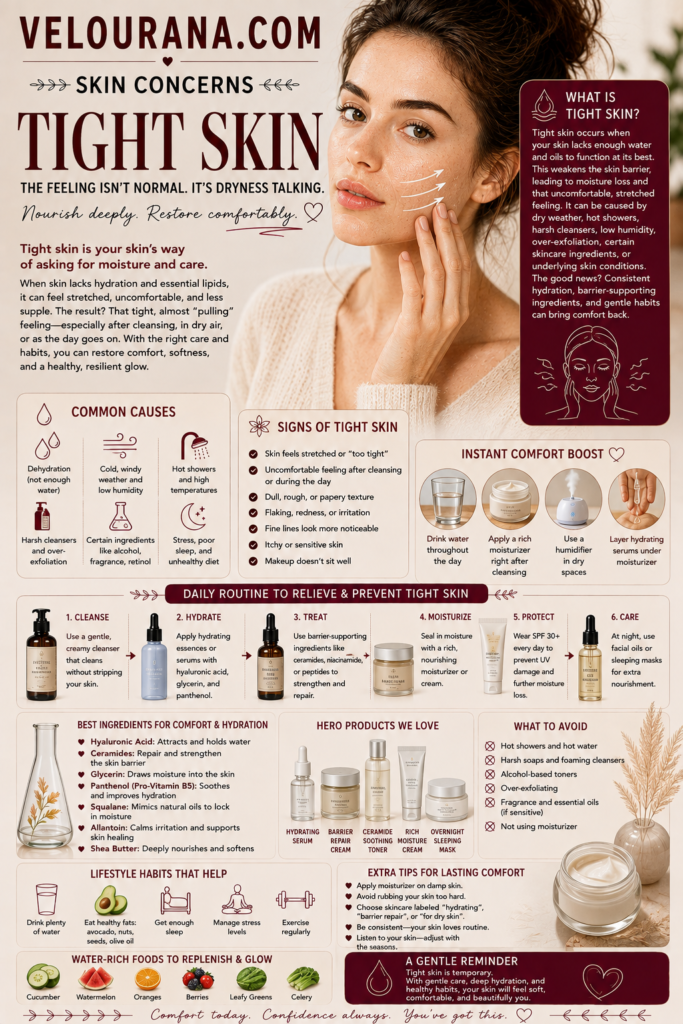
It may seem sudden. One morning the face feels normal; the next, the cheeks feel stretched after washing. A moisturizer that usually feels sufficient suddenly disappears into the skin without restoring comfort. Makeup begins to sit differently. The area around the mouth feels less flexible. Yet no dramatic rash is visible, no obvious new product has been introduced, and nothing seems different enough to explain why the skin feels so noticeably wrong.
This is where tightness becomes especially revealing.
The skin is responsive to far more than the products placed directly onto it. Weather, indoor climate, water temperature, cleansing frequency, sleep, travel, age, treatment intensity, makeup habits and repeated friction can all influence how comfortable the surface feels. Often the problem is not one dramatic mistake but the cumulative effect of several ordinary habits.
That is why persistent tightness can be difficult to solve by purchasing a single “hydrating” product.
The most useful approach is to identify the conditions surrounding the symptom. When does it appear? What makes it worse? What changed in the days before it began? Does it improve on weekends, during certain seasons, after avoiding a particular product, or when the routine becomes simpler?
These questions turn tight skin from an irritating mystery into a pattern that can be understood.
Cold Weather Changes the Entire Moisture Environment
Winter is one of the most familiar periods for dry and tight skin.
Cold air generally holds less moisture than warm air, and indoor heating can make the surrounding environment even drier. The result is a combination that encourages greater loss of water from the skin's outer layers.
For many people, the first signs are subtle.
Lips begin to dry more quickly. Hands require cream more often. The skin around the nose becomes slightly rough. Then the face starts to feel tighter after cleansing.
What is important is that the skincare routine may not have changed at all.
The environment has.
A lightweight moisturizer that was perfectly adequate in September may feel insufficient in January. A foaming cleanser tolerated comfortably during humid weather may become too drying when the surrounding air is colder and less humid.
This is why seasonal skincare adjustment is not merely a cosmetic trend.
It reflects changing physical conditions.
The skin exists in constant relationship with the atmosphere. When the environment makes water loss easier, the routine may need to provide stronger support against that loss.
Indoor Heating Can Be More Drying Than the Weather Outside
People often blame winter wind while spending most of the day indoors.
Yet heated indoor environments can be an equally important contributor to persistent dryness.
Central heating lowers relative humidity in many enclosed spaces. Offices, homes and hotels may feel comfortably warm while the air remains extremely dry.
The skin is exposed to that environment for hours.
This can explain a familiar pattern: the complexion feels reasonably comfortable in the morning but becomes progressively tighter throughout the working day. By evening, the cheeks feel dry despite moisturizer having been applied earlier.
Reapplying moisturizer can help, but the larger issue is that the skin has spent eight or ten hours in dry air.
Where practical, humidification can improve the surrounding environment. A humidifier is not a cosmetic treatment, but increasing indoor humidity may reduce one of the environmental forces encouraging moisture loss.
The broader lesson is useful.
When tightness develops, do not examine only what is touching the skin.
Examine the air around it.
Air Conditioning Can Create Summer Dryness
Warm weather is often associated with more comfortable skin because humidity tends to be higher in many climates.
Air conditioning complicates that assumption.
A person may spend only a few minutes outdoors before entering an air-conditioned office, car, shopping centre or home. The skin can therefore spend most of the day in cool, dry indoor air despite the summer heat outside.
This can create a strange mixture of oiliness and dehydration.
The T-zone may still become shiny because sebaceous activity continues, yet the cheeks feel tight. The person interprets the shine as evidence that the skin is oily and responds by using stronger cleansers or powders.
The tightness then becomes worse.
This is one reason visible oil alone should never be used to determine whether the skin has sufficient moisture.
The surface can produce sebum while still feeling uncomfortable from water loss.
Recognizing that combination prevents the common mistake of trying to cleanse away every sign of shine from an already stressed complexion.
Long Flights Can Make Healthy Skin Feel Suddenly Tight
Air travel creates a particularly dramatic example of environmental dryness.
Aircraft cabins are maintained at low humidity levels compared with many everyday environments. During a long flight, the skin may spend several hours exposed to dry air while the passenger is also sleeping irregularly, touching the face, drinking differently and experiencing changes in temperature.
Even people whose skin is normally comfortable can notice tightness after landing.
This does not necessarily mean the skin has permanently changed.
It has experienced an unusual environment.
The most useful response around travel is usually not an excessively complicated “flight skincare routine” but sensible preparation. Gentle cleansing before or after travel, sufficient moisturization, avoidance of unnecessary exfoliation immediately beforehand, and reapplication of moisturizer where needed can all help.
Travel also illustrates why skincare should be responsive rather than rigid.
The same face can behave very differently in Athens, London, Dubai or an aircraft cabin without any permanent change in skin type.
Hot Showers Are a Common but Underestimated Trigger
The hotter the water, the cleaner the skin can feel.
That sensation is misleading.
Very hot water can contribute to the removal of natural surface oils and worsen dryness, particularly when combined with long shower duration.
For the body, this may first appear as itching or roughness on the legs and arms. For the face, the result is often immediate tightness after washing.
The difficulty is that hot water feels good.
It is comforting in winter, relaxing after exercise and psychologically associated with thorough cleansing.
Reducing the temperature can therefore feel like sacrificing part of the ritual.
Yet skin generally does not require very hot water to become clean.
Comfortably warm or lukewarm water is sufficient for ordinary cleansing and is less likely to intensify dryness.
This is one of the simplest changes available because it requires no new product at all.
Washing Too Often Can Quietly Damage Comfort
There are many reasons people wash their face repeatedly.
They exercise. They sweat. They remove makeup after work and wash again before bed. They cleanse immediately after waking. They wash after commuting or after being outdoors.
Each individual cleansing session may seem justified.
Collectively, however, frequent washing can become too much for dry or sensitive skin.
The skin does not reset completely between cleansing events. Repeated exposure to surfactants and water can gradually increase dryness, particularly when strong cleansers are involved.
For someone experiencing persistent tightness, keeping track of how often the face is actually washed can be surprisingly useful.
Three or four cleanses in a day may have become normal without ever being consciously chosen.
Reducing unnecessary cleansing does not mean neglecting hygiene.
It means recognizing that more cleansing is not automatically better cleansing.
Towels and Friction Matter More Than They Seem
After washing, most people dry the face without thinking about it.
This moment can nevertheless contribute to irritation.
Rubbing vigorously with a towel creates mechanical friction. If the skin is already dry or sensitive, repeated rubbing may intensify discomfort.
Patting gently rather than scrubbing is usually more appropriate.
The towel itself should also be considered.
A rough fabric may be perfectly tolerable on resilient skin but uncomfortable when the face is already irritated. Towels should also be changed regularly for ordinary hygiene.
These details sound minor compared with sophisticated skincare ingredients.
That is precisely why they are often missed.
Tight skin is frequently the result of many small stresses rather than one catastrophic event.
Over-Exfoliation Often Hides Behind the Desire for Smoothness
Dry skin can look textured.
Texture encourages exfoliation.
Exfoliation temporarily removes some of the visible roughness.
The smoother appearance creates the impression that exfoliation is solving the problem.
Then the skin becomes tight again.
This cycle is common because cosmetic smoothness and biological comfort are not always moving in the same direction.
Alpha hydroxy acids, beta hydroxy acids, exfoliating toners, peeling solutions, scrubs and resurfacing masks all have potential uses. Problems arise when several forms of exfoliation overlap or when frequency exceeds the skin's tolerance.
Someone may use a glycolic toner without thinking of it as exfoliation, then apply a serum containing another acid, followed by a weekly peel.
The routine looks varied.
The skin experiences repeated exfoliating exposure.
Persistent tightness, stinging and increased sensitivity can be signals that the surface is being asked to tolerate more renewal-focused treatment than it currently needs.
When this happens, the solution may not be a stronger moisturizer layered over the same routine.
The more effective change may be reducing the source of irritation.
Retinoids Can Produce a Delayed Tightness
Retinoids are often introduced with enthusiasm.
The first few applications may seem uneventful. Then, days or weeks later, the skin becomes dry, flaky or tight.
This delayed response can make the cause less obvious.
The user may assume that the weather has changed or that the moisturizer suddenly stopped working.
Retinoids can be extremely useful, but tolerance varies significantly. Starting too frequently, using too much or combining them with multiple other active products can create cumulative irritation.
This does not mean that tightness always requires abandoning a retinoid.
It does mean the routine should be adjusted according to tolerance.
Frequency, amount, moisturizer use and the presence of other exfoliating products all matter.
A sustainable routine is more valuable than an aggressive routine that repeatedly pushes the skin into discomfort.
Strong Acne Treatments Can Dry More Than Blemishes
Acne-prone skin creates a particularly difficult relationship with tightness.
People want to control oil and prevent breakouts, so products are often chosen for their ability to cleanse deeply, exfoliate or reduce blemishes.
But acne treatment can become drying.
Salicylic acid, benzoyl peroxide, retinoids and other treatment categories may contribute to dryness or irritation depending on formulation and frequency.
The result is a confusing complexion.
There may still be active blemishes and oil production, yet the skin feels tight and rough.
The instinct to intensify treatment can make the cycle worse.
Effective acne care should not be measured by how dry the skin becomes.
Dryness is not evidence that blemishes are being successfully “dried out.”
Maintaining tolerable hydration can actually make it easier to remain consistent with an acne routine.
This is an important psychological shift.
The goal is not to choose between treating acne and maintaining skin comfort.
A well-designed routine aims to do both.
Matte Makeup Can Extend Tightness Through the Entire Day
Some makeup products are designed specifically to absorb oil and resist movement.
This is useful for many people.
For dry skin, however, the same properties can create discomfort.
A matte foundation may feel fine when first applied over moisturizer but become increasingly rigid as the day progresses. Powder can amplify the effect, particularly when repeatedly reapplied.
The skin underneath may also be losing water through the day.
By afternoon, the combination of environmental dryness, long-wear makeup and powder can create significant tightness.
Changing the entire makeup collection is not always necessary.
Sometimes reducing powder on dry areas, improving skin preparation or choosing a more flexible base product is enough.
The important point is that makeup is not separate from skincare.
It sits on the same biological surface for hours and can influence how that surface feels.
Facial Mists Can Feel Helpful Without Solving the Problem
A facial mist can be extremely satisfying when the skin feels tight.
The immediate coolness produces relief. The face feels refreshed. The surface temporarily becomes more comfortable.
The mistake is assuming that spraying water alone provides lasting hydration.
If that water evaporates without a product helping retain moisture, the effect may be short-lived.
Mists can still be useful.
Some contain humectants or soothing ingredients. They may improve comfort during travel or in dry environments. But for persistent dryness, they work best as part of a broader moisturizing strategy rather than as the primary solution.
This distinction reflects a recurring principle.
Feeling hydrated for thirty seconds and maintaining hydration for several hours are not the same outcome.
Fragrance Can Become a Problem Only After Skin Is Irritated
A fragranced moisturizer may be used for months without difficulty.
Then the skin becomes dry and suddenly the same product stings.
This can happen because tolerance is not fixed.
When the outer layer is compromised or irritated, ingredients that previously felt harmless can become uncomfortable.
Fragrance is a common example because it adds sensory pleasure without being necessary for moisturization.
For someone with persistently tight or reactive skin, simplifying toward fragrance-free products can remove one potential source of irritation.
This does not mean fragrance is universally harmful.
It means unnecessary exposure becomes less attractive when the skin is already struggling.
The same reasoning applies to highly complex formulas containing many botanical extracts.
When the skin is calm, complexity may be tolerated.
When the skin is reactive, simplicity becomes easier to evaluate.
Age Gradually Changes the Baseline
Tightness can appear even when nothing obvious has changed because the skin itself changes over time.
With age, the skin tends to become drier. Sebum production may decline, and the mechanisms supporting moisture retention can become less efficient.
The transition is gradual.
Someone may use the same cleanser and moisturizer for ten years and suddenly notice that they are no longer enough.
The products did not necessarily become worse.
The skin's baseline changed.
This is why skincare should evolve.
A routine is not a lifelong identity.
A richer moisturizer, gentler cleanser or reduced exfoliation frequency may become appropriate even if those choices once seemed unnecessary.
Adapting to age is not surrendering to aging.
It is responding accurately to current physiology.
Medications Can Sometimes Contribute to Dryness
Persistent dryness can occasionally be influenced by medication.
Some treatments used for acne, blood pressure, cholesterol and other conditions can affect skin dryness directly or indirectly.
This is not something to diagnose independently.
If significant tightness begins after starting a new medication, the appropriate response is not to discontinue prescribed treatment without medical guidance.
Instead, the timing can be mentioned to the prescribing clinician or dermatologist.
This is another example of why skincare should not be viewed as an isolated cosmetic world.
The skin is part of the body.
Changes elsewhere can affect it.
Stress Is Often Blamed Too Easily—but Can Still Matter Indirectly
“Stress” is frequently used as a universal explanation for skin problems.
That can become unhelpfully vague.
Tight skin should not automatically be attributed to stress when clear physical triggers such as harsh cleansing or low humidity are present.
Yet stressful periods can indirectly change skincare conditions.
People sleep less. They take hotter showers. They skip moisturizer. They touch or rub the face more frequently. They may introduce aggressive products in an attempt to quickly improve their appearance before an event.
The stress itself may be less important than the behaviors accompanying it.
Looking at these behaviors produces more actionable information than simply concluding that the skin is stressed.
Swimming Pools and Seawater Can Both Change Skin Comfort
Swimming is another overlooked trigger.
Chlorinated pool water can leave some people feeling dry and tight. Seawater may also feel drying after prolonged exposure, particularly when combined with sun and wind.
The effect becomes more noticeable when the skin is already predisposed to dryness.
Rinsing the skin after swimming and applying moisturizer afterward can help restore comfort.
For frequent swimmers, the cumulative effect matters.
Someone who swims several times per week may need to choose gentler cleansers and more consistent moisturization than someone exposed only occasionally.
The activity itself does not need to be abandoned.
The skincare routine simply needs to account for it.
Sun Exposure Can Intensify Dryness Even Without Burning
Sunburn obviously damages the skin and can lead to significant dryness and peeling.
But even without a visible burn, repeated sun exposure can contribute to changes in the skin.
This is one reason sunscreen remains important within a dry-skin routine.
Some people resist sunscreen because previous formulations felt drying or uncomfortable. Fortunately, modern sunscreens exist in many textures, including richer formulations that can suit dry skin better.
Sun protection should therefore be adapted rather than abandoned.
The correct formulation is one that provides effective protection while remaining tolerable enough to use consistently.
Tightness Around the Eyes Requires Special Care
The eye area often becomes tight before the rest of the face.
The skin there is thinner and more delicate, and people may unknowingly expose it to repeated friction through makeup removal, rubbing or cleansing.
Long-wearing eye makeup can require more removal effort, and harsh rubbing can leave the area dry and uncomfortable.
A gentle removal technique becomes especially important.
The objective should be to dissolve and remove makeup rather than scrub it away.
Persistent eyelid irritation, swelling, scaling or significant itching should not automatically be treated as simple dryness. The eye area is particularly prone to dermatitis and allergic reactions, so professional advice may be appropriate when symptoms persist.
Tightness Around the Mouth Can Have Different Causes
The area around the mouth is another common site of dryness.
Lip licking, toothpaste residue, frequent wiping, cold weather and skincare products can all contribute.
The temptation is to apply heavier and heavier creams.
Sometimes that helps.
But persistent redness, small bumps or irritation around the mouth can have causes that require a different approach.
Perioral dermatitis, for example, should not be managed by simply layering increasingly rich products without professional evaluation.
Location matters.
When tightness is localized rather than general, considering what repeatedly touches that area can provide useful clues.
Neck Tightness Often Comes From Neglect or Over-Treatment
The neck occupies an awkward position in skincare.
Some people ignore it entirely.
Others extend every facial active product downward.
Both extremes can create problems.
The neck can be sensitive to retinoids, exfoliating acids and fragrance. Products tolerated easily on the face may irritate the neck when used at the same frequency.
At the same time, failing to moisturize the neck while cleansing it regularly can contribute to dryness.
The solution is not necessarily to treat the neck identically to the face.
It may require a gentler routine.
Skin areas differ in thickness, exposure and tolerance.
The Pillowcase and Bedding Question
Bedding is often discussed in skincare with exaggerated claims.
A pillowcase will not cure tight skin.
Still, repeated friction and contact matter.
Very rough fabrics may be uncomfortable for sensitive skin. Laundry detergents or fragranced fabric products can occasionally contribute to irritation in susceptible individuals.
This should not become a source of paranoia.
Most people do not need specialized luxury pillowcases to maintain healthy skin.
But when tightness or irritation seems concentrated on areas contacting bedding, reviewing detergent, fabric softness and washing frequency can be reasonable.
When Tightness Improves Away From Home
One of the most useful clues is environmental contrast.
If the skin feels persistently tight at home but becomes comfortable during a holiday, something in the ordinary environment may be contributing.
The reverse can also happen.
A person travels and suddenly develops dryness despite using the same products.
These patterns can reveal influences such as humidity, water hardness, heating, air conditioning or changes in routine.
Not every environmental variable can be controlled.
But noticing the pattern prevents unnecessary product switching.
Sometimes the cleanser is not the problem.
The climate is.
Hard Water May Affect How Cleansing Feels
Water composition varies by location.
Hard water contains higher concentrations of minerals such as calcium and magnesium. Research into its relationship with skin conditions is still evolving, but some people report differences in dryness or cleansing feel after moving between areas with different water hardness.
The important point is not to assume hard water is always the cause.
It is one possible environmental variable.
If tightness begins after moving house, travelling or changing water source, the timing may be worth considering alongside more established factors such as cleansing method and humidity.
A New Product Is Not Always the Newest Product
When irritation appears, people usually blame the most recently purchased item.
Sometimes that is correct.
But reactions can also emerge after cumulative exposure.
A product used for weeks may become problematic only after another active is added. An exfoliant tolerated in summer may become too aggressive during winter. A fragranced cream may sting only after retinoid-related dryness develops.
This is why skincare troubleshooting should consider interactions.
The question is not merely, “What did I add yesterday?”
It is also, “What has the total routine become?”
The Importance of Returning to a Baseline
When the cause of tightness is unclear, simplification is often the most informative strategy.
A baseline routine might include a gentle cleanser, a moisturizer suitable for the level of dryness and daily sunscreen.
This is not intended as a permanent rejection of every other product.
It creates a controlled environment.
If the skin becomes more comfortable, additional products can be reintroduced gradually.
If the tightness persists despite a gentle baseline, that information is equally useful.
It suggests the need to look more closely at environmental factors or consider professional assessment.
When It Is Time to Stop Experimenting
Most mild tightness improves with sensible adjustments.
There is still a point at which continued experimentation becomes inappropriate.
If the skin is persistently painful, cracked, bleeding, intensely itchy, swollen, inflamed or extensively peeling, a dermatologist should assess it.
The same applies when symptoms repeatedly return despite careful skincare.
Conditions such as eczema, psoriasis, allergic contact dermatitis and other dermatological disorders can resemble ordinary dryness but require more specific management.
Professional diagnosis is particularly important when the symptoms interfere with sleep, daily activity or quality of life.
Cosmetic skincare has limits.
Recognizing them is part of responsible skincare.
Tight Skin Becomes Easier to Understand When You Watch the Pattern
The most useful information about tight skin often comes not from the mirror but from timing.
Does it appear immediately after washing?
Does it become worse in winter?
Does it improve during humid weather?
Does it begin after applying foundation?
Does the neck react while the face remains comfortable?
Does the skin become tight only after exfoliation nights?
These patterns can reveal more than changing products randomly.
The sensation itself becomes data.
The Goal Is Not to Eliminate Every Environmental Influence
Perfect control is impossible.
Weather changes.
People travel.
Air conditioning exists.
Hot showers occasionally happen.
Makeup is worn.
Treatments are introduced.
The objective is not to construct a life in which the skin never encounters stress.
It is to build enough resilience and enough flexibility into the routine that ordinary environmental changes do not constantly push the complexion into discomfort.
That usually requires moderation more than complexity.
Cleanse sufficiently, not aggressively.
Moisturize according to actual dryness rather than texture preference alone.
Use active ingredients according to tolerance.
Adjust seasonally.
Observe patterns.
Seek professional help when symptoms move beyond ordinary cosmetic dryness.
Tightness Is Often the First Warning, Not the Final Problem
Visible peeling may arrive later.
Cracking may never appear.
Redness may be minimal.
Tightness often comes first.
That makes it valuable.
It can signal that the routine is becoming too aggressive before irritation becomes obvious. It can reveal that environmental humidity has changed before scaling appears. It can show that a moisturizer is no longer sufficient before the skin becomes visibly rough.
Listening early makes correction easier.
The sensation should not cause alarm, but neither should it automatically be ignored.
Skin rarely communicates through words.
It communicates through changes in texture, appearance and sensation.
Tightness is one of those signals.
Once its triggers are understood, the solution often becomes less dramatic than expected.
The skin may not need ten new products.
It may need warmer—not hot—water.
One fewer exfoliating night.
A richer moisturizer in winter.
Less powder.
More consistent moisturization after swimming.
A gentler cleanser.
A quieter routine.
These changes are not glamorous.
But comfortable skin rarely depends on glamour.
It depends on creating conditions in which the surface can function without constantly being pushed beyond its ability to recover.
When those conditions improve, the face stops demanding attention.
The tightness fades into the background.
And the skin begins to feel like skin again rather than something stretched too tightly across the face.
The End Velourana
 Discover More From Our Family of Websites
 ZodiacBearing (Astrology, Tarot, Numerology, Angel Numbers & Spiritual Guidance)
 Velourana (Beauty, Makeup, Hair Care, Skincare & Beauty Tips)
 HavenBearing (Home, Living, Organization, Décor & Everyday Inspiration)
 PawBearing (Pet Care, Dog Breeds, Animal Health, Training & Pet Products)
 PsyCatherine (Notes From the Journal of a Psychologist on Real Life)