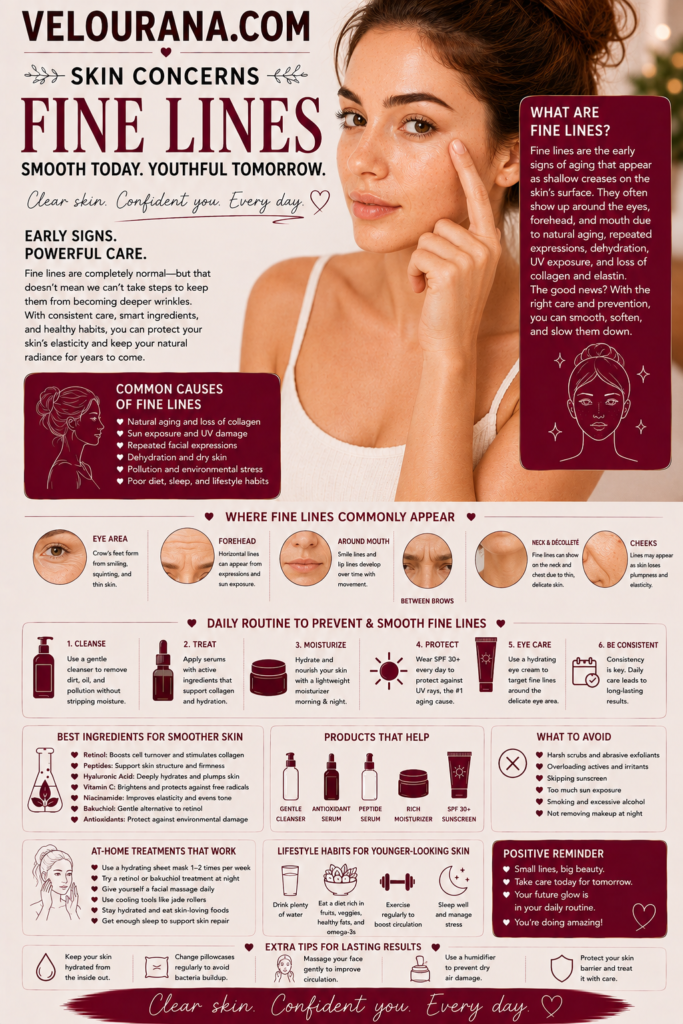
CATEGORY: Fine Lines
There is an understandable tendency to judge aging skin by one visual criterion: smoothness. The fewer lines a face appears to have, the younger it is assumed to look. The more visible its creases, the more aggressively they are treated as evidence of decline.
Yet smoothness and youth are not identical qualities.
A face can be deeply hydrated, luminous and beautifully textured while still showing fine lines. Another can appear temporarily smooth because of makeup, lighting or a cosmetic film while remaining dry, irritated or heavily photodamaged beneath the surface. A third may have relatively few expression lines but show uneven tone, reduced elasticity or other signs of aging more strongly.
Visible age is the result of many features interacting at once.
Fine lines matter because they are among the first structural changes people notice, but they should not be allowed to become the entire definition of healthy-looking skin. When every decision is organized around making the surface appear perfectly flat, skincare can become strangely self-defeating. People exfoliate too frequently, overload their routines with multiple active ingredients, avoid facial expression, chase short-term tightening sensations and abandon products before long-term benefits have had time to emerge.
The pursuit of smoothness can therefore produce skin that is less comfortable, less resilient and more reactive.
A better approach begins by separating four different goals that are often confused: temporary smoothing, long-term improvement, prevention of additional damage and correction of established structural change.
Each belongs to a different category of skincare.
Moisturization can create immediate softness and reduce the visual prominence of shallow lines. Sun protection can reduce future environmental damage. Certain topical treatments can gradually improve features of photoaging. Professional procedures may address deeper or more dynamic changes beyond what cosmetics can realistically achieve.
None of these is inferior to the others. They simply operate on different timescales and through different mechanisms.
Once that distinction is understood, the conversation about fine lines becomes more intelligent. The question stops being, "What removes wrinkles?" and becomes, "What exactly am I trying to change?"
Why Fine Lines Are So Easily Misread
Fine lines look simple because they are visually simple.
A shallow crease is there or it is not. It appears deeper or softer. It becomes more noticeable under one light and less noticeable under another.
But what the eye sees is not necessarily a direct measurement of what is happening biologically.
The visibility of a fine line depends on depth, hydration, pigmentation, surface roughness, facial movement, surrounding volume, lighting angle, makeup and even the position of the head. A tiny depression becomes more noticeable when side lighting casts a shadow across it. The same line may nearly disappear in soft frontal light.
This explains why mirrors can sometimes feel inconsistent.
Bathroom lighting may reveal every texture irregularity. Daylight beside a window may make the same skin look smoother. A photograph taken from below can emphasize one set of lines, while a photograph from slightly above can minimize them.
The line itself may not have changed.
Its contrast has.
This distinction becomes especially important when evaluating skincare results. A person can believe that a product has dramatically reduced fine lines because the skin is more hydrated and reflective. That improvement may be genuine, but it does not necessarily mean that the underlying dermal structure has been substantially remodeled.
Conversely, a useful long-term treatment may produce gradual biological improvement that is difficult to recognize from day to day because facial lighting, dryness and expression are constantly changing.
The human eye is poor at detecting slow change when it sees the same face every morning.
This is why skincare evaluation benefits from patience and consistency. Judging a routine according to whether the face looks exceptionally smooth on one particular day creates noise. Observing how the skin behaves over weeks and months provides a more useful picture.
Fine-line care requires a longer memory than the mirror naturally provides.
Surface Smoothness Is a Real Benefit, but It Is Not the Whole Story
It is fashionable in some skincare discussions to dismiss immediate cosmetic effects as superficial.
That is unnecessarily rigid.
If a moisturizer makes the skin look smoother, softer and more comfortable, that is a legitimate benefit. If a primer diffuses light and makes fine lines less noticeable beneath makeup, that is also a legitimate cosmetic effect. If a hydrating serum temporarily reduces the appearance of shallow dehydration lines, the result still matters to the person using it.
The problem lies only in mislabeling the mechanism.
Cosmetic smoothing should not be confused with structural rejuvenation.
Many products improve appearance through hydration, emollience, film formation or optical diffusion. These mechanisms can create a striking visual result because fine lines are partly perceived through the shadows and texture they create.
A well-formulated moisturizer may improve the outer layers of skin enough that tiny creases become far less obvious. An occlusive component may reduce water loss. Humectants may help the stratum corneum retain water. Emollients may soften roughness between surface cells.
The skin appears plumper because its outer layers are better hydrated.
This is not fake improvement.
It is simply improvement occurring at a different level.
Confusion begins when every visible change is described using terms such as "rebuilding," "lifting," "reversing" or "renewing." Those words suggest deeper and more durable biological transformation than a temporary hydration effect can reasonably provide.
Good skincare language should therefore become more precise.
A moisturizer smooths.
A sunscreen protects.
An evidence-based active may gradually improve aspects of photoaging.
A medical procedure may produce a deeper structural or neuromuscular change.
These categories overlap in appearance, but not in mechanism.
The Skin Barrier Has More to Do with Fine Lines Than It Gets Credit For
Fine-line conversations usually leap quickly toward collagen.
The barrier is less glamorous.
Yet the outermost layers of the epidermis strongly influence how smooth, flexible and comfortable the surface looks.
The skin barrier helps regulate transepidermal water loss and protects the tissue below from environmental stress. When barrier function is compromised, the surface may become dry, rough, tight or irritated. Fine lines can appear more pronounced because the outer layers no longer lie as smoothly.
This is why aggressive skincare can create the illusion of accelerated aging.
Imagine someone concerned about forehead lines who begins using a retinoid, a glycolic acid toner, a strong vitamin C serum and a cleansing brush at the same time. Within days, the face becomes tight and flaky.
The person looks in the mirror and sees more texture.
The instinct may be to add even more "anti-aging" products.
Yet the immediate problem is not that the skin suddenly lost a dramatic amount of collagen. The barrier has been disrupted.
Restoring comfort may improve the appearance far more effectively than introducing another active ingredient.
This is an important principle because modern skincare culture often treats irritation as evidence of seriousness. Tingling is interpreted as potency. Peeling is interpreted as renewal. Redness is interpreted as activity.
But irritation is not a proxy for effectiveness.
A product does not need to hurt to produce benefit.
In fact, unnecessary irritation can interfere with consistent use of treatments that require time.
Fine-line care works best when the barrier is regarded not as a passive surface but as the platform on which the rest of the routine depends.
Collagen Matters, but "Boosting Collagen" Is Too Simple
If skincare advertising had a favorite structural protein, it would be collagen.
The term appears everywhere because it sounds both scientific and intuitive. Aging skin has less organized collagen support, therefore a product that "boosts collagen" seems to solve the problem.
Biology is not quite that simple.
Collagen exists within a complex extracellular matrix. Its synthesis, degradation, organization and interaction with surrounding cells all matter. Aging changes not only the quantity of supporting structures but their quality and arrangement.
Ultraviolet exposure further disrupts this environment by increasing pathways associated with matrix degradation and photoaging.
This is why the phrase "collagen loss" is useful as shorthand but limited as an explanation.
It can also lead consumers toward misleading assumptions.
A product containing collagen does not necessarily deposit new structural collagen into the dermis. A cream claiming to "support collagen" may be referring to indirect mechanisms. A laboratory finding showing that an ingredient influences collagen-related pathways does not automatically prove that a finished cosmetic will visibly erase lines in ordinary use.
Clinical relevance matters.
Formulation matters.
Concentration matters.
Delivery matters.
Duration matters.
The condition being treated matters.
When these details disappear, ingredient marketing becomes a story rather than evidence.
A more useful perspective is to ask which interventions have demonstrated meaningful improvement in visible photoaging and under what conditions. This approach does not produce dramatic slogans, but it leads to better expectations.
The biology of aging skin is complicated enough that any product promising complete restoration through a single ingredient deserves skepticism.
The Role of Retinoids Is Stronger When Expectations Are Correct
Retinoids occupy a unique position in fine-line care because they are among the most extensively discussed and clinically relevant topical approaches to photoaged skin.
Their reputation is not entirely marketing.
Prescription retinoids, particularly tretinoin, have long been used in dermatology for photoaging and can improve features such as fine wrinkling over time. Cosmetic retinoids, including retinol and related derivatives, are widely used at lower strengths or in formulations intended for non-prescription use.
The critical phrase is "over time."
Retinoid-related improvement is not comparable to the instant smoothness created by a hydrating product.
This is where consumer expectations often become distorted.
A moisturizer can make skin look better within hours. A retinoid may require months of consistent use before visible changes become meaningful. Because immediate visual reward is smaller, people sometimes increase the frequency or quantity too quickly.
The result is irritation.
Retinoid dermatitis can involve dryness, flaking, stinging and redness. Ironically, those changes can temporarily make fine lines look worse.
The product intended to improve the appearance of aging becomes associated with rougher-looking skin because it was used beyond the user's tolerance.
This does not mean the ingredient is unsuitable for everyone who experiences early dryness. It means introduction strategy matters.
Gradual use allows the skin to adapt. A supportive moisturizer can improve comfort. Combining multiple strong actives simultaneously may needlessly complicate tolerance.
Most importantly, success should not be measured by peeling.
Visible exfoliation is not the therapeutic objective.
The objective is consistent exposure to an appropriate treatment over a sufficient period while maintaining reasonable skin comfort.
This is a far quieter model of anti-aging than the dramatic transformation promised by advertising. It is also far more sustainable.
Fine Lines and the Problem of Over-Treatment
There is a peculiar psychological effect that often accompanies the first signs of aging.
One line creates urgency.
A person who previously used only cleanser and moisturizer suddenly feels that an entire intervention must begin. New products arrive quickly: retinol, peptides, acids, vitamin C, exfoliating masks, eye cream and perhaps a device promising lifting or tightening.
Each product may have a plausible role independently.
Together, introduced without a plan, they can create confusion.
If the skin improves, it becomes impossible to know which product mattered.
If irritation develops, it becomes impossible to know which product caused it.
If the routine is too complicated to maintain, everything is eventually abandoned.
This is why simplicity is not the opposite of sophistication.
A routine becomes sophisticated when every step has a reason.
For example, gentle cleansing has the purpose of removing debris, sunscreen and makeup without unnecessarily disrupting the barrier. Moisturizer supports hydration and comfort. Sunscreen reduces ultraviolet exposure. A targeted active addresses a specific concern.
Beyond that foundation, each addition should earn its place.
This principle becomes particularly useful for people with sensitive or reactive skin, where stacking multiple exfoliating or stimulating products can produce persistent low-grade irritation.
A complicated routine may look more serious.
A coherent routine is more useful.
Expression Is Part of the Mechanism, Not a Habit to Eliminate
Fine lines around the eyes and forehead are often called expression lines because muscle movement contributes to their formation.
Unfortunately, this can lead to a strange interpretation: perhaps facial expression itself should be minimized.
This idea misses the point.
Human faces are designed for communication.
We smile, frown, squint, raise our eyebrows, laugh and concentrate. The skin folds because the underlying muscles move.
Trying to eliminate ordinary expression in order to prevent lines is neither realistic nor necessary.
What matters is understanding why these lines behave differently from purely surface dryness.
A horizontal forehead line that appears only when the eyebrows rise is primarily dynamic. A line that remains visible with the forehead relaxed has become more static. The mechanical pattern is the same, but the tissue increasingly retains evidence of repeated folding.
Topical skincare can improve the quality of the skin overlying the muscle.
It cannot stop the muscle from contracting.
This distinction explains why some concerns respond better to medical aesthetic treatments that act on muscular activity rather than on the surface itself.
The important conclusion is not that expression lines are untreatable.
It is that the correct intervention depends on the mechanism.
Expecting a topical cream to eliminate muscle-driven folding is like expecting sunscreen to hydrate dry skin. Both are useful products, but they solve different problems.
The Eye Area Demonstrates the Limits of Product Categories
Few areas of the face generate as much specialized marketing as the skin around the eyes.
There are eye creams for fine lines, puffiness, dark circles, firmness, lifting and brightness. Some are excellent products.
Yet the category itself can create the impression that the eye area requires entirely separate biological laws.
It does not.
The skin around the eyes is thinner and can be more sensitive, which means formulation matters. Repeated blinking and smiling create constant movement. The area is also highly visible and particularly sensitive to dryness, making even shallow creases noticeable.
Moisturization can therefore be very helpful.
What matters is whether a dedicated eye cream provides something that the rest of the facial routine does not.
For some people, the answer is yes. They may prefer a richer texture around the eyes, need a gentler formulation or enjoy a product designed specifically for comfortable application in that region.
For others, a suitable facial moisturizer may already meet the need.
The product name is less important than the function.
This is an example of a broader truth in skincare: categories are designed partly for retail convenience, while skin biology does not necessarily respect those categories.
A "neck cream" may contain useful ingredients, but the neck does not recognize the marketing label.
A "line filler" may temporarily smooth texture, but it does not necessarily fill tissue structurally.
A "sleeping mask" may primarily function as a moisturizer.
Fine-line care becomes easier when product names are translated into mechanisms.
Sun Protection Is the Most Important Anti-Aging Step That Does Not Look Like Treatment
Many skincare routines are organized around the evening.
Nighttime feels therapeutic.
The face is cleansed, serums are applied, retinoids are layered, moisturizers are sealed in. The ritual feels active and restorative.
Morning sunscreen can feel less exciting.
Yet from the perspective of preventable visible aging, daily ultraviolet protection is fundamental.
Chronic UV exposure contributes substantially to photoaging, including fine and coarse wrinkling, pigment changes and alterations in collagen and elastic structures.
This means that a person can invest heavily in nighttime treatments while continuing to accumulate the very environmental damage those treatments are meant to address.
The contradiction is obvious once stated.
Sunscreen does not usually make an established line disappear after application. Its value is measured partly by future damage that does not occur.
This makes prevention psychologically difficult because there is no dramatic visible reward.
A serum can create glow immediately.
A sunscreen's greatest achievement may be invisible.
The same logic applies to shade, hats and sensible sun behavior.
None of these techniques promise the fantasy of reversing age. They simply reduce unnecessary environmental contribution to it.
Over decades, that distinction becomes significant.
Why Hydration Can Transform the Face Without Changing Its Age
One of the most visually rewarding things skincare can do is improve hydration.
This is especially true as the skin becomes drier with age.
Well-hydrated skin reflects light more evenly. The surface appears smoother. Fine texture becomes softer. Makeup applies more gracefully.
The entire face may look fresher.
This visual improvement can be so strong that people interpret it as rejuvenation.
In a cosmetic sense, that is understandable.
But the skin has not become chronologically younger.
It has become better hydrated.
This distinction might sound unnecessarily technical, yet it protects consumers from unrealistic expectations.
If hydration is the mechanism, the effect requires continued maintenance.
Stop moisturizing a persistently dry skin type and the fine texture may become more visible again.
That does not mean the moisturizer was ineffective.
It means the condition it was addressing was ongoing.
The same principle applies to many areas of personal care. Hair conditioner improves manageability while it is used. Lip balm supports dry lips but does not permanently change the climate. Moisturizer manages the surface environment of skin.
Skincare does not have to produce permanent transformation to be valuable.
The Strange Relationship Between Matte Skin and Visible Lines
Texture is partly a lighting phenomenon.
This becomes obvious when comparing matte and luminous finishes.
A highly matte surface absorbs and scatters light differently from a hydrated, softly reflective one. Fine lines can appear deeper because shadows become more pronounced across a dry or powdered surface.
This is why some people discover that the makeup techniques they loved at twenty-five become less flattering later.
The skin has changed, but the cosmetic finish may also be contributing.
Heavy powder can settle into creases. Full-coverage foundation can create a thicker film that bends and gathers when the face moves. Extremely dry concealers can emphasize the delicate texture beneath the eyes.
The solution is not necessarily to stop using these products.
It is to reconsider quantity and placement.
A small amount of strategically applied makeup can sometimes create a smoother appearance than trying to completely cover every line.
This is counterintuitive because concealment usually suggests adding more product.
With fine lines, less can create the illusion of more smoothness precisely because there is less material available to accumulate within the crease.
This principle demonstrates again why visible lines cannot be understood solely as structural damage.
Their appearance is always partly optical.
Lifestyle Factors Matter, but They Should Not Become Moral Judgments
Fine-line discussions often expand into lifestyle advice.
Some of it is reasonable.
Smoking is strongly associated with premature skin aging. Chronic ultraviolet exposure accelerates photoaging. Repeated tanning is damaging. General nutrition and health influence the biological environment in which skin functions.
Problems begin when lifestyle advice becomes moralized.
A person with visible lines is not necessarily someone who failed to drink enough water, sleep enough, eat perfectly or manage stress correctly.
Genetics matter.
Anatomy matters.
Hormonal transitions matter.
Environmental exposure accumulates unevenly.
Chronological aging matters.
Skincare should not become a system for blaming people for looking their age.
This is especially important because beauty culture often converts uncertainty into personal responsibility.
If a product fails, perhaps the user did not apply it correctly.
If skin remains lined, perhaps the person did not begin young enough.
If aging becomes visible, perhaps the lifestyle was inadequate.
This logic is convenient for selling endless correction.
It is less useful for understanding biology.
Healthy habits can support skin health. They do not grant immunity from age.
Fine Lines Around the Mouth Require Different Expectations
The area around the mouth introduces another layer of complexity because it combines repeated movement with changes in surrounding support.
Speaking, eating, smiling, pursing the lips and countless subtle expressions continually move this area. With time, fine vertical lines may become increasingly visible.
But the mouth does not age only at the level of the skin.
Underlying fat compartments, bone and soft-tissue support also change over time. These deeper anatomical shifts affect how the overlying surface folds.
This is why a topical product may improve texture without completely changing the overall appearance.
The visible concern is not purely epidermal.
Recognizing this is essential because it prevents unrealistic escalation.
Applying stronger and stronger acids to a structurally influenced line will not necessarily improve it. The person may only irritate the skin around an unchanged crease.
This is one of the situations where professional assessment can be useful if the concern is significant.
Different interventions target different anatomical levels.
Skincare operates primarily at the skin.
It should not be expected to replace volume, reposition tissue or alter facial structure.
The Difference Between Prevention and Preservation
Anti-aging language often describes prevention as though aging itself could be prevented.
It cannot.
The more precise goal is preservation.
Healthy skin can be protected from unnecessary damage. Barrier function can be supported. Photoaging can be reduced. Certain visible changes can be delayed or softened.
But chronological aging continues.
The distinction is important psychologically.
"Prevention" implies that the ideal result is never showing signs of age.
"Preservation" recognizes that the objective is to maintain the skin's condition as well as reasonably possible while time continues.
This is a far more sustainable standard.
It also explains why beginning sensible care earlier can be useful without encouraging obsession in young adults.
There is no need to treat an eighteen-year-old face as though wrinkles are an emergency waiting to happen.
Simple sun protection, appropriate moisturization and avoiding unnecessary damage are already meaningful preventive measures.
Aggressive anti-aging treatment before it is needed may create more irritation than benefit.
Good skincare is responsive, not fearful.
When Professional Treatment Makes More Sense Than Another Cosmetic
There is a point at which buying another cream becomes less rational than acknowledging the limits of cosmetics.
This point differs from person to person because the desired outcome differs.
Someone who wants slightly softer fine texture may be satisfied with a good moisturizer, sun protection and a carefully chosen topical active.
Someone who wants a strong reduction in established forehead lines or crow's-feet may eventually discover that topical skincare cannot provide the degree of change they expect.
At that point, professional treatment becomes a separate conversation.
Depending on the concern, dermatologists and appropriately qualified practitioners may use prescription medication, chemical peels, lasers, resurfacing procedures, injectable treatments or other techniques.
Each carries different benefits, risks, recovery periods and suitability considerations.
The important point is not that procedures are superior.
It is that they operate at different levels.
A moisturizer and a laser should not be judged according to the same expected outcome.
Neither should a cosmetic retinol and a prescription retinoid.
Fine-line care becomes much clearer when categories are not blurred by marketing.
The Most Effective Routine May Look Surprisingly Ordinary
After all the complexity surrounding fine lines, the most rational routine can appear almost disappointingly simple.
Cleanse gently.
Maintain hydration.
Protect the skin from ultraviolet exposure.
Introduce one evidence-based active if appropriate and tolerated.
Allow time.
That is not a glamorous formula.
It does not generate an impressive shelf photograph.
But it aligns with the biology more effectively than constantly adding new products.
Additional ingredients can certainly have value. Antioxidants, niacinamide, peptides, exfoliating acids and specialized moisturizers may all serve specific purposes depending on the individual.
The mistake is assuming that every potentially useful ingredient must be used simultaneously.
Skin does not improve in proportion to the number of steps performed.
A routine is successful when it is coherent, tolerable and sustainable.
Fine Lines Become Easier to Manage When They Stop Being the Enemy
The cultural language of aging is frequently adversarial.
Fight wrinkles.
Defy age.
Reverse time.
Erase lines.
Combat aging.
This language turns every visible crease into a defeat.
Yet fine lines are not an invading disease.
They are partly the result of normal tissue aging interacting with years of expression and environment.
Some of their progression can be influenced.
Some of their visibility can be softened.
Some can be treated medically if desired.
But the skin cannot be maintained indefinitely in the mechanical state of adolescence.
Once this is accepted, skincare becomes more strategic.
A person can still want smoother skin without expecting perfection.
A moisturizer can be appreciated for hydration rather than criticized for failing to rebuild the dermis.
Sunscreen can be valued for protection rather than expected to erase established lines.
A retinoid can be used patiently rather than aggressively.
A professional procedure can be considered when the desired outcome exceeds what cosmetics can provide.
And a remaining line can exist without invalidating the routine.
This is perhaps the central paradox of fine-line care.
The more desperately smoothness is pursued, the easier it becomes to damage the very skin one is trying to improve.
The more accurately the problem is understood, the calmer and often more effective the routine becomes.
Healthy-looking skin is not perfectly flat skin.
It is skin that is comfortable, protected, resilient, reasonably hydrated and cared for according to its actual biology.
Fine lines can exist within that definition.
They are not evidence that skincare has failed.
They are part of the surface history of a living face.
The goal is not to erase that history completely.
It is to make sure the next chapter is written with better protection, better understanding and far less unnecessary damage.
The End Velourana
 Discover More From Our Family of Websites
 ZodiacBearing (Astrology, Tarot, Numerology, Angel Numbers & Spiritual Guidance)
 Velourana (Beauty, Makeup, Hair Care, Skincare & Beauty Tips)
 HavenBearing (Home, Living, Organization, Décor & Everyday Inspiration)
 PawBearing (Pet Care, Dog Breeds, Animal Health, Training & Pet Products)
 PsyCatherine (Notes From the Journal of a Psychologist on Real Life)