
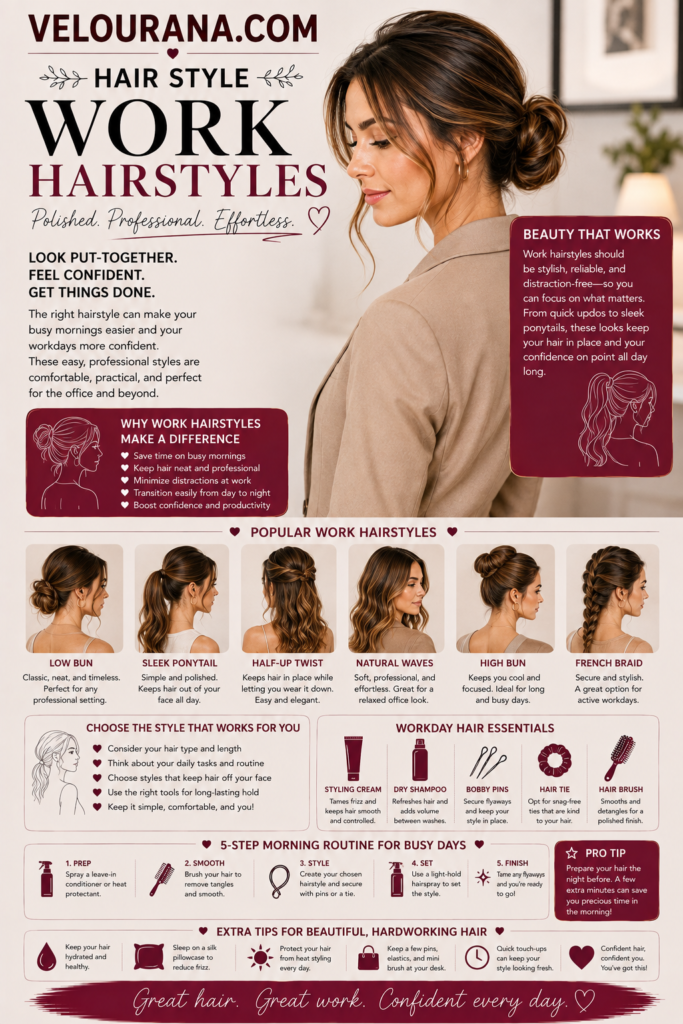
CATEGORY: Work Hairstyles
A work hairstyle is rarely tested at the moment it is finished. Its real test begins afterward.
It begins when someone leaves home and encounters weather, public transport, a car headrest or a hurried walk to work. It continues beneath office lighting, through hours spent at a desk, conversations in corridors, telephone calls, video meetings and the unconscious habit of touching or moving the hair while concentrating. By late afternoon, the hairstyle that looked immaculate in the morning has experienced an ordinary working day, and that is precisely what separates a useful professional style from one that merely photographs well.
The most successful work hair is built around endurance, but endurance should not be confused with stiffness. Hair does not need to be fixed into an immovable shape to survive the day. In many cases, the opposite is true. Hairstyles that allow a degree of natural movement can age more gracefully because they do not depend on every section remaining exactly where it began.
What matters is architecture: the underlying shape, the placement of weight, the relationship between the front and the face, and the ability of the style to change slightly without losing its identity.
This is a more useful way to think about work hairstyles than dividing them into supposedly professional and unprofessional categories. The modern workplace contains too many different environments, dress codes, hair textures and personal styles for one narrow visual formula to make sense. A lawyer in a traditional office, a designer in a studio, a teacher in a classroom, a manager working partly from home and someone moving continuously through a practical workplace do not necessarily need the same relationship with their hair.
Yet they share one requirement.
The hairstyle has to live through the day.
Designing the Hairstyle Backward From the Day Ahead
Most hairstyling begins in front of a mirror. Work hairstyling becomes more effective when it begins mentally several hours later.
Imagine the middle of the afternoon rather than the beginning of the morning. Consider where the hair usually sits after hours of movement, whether the crown tends to flatten, whether the front begins falling forward, whether natural texture expands, or whether a gathered style becomes uncomfortable.
These patterns reveal what the hairstyle actually needs.
A person who repeatedly pushes her hair behind her ears while working may be choosing a morning style that does not respect how she naturally wants the hair positioned. Someone who loosens a ponytail before lunch because of tension is receiving clear information about the structure of that ponytail. Someone whose carefully straightened hair begins recovering its natural wave during every humid commute may be investing time in a finish that the environment consistently refuses to preserve.
None of these situations represents failure on the part of the hair.
They represent a mismatch between styling and reality.
Once the working day becomes part of the design process, different priorities emerge. Comfort matters earlier. Texture is considered more honestly. The commute becomes relevant. The tendency of the hair to settle or expand is anticipated rather than discovered repeatedly.
This approach also reduces the pressure to create a hairstyle that is perfect at eight in the morning. A style can begin slightly more structured if it naturally softens into the desired shape. Volume can be positioned with the knowledge that some of it will settle. Natural curls can be shaped with enough flexibility to accommodate movement.
The goal becomes longevity through adaptation rather than longevity through force.
The Commute Is the First Styling Environment
The journey to work can alter hair before the professional day has even begun.
Wind moves the front sections. Humidity changes texture. Heat creates moisture around the hairline. Rain introduces another variable entirely. Scarves, coats and high collars interact with the lower lengths. A car seat can flatten the back of a carefully shaped style. Public transport can make elaborate loose hair feel inconvenient before the wearer reaches her destination.
These conditions are often treated as unfortunate interruptions between home and office, but for someone who commutes regularly they are simply part of the hairstyle's normal environment.
This changes how preparation can be approached.
A hairstyle intended to remain absolutely smooth despite a humid journey may demand more intervention than one that allows some natural texture to exist from the beginning. Hair that will spend half an hour against a high winter collar may benefit from being positioned differently during travel and released afterward. Volume concentrated exactly where a headrest presses against the hair may need a different structure.
The commute also exposes one of the weaknesses of overworked hair: the more dependent a style is on perfect surface control, the more vulnerable it becomes to ordinary disruption.
A hairstyle with a strong overall silhouette is more forgiving.
The front can be restored quickly because the underlying direction remains clear. A little movement at the crown does not destroy the entire idea. Waves can shift without appearing ruined. Curls and coils can respond to the environment while retaining their broader shape.
Work hair becomes easier when the commute is expected rather than fought every morning.
The Face Is Where Professional Styling Carries Most of Its Visual Weight
Although the complete hairstyle matters, the area surrounding the face often determines whether work hair feels considered.
This is where colleagues look during conversation. It is what appears most prominently during video calls. It is the part of the hairstyle the wearer herself sees whenever she catches her reflection.
A relatively simple hairstyle can therefore feel highly polished when the front has been thoughtfully arranged.
This does not mean the hairline needs to be severe or every short strand controlled. It means the front should have direction. A part should look as though it belongs where it sits. Face-framing pieces should appear intentional rather than continually falling into inconvenient positions. The relationship between the crown and forehead should feel balanced.
For straight hair, a subtle shift in the part can change the entire impression. For waves, the first movement around the face can determine whether the style feels relaxed or more structured. Curly hair can use selected front curls to establish the silhouette while allowing greater freedom elsewhere. Coily hair can create height, framing or asymmetry without reducing its natural volume.
This concentration of visual importance around the face is useful on rushed mornings because it reveals where attention produces the greatest return.
Not every centimetre of hair requires equal intervention.
A person can spend considerable time perfecting the back of the hairstyle while the front remains uncomfortable, only to spend the day pushing it away. Reversing those priorities often creates a more convincing result with less work.
Professional polish is frequently about placement rather than complexity.
The Crown Determines Whether a Hairstyle Feels Awake or Exhausted
The crown is another small area with disproportionate influence.
When it collapses completely, long or dense hair can appear visually heavy. When it is excessively lifted, a style intended to feel understated can become more dramatic than expected. The most flattering amount of volume varies according to the haircut, texture and individual preference, but some consideration of the crown helps establish the overall architecture.
Work hairstyles benefit particularly from volume that can settle attractively.
A style constructed around extreme morning lift may look very different several hours later. If the initial shape is more integrated with the natural behavior of the hair, the change becomes less noticeable.
Fine hair may need lightness more than aggressive volume. Heavy styling can cause the very collapse it was intended to prevent. Dense hair often has enough natural presence and may benefit from directing volume rather than adding more. Curly and coily textures already create dimensional crowns in different ways, so the question becomes shape rather than lift for its own sake.
The crown also affects gathered hair. Pulling everything tightly against the head produces a different professional character from preserving some natural dimension above the fastening. Neither is inherently more appropriate. One feels sharper; the other softer.
Understanding this distinction allows a simple gathered style to be adapted to different personal aesthetics without becoming an entirely different hairstyle.
The Midday Version of the Hairstyle Matters More Than the Morning Photograph
Hair rarely remains unchanged through a working day, and attempting to prevent every change can create unnecessary frustration.
The more useful question is whether the hairstyle still looks coherent after it has changed.
A blow-dried finish may become softer. A wave may lose some definition. Natural curls may gain volume. Straight hair may develop a slight bend where it has rested against clothing. A ponytail may become less pristine around the hairline.
If the style still has a clear silhouette, these changes are often inconsequential.
In fact, hair can become more attractive after the first hour because it stops looking freshly manipulated and begins looking naturally settled.
The professional image does not depend on preserving the exact moment styling ended.
This is where a distinction between structure and surface becomes valuable. Structure is the broad architecture: where the hair is parted, where the volume sits, whether it is loose or gathered, how it frames the face. Surface is the finer detail: individual flyaways, precise wave definition, tiny variations in texture.
A durable work hairstyle protects the structure and allows some flexibility at the surface.
This dramatically reduces maintenance.
Instead of interpreting every change as something requiring correction, the wearer can decide whether the overall shape remains successful. Most of the time, it does.
That freedom from constant inspection is one of the qualities that makes a hairstyle genuinely compatible with work.
Comfort Is an Engineering Problem as Much as a Beauty Decision
A hairstyle worn for many hours has to distribute physical forces sensibly.
This becomes especially apparent with long or dense hair. Gathering substantial weight into one high, tightly secured point can create tension that feels insignificant initially and increasingly unpleasant later. The hairstyle may remain visually perfect while becoming physically unsustainable.
Comfortable styling takes weight seriously.
The position of a fastening changes how the scalp experiences the hair. The size and shape of a bun influence how concentrated that weight becomes. The number and placement of pins can determine whether the structure feels secure or irritating.
Loose hair has its own physical considerations. Very long hair can become trapped behind the body while seated. Dense hair can create warmth around the neck. Front layers can interfere with glasses, headphones or repeated telephone use.
These details may sound mundane compared with discussions of shine, texture and silhouette, yet they often determine which hairstyles people actually repeat.
A work hairstyle becomes part of a routine only when it feels good enough to wear without resentment.
This is one reason the most visually elaborate solution is not necessarily the most sophisticated. A hairstyle that has been intelligently simplified around the physical realities of the day may represent far better design.
Beauty is not compromised by practicality.
For work hair, practicality is part of beauty because it allows the appearance to remain composed naturally rather than through endurance.
The Desk Changes the Relationship Between Hair and Body
Sitting for several hours creates styling considerations that are almost invisible while standing in front of a mirror.
The back of a chair interacts with long hair. A low bun may sit exactly where the head naturally rests. A ponytail positioned at certain heights can be repeatedly pushed upward or sideways by the chair. Long loose hair can become trapped between the back and seat.
These interactions are easy to ignore because they do not appear in photographs.
They are nevertheless part of everyday work.
Someone who spends much of the day seated may discover that a hairstyle positioned slightly higher or lower becomes dramatically more comfortable. Long hair may feel better brought forward periodically or gathered loosely when concentrated desk work begins. A style that avoids placing a large structure directly against the chair can reduce unconscious adjustment.
The same principle applies to headphones.
A headband, high-volume side sections or certain accessory placements may interfere with over-ear headphones worn for long periods. Glasses can interact with hair around the temples. Even frequently putting on and removing a jacket can disturb hair positioned around the shoulders.
Professional styling becomes much more personal once these small physical routines are considered.
The aim is not to eliminate every interaction between hair and the environment. That would be impossible. It is to avoid building the hairstyle directly around a point of predictable friction.
When those conflicts disappear, the hairstyle feels remarkably easier even though its appearance may have changed very little.
Natural Texture Often Becomes More Reliable When It Is Given Room to Behave Naturally
The working day exposes the limits of styling against natural texture.
Hair has memory. Humidity, moisture and movement can encourage it toward its natural pattern, particularly over many hours. A finish that depends on continuously suppressing that behavior may require more preparation and more concern throughout the day.
Working with texture creates a different relationship.
Waves can be allowed to develop rather than treated as imperfections in straight hair. Curls can retain variation without requiring every section to match. Coils can occupy their natural volume instead of being judged according to standards created for smoother textures.
This does not mean natural hair must always be worn completely untouched.
Professional styling can still shape, define, gather, stretch or redirect texture according to preference. The difference is that the underlying behavior of the hair becomes an ally rather than an adversary.
A curly style that expands slightly during the day may simply become fuller. A coily silhouette can tolerate small changes because texture is already part of its architecture. Wavy hair can soften without losing its identity.
This flexibility creates resilience.
The hairstyle does not have only one acceptable state.
It exists within a range of attractive states, all recognizably part of the same look.
For a long working day, that is a considerable advantage.
Heat Styling Has a Different Role in a Repeated Work Routine
Heat styling can create beautiful professional finishes, but repetition changes the calculation.
An occasional blowout or straightened style is different from a routine that depends on extensive heat every weekday simply to make the hair feel suitable for work.
The issue is not that heat-styled hair is somehow less authentic or that it should be avoided categorically. The more useful question is whether the desired finish can be maintained efficiently and whether the routine respects the condition of the hair over time.
A work hairstyle is repeated far more frequently than a special-occasion look. Small decisions therefore accumulate.
A finish that lasts several days may make more sense than reconstructing it each morning. Targeted restyling may be sufficient when only the front has changed. Preserving a blowout overnight can reduce the amount of intervention required the following day.
Natural texture can also coexist with selective heat styling rather than forcing an all-or-nothing choice. The front or ends may receive attention while the overall movement remains natural.
This reflects the broader philosophy of good work hair: intervention should have a purpose.
The objective is not to perform the maximum amount of styling. It is to create a reliable appearance with an amount of effort that remains sensible when repeated week after week.
Professional Consistency Does Not Require Wearing the Same Hair Every Day
Reliability can easily become monotony if consistency is interpreted too literally.
A professional hair identity can remain coherent while changing from day to day.
The continuity may come from the way the hair frames the face rather than from one fixed hairstyle. It may come from maintaining natural texture across loose and gathered variations. It may come from a preference for clean lines, softness, volume or minimalism.
This creates room for variation without requiring a new visual identity every morning.
The hair might be loose when freshly styled and gathered later in the week. Natural curls may change in volume over several days while remaining part of the same aesthetic. A short cut may alternate between smoother and more textured finishes. Long hair may shift between open and controlled shapes according to the schedule.
The advantage of this approach is that the routine follows the condition of the hair.
Instead of forcing every day to resemble wash day, styling can adapt as texture evolves. Hair that no longer wants to behave exactly as it did two days earlier can move naturally into another form.
This is more efficient and often more attractive.
Professional consistency is then communicated through care and intentionality rather than repetition.
The person looks recognizably herself even though the hairstyle changes.
The Working Week Has Its Own Hair Rhythm
Hair does not reset automatically every morning, and professional routines become more realistic when the week is treated as a sequence rather than five unrelated styling sessions.
The condition of the hair on the first day after washing may differ considerably from its condition several days later. Some textures become easier to shape after a little time. Others lose volume or become more prone to oiliness at the roots. A blowout may gradually soften. Curls may become less individually defined while maintaining an attractive overall texture.
Instead of fighting these changes, the work week can be organized around them.
This does not require a rigid schedule. It requires observation.
The style that works beautifully when the hair is freshly washed does not have to remain the style used later. As the hair changes, the architecture can change with it.
This creates a more intelligent routine because styling follows the material available on that particular morning.
The concept also reduces unnecessary washing or restyling undertaken solely because the hair no longer resembles its first-day state. A different professional appearance can emerge from the same hair several days later.
There is elegance in allowing that evolution.
The working week becomes a progression rather than a repeated attempt to return to the beginning.
Small Adjustments Are More Valuable Than Emergency Reconstruction
A reliable work hairstyle should not require carrying an entire styling station to work.
Nevertheless, hair occasionally needs attention. Weather changes. A fastening shifts. The front behaves differently after several hours.
The most useful corrections are small because the original architecture remains intact.
A part can be restored. The front can be repositioned. A fastening can be adjusted. The crown can be gently reshaped. A section that has become inconvenient can be secured.
These interventions work because they address the point where the hairstyle has changed rather than assuming the entire style has failed.
This is another reason strong underlying structure matters.
When the hair begins as a collection of individually perfected details, damage to one detail can feel disproportionately important. When the hairstyle begins as a coherent shape, minor irregularities remain minor.
The same principle reduces the tendency to touch the hair continuously.
Frequent manipulation can create more disruption than the original problem. Once the hairstyle has been corrected sufficiently, leaving it alone is often the best decision.
Work hair should support attention directed elsewhere.
A Professional Hairstyle Should Survive Changes in Authority and Context
A normal working day can contain several different social environments.
Someone may begin with informal conversation among colleagues, move into a formal client meeting, appear on camera with senior management and finish the day at an external event. The hairstyle does not necessarily change between these contexts, yet it should feel comfortable in all of them.
This is where personal authenticity becomes valuable.
A hairstyle that feels genuinely connected to the wearer tends to travel between contexts more successfully than one created specifically to imitate a narrow image of authority.
Confidence is not produced by a bun, straight hair, a ponytail or any other single construction.
It comes partly from familiarity. A person who understands her hair and knows that it will behave reliably is less likely to become self-conscious when the context becomes more formal.
Professional presence is therefore supported by mastery rather than conformity.
A well-shaped natural texture can carry authority. So can long loose hair, a precise crop, braids, waves or a gathered style. The broader presentation, workplace culture and practical situation matter more than adherence to one hairstyle.
The aim is not to create hair that announces professionalism.
It is to create hair that never undermines the wearer's ability to feel fully present.
The End of the Day Reveals Whether the Hairstyle Was Truly Successful
By the time work finishes, a hairstyle has accumulated evidence.
If it remains comfortable, recognizable and reasonably close to its intended shape, it has succeeded even if it no longer looks freshly styled.
If it has required repeated adjustment, caused discomfort or demanded constant concern, the morning appearance becomes less important.
This end-of-day perspective is valuable because it encourages gradual refinement.
Perhaps the hairstyle needs less tension.
Perhaps the front should begin farther away from the face.
Perhaps more natural texture should be allowed.
Perhaps the crown should not be built quite so high.
Perhaps the haircut itself needs to better support the routine.
These are not failures. They are information.
The best professional routines are developed through this kind of observation. They become increasingly personal because generic advice is replaced by knowledge of how one person's hair behaves through one person's day.
Eventually, the hairstyle stops feeling like a daily beauty problem requiring a fresh solution.
It becomes familiar infrastructure.
Work Hair at Its Best Is Quietly Competent
There is an appealing parallel between a well-designed work hairstyle and professional competence itself.
Neither needs to draw constant attention to the effort behind it.
The hairstyle works because its foundations are sound. It understands the environment. It accommodates change. It does not collapse because one small thing moves out of place. It remains flexible without losing its structure.
This is a more interesting model of professional beauty than perfection.
Hair can have texture.
It can move.
It can become slightly softer after lunch.
Natural curls can expand.
Straight hair can develop a little movement.
A ponytail can become less pristine around the hairline.
A short cut can shift subtly through the day.
None of these changes removes intention.
The professional quality remains because the complete shape continues to make sense.
This perspective also removes much of the unnecessary pressure surrounding work hair. There is no requirement to perform an elaborate transformation every morning. There is no universal texture that communicates competence. There is no obligation to hide personality beneath a supposedly safe hairstyle.
Instead, there is an opportunity to develop something far more useful: a relationship with the hair that understands both aesthetics and reality.
The commute is part of that reality.
The chair is part of it.
The weather is part of it.
The camera is part of it.
The length of the working day is part of it.
So are the wearer's natural texture, personal style and tolerance for morning preparation.
When all of these elements are allowed into the decision, professional hairstyling becomes simpler rather than more complicated. Choices that repeatedly fail can be discarded. Techniques that work can be refined. The hairstyle begins to cooperate with the day.
Over time, this can produce something more valuable than a collection of different work hairstyles.
It produces a dependable professional hair identity.
The person knows what degree of polish feels right. She knows where her hair naturally wants to sit. She understands which textures survive her commute, which structures remain comfortable and how much morning effort is genuinely worthwhile.
There is no longer a need to ask whether the hairstyle looks sufficiently like an abstract idea of professional hair.
It looks professional because it is deliberate, appropriate to its environment and completely under the wearer's understanding.
That is the real architecture of successful work hair.
Not a rigid structure that refuses to move, but a thoughtful one that can move through an entire working day without losing what made it work in the first place.
The End
Velourana.
 Discover More From Our Family of Websites
 ZodiacBearing (Astrology, Tarot, Numerology, Angel Numbers & Spiritual Guidance)
 Velourana (Beauty, Makeup, Hair Care, Skincare & Beauty Tips)
 HavenBearing (Home, Living, Organization, Décor & Everyday Inspiration)
 PawBearing (Pet Care, Dog Breeds, Animal Health, Training & Pet Products)
 PsyCatherine (Notes From the Journal of a Psychologist on Real Life)

