CATEGORY: Dehydration
There is a particular kind of skincare confusion that begins with a contradiction. The face looks shiny, especially through the forehead, nose and chin, yet immediately after cleansing it feels tight. Foundation seems to slide away from some areas while clinging stubbornly to others. The pores remain visible, occasional blemishes continue to appear, and by afternoon there may be enough surface oil to make blotting paper seem essential. At the same time, the complexion looks strangely dull, delicate lines seem more obvious, and the skin never quite achieves the comfortable, flexible feeling associated with good hydration.
The obvious conclusion is often that the skin is oily and therefore needs less moisture. Stronger cleansers appear logical. Rich moisturisers are avoided. Exfoliation becomes more frequent. Mattifying products multiply.
Yet the contradiction persists because oiliness and dehydration are not opposites.
Sebum is oil. Hydration refers primarily to water. Although these two elements interact within the skin's protective environment, they are not interchangeable. A complexion can produce substantial amounts of sebum while its outermost layers struggle to retain sufficient water. Once this distinction is understood, the apparently impossible combination of shine and tightness becomes considerably easier to interpret.
This matters beyond terminology. Mistaking dehydration for excessive oiliness can encourage a routine that continually removes lipids, increases irritation and leaves the skin feeling progressively less comfortable. The resulting cycle is frustrating precisely because every response seems sensible when viewed through the assumption that shine must mean the skin has too much of everything.
Dehydrated oily skin requires a different philosophy. The objective is neither to drown the complexion in heavy creams nor to strip it into submission. It is to restore proportion: cleanse effectively without unnecessary aggression, support water retention without creating unwanted heaviness, use active ingredients according to tolerance rather than ambition, and recognise that a healthy complexion does not have to be perfectly matte.
The paradox disappears once oil and water are allowed to be different things.
Oil Production and Water Retention Tell Different Stories
Skin type is often discussed as though it were a single measurement. In reality, several characteristics contribute to how a complexion behaves.
Sebaceous glands produce sebum, a lipid-rich substance that reaches the skin's surface and contributes to its protective environment. Some people naturally produce more sebum than others. Genetics, hormones, age and other biological influences all contribute to this variation. This is one reason oily skin can persist even when someone uses products designed to remove surface oil repeatedly.
Hydration describes something else: the amount of water available within the outer layers of the skin and the skin's ability to retain it.
The distinction becomes particularly important at the stratum corneum, the outermost portion of the epidermis. This layer is sometimes compared to a brick wall. Corneocytes act loosely like bricks, while surrounding lipids contribute to the organised material between them. The analogy is imperfect, but it captures an important principle: the quality of the outer barrier influences how efficiently the skin limits unnecessary water loss.
Water is continually moving through the skin and eventually evaporating from its surface. This normal process is known as transepidermal water loss. The problem is not that water ever escapes; some loss is physiological. Difficulty arises when the barrier is compromised or environmental conditions increase evaporation enough that the outer skin becomes insufficiently hydrated.
An oily complexion is not automatically protected from this process.
Surface sebum may create shine, but visible oil does not prove that the stratum corneum contains an optimal amount of water. This explains why someone can blot oil from the nose while simultaneously experiencing tightness around the mouth or fine surface lines across the forehead.
It also explains why the solution cannot be determined simply by looking at shine.
The relevant question becomes more precise: is the complexion producing abundant oil, losing too much water, or doing both?
For many people, the answer is both.
The Tight-After-Washing Clue
One of the most useful observations in a dehydration-prone routine occurs within minutes of cleansing.
Healthy skin does not need to feel squeaky in order to be clean.
The sensation of extreme tightness after washing is sometimes celebrated because it creates an immediate impression that grease, dirt and residue have been thoroughly removed. For oily skin in particular, that feeling can become psychologically reassuring. A cleanser that leaves the complexion comfortable may even be dismissed as insufficiently powerful because the familiar post-cleansing tightness is absent.
But tightness is not a cleanliness meter.
Cleansing needs to remove sunscreen, makeup, excess sebum and accumulated material appropriately. It does not need to remove every trace of the skin's surface lipids.
When cleansing is too aggressive for an individual's skin, the result can be an uncomfortable cycle in which the face feels extremely clean for a short period and increasingly uncomfortable afterward. The person may then apply a collection of strong treatments to control oil, extending the challenge to the barrier.
Water temperature can intensify the effect. Very hot water feels satisfying, particularly when someone associates heat with deeper cleansing, but prolonged hot-water exposure can aggravate dryness and discomfort. Dermatologists commonly recommend warm rather than hot water and gentle cleansing practices for dry or sensitive skin.
The frequency of cleansing matters too.
A person who wakes with an oily forehead may cleanse vigorously in the morning, wash again after exercise, cleanse after returning home and perform another thorough routine before bed. Each individual wash can appear reasonable, yet the cumulative effect may be excessive.
This does not mean oily skin should be left unwashed or that everyone needs the same cleansing frequency. Context matters. Someone wearing substantial makeup and water-resistant sunscreen needs effective evening removal. Someone exercising heavily may understandably want to cleanse afterward.
The principle is proportionality.
If the complexion repeatedly feels tight immediately after washing, becomes uncomfortable until moisturiser is applied or begins stinging when previously tolerated products touch the skin, cleansing deserves examination before another treatment product is purchased.
Sometimes the first meaningful hydration step is not adding anything.
It is removing less.
Why More Shine Does Not Necessarily Mean More Hydration
A persistent skincare belief proposes that dehydrated skin automatically produces extra oil to compensate for missing water. The idea is appealing because it neatly explains why a tight complexion might also become shiny.
Reality is more complicated.
Sebum production and epidermal hydration are influenced by different mechanisms, and it is too simplistic to assume that every increase in shine is the sebaceous glands deliberately responding to dehydration by manufacturing replacement oil. Hormones, genetics, temperature, age, skincare products and individual physiology can all influence oiliness.
This distinction matters because explanations shape behaviour.
If someone believes every trace of oil is a direct emergency response to dehydration, they may expect that applying enough moisturiser will permanently transform naturally oily skin into a low-sebum complexion. When this fails to happen, the moisturiser is blamed.
A more realistic expectation is that improving hydration can make oily skin feel more comfortable, improve surface texture and allow a less aggressive routine. It does not necessarily change the person's fundamental tendency toward sebum production.
That is perfectly acceptable.
Healthy oily skin is still oily skin.
The objective is not to convert every complexion into the same imagined "normal" skin type. It is to allow each skin type to function comfortably while addressing specific concerns.
For someone naturally prone to oiliness, this may mean accepting some midday shine while eliminating the uncomfortable tightness that used to accompany it. That represents progress even if blotting paper remains useful.
The skincare industry has spent decades treating shine as an enemy. Yet a slightly luminous surface is not evidence of poor hygiene or failed skincare. The obsession with absolute mattness can encourage people to keep removing oil long after the complexion has been adequately cleansed.
Dehydration becomes easier to manage when comfort replaces mattness as the primary measure of success.
Acne-Prone Skin Makes the Balance More Difficult
The relationship between dehydration and oiliness becomes particularly complicated when acne enters the picture.
Someone experiencing breakouts has good reason to think carefully about products. Certain textures may feel uncomfortable, some ingredients may not suit the individual, and effective acne treatments themselves can produce dryness or irritation. The understandable fear is that moisturising will somehow feed the acne.
This can lead to a routine dominated by removal and treatment.
A foaming cleanser is followed by an exfoliating acid. A spot treatment is applied. Perhaps a retinoid is used later. A clay mask appears several times a week. Moisturiser, meanwhile, is treated as optional because the face already looks oily.
The problem is not necessarily any single one of these products. Many active ingredients have legitimate roles in acne management. The difficulty is cumulative intensity.
When multiple drying or irritating interventions are layered together, the skin may become increasingly uncomfortable. Flaking develops around active blemishes. Concealer catches on those flakes. More exfoliation is introduced to smooth them. The surface becomes even less tolerant.
A moisturiser can play an important supporting role in acne routines precisely because treatment should not require unnecessary suffering.
The appropriate formulation does not have to be rich or greasy. Modern moisturisers exist in fluid, lotion, gel-cream and cream textures, allowing people with oily skin to select products that feel cosmetically acceptable. Ingredients such as glycerin, hyaluronic acid, ceramides and various emollients can be incorporated into relatively lightweight formulations.
What matters is that hydration support becomes part of the treatment strategy rather than an afterthought.
An acne routine that controls breakouts but leaves the entire face burning, peeling and chronically tight is not automatically superior because it feels powerful.
Tolerance matters because consistency matters.
A well-designed routine that can be followed comfortably over time is often more sensible than an excessively aggressive routine that repeatedly forces the user to stop everything while the skin recovers.
Dehydration Can Distort the Appearance of Texture
One of the most frustrating characteristics of dehydrated skin is that it can make the complexion appear simultaneously oily and rough.
Oil reflects light, creating shine. Dehydration can make the outer surface less smooth, affecting how light reflects across the rest of the face. The result may be bright highlights across oily areas surrounded by a complexion that somehow still looks dull.
Fine surface lines can become more obvious as well.
This is especially noticeable around the eyes, across the forehead and near the mouth, where movement already creates temporary folds. When the outer skin contains less water, these lines may appear more sharply defined.
They are easily mistaken for sudden ageing.
Someone may therefore respond by adding stronger anti-ageing products at precisely the moment when the skin would benefit from a calmer routine. A powerful retinoid, acid or exfoliating treatment is introduced because the forehead suddenly appears lined. If the underlying issue is partly dehydration, irritation can make the surface look worse before any longer-term benefits of the active ingredient have an opportunity to develop.
Hydration cannot remove established structural wrinkles, and it should never be marketed as though it can rebuild the deeper architecture of ageing skin overnight. What it can do is improve the appearance of the outer surface, allowing existing lines to appear less exaggerated by dryness.
This distinction is subtle but valuable.
When a complexion appears unexpectedly older after travel, harsh weather, excessive cleansing or an unusually aggressive week of skincare, the immediate conclusion does not have to be that irreversible ageing has suddenly accelerated.
Sometimes the skin is simply thirsty.
The Humectant Trap
Once dehydration has been identified, another extreme becomes possible: collecting hydrating serums.
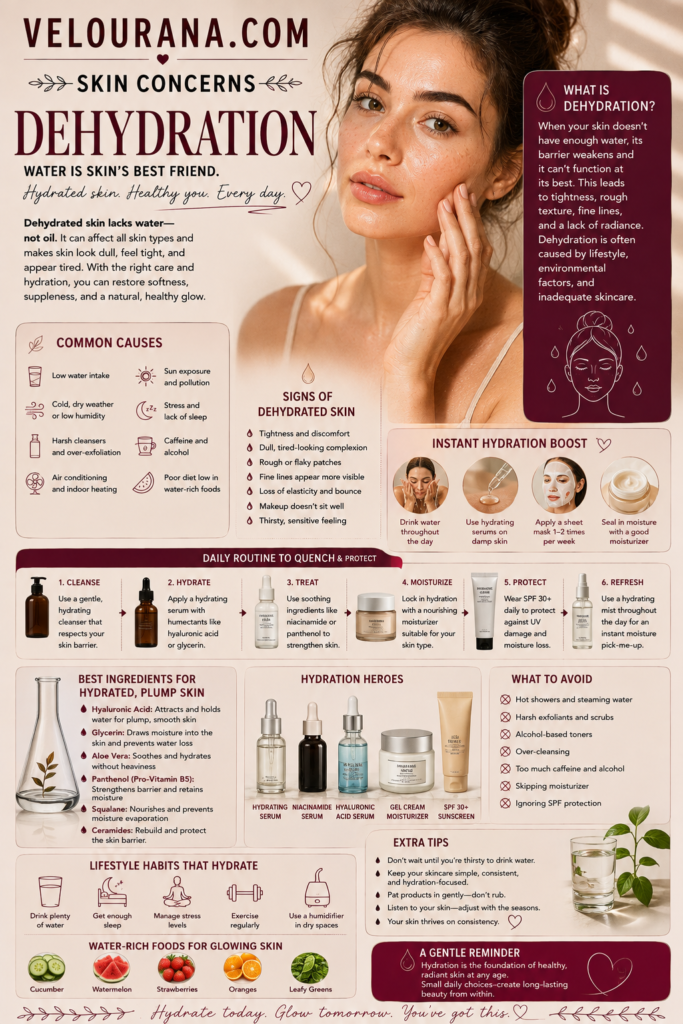
Hyaluronic acid has become almost synonymous with hydration, but it belongs to a broader family of ingredients known as humectants. Glycerin is another extremely common example. Humectants help attract and bind water within the outer skin, making them useful components of hydration-focused formulations.
The mistake is assuming that humectants are the entire solution.
A person may apply a hydrating toner, hyaluronic acid essence, glycerin serum and another "moisture booster," then wonder why the face still feels tight several hours later.
The missing concept is retention.
A well-rounded moisturising strategy generally combines different functions. Humectants contribute water-binding effects. Emollients help smooth and soften the surface. More occlusive ingredients can reduce the rate at which water escapes.
Not every oily complexion requires a highly occlusive ointment. The point is not that everyone should seal the face beneath petrolatum. The point is that hydration should be considered as a complete system rather than a competition to apply the largest number of water-based layers.
For many people with oily but dehydrated skin, a well-formulated lightweight moisturiser may be more useful than several redundant serums.
This can also simplify troubleshooting.
When ten products are layered together, it becomes difficult to know which one is helping and which one is causing irritation. A shorter routine makes cause and effect easier to observe.
There is elegance in functional simplicity: a gentle cleanser that does its job, one hydrating product if desired, an appropriate moisturiser, sunscreen during the day and carefully selected treatment products for genuine concerns.
Hydration does not require maximalism.
Moisturiser Texture Should Follow the Skin, Not the Label
People with oily skin often have a complicated relationship with moisturiser because traditional creams can feel too heavy.
This is a legitimate sensory preference, not a failure to understand skincare.
A product that leaves someone feeling coated and uncomfortable is unlikely to become a consistent part of their routine. Fortunately, hydration does not depend on using the thickest available formulation.
Lotions and gel-creams can provide humectants and emollients in textures that spread easily and absorb with relatively little residue. Some oily complexions may prefer a lightweight moisturiser during humid weather and something slightly richer during winter. Others may use different textures on different areas of the face.
Combination skin makes this particularly useful.
The forehead and nose may need only a light layer while the cheeks or mouth area benefit from more emollient support. There is no requirement that exactly the same quantity of moisturiser be applied uniformly across every centimetre of the face.
The word "oil-free" can also become unnecessarily powerful in purchasing decisions. Whether a formulation suits acne-prone or oily skin depends on more than a single marketing phrase. Texture, overall formulation, individual tolerance and the rest of the routine all matter.
Likewise, "rich" is not synonymous with superior hydration.
A beautifully formulated light moisturiser that someone uses consistently can be far more useful than an intensely occlusive cream that feels so unpleasant it remains untouched.
The best texture is the one that provides sufficient support without creating a sensory experience the user dislikes.
Skincare has to work on human beings, not just on ingredient charts.
Active Ingredients Need a Hydrated Context
Retinoids, exfoliating acids and other active ingredients can be valuable, but their benefits are often discussed separately from the condition of the skin receiving them.
This creates a strange situation in which people carefully research the percentage of an acid while paying little attention to whether their complexion is already irritated.
Dehydrated skin may tolerate active ingredients poorly, particularly when the barrier has been compromised. Burning, persistent stinging, redness, flaking and unusual sensitivity are signals worth respecting.
The instinct to "push through" irritation comes partly from the belief that visible discomfort proves a treatment is working.
That is not a useful universal rule.
Some active ingredients can cause an adjustment period, and certain treatments require patience. But significant or persistent irritation is not automatically a badge of effectiveness. A routine should be adjusted according to individual tolerance, and professional guidance may be appropriate for prescription treatments or significant skin conditions.
For non-prescription routines, introducing one major active at a time can make the skin's response easier to interpret.
Frequency can be adjusted as well.
Someone who tolerates an exfoliating acid twice weekly has no obligation to use it daily simply because another person's routine does. Someone using a retinoid may find that moisturising before or after application improves comfort. The exact strategy depends on the product and individual circumstances, but the principle remains consistent: efficacy and tolerance need to coexist.
Dehydration is often a useful signal that the routine has become unbalanced.
Instead of purchasing another corrective treatment, reducing active frequency for a period can reveal whether the complexion needed intervention or simply rest.
Climate Can Change an Oily Complexion Dramatically
People frequently discover dehydration when the seasons change.
Summer humidity can make oily skin feel almost excessively comfortable. Lightweight products seem sufficient. Moisturiser may feel unnecessary by midday, and the complexion remains flexible even after cleansing.
Then winter arrives.
Cold outdoor air and heated indoor environments alter the conditions surrounding the skin. A routine that seemed perfectly balanced several months earlier begins producing tightness. The same cleanser suddenly feels harsher. The lightweight gel that worked beautifully in July no longer provides enough comfort.
The skin type may not have fundamentally changed.
The environment has.
Air conditioning can create a similar effect during summer, especially for people who spend most of the day indoors. Long-haul travel introduces another abrupt environmental shift. A person can leave a humid location, spend hours in a dry aircraft cabin and arrive somewhere cold within a single day.
A responsive routine accommodates these changes.
This might mean switching from a gel to a lotion, using a richer moisturiser at night, cleansing less aggressively in the morning or reducing exfoliation during periods when the skin feels more vulnerable.
Such adjustments are sometimes portrayed as inconsistency. In reality, they reflect intelligent observation.
We change clothing according to temperature because environmental conditions change what the body needs for comfort. There is little reason skincare should be expected to remain completely static.
The complexion does not know that a particular moisturiser has been declared someone's "holy grail." It responds to the conditions it actually encounters.
Makeup Often Reveals Dehydration Before the Mirror Does
Dehydration can become particularly obvious during makeup application.
Foundation that normally sits smoothly begins catching around the nose or mouth. Concealer gathers beneath the eyes. Powder makes the complexion look unexpectedly papery. At the same time, oil eventually breaks through the centre of the face.
This can lead to an increasingly elaborate makeup strategy: more primer for the flakes, more powder for the shine, more setting spray to merge the layers and more exfoliation the night before to create a smoother canvas.
Sometimes the problem begins underneath all of this.
When the outer skin is poorly hydrated, makeup cannot create the same smooth optical surface. Heavy powder may accentuate fine texture, while adding more foundation over flaky areas creates thickness rather than smoothness.
Preparing dehydrated oily skin therefore requires balance.
The skin should be moisturised sufficiently before makeup without being overloaded with layers that have not settled. Allowing skincare time to absorb can help. The amount of moisturiser can be varied according to different facial areas, and mattifying products can be reserved for genuinely oily zones rather than spread across the entire face automatically.
This targeted approach recognises that the complexion can contain different needs simultaneously.
The goal is not to make skin uniformly dry before makeup. It is to create a comfortable surface and then control excess shine where necessary.
Makeup performance can consequently become a useful indicator of skincare progress. When foundation begins sitting more evenly and powder no longer emphasises every tiny line, improved hydration may be contributing even if the person's natural oil production remains.
The Psychological Appeal of Stripping the Skin
There is another dimension to dehydrated oily skin that has little to do with ingredients: the emotional satisfaction of immediate results.
Removing oil produces an instant transformation.
A shiny face becomes matte within seconds after cleansing, blotting or powdering. This is visible, measurable and gratifying. Hydration improvements are usually slower and subtler. They appear as better comfort, smoother texture and greater stability over days or weeks.
This difference can make aggressive oil removal psychologically compelling.
The person sees shine and acts. The shine disappears. The action appears successful.
But skincare should not be judged only by what happens during the first five minutes after application.
If a cleanser creates perfect mattness but leaves the skin painfully tight an hour later, the immediate cosmetic result has come at a cost. If blotting paper is required every few hours but the skin otherwise feels comfortable, that may actually be preferable to maintaining an artificially dry surface through repeated harsh cleansing.
Long-term thinking changes the objective.
Instead of asking, "How can I remove all this oil right now?" the better question becomes, "How can I keep this complexion comfortable and stable throughout the day?"
That shift may seem small, but it can completely restructure a routine.
A More Rational Morning
A hydration-conscious morning routine for oily skin does not need to be complicated.
Whether a morning cleanser is necessary depends on individual preference and skin behaviour. Some people enjoy a gentle cleanse after sleeping, while others with easily dehydrated skin may find that rinsing appropriately is sufficient. There is no universal requirement that every face undergo intensive cleansing twice daily.
After cleansing, a hydrating serum or toner can be used if it genuinely improves comfort, but it is optional rather than mandatory.
Moisturiser then becomes a functional choice rather than an ideological one. A lightweight formula can provide hydration support without leaving the skin excessively heavy.
Daytime sunscreen remains important. Broad-spectrum protection helps protect against ultraviolet exposure, which contributes substantially to premature visible skin ageing. Choosing a sunscreen with a finish that suits oily skin can make daily use considerably easier.
The sophistication of the routine lies in its compatibility.
A moisturiser that pills underneath sunscreen is not ideal for that particular combination. A sunscreen so greasy that the user avoids applying an adequate amount is not practically successful merely because its ingredient list looks impressive. Products need to work together in real life.
The morning routine should leave the complexion protected and comfortable enough that it can largely be forgotten until later.
Skincare is working particularly well when it stops demanding constant attention.
A Calmer Evening Can Do More Than Another Treatment
Evening is where routines often become crowded.
Once sunscreen and makeup have been removed appropriately, there is a temptation to treat every possible concern before bed: pores, pigmentation, wrinkles, acne, texture, dullness and dehydration.
The result can resemble a laboratory experiment.
For dehydrated oily skin, the evening may instead be an opportunity to simplify.
Effective cleansing is important, particularly when makeup or resistant sunscreen has been worn. Double cleansing can be useful for some people in those circumstances, but it should not become a ritual of progressively stronger cleansing simply because two steps sound more thorough.
Afterward, treatment products can be used according to actual goals and tolerance rather than habit. A moisturiser completes the routine.
When the skin has become significantly irritated, temporarily reducing optional actives can provide a useful reset. This does not mean abandoning evidence-based ingredients permanently. It means recognising that the skin's current condition influences what it can comfortably tolerate.
A calm evening routine may feel less productive than a seven-step transformation ritual.
Yet skin does not reward effort for its own sake.
How to Recognise Improvement
Dehydration does not have a single home test that can definitively diagnose and measure it, despite the popularity of various pinching and squeezing tricks online.
The most useful evidence often comes from observing patterns.
Does the skin feel less tight after cleansing? Does moisturiser remain comfortable for longer? Has the sudden stinging disappeared? Does makeup sit more evenly? Are fine surface lines less exaggerated? Does the complexion remain flexible even when some natural oil appears during the day?
These changes matter.
Improvement should not be defined solely by reduced shine because the underlying skin type may remain oily. Expecting hydration care to eliminate natural sebum production creates an unfair standard.
The more meaningful goal is stability.
A stable complexion does not swing dramatically between stripped tightness and heavy greasiness because the routine is constantly fighting it. It tolerates necessary cleansing, remains comfortable between applications and responds predictably to treatment products.
Progress may therefore look less dramatic than a before-and-after photograph suggests.
It may simply feel better.
In skincare, comfort is valuable information.
When It May Not Be Simple Dehydration
Not every tight, flaky or oily complexion should be self-diagnosed as dehydrated skin.
Persistent redness, intense itching, cracking, bleeding, swelling, significant pain or recurring rashes can indicate conditions that require professional evaluation. Seborrheic dermatitis, eczema, rosacea, psoriasis, contact dermatitis and other dermatological conditions can sometimes produce symptoms that consumers initially interpret as ordinary dryness or dehydration.
Acne itself can also warrant professional treatment when it is persistent, severe, painful or causing scarring.
This is why adding more products indefinitely is not always the sensible response.
If a carefully simplified routine and appropriate moisturising fail to improve persistent discomfort, a dermatologist can assess whether something beyond routine-related dehydration is occurring.
Professional diagnosis becomes particularly valuable when the skin's behaviour seems contradictory or when previously tolerated products suddenly provoke significant reactions.
Skincare literacy includes recognising its limits.
The Goal Is Comfortable Oily Skin, Not Skin Without Oil
The dehydration paradox ultimately becomes easier to solve when the objective changes.
Oily skin does not need to be cured of being oily.
It needs to be understood.
Sebum can coexist with insufficient water. Shine can coexist with tightness. Acne treatments can coexist with moisturisers. Hydration can be improved without smothering the complexion beneath a heavy cream.
Once these ideas are separated, skincare becomes more precise.
A gentle but effective cleansing routine reduces unnecessary stripping. Humectants can help bind water. Moisturisers provide broader support for softness and retention. Active ingredients can address genuine concerns without being layered recklessly. Environmental changes can be answered with seasonal adjustments rather than panic.
Most importantly, the appearance of oil no longer automatically triggers an attempt to remove everything from the surface.
There is a point at which controlling oil becomes overcontrolling skin.
A complexion that develops some shine by afternoon but feels comfortable, smooth and resilient may be functioning far better than one kept perfectly matte through repeated cleansing and aggressive treatment.
The distinction between oil and water makes that possible to understand.
Dehydrated oily skin seems contradictory only when moisture is treated as one substance. Once hydration and sebum are recognised as separate but interacting elements, the contradiction disappears.
The goal is not dryness.
It is balance.
The End Velourana
 Discover More From Our Family of Websites
 ZodiacBearing (Astrology, Tarot, Numerology, Angel Numbers & Spiritual Guidance)
 Velourana (Beauty, Makeup, Hair Care, Skincare & Beauty Tips)
 HavenBearing (Home, Living, Organization, Décor & Everyday Inspiration)
 PawBearing (Pet Care, Dog Breeds, Animal Health, Training & Pet Products)
 PsyCatherine (Notes From the Journal of a Psychologist on Real Life)