
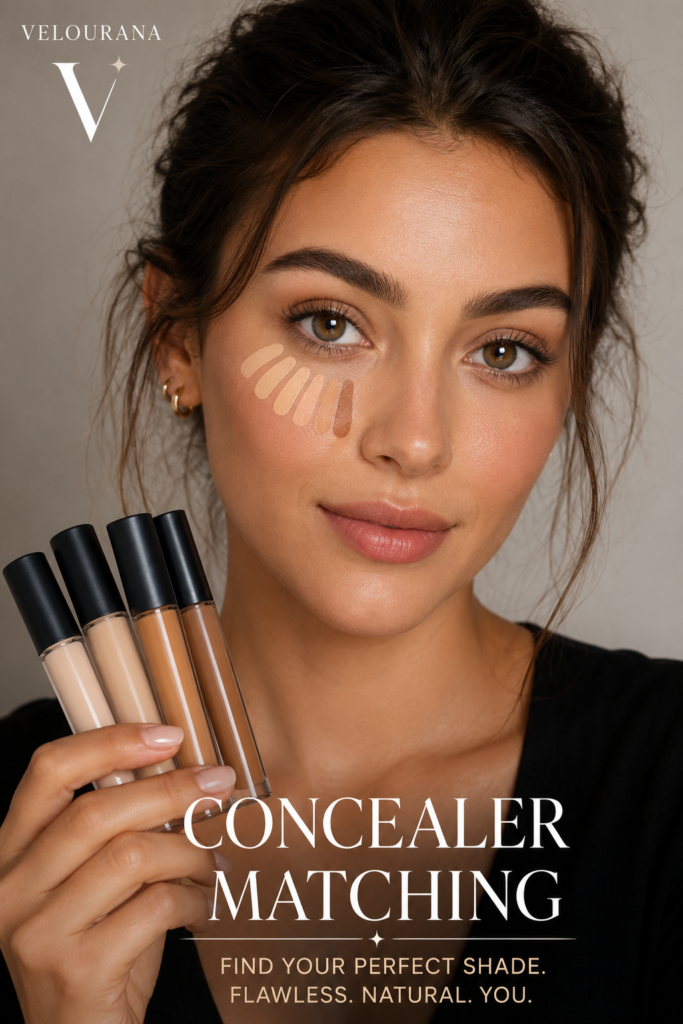
CATEGORY: Concealer Matching
Concealer matching becomes much easier when you stop searching for one magical shade that is expected to solve every complexion problem.
A single concealer may work beautifully in several situations, but different areas of the face often require different strategies.
The shade that disappears over a blemish may not provide enough brightness beneath the eyes.
The peachier concealer that neutralizes blue-purple darkness can look orange on the cheeks.
A concealer that matches your winter complexion may become too pale after summer tanning.
A full-coverage formula that works perfectly over pigmentation may look heavy and dry around the eyes.
This is why the most reliable approach is not simply to identify “your concealer shade.”
It is to build a small, logical concealer system.
That system begins with understanding your natural skin depth and undertone. It then takes into account discoloration, purpose, formula, season, foundation choice, finish and the amount of contrast you actually want.
Once these variables are separated, concealer stops feeling unpredictable.
You can identify why a shade is wrong.
You can understand whether the problem comes from depth, undertone, correction or formula.
And most importantly, you can select products according to their function rather than according to vague shade names.
Begin With Your True Complexion Reference
Every concealer system needs an anchor.
That anchor should be your normal complexion rather than the darkest pigmentation, reddest blemish or brightest part of your face.
If you wear foundation and already own a shade that matches beautifully, that foundation can serve as an excellent reference.
If you do not wear foundation, examine your overall facial complexion in natural daylight.
Look at the jaw, forehead, cheeks and neck together.
Do not concentrate exclusively on one area.
The face naturally contains several colors.
The cheeks may be redder.
The forehead may be deeper.
The area around the mouth may be darker.
The neck may receive less sun.
Your goal is to understand the overall complexion into which your concealer needs to blend.
Identify Skin Depth Before Anything Else
Skin depth is the first structural element of concealer matching.
Ask whether your complexion is broadly fair, light, medium, tan, deep or rich.
These categories are only navigation tools.
They are not standardized measurements.
One brand’s light-medium may be another brand’s medium.
One company’s deep shade can resemble another company’s tan.
The important point is not the wording.
It is the actual visual relationship between the product and your skin.
Once you know your approximate depth, you can eliminate large sections of a shade range and focus on realistic candidates.
Undertone Refines the Match
After depth comes undertone.
Warm complexions may lean golden, yellow or peach.
Cool complexions may lean pink, rosy or red.
Neutral complexions may sit between warm and cool.
Olive complexions often contain muted greenish, golden-green or neutral-green characteristics.
These categories can overlap.
Someone can be neutral-warm.
Someone can be neutral-cool.
Someone can be golden-olive.
The objective is not to force yourself into one perfect label.
The purpose of undertone classification is simply to help explain why some concealers disappear while others turn yellow, pink or orange.
Watch How Products Behave on Your Skin
Your skin provides better information than a questionnaire.
If warm concealers repeatedly become orange, remember that pattern.
If neutral shades look pink, that tells you something.
If olive shades disappear while ordinary golden shades look saturated, that is valuable evidence.
Over time, successful and unsuccessful products reveal your complexion more accurately than generic undertone tests.
The goal is to develop pattern recognition.
Build the System Around Functions
A practical concealer collection should be organized by function rather than quantity.
You may need a complexion-matched shade for blemishes and pigmentation.
You may want a slightly brighter shade beneath the eyes.
You may need one corrector if you regularly deal with pronounced discoloration.
That may be enough.
The objective is not to own many shades.
It is to make sure each product has a clear purpose.
Your Exact-Match Concealer Is the Foundation of the System
If you own only one concealer, a shade close to your natural complexion is usually the most versatile choice.
It can cover blemishes.
It can soften pigmentation.
It can work beneath the eyes when the discoloration is mild.
It can be used without foundation.
It can also be combined with a lighter concealer when you want additional brightness.
This shade should prioritize seamless integration rather than drama.
When applied to ordinary skin, it should become difficult to locate.
The Exact Match Should Not Be a Highlight Shade
A common mistake is calling a noticeably lighter concealer the “normal” concealer simply because bright under-eye makeup has become familiar.
For spot concealing, this causes problems.
A blemish covered with bright concealer becomes a pale dot.
A dark spot may become gray.
Pigmentation can appear more obvious because the corrected area no longer matches the surrounding complexion.
Your exact-match concealer should be selected according to camouflage, not brightness.
The Brightening Shade Is Optional
A second, slightly lighter concealer can be useful if you enjoy brighter under-eyes or strategic facial highlighting.
This shade does not need to be dramatically pale.
A modest difference can create plenty of visual lift.
The best brightening shade usually maintains a compatible undertone with your complexion while moving slightly lighter in depth.
This preserves harmony.
Brightening Is Not the Same as Correcting
A brightening concealer changes lightness.
A corrector changes color.
This distinction prevents many concealer mistakes.
If the under-eye area is dark because of blue or purple discoloration, a very light concealer may simply turn gray.
The problem was not insufficient brightness.
The problem was unneutralized color.
Correct first when necessary.
Brighten afterward.
Your Corrector Should Solve a Specific Problem
Do not buy several correctors simply because they exist.
Choose one only if you regularly encounter a discoloration that ordinary concealer does not handle efficiently.
Peach and orange families are commonly used against blue-purple darkness.
Green is used against pronounced redness.
Yellow can reduce certain violet tones.
Lavender can soften strong yellow or sallow coloration.
The corrector should correspond to an actual recurring need.
Corrector Depth Must Suit Your Complexion
A corrective hue can be theoretically appropriate and still be wrong in intensity.
A pale peach may be suitable on fair skin but ineffective on deeper pigmentation.
A strong orange may work on deep skin but overwhelm a very light complexion.
Correction should be proportional to both complexion depth and the strength of the discoloration.
The Corrector Should Reduce Product, Not Add Layers
A good corrector makes concealer easier to use.
If you apply corrector and then need several thick layers of concealer to hide the corrector itself, something is wrong.
The shade may be too strong.
The amount may be excessive.
The corrector should reduce the contrast enough that a normal concealer layer can finish the work.
Learn to Diagnose Concealer Problems
A strong concealer system depends on diagnosis.
When something looks wrong, ask why.
Do not immediately buy another product.
Determine whether the issue is depth, undertone, correction, formula, texture, powder or lighting.
Each creates different visual symptoms.
If Concealer Looks Too Light
A too-light concealer creates pale contrast.
On blemishes, it produces bright dots.
Over dark pigmentation, it can create grayness.
Beneath the eyes, it may create a stark band that does not connect with the cheeks.
The solution is usually to move closer to your natural depth.
If Concealer Looks Too Dark
A concealer that is too deep creates shadow.
A spot-concealed mark may become muddy.
The under-eye area may appear more tired rather than brighter.
Try a lighter depth while preserving undertone.
If Concealer Looks Yellow
Yellow usually indicates excessive golden warmth relative to the complexion.
A neutral or cooler alternative may work better.
However, also check your foundation.
A foundation that is unusually cool can make an otherwise balanced concealer appear more yellow by comparison.
If Concealer Looks Orange
Orange usually points toward excessive peach or red warmth.
This is especially common on olive complexions.
A neutral, olive or muted alternative may be more suitable.
Do not automatically move lighter.
Depth and undertone are different problems.
If Concealer Looks Pink
Pinkness usually indicates a cool or rosy mismatch.
Warm and olive skin can make this particularly obvious.
Look for neutral, golden-neutral or olive alternatives depending on the complexion.
If Concealer Looks Gray
Grayness needs careful diagnosis.
The product may be too light.
Blue-purple discoloration may remain visible underneath.
The corrector may be insufficient.
The powder may be too pale.
The concealer may be extremely matte.
Determine when the grayness appears.
If it appears only beneath the eyes, underlying color may be responsible.
If it appears everywhere, depth or formula may be the issue.
Match Spot Concealer Closely
Spot concealing is the least forgiving concealer function.
The objective is disappearance.
Use a shade close to the surrounding skin or finished foundation.
Apply it precisely.
Keep the strongest coverage in the center of the mark.
Blend only the perimeter.
Spreading concealer over a large area can make a slight mismatch much more obvious.
Raised Blemishes Need Realistic Expectations
A concealer can change color.
It cannot flatten texture.
A raised blemish will still catch light differently from surrounding skin.
Trying to erase it completely with thick layers can make the texture more noticeable.
Reduce redness.
Match the surrounding complexion.
Then stop.
Flat Pigmentation Is Easier to Camouflage
Flat dark spots can often be concealed very effectively because there is no raised structure.
If the mark is strongly pigmented, use correction when needed.
Then place an accurate skin-toned concealer on top.
Because the texture is flat, the final result can be extremely seamless.
Match Under-Eye Concealer According to the Problem
The under-eye area may contain pigmentation, blue-purple color, brown discoloration or structural shadow.
These need different approaches.
If discoloration is mild, a skin-matched concealer may be enough.
If blue-purple darkness is pronounced, warm correction may help.
If the problem is mostly structural hollowing, strategic brightness is more useful than heavy correction.
The Inner Corner Often Needs More Concealer Than the Outer Eye
Many people apply concealer evenly beneath the entire eye.
But darkness is often concentrated near the inner corner.
Applying more product where it is needed and less elsewhere produces a more natural result.
This is another reason functional placement matters more than blanket coverage.
Concealer Should Not Automatically Reach the Lash Line
If the skin directly beneath the lashes is relatively even, covering it heavily can create unnecessary texture.
Place concealer where the darkness actually exists.
Leave normal skin visible where possible.
Foundation Changes the Concealer Match
If you wear foundation, concealer should be evaluated with it.
Foundation can alter depth and undertone.
A concealer that matches bare skin may look different over foundation.
Spot concealer should usually coordinate with the finished base.
Under-eye concealer may be slightly brighter but should still belong to the same overall color family.
Foundation Oxidation Can Create False Concealer Problems
If foundation darkens during wear while concealer remains stable, the concealer may appear too light later.
The concealer did not necessarily fail.
The surrounding base changed.
This is why both products should be evaluated after settling.
Concealer Oxidation Can Do the Opposite
A concealer may dry darker or warmer while the foundation remains stable.
A perfect fresh match can turn into a visible patch.
Always judge the final dried shade.
Build Dry-Down Into Every Shade Test
Apply the product.
Wait.
Then compare.
This simple habit can prevent many incorrect purchases.
Fresh liquid color is not always final color.
The match that matters is the one you wear after the formula has settled.
Test in Natural Light
Artificial lighting can distort undertone.
Warm light can disguise excess yellow or orange.
Cool light can exaggerate pink or gray.
Indirect daylight is one of the most useful tools available for complexion matching.
You do not need harsh sunlight.
A window is usually enough.
Test on the Correct Area
The hand is convenient but not definitive.
Hands may be deeper, warmer or more tanned than the face.
For facial spot concealer, test near the jaw or another representative area.
For under-eye concealer, test beneath the eye.
The product needs to work where it will actually be worn.
Compare Several Shades Side by Side
Side-by-side swatching makes undertones easier to recognize.
A single shade may look neutral until placed next to a warmer and cooler alternative.
Then its true color becomes clearer.
Compare similar depths.
Let them dry.
Look for the one that attracts the least attention.
The Border Between Concealer and Skin Tells the Truth
Do not stare only at the center of the swatch.
Look at the edge.
Can you clearly see where product becomes skin?
If the transition is obvious, the match may not be ideal.
A good spot-concealing shade creates a disappearing boundary.
Step Back From the Mirror
Magnifying mirrors are useful for placement.
They are terrible for judging the overall effect.
After concealing, step back.
Look at the entire face.
Are your eyes still drawn to the corrected area?
Does the under-eye brightness look balanced?
Does the complexion remain harmonious?
Normal viewing distance reveals whether the makeup is working.
Fair Complexions Need Small Adjustments
On fair skin, even a small depth difference can create strong contrast.
Under-eye concealer does not need to be dramatically lighter.
Undertone mismatches can also appear quickly because yellow, pink and peach pigments are easy to see.
Precise matching is particularly valuable.
Medium Complexions Often Need Undertone Precision
Medium skin spans many undertone families.
Golden, neutral, peach and olive shades may all exist at nearly identical depth.
This can make undertone more important than lightness.
Compare multiple options at the same depth.
Olive Complexions Need Muted Color
Olive skin frequently rejects saturated peach and pink concealers.
If warm shades become orange and neutral shades become pink, look for olive, neutral-olive or muted alternatives.
Do not assume olive automatically means tan or medium.
Olive undertones exist across the depth spectrum.
Deep Complexions Need Preservation of Depth
Deep skin can become ashy when concealer is too pale.
For under-eye brightness, use moderate lightness and appropriate correction.
For blemishes, stay close to the complexion depth.
Brightness should enhance richness rather than replace it.
Rich Complexions May Benefit From Deeper Correctors
Pronounced blue-gray or purple discoloration on rich skin may require orange or red-orange correction.
The final concealer can then remain closer to natural depth.
This often looks more seamless than applying very pale concealer directly over the darkness.
Formula Changes the Match
Two concealers with similar color can look different because of finish and coverage.
A matte formula may appear deeper.
A radiant formula may look brighter.
A full-coverage product shows its pigment more strongly.
A sheer product allows more natural skin to influence the final appearance.
Shade cannot be evaluated independently from formula.
Full Coverage Requires Greater Accuracy
The more opaque the concealer, the more precise the color needs to be.
A high-coverage spot concealer should match extremely well.
There is less natural skin showing through to soften the mismatch.
Sheer Concealer Can Be More Forgiving
Light coverage allows natural skin tone to remain visible.
This can make a small depth or undertone error less obvious.
However, sheer coverage may not neutralize strong discoloration.
Correction can become more important.
Matte Concealer Is Not Automatically Better for Blemishes
Matte formulas can stay in place well, but if the surrounding skin is luminous, an extremely matte spot may become visible.
Finish should coordinate with the surrounding complexion.
A shiny blemish and a dry concealer can create obvious texture contrast.
Radiant Concealer Is Not Automatically Better Under the Eyes
Radiance can create brightness, but too much shine can emphasize texture or make the eye area appear greasy.
Choose according to your skin and the finish you prefer.
Powder Changes the Final Color System
Setting powder can warm, lighten or mute concealer.
A yellow powder may make a neutral under-eye warmer.
A pale powder can create ashiness on deep skin.
A pink powder can alter undertone.
Always judge the complete makeup system.
Test Concealer Before and After Powder
If the color looks correct before powder but wrong afterward, the concealer may not need replacing.
Test the powder separately.
This can save unnecessary purchases.
Seasonal Matching Is Normal
Your complexion may change throughout the year.
A concealer that disappears in winter can become too light in summer.
A summer shade can become too deep when the tan fades.
This does not mean you need a completely new system every season.
Two Depths Can Cover Most Seasonal Changes
Keeping a lighter and deeper version of a compatible concealer formula provides flexibility.
Use the lighter one in winter.
Use the deeper one in summer.
Mix them during transitional periods.
This can also create a custom under-eye brightness level.
Mixing Is Most Predictable Within the Same Formula
Two shades from the same concealer line generally mix well because they share texture, finish and setting behavior.
Mixing unrelated products can work, but formula compatibility becomes another variable.
Mix Depth Before Trying to Mix Complex Undertones
Adjusting depth is straightforward.
Adjusting undertone can be less predictable.
If a concealer is slightly too warm, adding neutral may help.
If it is dramatically orange, another shade is usually easier.
Online Matching Requires a Different Strategy
When you cannot test in person, begin with products you already know.
Use an accurate foundation shade as a reference.
Study neighboring swatches.
Read undertone descriptions.
Compare multiple sources.
Look for users with similar known matches.
Do not rely on one photograph.
Online Shade Finders Are Shortlisting Tools
Automated matching systems can narrow the range.
They cannot guarantee perfection.
Lighting, camera processing and brand shade classification all introduce uncertainty.
Use the recommendation as evidence, not certainty.
Shade Names Are Not Standardized
“Beige,” “sand,” “honey,” “tan” and similar names have no universal color meaning.
The same name can describe completely different shades between brands.
Always examine the actual shade and undertone description.
Shade Numbers Are Not Standardized Either
A number such as 20 or 250 tells you only where the shade sits inside that specific range.
Do not match foundation and concealer numbers unless the brand explicitly links them.
Keep a Personal Shade Record
Once you find something that works, record it.
Write down the exact brand, product and shade.
Note what you use it for.
Exact spot match.
Under-eye match.
Summer match.
Winter match.
Corrector.
This prevents you from repeatedly starting from zero.
Record Failed Shades Too
A failed concealer still provides data.
Too yellow.
Too orange.
Too pale.
Perfect undertone but too deep.
Gray beneath the eyes.
These observations help narrow future choices.
Your Makeup History Becomes a Matching Database
Over time, you may notice that neutral-olive shades consistently work.
You may discover that peach concealers suit the under-eye but not the face.
You may learn that one brand’s neutral family is too pink while another’s is ideal.
This accumulated knowledge is extremely valuable.
Do Not Copy Another Person’s Shade Blindly
Two people can appear similar online and still have different undertones.
Lighting, cameras and foundation can distort complexion.
Use other people’s shade matches as clues, not guarantees.
Influencer Makeup Often Uses Deliberate Contrast
Bright under-eye makeup can be beautiful, but it may be designed for photography, video or dramatic style.
Do not assume that the same contrast is necessary for ordinary concealing.
Choose according to your preferred result.
Natural Makeup Requires Less Contrast
For a natural complexion, keep spot concealer close to skin depth.
Keep under-eye brightness moderate.
Use correction only where necessary.
Preserve natural skin variation.
Glamorous Makeup Can Use More Contrast
If you prefer a sculpted look, a brighter concealer can be intentional.
The undertone should still coordinate.
Strong depth contrast looks more polished when the color family remains harmonious.
Concealer Without Foundation Requires High Accuracy
Bare-skin concealer sits directly beside untreated skin.
This makes shade accuracy especially important.
Use a close match for spots.
Use only modest brightness beneath the eyes.
Blend boundaries carefully.
Concealer With Foundation Allows More Controlled Variation
Foundation creates a uniform base.
This can make spot concealing easier because the surrounding color is consistent.
It also allows a brighter under-eye shade to be integrated more deliberately.
However, the two products must still coordinate.
Color Correction Should Be Targeted
Do not apply peach, green or orange everywhere because a tutorial recommends it.
Place correction only where the corresponding discoloration exists.
This reduces product and preserves skin texture.
Corrector Placement Can Be More Important Than Corrector Strength
A tiny amount applied precisely to a blue inner corner may do more than a thick peach layer under the entire eye.
A small green dot over a red blemish may be enough.
Precision is efficient.
Do Not Chase Total Erasure
Complete opacity is not always the most flattering goal.
Reducing contrast often makes the face look fresher than covering every natural shadow and mark.
Some darkness beneath the eye can remain.
Some freckles can show.
Some natural redness can remain.
Skin looks like skin because it contains variation.
Concealer Should Improve Attention, Not Create Perfection
A useful way to judge success is to notice where your eye goes.
Before concealer, perhaps you immediately see a dark blemish.
After concealer, if your attention moves away from it, the product has worked.
The mark does not need to vanish under magnification.
Texture Should Remain Believable
A perfectly color-corrected blemish can still look obvious if covered with a thick dry layer.
An under-eye area can be bright but heavily creased.
Color matching and texture matching work together.
Use enough product to improve the area without creating a new surface problem.
Less Product Often Improves the Match
Thick concealer shows more of its own pigment.
A thin layer allows the skin or foundation underneath to participate in the final color.
This can make a close shade appear even more seamless.
Use the minimum amount necessary for the coverage you want.
Layer Only Where Needed
Instead of applying a thick layer everywhere, build concealer selectively.
Add more over the darkest point.
Leave surrounding areas thinner.
This creates dimension and reduces cakiness.
Let Concealer Sit Before Deciding You Need More
Some formulas become more opaque as they set.
If you add another layer immediately, you may end up with excessive coverage.
Give the first layer time.
Reassess After the Full Makeup Is Finished
Bronzer, blush, powder and contour can change the way concealer appears.
A bright under-eye may become more dramatic after bronzer is added.
Blush may soften transitions.
Powder may change undertone.
Judge the final look as a complete system.
The Neck and Chest Still Matter
Foundation and concealer can match each other perfectly while the entire face remains disconnected from the neck.
Look at the whole visible complexion.
The goal is harmony, not just internal consistency between two products.
Do Not Force One Shade to Do Everything
This is the central lesson of a reliable concealer system.
One product may be capable of several tasks.
But if your exact spot shade is too dark for the brightness you want under the eyes, that does not make it a bad concealer.
If your peach under-eye product looks orange on blemishes, that does not mean it failed.
The products simply have different jobs.
A Three-Product Concealer System Is Often Enough
For many people, a very practical setup consists of three products.
An exact complexion match.
A slightly brighter concealer.
One corrector tailored to the main discoloration.
You may need fewer.
You may occasionally need more.
But this structure covers a large number of makeup situations without creating unnecessary clutter.
Some People Need Only One Concealer
If your discoloration is mild and you prefer natural makeup, an excellent complexion-matched concealer may do everything you need.
Use it on spots.
Use it lightly beneath the eyes.
Let formula and placement create subtle brightness.
There is no reason to complicate a system that already works.
Some People Benefit From Two Exact-Match Depths
If your skin changes considerably between seasons, two complexion shades may be more useful than an additional brightener.
You can mix them.
You can adapt throughout the year.
You can use the lighter shade for selective brightness.
Purchase According to Actual Need
Makeup collections become expensive when products are bought for hypothetical problems.
If you do not have pronounced redness, you probably do not need green corrector.
If your dark circles are mild, you may not need a peach corrector.
If your exact-match concealer already brightens sufficiently, you may not need a second shade.
Build the system around your complexion.
Reassess When Your Skin Changes
Your ideal concealer may change over time.
Sun exposure can deepen skin.
Skincare may reduce pigmentation.
Redness may fluctuate.
The under-eye area can change.
A shade that worked perfectly several years ago may no longer be ideal.
Match the skin you have now.
Reassess When You Change Foundation
A new foundation can alter the entire concealer relationship.
If you move from warm foundation to neutral foundation, existing concealers may appear different.
If your new base is deeper, your old brightening shade may become too pale.
Whenever the foundation changes substantially, check the concealer system again.
Reassess When You Change Formula
A new concealer formula may require a different depth even within the same brand.
Coverage, finish and dry-down can change the perceived color.
Do not assume that the same shade name in another formula will behave identically.
Reassess Under Different Lighting
A concealer that looks good only under bathroom lighting is not a reliable match.
Check daylight.
Check ordinary indoor light.
If photography matters, check photographs too.
The product should remain reasonably harmonious across realistic environments.
Do Not Expect Absolute Color Uniformity
Human skin changes with circulation, temperature, sun exposure and lighting.
No concealer shade will look mathematically identical at every moment.
The goal is not absolute color perfection.
The goal is convincing visual harmony.
Learn When to Stop Adjusting
Concealer matching can become obsessive.
A shade may be 95 percent accurate but you continue searching for an imaginary perfect alternative.
If the product disappears at normal distance, wears well, photographs acceptably and does not create an obvious undertone shift, it is probably doing its job.
Tiny differences visible only under extreme magnification may not matter.
The Best Match Is Functional
A useful concealer match performs its intended job.
A spot shade disappears.
An under-eye shade refreshes.
A corrector reduces unwanted color.
A seasonal shade adapts to complexion changes.
Function is more meaningful than theoretical perfection.
Create a Repeatable Matching Routine
Whenever you test a new concealer, follow the same sequence.
Identify the intended purpose.
Choose the likely depth.
Choose the likely undertone.
Apply to the correct area.
Allow it to dry.
Check in daylight.
Compare with foundation if relevant.
Observe the finish.
Wear it for a realistic period.
This consistent process prevents random decisions.
Diagnose One Variable at a Time
If the concealer fails, ask one question at a time.
Is the depth wrong?
If not, is the undertone wrong?
If not, is underlying discoloration affecting the result?
If not, is the formula too matte or too radiant?
If not, is powder changing the appearance?
This method is far more effective than replacing everything at once.
A Wrong Shade Is Not Always a Completely Useless Shade
A concealer that is slightly too light may become a brightener.
A slightly deep shade may become a summer option.
Two near-matches may be mixed.
However, dramatically wrong undertones are harder to repurpose.
Use judgment rather than forcing every product to work.
Do Not Keep a Product That Requires Excessive Correction
If a concealer needs multiple mixers, correctors and powders just to become usable, another shade is probably more practical.
A reliable system should simplify makeup.
Concealer Matching Should Save Time Eventually
The early learning stage may require experimentation.
Once your patterns are understood, the process becomes faster.
You know your depth.
You know which undertones tend to work.
You know how much brightness you prefer.
You know whether you need correction.
Future purchases become easier.
The System Should Be Easy to Remember
A complicated collection is not automatically better.
You should be able to explain the function of every concealer you own.
This one matches my complexion.
This one brightens.
This one corrects blue-purple darkness.
That clarity prevents accidental misuse.
Concealer Matching Is Ultimately About Relationships
A shade is never simply good or bad.
It is good or bad relative to something.
Relative to your complexion depth.
Relative to your undertone.
Relative to the discoloration underneath.
Relative to your foundation.
Relative to your season.
Relative to your desired makeup style.
Understanding these relationships removes much of the mystery.
Your Skin Is the Final Authority
Shade charts are helpful.
Online tools are helpful.
Beauty consultants can be helpful.
Influencer comparisons can be helpful.
But none of them sees the product on your skin under your ordinary lighting.
The final result belongs to you.
If a shade labeled warm disappears into your supposedly neutral complexion, use it.
If an olive shade works better than the golden option a quiz recommended, choose olive.
If the popular brightening shade looks too pale, select something deeper.
Results matter more than labels.
The Complete Concealer System in Practice
Imagine that you have a medium neutral-olive complexion.
You own an exact neutral-olive concealer that matches your foundation.
You use it on blemishes and pigmentation.
Your under-eye darkness has a blue-purple quality, so you apply a very small amount of muted peach corrector near the inner corner.
Then you use the complexion concealer over it.
On days when you want additional brightness, you add a slightly lighter neutral-olive concealer only to the deepest shadow.
This is a system.
Every product has a purpose.
No shade is being asked to solve a problem it was not designed for.
Another System Could Be Much Simpler
Imagine fair neutral skin with mild under-eye darkness and occasional blemishes.
One flexible medium-coverage concealer that matches the complexion may be enough.
Use a tiny amount on blemishes.
Use slightly more beneath the eyes.
A radiant finish provides enough brightness without requiring a second shade.
This is also a complete system.
Complexity should be proportional to need.
There Is No Ideal Number of Concealers
The correct number is the number required to solve your actual makeup problems efficiently.
For one person, that is one.
For another, three.
Someone with substantial seasonal depth changes and pronounced discoloration may use more.
The objective is functional coverage, not collecting shade categories.
The Best System Prevents Repeat Mistakes
Once you understand your own complexion, you stop repeatedly purchasing the same wrong type of shade.
You stop buying peach when peach always turns orange.
You stop buying pale under-eye concealer when it always becomes gray.
You stop using highlighting concealer on blemishes.
You stop assuming every product labeled neutral will match.
This is the real value of a concealer matching system.
Match First, Correct Second, Brighten Deliberately
A simple order of thought can guide almost every concealer decision.
Understand the complexion.
Identify the discoloration.
Correct if necessary.
Match the final concealer to the skin.
Add brightness only if desired.
This prevents brightness from becoming a substitute for actual matching.
Natural-Looking Concealer Is Usually Quiet
The best concealer often does not look impressive as a swatch.
It is not dramatically bright.
It is not obviously golden.
It is not strongly peach.
It simply blends.
That visual quietness is valuable.
The purpose of most concealing is to draw less attention to an area.
Brightness Should Still Belong to the Face
Even deliberate highlighting should remain related to the complexion unless a theatrical effect is intended.
A bright under-eye should look illuminated, not detached.
The forehead, nose, chin and eyes should still appear part of one coherent face.
Color Correction Should Still Look Like Skin
Once the concealer is applied, no one should be thinking about the peach, orange or green underneath.
The final effect should look balanced.
Corrective colors are tools, not visible features.
The Final Test Is Whether You Notice the Makeup
Look at the finished complexion.
Do you notice a blemish or a pale dot?
Do you notice dark circles or an orange corrector?
Do you notice pigmentation or a gray patch?
Do you notice foundation and concealer as separate zones?
When the system is working, you notice less of all of these.
Concealer Matching Is a Skill That Improves
The more carefully you observe color, the easier matching becomes.
You learn to distinguish too deep from too warm.
You recognize ashiness caused by insufficient correction.
You notice the difference between facial redness and true cool undertone.
You understand how olive skin reacts to peach pigments.
These observations accumulate.
A Reliable System Removes Guesswork
You no longer need to choose concealer because the shade looks attractive in the tube.
You have criteria.
Depth.
Undertone.
Purpose.
Correction.
Formula.
Finish.
Dry-down.
Season.
Foundation compatibility.
Each one contributes to the decision.
The Perfect Concealer Collection Is the One You Actually Use
A drawer filled with near-matches is not a successful system.
A few carefully selected products that consistently perform are much more valuable.
Choose shades that solve recurring problems.
Keep records.
Replace only when necessary.
Use mixing strategically.
Avoid buying duplicates without purpose.
Concealer Should Support the Complexion, Not Replace It
The final objective is not to erase every sign of natural skin.
It is to create balance.
Reduce redness when desired.
Soften dark circles.
Camouflage pigmentation.
Brighten selected shadows.
Then allow the rest of the complexion to remain alive and dimensional.
Build Your System Around Reality
Your actual skin is more important than theoretical makeup rules.
If you have strong pigmentation, account for it.
If you have olive undertones, respect them.
If you tan substantially, plan for seasonal changes.
If you never wear foundation, prioritize exact bare-skin matching.
If you prefer dramatic makeup, build brighter contrast intentionally.
The system should reflect your reality.
The Most Important Concealer Matching Principles
A close skin match is usually best for blemishes and facial pigmentation.
Under-eye concealer can be slightly brighter but does not automatically need to be dramatically lighter.
Strong discoloration may require correction rather than extra brightness.
Undertone matters as much as depth.
Olive complexions often need more muted shade families.
Deep complexions should preserve natural richness rather than relying on pale brightness.
Fair complexions need careful control because small depth differences can appear significant.
Dry-down must be tested.
Foundation changes the concealer relationship.
Powder can change the final shade.
Natural light reveals mistakes.
Precision often matters more than quantity.
Your Concealer System Should Feel Predictable
Once it is working, you should know what to reach for.
A blemish appears.
You use the complexion match.
The under-eye area looks more discolored than usual.
You add a small amount of corrector.
You want extra brightness for evening makeup.
You add the lighter shade.
Your complexion becomes deeper in summer.
You mix the seasonal shades.
There is no confusion because every product has a defined purpose.
Concealer Matching Becomes Easier When You Stop Searching for One Perfect Shade
There may not be one perfect concealer.
There may instead be one perfect spot shade.
One excellent under-eye shade.
One useful corrector.
One seasonal variation.
That is a more realistic way to think about complexion makeup.
The goal is not to identify a universal color that magically adapts to every part of the face.
The goal is to understand what each area needs and use the smallest, most appropriate adjustment.
Build Slowly and Keep What Works
There is no need to purchase an entire concealer wardrobe immediately.
Start with the strongest need.
Find a true complexion match.
Use it.
Observe where it succeeds and where it does not.
If you need more under-eye brightness, add a second shade.
If discoloration still turns gray, investigate correction.
If your skin changes seasonally, add a deeper or lighter companion shade.
Build from evidence.
Concealer Matching Is Ultimately About Control
A good system gives you control over three main variables.
Color.
Depth.
Light.
Color correction controls unwanted undertones in discoloration.
Skin-matched concealer controls coverage and integration.
Brightening concealer controls light.
Once you stop asking one product to control all three simultaneously, the process becomes much more precise.
The Final Goal Is Seamless Choice
Concealer should not dictate your makeup.
It should support it.
You should be able to choose natural coverage one day and brighter makeup another.
You should be able to conceal one blemish without applying foundation everywhere.
You should be able to correct dark circles without creating a gray mask.
A thoughtful matching system gives you this flexibility.
Concealer Matching Is Not About Chasing Perfection
There will always be slight variation in skin.
Lighting changes.
The complexion changes.
Products dry differently.
No shade remains mathematically perfect in every circumstance.
The practical goal is much simpler.
Choose products that remain harmonious most of the time, under the conditions in which you actually wear them.
The Best Concealer System Disappears Into Your Routine
Eventually, you stop thinking about undertone charts every morning.
You already know what works.
You know which shade covers blemishes.
You know how much corrector is enough.
You know which concealer brightens without looking pale.
You know how to adjust in summer.
That is when matching has become a usable skill rather than a constant shopping problem.
Concealer Should Make the Complexion Easier, Not More Complicated
If your routine requires ten layers and constant correction, simplify it.
Return to the fundamentals.
What color is the skin?
What color is the discoloration?
What needs to disappear?
What needs to brighten?
What can remain natural?
Answer those questions and the correct products become easier to identify.
A Reliable Concealer System Is Personal
Someone else’s ideal system may not resemble yours.
Their dark circles may be blue.
Yours may be brown.
Their skin may be warm.
Yours may be olive.
They may wear full-coverage foundation.
You may wear concealer alone.
They may prefer dramatic brightness.
You may prefer invisible correction.
There is no reason the same products should work identically.
Let Function Lead the Final Decision
When choosing between two shades, ask which one better performs the intended job.
For blemishes, choose the one that disappears.
For dark circles, choose the one that neutralizes and integrates.
For brightness, choose the one that illuminates without detaching from the complexion.
For seasonal adjustment, choose the depth that remains harmonious.
Function makes the choice clearer.
The Complete Concealer Matching Philosophy
Understand your natural complexion.
Separate depth from undertone.
Observe discoloration rather than naming it vaguely.
Use correction only when necessary.
Match spot concealer closely.
Brighten intentionally.
Allow formulas to dry before judging them.
Coordinate concealer with foundation and powder.
Adjust for season.
Use less product.
Preserve natural skin variation.
Record what works.
Learn from what does not.
Those principles are more useful than any single shade chart.
When Concealer Is Truly Matched
A blemish becomes less noticeable without becoming a pale dot.
A dark spot disappears without turning gray.
Under-eye darkness softens without producing an orange or chalky band.
Foundation and concealer flow into each other.
The complexion remains dimensional.
The product does not demand attention.
This is what successful matching looks like.
The Best Concealer Is Not the One You Can See
Beautiful concealer rarely announces itself.
Its success is measured by what stops attracting attention.
You see the eyes rather than the dark circles.
You see the complexion rather than the blemish.
You see balanced skin rather than separate areas of correction.
That is the real purpose of matching.
Not to create a perfect block of color.
Not to follow a rule about being two shades lighter.
Not to imitate someone else’s complexion.
But to build a small, reliable system that understands your skin and responds intelligently to what it needs.
Once you achieve that, concealer becomes one of the simplest and most flexible tools in your makeup routine.
The product no longer fights the complexion.
It works with it.
And that is what a truly successful concealer match should always do.
The End
Velourana
 Discover More From Our Family of Websites
 ZodiacBearing (Astrology, Tarot, Numerology, Angel Numbers & Spiritual Guidance)
 Velourana (Beauty, Makeup, Hair Care, Skincare & Beauty Tips)
 HavenBearing (Home, Living, Organization, Décor & Everyday Inspiration)
 PawBearing (Pet Care, Dog Breeds, Animal Health, Training & Pet Products)
 PsyCatherine (Notes From the Journal of a Psychologist on Real Life)

