
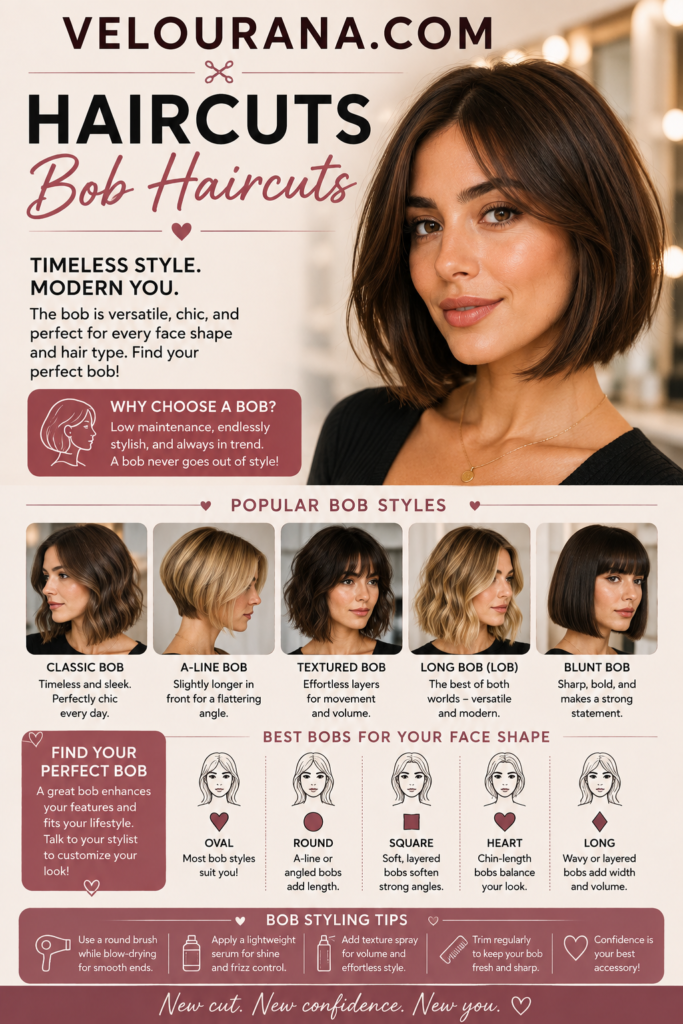
CATEGORY: Bob Haircuts
Few haircuts have managed to remain as recognizable, adaptable and continuously relevant as the bob. Its basic idea sounds remarkably simple: the hair is cut to a shorter length somewhere around the jaw, chin, neck or shoulders. Yet within that relatively compact silhouette exists an enormous range of possibilities.
A bob can be sharply geometric or deliberately undone. It can hug the jaw, float above the shoulders, curve inward toward the neck or fall almost completely straight. It can be blunt and dense, softly layered, asymmetrical, wavy, curly, sleek or full of movement. Add bangs and the personality changes again. Change the parting, and the same haircut can suddenly feel more dramatic or relaxed.
This flexibility explains why the bob never belongs entirely to one decade.
Different periods reinterpret it according to their own ideas of beauty. One era may favor immaculate precision and glass-like shine, while another prefers texture, movement and imperfect ends. The underlying haircut survives because its proportions can be redesigned without losing its identity.
For someone considering shorter hair, however, choosing “a bob” is only the beginning. The exact length matters enormously. So does hair density, natural texture, face framing, the position of the shoulders and neck, and the amount of styling someone genuinely wants to do at home.
A beautiful bob is not simply short hair cut in a straight line. It is a carefully chosen silhouette.
The Length Can Change the Entire Character of the Cut
A difference of only a few centimeters can make two bobs feel like completely different hairstyles.
A short bob sitting around the jaw creates a strong relationship with the face. Its perimeter can emphasize the jawline and neck, particularly when the ends are blunt and the hair is relatively straight. This length often feels decisive because there is little distance between the haircut and the facial structure.
Move the perimeter slightly lower and the effect begins to soften.
A chin-length bob still frames the face closely but provides more movement around the sides. Depending on the texture, it may tuck behind the ears easily or curve naturally toward the neck.
A bob approaching the base of the neck creates greater versatility. There is more hair available for waves, layers and styling, and some people find it easier to manage because the ends are less likely to sit directly against the jaw.
Then there is the long bob, often called a lob, which reaches somewhere around the shoulders or collarbone. It retains the visual clarity of a bob while preserving enough length for more tied styles and greater styling flexibility.
None of these lengths is automatically more modern or flattering than another.
The important question is where the strongest line of the haircut should sit.
A stylist can evaluate the face, neck, shoulders and natural behavior of the hair before choosing that point. Someone may discover that moving the intended length only slightly higher or lower creates a noticeably better proportion.
This is one reason photographs are useful during a consultation. Saying “chin-length” can mean different things to different people, while an image communicates the desired relationship between the hair and face much more clearly.
The Blunt Bob Creates Strength Through Simplicity
The blunt bob is perhaps the clearest expression of the haircut.
The perimeter is strong, with relatively little graduation or layering disrupting the lower edge. When the hair is straight, the result can appear exceptionally precise. With waves, the same strong baseline provides structure beneath the movement.
Blunt bobs can be particularly effective on fine hair because preserving weight at the perimeter can make the ends appear fuller. Excessive layering in fine hair sometimes removes density from exactly the area where it is most needed.
That does not mean every fine-haired bob should be completely one length.
Subtle internal shaping can help the hair move while maintaining the appearance of a strong perimeter. The difference may be almost invisible when looking at the finished haircut.
On thick hair, a completely blunt bob can become much heavier.
The outer line may look beautiful, but excessive internal bulk can cause the haircut to expand outward or form a triangular silhouette. Strategic weight removal can make the hair easier to manage while leaving the visible perimeter strong.
This is an important distinction.
A haircut can look blunt without being technically untouched inside.
Good cutting allows the visual design and the practical behavior of the hair to coexist.
Layers Give the Bob an Entirely Different Personality
Introducing layers changes the way a bob moves.
Instead of concentrating most of the visual weight at the bottom, layers distribute movement through the interior and around the face. The haircut can become softer, lighter and more textured.
The amount of layering determines how far this transformation goes.
Long, subtle layers may simply prevent a bob from feeling too solid. More noticeable layers can create volume, separation and movement throughout the shape. Shorter layers can move the haircut toward shaggy or highly textured territory.
Hair density should influence the decision.
Thick hair can benefit from carefully designed layers because they remove some of the bulk that would otherwise collect around the lower part of the haircut.
Fine hair requires greater caution. Too many short layers can reduce the visual density of the ends and leave the haircut looking thinner than intended.
Texture matters equally.
Wavy hair may become more expressive once layers allow individual bends to form. Curly hair can gain a more balanced shape when the layers prevent all the volume from accumulating at one level.
The best layered bob therefore does not begin with the question, “How many layers should I have?”
It begins with a more useful question: “Where does this hair need movement, and where does it need weight?”
The French Bob Is More About Attitude Than a Single Measurement
The French bob has become one of the most recognizable interpretations of shorter hair, yet the term is often used for several slightly different cuts.
Typically, it is relatively short, often around the jaw or chin, and may be paired with bangs. The finish frequently feels less rigid than a highly polished geometric bob. Natural movement, soft texture and a slightly undone quality are often part of its appeal.
What makes it attractive is not simply the nationality attached to the name.
It is the balance between structure and ease.
The perimeter provides a clear haircut, but the styling does not necessarily look overworked. Waves may remain imperfect. Ends can move in different directions. Bangs may be soft rather than immaculate.
This type of bob works particularly well when the natural texture is allowed to participate.
Someone with slight waves may discover that a shorter length encourages more movement. Fine straight hair can create a delicate version with a clean perimeter. Curly hair can reinterpret the idea completely while preserving the compact silhouette.
Trying to reproduce an inspiration photograph strand for strand can remove the quality that made the haircut attractive in the first place.
The goal is usually not perfection.
It is character.
The Italian Bob Brings More Weight and Glamour
Where some shorter bobs feel delicate and minimal, the Italian bob is generally associated with a fuller, more substantial silhouette.
The length often sits around the chin or slightly below, with enough density through the ends to create movement and body. Rather than appearing aggressively sculpted, it can feel luxurious and relaxed.
The ability to change the parting is often part of its appeal.
Hair can be pushed from one side to another, creating volume without requiring a permanently fixed shape. The ends may curve gently or move naturally rather than forming an extremely rigid line.
This interpretation can work particularly well for someone who wants short hair without making it feel severe.
The exact technique still needs to reflect density.
Very thick hair may require internal weight management so the shape remains mobile. Fine hair may benefit from retaining as much perimeter density as possible.
The styling can be polished, but it does not need to eliminate all natural movement.
A bob often becomes more interesting when it looks like hair rather than a perfectly immovable object.
Wavy Hair Can Bring a Bob to Life
A bob and natural waves can be an excellent combination because removing length changes the amount of weight pulling on the hair.
Long hair can stretch waves downward. Once several centimeters are removed, some people discover more texture than they realized they had.
The shorter silhouette gives those waves a visible structure.
Instead of disappearing into long lengths, bends and curves occur around the jaw, neck and shoulders where they become part of the haircut.
The challenge is predicting how the hair will respond.
A bob that appears to reach one point while wet may sit noticeably higher once waves develop. The stylist needs to consider the natural pattern before establishing the final perimeter.
Layers can help or hinder depending on how they are placed.
Well-designed layers may encourage movement and prevent excessive weight at the bottom. Too much layering can create unwanted expansion or reduce the strength of the bob shape.
Someone who intends to wear the hair naturally should communicate this clearly before the cut.
The best haircut for an air-dried wave may differ from the best haircut for hair that will be straightened after every wash.
Curly Bobs Need to Be Designed in Three Dimensions
Curly hair makes the geometry of a bob more complex because the hair does not simply travel downward.
It expands outward, contracts upward and forms individual curl groups that occupy space in different ways.
This makes shrinkage essential to the planning process.
A curly bob cut to shoulder length while stretched may settle significantly higher when dry. Different parts of the head can also shrink by different amounts.
The shape therefore needs to be evaluated as a three-dimensional silhouette rather than merely as a horizontal cutting line.
Volume distribution becomes important.
If too much weight remains at the bottom, the haircut can expand into a triangular shape. Strategic layering can create balance, but removing too much weight may compromise the fullness that makes the bob attractive.
The desired silhouette should guide the technique.
Some people want a rounded curly bob with visible volume around the sides.
Others prefer a more elongated shape with less width.
Neither is universally better.
The haircut should respect both the curl pattern and the person's preference for volume.
A Bob Can Make Fine Hair Appear More Substantial
One reason bobs remain popular among people with fine hair is that removing long, thin ends can immediately change the appearance of density.
Long hair does not automatically look fuller simply because there is more of it.
If the lower lengths have become sparse, cutting the perimeter higher can place the ends where the hair is naturally denser.
A strong bob line can therefore make the entire hairstyle appear more substantial.
This effect is especially noticeable with relatively blunt cuts.
The hair collects around one perimeter instead of being dispersed through many layers and lengths.
Styling can reinforce the effect.
Gentle root lift creates movement without requiring extreme volume. A slight bend through the lengths can make the hair occupy more visual space. Texture can prevent fine strands from lying completely flat against one another.
Product quantity should remain controlled.
Fine bobs can become heavy quickly when overloaded with oils, creams or styling products. The aim is to support the shape rather than coat it into submission.
Thick Hair Requires Control Without Losing Its Richness
Thick hair can create an extraordinary bob because the density gives the perimeter substance.
It can also create considerable bulk.
When thick hair is cut shorter, the reduced weight may allow it to expand more than expected. A haircut that looked sleek when long can suddenly become much wider once the lengths are removed.
This should be anticipated rather than corrected aggressively afterward.
Internal weight can be managed without destroying the visible density of the ends. Layers may be introduced strategically, particularly where the hair naturally becomes bulky.
The exact approach depends on texture.
Thick straight hair behaves differently from thick waves or curls.
The objective is not to make thick hair artificially thin.
Its density is one of its strengths.
The goal is to distribute that density so the haircut has movement and shape rather than uncontrolled bulk.
Bangs Can Completely Redesign a Bob
Adding bangs changes the relationship between the bob and the face.
A blunt fringe combined with a blunt bob creates strong geometry. The haircut becomes structured from both the forehead and the perimeter.
Wispy bangs soften the front while allowing the bob itself to remain relatively strong.
Curtain bangs introduce movement and can connect into layers around the cheekbones.
A side-swept fringe creates asymmetry and may make a classic bob feel more fluid.
The choice should relate to the overall haircut rather than being treated as a separate decision.
If the bob is heavily textured, an extremely rigid fringe creates deliberate contrast. That can be beautiful if contrast is the intention.
If a seamless result is preferred, the bangs can echo the movement already present elsewhere.
The amount of maintenance also increases once a fringe is introduced.
A bob may hold its general shape for several weeks, while shorter bangs can begin interfering with the eyes much sooner.
The complete maintenance schedule should therefore be considered before combining the two.
The Bob Changes When You Change the Part
One of the easiest ways to alter a bob without cutting anything is to move the parting.
A precise center part emphasizes symmetry and can make a blunt bob appear particularly graphic.
An off-center part introduces subtle movement without dramatically changing the balance.
A deep side part creates more volume on one side and can make the haircut feel glamorous or deliberately asymmetric.
Not every head of hair allows the part to move equally easily.
Growth patterns and cowlicks can create a strong natural direction. Hair that has been worn in the same part for years may also need time and styling to settle somewhere new.
A bob designed with enough flexibility can make these changes easier.
This is particularly useful for people who enjoy altering their hairstyle from day to day without changing the actual cut.
The Neck and Shoulders Become Part of the Design
Long hair extends well beyond the face, neck and shoulders, so small changes in perimeter position may not dramatically alter the overall silhouette.
A bob behaves differently.
Its lower edge sits directly in relation to the jaw, neck or shoulders.
This makes those anatomical landmarks part of the haircut.
A jaw-length bob can expose much of the neck.
A longer bob may sit directly against the shoulders, where the ends can begin flipping outward because of physical contact.
A collarbone-length bob moves differently again because some strands fall in front of the shoulders while others move behind them.
This is why the same measured hair length can behave differently on two people.
Neck length, shoulder position and head shape influence where the perimeter actually sits.
Choosing the length while looking at the whole person rather than only the hair creates a more balanced result.
Shorter Hair Does Not Automatically Mean Less Maintenance
A bob is often chosen because someone wants easier hair.
It can certainly reduce washing, drying and detangling time compared with very long hair.
But shorter does not always mean maintenance-free.
A precise bob can reveal growth more quickly because the perimeter is part of the design. As the hair becomes longer, the line moves downward and the silhouette gradually changes.
A short bob may therefore require regular salon visits if maintaining the exact shape is important.
Styling needs vary enormously.
Someone with naturally straight hair and a compatible cut may wash the bob and allow it to dry with minimal intervention.
Another person may need to blow-dry the roots and ends to achieve the intended shape.
Wavy and curly bobs can sometimes become easier than longer hair because the natural texture gains movement once excess weight is removed.
The best predictor of maintenance is not the length itself.
It is the difference between the hair's natural behavior and the appearance you want it to have every day.
Growing Out a Bob Can Be Part of the Haircut's Evolution
Unlike bangs, a bob does not usually create one dramatically awkward growing stage.
It changes gradually.
A jaw-length bob becomes chin length.
A chin-length bob moves toward the neck.
A longer bob reaches the shoulders and eventually begins behaving more like medium-length hair.
The main challenge occurs when the ends meet the shoulders. They may begin flipping outward or moving in directions they did not when the haircut was shorter.
Strategic trims can guide the shape through this stage.
Layers may be adjusted, the perimeter can be balanced and face-framing pieces can evolve as the overall length increases.
Someone growing a bob does not necessarily need to avoid the salon.
Occasional reshaping can make the process look intentional while preserving the length being gained.
Choosing a Bob That Belongs to You
The enormous number of bob variations can make choosing one feel more complicated than choosing long hair.
In reality, the process becomes easier when trends are treated as inspiration rather than instructions.
Start with length.
How much of the neck do you want visible? Do you need enough hair to tie back? Are you comfortable with a perimeter sitting around the jaw, or would you prefer something closer to the shoulders?
Then consider weight.
Do you want a strong, dense edge or more movement through layers?
Consider texture.
Will you wear the hair naturally, straighten it, create waves or alternate between several finishes?
Think about maintenance.
Are regular precision trims acceptable? How much time will you realistically spend styling after washing?
Finally, consider the overall personality of the haircut.
Do you want something sharp?
Soft?
Minimal?
Voluminous?
Undone?
Classic?
The answers are more useful than trying to determine which fashionable bob name supposedly belongs to your face shape.
Why the Bob Continues to Survive Every Hair Trend
The bob endures because it is not really one haircut.
It is a framework.
Within that framework, almost everything can change.
The length can move from the jaw to the shoulders.
The perimeter can be blunt or softened.
Layers can be almost invisible or deliberately obvious.
The hair can be straight, wavy or curly.
Bangs can be added or removed.
The part can move.
Volume can be controlled or celebrated.
The finish can be immaculate or deliberately imperfect.
This flexibility allows the bob to change with fashion without becoming dependent on fashion.
A particular variation may dominate photographs for a season, but the underlying haircut remains useful long after the trend name disappears.
The most successful bob is therefore not necessarily the newest one.
It is the one whose proportions make sense for the person wearing it.
When length, density, texture, movement and maintenance are considered together, the haircut can feel both distinctive and surprisingly natural.
That is the real strength of the bob.
It can make a decisive change to the way someone looks without requiring the hair to become something it was never capable of being.
And perhaps that is why, after more than a century of reinvention, we keep cutting it again.
The End
Velourana.
 Discover More From Our Family of Websites
 ZodiacBearing (Astrology, Tarot, Numerology, Angel Numbers & Spiritual Guidance)
 Velourana (Beauty, Makeup, Hair Care, Skincare & Beauty Tips)
 HavenBearing (Home, Living, Organization, Décor & Everyday Inspiration)
 PawBearing (Pet Care, Dog Breeds, Animal Health, Training & Pet Products)
 PsyCatherine (Notes From the Journal of a Psychologist on Real Life)

