
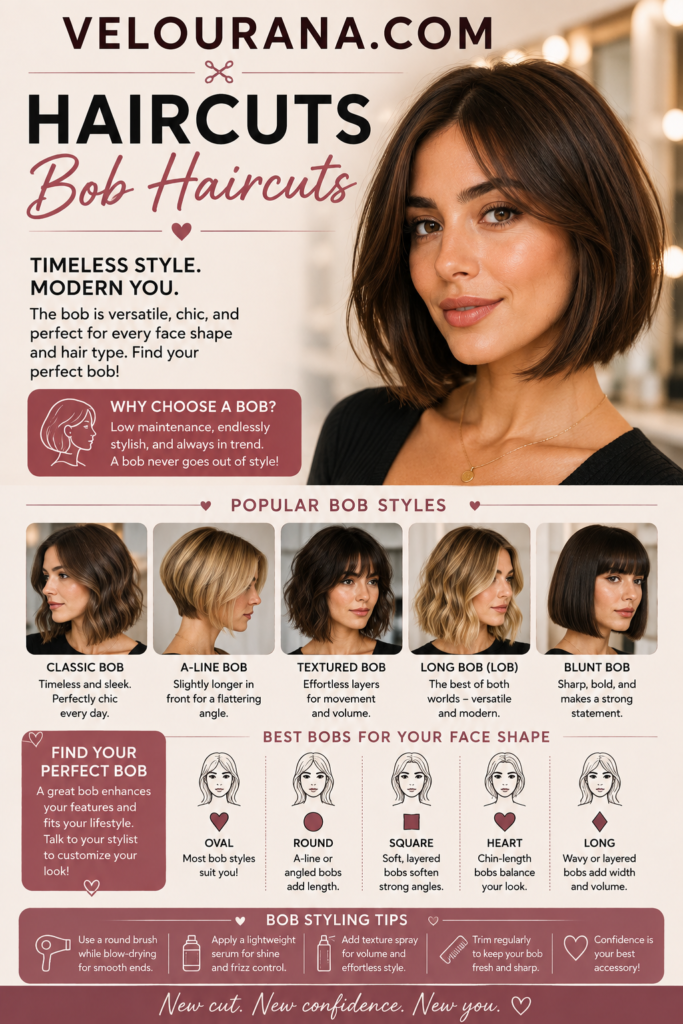
CATEGORY: Bob Haircuts
There is something immediately recognizable about a blunt bob. The hair reaches a deliberate stopping point and appears to finish almost all at once, creating a strong perimeter that can make even a relatively simple hairstyle look considered and polished. There may be very little obvious layering, no elaborate graduation and no complicated arrangement around the face. The strength of the haircut comes from the line itself.
That simplicity is also what makes a blunt bob so dependent on precision.
When a haircut contains abundant layers and texture, individual differences in length can disappear into movement. A blunt bob offers fewer places for inaccuracies to hide. The perimeter is visible, the balance from one side to the other matters, and the point at which the hair ends becomes one of the most important elements of the entire hairstyle.
Yet a blunt bob does not have to be severe.
The same fundamental cut can look sharp and architectural on sleek straight hair, soft and expensive with a gentle bend, relaxed when worn with natural waves, or full and expressive when interpreted for curls. It can sit tightly around the jaw or extend toward the collarbone. It can be paired with a center part, side part or several different types of bangs.
The defining idea is not absolute rigidity. It is the preservation of enough weight around the perimeter to create a clear, substantial shape.
This is particularly important because the blunt bob has acquired a reputation as a haircut that can make hair appear thicker. That can certainly be true, especially for fine hair, but the effect depends on why the hair looks thin in the first place and how the cut is designed.
Understanding the relationship between length, density and texture is what turns a fashionable blunt bob into a haircut that actually works.
Why a Strong Perimeter Can Make Fine Hair Look Fuller
Fine hair and thin hair are not necessarily the same thing. Fine describes the diameter of individual strands, while overall density refers to how much hair is present on the scalp. Someone can have very fine strands but a great deal of hair, or thicker strands with relatively low density.
The blunt bob can be useful in several of these situations because it concentrates visual weight around one level.
Long hair often becomes progressively less dense toward the ends. Normal shedding, breakage, previous layering and the natural growth cycle can leave the lower lengths looking much thinner than the hair closer to the scalp. Keeping those sparse ends simply because they provide additional length does not always create the appearance of more hair.
Cutting the perimeter higher can remove the weakest portion.
Suddenly the ends are positioned where the hair is naturally denser. Instead of a collection of increasingly transparent lengths, the eye sees a stronger continuous edge.
The haircut has not created additional strands.
It has changed where the existing density is displayed.
This is one reason a shorter blunt bob can sometimes make fine hair appear dramatically fuller than hair that was considerably longer.
Preserving weight is important, however. If fine hair is heavily layered immediately after being cut into a bob, some of the density gained at the perimeter can be lost again.
That does not mean internal shaping is forbidden. Very subtle adjustments can improve movement without creating visible layers.
The aim is to preserve the impression of fullness while preventing the haircut from becoming unnecessarily rigid.
Choosing the Exact Length Is More Important Than Choosing the Name
A blunt bob can finish almost anywhere between the jaw and shoulders, and every change in length alters the result.
A jaw-length version is bold because the perimeter sits directly beside the facial structure. The neck becomes more exposed, and the line of the haircut can draw attention toward the jaw.
Move the cut slightly lower and it begins to feel softer.
At chin length, there is enough hair to create movement while the haircut still remains clearly short. Depending on texture and head shape, the ends may curve toward the neck or sit farther away from it.
A bob ending around the lower neck creates a different balance. There is more weight and slightly more styling flexibility.
Once the perimeter approaches the shoulders, the haircut begins moving into long-bob territory. This can be useful for someone who wants the density and visual clarity of a blunt cut without sacrificing as much length.
Lifestyle can influence this decision as much as appearance.
If you need to tie your hair back regularly, an extremely short bob may not provide enough length. If you dislike hair touching your neck, going slightly shorter may actually feel more comfortable.
Shoulder contact matters too.
A perimeter sitting directly on the shoulders can flip outward because the hair physically encounters them. A slightly shorter bob may hang freely, while a slightly longer version may have enough weight to pass the shoulder more predictably.
The ideal length is therefore not simply the one that looks best in a photograph.
It is the one that works with the proportions and physical behavior of your own hair.
A Blunt Bob Does Not Have to Be Technically One Length
The phrase “blunt bob” can create the impression that every strand must be cut to exactly the same length and left completely untouched inside.
In practice, the visible effect matters more than technical purity.
Someone with very thick hair may love the strong perimeter of a blunt bob but find a completely solid interior overwhelmingly heavy. The hair can expand around the sides, become difficult to style and form a triangular silhouette.
A stylist can remove or redistribute some internal weight while preserving the outer line.
The finished haircut still reads as blunt because the perimeter remains visually substantial.
This is one of the differences between copying the appearance of a haircut and copying a cutting technique without adaptation.
Two people may wear bobs that look almost identical from the outside while the internal structure is completely different because one has fine straight hair and the other has dense, wavy hair.
The haircut should respond to the material it is made from.
Hair is not fabric cut from a standardized roll. Density varies across the scalp. Individual strands have different diameters. Growth patterns change direction. Waves and curls contract when dry.
A good blunt bob respects those differences while preserving the intended silhouette.
Straight Hair Shows the Precision of the Cut
Straight hair can make a blunt bob particularly striking because the perimeter remains highly visible.
A sleek finish emphasizes every element of the geometry. The relationship between the front and back becomes clear. The balance of the corners matters. The exact position of the line against the jaw or neck becomes part of the overall appearance.
This can create an exceptionally polished haircut.
It also means that precision matters.
Straight hair does not naturally disguise unevenness through curls or waves. A small imbalance can become more noticeable, particularly when the hair is worn completely smooth.
The styling can range from very sleek to relatively natural.
A polished version may involve blow-drying the hair smoothly and controlling the ends so they sit in the intended direction. Heat styling can create an even straighter finish when desired, with appropriate heat protection and sensible temperature management.
But a blunt bob does not need to look ironed flat.
Allowing a small amount of natural movement can make the cut feel softer while the perimeter still provides structure.
Even tucking one side behind the ear can change the entire personality of a straight blunt bob, introducing asymmetry without changing the haircut itself.
Waves Create Contrast Against the Strong Perimeter
A blunt perimeter combined with waves creates an attractive tension between structure and movement.
The lower edge provides a recognizable shape, while the lengths above it bend and separate naturally.
This can make a blunt bob feel much less formal.
Rather than seeing one uninterrupted line of hair, the eye notices individual waves moving within a strong overall silhouette.
Natural waves may also become more pronounced after cutting.
Longer hair carries more weight, which can stretch some wave patterns downward. Removing length may allow the hair to spring into stronger bends.
This should be anticipated when deciding where the bob will finish.
A wet haircut that appears to sit comfortably below the chin may rise once the waves return.
The stylist should therefore consider the hair in its natural state, particularly when the wearer intends to air-dry regularly.
Layers are not automatically required to make wavy hair work in a bob.
Some waves perform beautifully within a relatively blunt shape. Others become too bulky without subtle weight adjustment.
The pattern and density determine the answer.
The goal is to retain the visual strength of the perimeter without suppressing the movement that makes wavy hair interesting.
Curly Hair Can Interpret Bluntness Differently
A curly blunt bob will not necessarily produce a ruler-straight visible line.
The curls themselves determine where individual sections appear to end. Some contract more than others, and the perimeter may look softly irregular even when the underlying haircut has been designed around a strong baseline.
The overall silhouette can still feel blunt.
What matters is that enough density remains toward the bottom to create a substantial shape.
Shrinkage must be considered carefully.
Curly hair can become considerably shorter when dry than when wet or stretched. Cutting directly to the desired final length without accounting for that movement can result in a bob that sits much higher than expected.
Volume distribution matters too.
If dense curls accumulate heavily around one level, the haircut may expand outward. Some people love that strong rounded shape. Others prefer more internal movement and less width.
There is no universal requirement to make curly hair appear narrower.
The desired silhouette should be discussed rather than assumed.
A blunt curly bob can celebrate volume just as successfully as a straight blunt bob celebrates precision.
The Center Part Creates Maximum Symmetry
A center part combined with a blunt bob emphasizes the geometry of the haircut.
Hair falls on both sides of the face with similar visual weight, and the perimeter creates a strong boundary underneath.
On straight hair, this can produce an extremely clean, minimal appearance.
The effect becomes softer with waves or curls because texture interrupts the symmetry without removing it entirely.
A center part also places attention directly on facial proportions because there is relatively little asymmetry in the hairstyle to redirect the eye.
This is sometimes described as flattering or unflattering according to face shape, but that language can be unnecessarily restrictive.
Some people deliberately enjoy the strong symmetry of a center-parted bob because it emphasizes their features rather than attempting to alter them.
The natural hairline should still be considered.
If the hair strongly prefers to part elsewhere, maintaining a perfect center may require regular root styling.
The visual effect should be worth the effort required to create it.
A Side Part Can Make the Same Bob Feel Completely Different
Moving the part away from the center can transform a blunt bob without removing a single strand.
More hair falls toward one side, creating additional volume and asymmetry. The strong perimeter remains, but the top of the haircut becomes more fluid.
A deep side part can produce considerable drama.
A slight off-center part provides a much subtler change.
This flexibility is valuable because a precise haircut does not need to mean a fixed hairstyle.
Someone can wear a center part for a sleek, symmetrical appearance and move the hair sideways another day for greater volume.
Natural growth patterns determine how easily this happens.
Hair that is accustomed to a center part may resist a dramatic side switch initially, while some hair moves between partings with almost no effort.
Styling the roots while damp can help establish the new direction.
The ability to change the part is one reason a relatively simple blunt bob can provide more variety than its minimal structure suggests.
Bangs Can Turn the Blunt Bob Into a Completely Different Haircut
Pairing a strong bob with bangs increases the amount of structure around the face.
A blunt fringe creates the most graphic combination. There is a defined line across the forehead and another around the lower perimeter, producing a highly intentional shape.
Wispy bangs reduce the severity. They introduce softness and transparency while the bob maintains its stronger baseline.
Curtain bangs create movement around the cheekbones and can make the front of the haircut feel more layered without changing the main perimeter.
Side-swept bangs introduce asymmetry.
The choice depends on how much structure you want around the face.
A strong blunt bob does not necessarily need a strong fringe. Sometimes contrast creates the more interesting result.
Maintenance should also be considered.
The bob may retain its general shape for a reasonable period, but short bangs reveal growth much sooner. Combining the two can mean more frequent salon visits if precision is important.
For someone who enjoys that polished appearance, the maintenance may be entirely worthwhile.
The Ends Determine Whether the Haircut Looks Healthy
Because a blunt bob places so much emphasis on its perimeter, the condition of the ends becomes visually important.
Dryness, splitting and breakage can soften the line in ways that are not intentional.
Regular trimming helps preserve the density and clarity that make the haircut attractive.
Haircare should support the ends without overwhelming them.
Fine hair may need lightweight conditioning so the perimeter remains mobile rather than collapsing beneath heavy product.
Thick, coarse or dry hair may benefit from richer conditioning to help the ends feel smooth and controlled.
Heat styling habits matter as well.
A blunt bob is sometimes styled frequently because sleekness emphasizes the cut. Repeated high-temperature styling without appropriate care can gradually undermine the healthy-looking perimeter that the haircut was designed to create.
The goal should be a polished line created primarily by the haircut, not by repeatedly forcing damaged hair into temporary smoothness.
Styling the Blunt Bob Sleek
The sleek blunt bob is perhaps the style's most recognizable form.
The roots sit relatively smooth, the lengths appear controlled and the perimeter is clearly visible.
Creating this finish begins with the blow-dry rather than relying entirely on a straightening tool afterward.
Directing the hair while drying can reduce unnecessary passes with additional heat. The ends can be encouraged to sit straight or curve very subtly inward depending on the desired finish.
A small amount of appropriate finishing product can control flyaways and add shine.
Quantity matters.
Too much oil or serum can cause fine hair to lose movement and make a freshly washed bob look heavy.
The finished hairstyle should still have life.
Sleek does not need to mean completely immobile.
The Same Cut Can Be Worn Tousled
One of the most useful characteristics of a blunt bob is the contrast between its structured haircut and potentially unstructured styling.
Adding bends or waves changes the appearance immediately.
The perimeter becomes less obvious in individual sections but remains visible as the overall boundary of the hairstyle.
This creates a relaxed effect without requiring the haircut itself to become heavily layered.
Natural texture can provide this automatically.
Straight hair can achieve it through styling when desired.
The waves do not need to be perfectly uniform. In fact, varying the direction and leaving the ends slightly less curled can prevent the style from looking overly formal.
The strong cut underneath gives the texture enough structure to remain intentional.
This is why the blunt bob can move surprisingly easily between polished and casual styling.
Maintenance Depends on How Precise You Want the Line to Remain
All haircuts change as they grow, but a blunt bob makes growth particularly visible because the perimeter is so important.
The line gradually moves downward.
A jaw-length bob becomes chin length.
A chin-length bob approaches the neck.
Eventually the relationship between the hair and shoulders changes.
If the exact silhouette is important, regular trims are necessary to restore it.
Someone who enjoys seeing the haircut evolve may wait longer.
The bob does not suddenly become unattractive because it has grown several centimeters. It simply becomes a different version of itself.
The need for maintenance is therefore partly aesthetic.
A highly geometric bob requires more precision than a relaxed blunt cut worn with natural waves.
Before choosing the haircut, it helps to decide whether you love the exact photographed length or the general concept.
That distinction can determine how often you will want to return to the salon.
Growing a Blunt Bob Longer Is Relatively Simple
A blunt bob offers one of the more straightforward routes back to longer hair because much of the perimeter may already be relatively even.
The main challenge usually appears around the shoulders.
As the ends begin touching them, they can flip outward or behave differently from the shorter bob.
This stage does not necessarily require aggressive layering.
Small adjustments can help the hair move more comfortably while preserving length.
Face-framing pieces can also evolve gradually if more movement is desired during the process.
Eventually the bob becomes a lob, then medium-length hair.
The strong perimeter can remain throughout, allowing the hair to look deliberate while gaining length.
Growing it out therefore does not need to mean avoiding trims entirely.
Removing damaged ends and maintaining balance can actually make the process look better without sacrificing meaningful progress.
A Simple Haircut Can Demand Sophisticated Decisions
The blunt bob demonstrates why apparently simple haircuts are often among the most technically interesting.
There are relatively few visible elements.
That means each one matters.
The exact length changes the relationship with the jaw, neck and shoulders.
Density determines how much weight should remain.
Texture determines how the perimeter will behave once dry.
The hairline influences the part.
Internal structure may need adjustment even when the exterior is intended to look completely blunt.
Lifestyle determines whether the hair needs enough length to tie back.
Maintenance preferences determine how precise the initial shape should be.
These decisions are far more important than choosing a fashionable name for the haircut.
Why the Blunt Bob Remains So Powerful
The blunt bob succeeds because it makes the hair itself look important.
It does not need elaborate decoration.
The perimeter becomes the design.
On fine hair, that line can create an impression of greater density by removing sparse lengths and concentrating the ends.
On thick hair, it can showcase abundance while careful internal work keeps the shape manageable.
On straight hair, it becomes precise.
On waves, it creates contrast.
On curls, it becomes a substantial three-dimensional silhouette.
It can look minimal with a center part, glamorous with a side part, dramatic with blunt bangs or softer with a wispy fringe.
The concept remains recognizable through all of these variations.
That is why the blunt bob is more than a temporary haircut trend.
It is a way of using length and density deliberately.
When the perimeter is placed where the hair looks strongest, the internal structure respects the natural texture and the styling expectations match everyday life, the apparent simplicity of the cut becomes its greatest advantage.
Nothing unnecessary distracts from the shape.
The hair ends exactly where it needs to end, and sometimes that clean decision is enough to make the entire hairstyle feel new.
The End
Velourana.
 Discover More From Our Family of Websites
 ZodiacBearing (Astrology, Tarot, Numerology, Angel Numbers & Spiritual Guidance)
 Velourana (Beauty, Makeup, Hair Care, Skincare & Beauty Tips)
 HavenBearing (Home, Living, Organization, Décor & Everyday Inspiration)
 PawBearing (Pet Care, Dog Breeds, Animal Health, Training & Pet Products)
 PsyCatherine (Notes From the Journal of a Psychologist on Real Life)

