
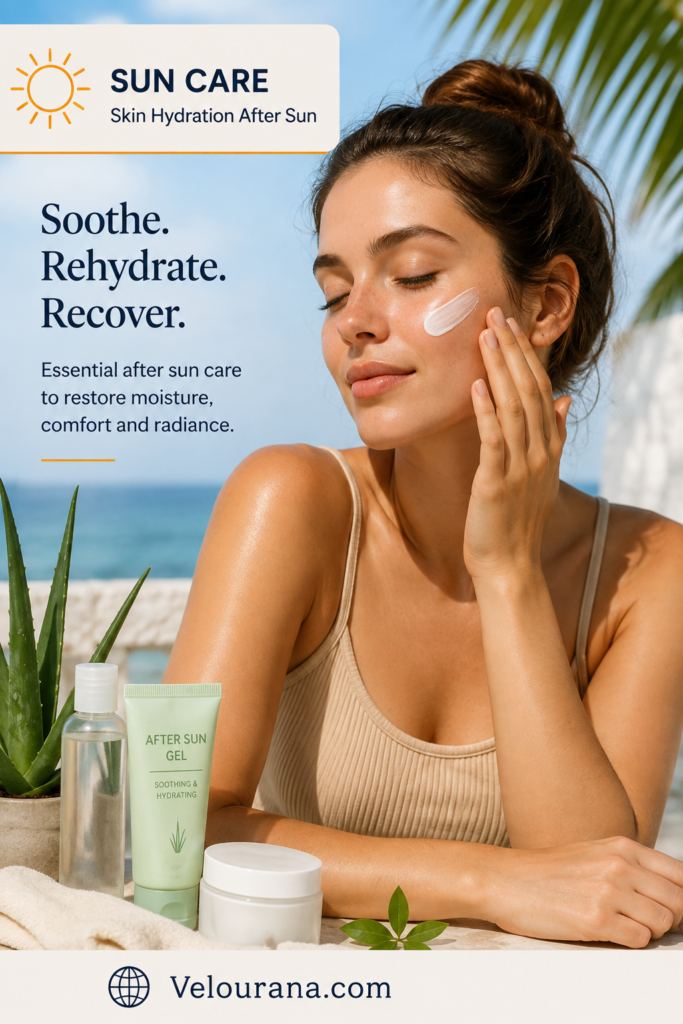
CATEGORY: Skin Hydration After Sun
After a day spent outdoors, skin can feel very different from the way it felt in the morning. Heat, sunlight, wind, perspiration, salt water, chlorine, sunscreen, and repeated cleansing can leave the complexion feeling warm, tight, dry, or uncomfortable.
Hydration becomes particularly appealing at this point.
The beauty industry offers an enormous range of after-sun products, but the ingredient lists often contain familiar groups of ingredients performing different roles. Some attract and hold water within the upper layers of the skin. Some soften the surface. Others help support the skin barrier or simply provide a pleasant, lightweight texture that feels comfortable after heat exposure.
Understanding these functions makes choosing after-sun skincare much easier.
Instead of searching for one miracle ingredient, it is more useful to look for a balanced formulation that combines hydration with enough moisturization for your individual skin type.
After-Sun Hydration Has a Specific Purpose
The purpose of after-sun hydration is to improve comfort and help address dryness or dehydration after environmental exposure.
It is not a method of reversing ultraviolet exposure.
No hydrating serum, aloe gel, moisturizer, facial mist, or mask can make excessive sun exposure harmless.
This distinction is fundamental.
Sun protection happens before and during exposure through measures such as broad-spectrum sunscreen, shade, suitable clothing, hats, sunglasses, and sensible management of time outdoors.
Hydrating skincare comes afterward to help the skin feel comfortable.
Why Skin May Feel Thirsty After Sun
A summer day exposes skin to more than sunlight.
Perspiration increases in hot conditions. Wind encourages evaporation. Swimming repeatedly wets and dries the skin. Salt and chlorine can contribute to a dry or tight sensation. Air conditioning creates another environmental transition when someone moves indoors.
Sunscreen also needs to be removed at the end of the day, which adds another cleansing step.
The result can be skin that feels less comfortable even when it appears shiny.
This is why hydration can benefit a wide range of skin types after outdoor exposure.
Humectants Are Central to Hydrating Skincare
Many effective hydrating products contain humectants.
Humectants are ingredients used in cosmetic formulations to help attract and retain water.
They appear throughout skincare.
Toners, essences, serums, gels, creams, lotions, eye products, masks, and body moisturizers can all contain humectants.
The important question is not simply whether a product contains one.
It is whether the complete formulation provides the texture and level of moisturization that your skin needs.
Glycerin
Glycerin is one of the most established humectants in skincare.
It appears in products across virtually every price range.
Although it may receive less marketing attention than newer ingredients, glycerin can be an excellent component of an after-sun hydration routine.
Its great advantage is versatility.
It can be incorporated into very lightweight serums as well as richer creams.
This means people with different skin types can benefit from glycerin without needing the same product texture.
Why Glycerin Works Well in Summer Textures
A product does not need to be rich to contain glycerin.
A water-based gel serum can provide a refreshing experience while using glycerin as part of its hydrating system.
A lightweight body lotion can do the same for arms and legs.
This flexibility makes glycerin particularly useful when the weather is hot.
The skin receives hydration without necessarily being covered in a dense layer.
Hyaluronic Acid
Hyaluronic acid has become one of the most recognizable skincare ingredients associated with hydration.
It appears in serums, essences, masks, creams, eye products, and body care.
Many hyaluronic-acid products have watery or gel-like textures, making them particularly pleasant during warm weather.
A lightweight hyaluronic-acid serum can provide a refreshing first step after cleansing.
For dry skin, it can then be followed by a more substantial moisturizer.
Hyaluronic Acid Is Not Necessarily the Final Step
A common mistake is treating a hyaluronic-acid serum as though it automatically replaces moisturizer.
For some oily complexions, a sufficiently moisturizing serum or gel may indeed feel adequate.
Dry skin may need more.
If the complexion feels comfortable immediately after serum application but becomes tight later, follow with an appropriate moisturizer.
The routine should be judged by lasting comfort rather than the first minute.
Panthenol
Panthenol is frequently included in products positioned around hydration and skin comfort.
It can be found in serums, gels, creams, masks, lotions, and after-sun formulas.
Its versatility makes it particularly suitable for summer.
A lightweight panthenol serum can provide hydration without requiring a thick texture.
A body gel containing panthenol can feel refreshing after a shower.
A moisturizer can combine panthenol with humectants and emollient ingredients to provide a more complete final step.
Aloe Vera
Aloe vera has an exceptionally strong association with after-sun skincare.
Part of its appeal comes from the textures in which it is commonly formulated.
Aloe gels tend to be water-rich, spread easily, and feel fresh on warm skin.
If stored according to instructions and used slightly chilled, they can provide an especially pleasant sensory experience.
However, aloe should be evaluated as part of the entire formula.
Not Every Aloe Gel Is the Same
Two products with aloe displayed prominently on the packaging can have very different ingredient lists.
One may be relatively simple.
Another may contain fragrance, alcohol, colorants, or numerous botanical extracts.
This does not automatically make either product good or bad.
It simply means that the word "aloe" is not enough to determine suitability.
Sensitive skin should pay particular attention to the complete formulation.
Centella Asiatica
Centella asiatica has become increasingly common in hydrating and soothing-style skincare.
It appears in toners, essences, ampoules, serums, gels, masks, and moisturizers.
Many centella products are deliberately formulated with lightweight textures.
This makes them convenient for after-sun routines where heavy creams may feel uncomfortable.
A centella essence can provide the first hydrating layer.
A centella gel cream can provide a more complete moisturizing step.
There is no need to use both unless the skin benefits from the combination.
Beta-Glucan
Beta-glucan is another ingredient found in hydrating skincare.
It often appears alongside other humectants rather than as the only featured ingredient.
This is an important reminder that skincare formulas work as combinations.
A serum containing glycerin, beta-glucan, panthenol, and other complementary ingredients may be more convenient than purchasing separate products for each individual ingredient.
After-sun skincare benefits from this kind of simplicity.
Sodium PCA
Sodium PCA is another humectant used in cosmetic formulations.
It may not receive the same publicity as hyaluronic acid, but it can appear in hydrating toners, serums, and moisturizers.
Consumers do not need to search specifically for every individual humectant.
Instead, recognize that a well-designed formula may use several hydrating ingredients together.
The overall experience matters more than having the most fashionable name on the label.
Urea
Urea is used in skincare at different concentrations and for different purposes.
In moisturizing formulations, it can contribute to hydration.
It is particularly common in body-care products designed for dry skin.
Product concentration and intended use matter, so follow the directions of the specific formulation.
For after-sun body care, a familiar moisturizer already tolerated by the skin may be preferable to experimenting with a strong treatment product on areas that feel sensitive.
Ceramides
Hydration alone is not always enough.
This is where ceramides become particularly relevant.
Ceramides are lipids associated with the skin barrier and are widely incorporated into moisturizers.
A ceramide moisturizer can be useful after swimming, repeated cleansing, wind exposure, or time in dry air-conditioned environments.
The product does not need to be heavy.
Modern ceramide formulas include lotions, emulsions, and gel creams that can work comfortably in warm weather.
Why Barrier Support Matters After Hydration
Imagine applying a beautifully refreshing water-rich serum to dry skin.
For several minutes, everything feels excellent.
Then the tight sensation returns.
The problem may not be a lack of another hydrating serum.
The skin may simply need a more complete moisturizer afterward.
This is why after-sun routines often work best in two stages.
Hydrate first.
Moisturize second.
Squalane
Squalane is an emollient ingredient found in many moisturizers and facial products.
It can help soften the skin and contribute to a more comfortable finish.
Although oils may sound too heavy for summer, formulation matters enormously.
A gel cream containing a small amount of squalane can still feel very light.
Someone with dry skin may appreciate this balance after applying a water-based hydrating serum.
Shea Butter
Shea butter is considerably richer than the typical ingredients associated with cooling skincare.
That does not mean it has no place in after-sun hydration.
Very dry areas may benefit from richer moisturization once the skin has cooled.
A small amount of a shea-containing moisturizer may be useful on dry elbows, knees, hands, feet, or other areas.
The entire body does not need to receive the same texture.
Allantoin
Allantoin is commonly incorporated into products designed around skin comfort.
It may appear in gels, lotions, creams, cleansers, and after-sun products.
Like many supportive ingredients, it often works as one component of a larger formula.
There is rarely a need to purchase an allantoin-only product.
Look for a complete formulation that provides the hydration and moisturization appropriate to the skin.
Niacinamide
Niacinamide appears throughout contemporary skincare.
It can be found in serums, moisturizers, lotions, and many products designed for oily or combination complexions.
A well-tolerated niacinamide product may continue to fit comfortably into a summer routine.
However, skin that feels unusually reactive after a day outdoors may benefit from simplicity.
This is not necessarily the best time to introduce a strong unfamiliar formula merely because niacinamide is popular.
Green Tea Extract
Green tea extracts frequently appear in lightweight skincare.
They are particularly common in toners, essences, gels, and facial mists.
These textures make green-tea products naturally compatible with summer hydration routines.
The ingredient can be appreciated as part of the overall formula without expecting it to replace fundamental steps such as moisturization and sunscreen.
Cucumber Extract
Cucumber has long been associated with cooling beauty rituals.
Modern products use cucumber extracts in mists, gels, masks, toners, and eye products.
Much of the refreshing experience of these products comes from their water-rich texture and temperature.
A cool cucumber gel may feel wonderful after a hot day.
The sensation does not need to be interpreted as evidence that cucumber alone is responsible for the entire effect.
Algae and Marine Extracts
Marine-inspired skincare is particularly popular during summer.
Algae, seaweed, and related extracts appear in hydrating masks, serums, creams, and gels.
These products can be enjoyable, particularly when formulated in lightweight textures.
As always, the complete formulation determines how the product feels.
Ocean imagery on the packaging does not automatically make a moisturizer more hydrating.
Thermal Water
Thermal-water sprays offer one of the simplest forms of refreshing skincare.
A fine mist can feel excellent after heat exposure.
The droplets provide temporary freshness and can prepare the complexion for a serum or moisturizer.
Dry skin should not necessarily stop there.
If the face feels tight after the mist evaporates, follow with a product that provides more lasting hydration and moisturization.
Amino Acids
Amino acids can appear in moisturizing and hydrating formulations.
They are often part of more complex ingredient systems rather than the primary marketing feature.
Their presence is another reminder that a good moisturizer does not need to revolve around one superstar ingredient.
Balanced formulations frequently combine several ingredient categories.
Occlusive Ingredients
Some moisturizers include ingredients that help reduce water loss from the skin.
These can be particularly useful for dry skin.
However, a highly occlusive texture may feel uncomfortable immediately after a hot day.
One strategy is to apply lightweight hydration first and reserve richer products for later in the evening.
This provides refreshment initially and more substantial moisturization once body temperature has settled.
Ingredient Combinations Matter More Than Ingredient Trends
Skincare marketing often encourages consumers to search for individual hero ingredients.
Hyaluronic acid.
Aloe.
Centella.
Ceramides.
Niacinamide.
Each can have a place in skincare.
But products are formulations, not isolated ingredients.
A moisturizer containing several ordinary ingredients in a balanced base may suit the skin better than an elaborate serum built around one fashionable ingredient.
Look at Texture Alongside Ingredients
The same ingredient can appear in completely different textures.
Hyaluronic acid may be found in a watery toner, gel serum, sheet mask, gel cream, or rich moisturizer.
Ceramides may appear in a lightweight lotion or thick cream.
Aloe may be formulated as a gel or included in an emulsion.
Therefore, selecting after-sun skincare requires two questions.
What ingredients does the product provide?
How does the texture fit the climate and skin type?
Ingredients for Oily Skin After Sun
Oily skin generally benefits from hydration delivered through lightweight textures.
Look for serums or gels containing humectants such as glycerin or hyaluronic acid.
A gel moisturizer may provide enough additional comfort.
Niacinamide-containing products may also fit the routine if already well tolerated.
Avoid assuming that oily skin needs no hydration at all.
Ingredients for Dry Skin After Sun
Dry skin often needs both humectants and richer moisturizing ingredients.
A hydrating serum can provide the first layer.
A ceramide moisturizer, gel cream, or lotion can follow.
If very dry areas remain uncomfortable, a richer cream can be applied selectively.
This combination preserves the refreshing character of after-sun skincare without sacrificing adequate moisturization.
Ingredients for Combination Skin
Combination skin can use the same hydrating serum across the entire face.
Moisturizer can then be adjusted by area.
Apply less through the oilier central face.
Use more on dry cheeks or other areas.
This is often easier than trying to find one perfect product that behaves identically everywhere.
Ingredients for Sensitive Skin
Sensitive skin generally benefits from predictable formulations.
Choose products already known to be comfortable.
People who know that fragrance causes them problems may prefer fragrance-free options.
Strong menthol sensations or numerous unfamiliar botanical extracts may be unnecessary when the skin already feels stressed.
The objective is lasting comfort rather than dramatic sensation.
Fragrance in After-Sun Products
Many after-sun products are fragranced.
Coconut, aloe, cucumber, mint, citrus, and tropical scents can make the experience feel more summery.
People who enjoy and tolerate fragrance may appreciate this.
Those with sensitive skin may prefer simpler alternatives.
Fragrance is part of the sensory experience, not a requirement for effective hydration.
Menthol Is Not a Hydrating Ingredient
Menthol deserves special attention because it can create a powerful cooling sensation.
That sensation can be enjoyable.
It should not be confused with hydration.
A menthol product may feel intensely cold while a fragrance-free glycerin serum provides much more meaningful moisture.
Cooling sensation and hydration are separate properties.
Alcohol in Lightweight Formulas
Some lightweight skincare products contain alcohol as part of their formulation.
This can contribute to a quick-drying, fresh sensation.
Individual tolerance varies.
People who consistently find certain alcohol-rich products drying may prefer alternatives, especially after outdoor exposure.
The entire formulation should be considered rather than automatically judging a product by one ingredient.
Avoid Unnecessary Irritants When Skin Feels Stressed
After a long day outdoors, the skin may be less tolerant of experimentation.
This is a good time to favor familiar products.
Strong fragrances, intense cooling agents, aggressive exfoliants, or unfamiliar high-strength active products can wait if the complexion feels uncomfortable.
Hydration does not need to be dramatic.
What About Vitamin C?
Vitamin C is widely used in daytime skincare and antioxidant routines.
Someone who already uses a well-tolerated vitamin C product may continue according to their normal routine and the product instructions.
However, vitamin C should not be confused with an immediate after-sun hydration ingredient.
If the skin feels particularly sensitive, a simple hydrating evening can be more comfortable than insisting on every normal active step.
What About Retinoids?
Retinoids serve purposes different from cooling or hydrating skincare.
People using them should follow the instructions appropriate to their product.
If the skin feels unusually irritated after environmental exposure, changing or pausing prescription treatment should not be done casually; appropriate professional advice should guide treatment decisions.
For ordinary cosmetic routines, the key principle remains simplicity when the skin feels stressed.
What About Exfoliating Acids?
Exfoliating acids can be valuable in an established skincare routine.
They are not required for after-sun hydration.
If the skin feels warm, tight, tender, or unusually reactive, aggressive exfoliation may be uncomfortable.
Hydration and moisturization can take priority until the complexion feels normal.
Hydrating Ingredients in Facial Mists
Mists can contain glycerin, panthenol, botanical extracts, minerals, or other hydrating components.
Their main advantage is convenience.
They provide rapid refreshment with almost no weight.
For lasting hydration, however, a serum or moisturizer may still be necessary.
Hydrating Ingredients in Serums
Serums are perhaps the easiest format for combining several humectants.
A single serum may contain glycerin, hyaluronic acid, panthenol, beta-glucan, amino acids, and other supportive ingredients.
This can eliminate the need to layer multiple separate hydrating products.
Hydrating Ingredients in Gel Creams
Gel creams often combine humectants with emollient and barrier-supporting ingredients.
This makes them particularly useful after sun exposure.
They provide the refreshing sensory quality of a gel while offering more lasting moisturization.
Hydrating Ingredients in Body Lotions
Body lotions can combine glycerin, ceramides, emollients, and botanical ingredients in a spreadable texture.
They are particularly useful after showering.
Apply to shoulders, arms, chest, legs, and other exposed areas while the skin remains comfortable.
Hydrating Masks
Hydrating masks can contain many of the same ingredients found in serums and moisturizers.
Their difference is primarily format and application time.
A chilled sheet mask or gel mask can provide a pleasant summer ritual.
Use it according to the instructions.
A mask is an optional addition rather than a replacement for everyday skincare.
Avoid Ingredient Overload
If one serum already contains several hydrating ingredients, there may be little reason to apply three additional serums with similar formulas.
Ingredient duplication can make the routine sticky without adding meaningful benefit.
After-sun hydration is often most comfortable when kept concise.
One Good Serum Can Be Enough
A well-formulated hydrating serum can become the central after-sun product.
Apply it after cleansing.
Follow with moisturizer according to skin type.
This two-step approach is easy to maintain and adapt.
One Good Moisturizer Can Sometimes Be Enough
Some moisturizers already contain humectants, emollients, and barrier-supporting ingredients.
For certain skin types, a separate serum may be unnecessary.
After cleansing, one comfortable gel cream may provide everything needed.
Skincare does not become better simply because it contains more steps.
Cooling the Product Instead of Adding Cooling Ingredients
One of the smartest ways to create an after-sun experience is through temperature.
If storage instructions permit, keep a hydrating mist or gel moisturizer slightly cool.
This provides immediate refreshment without requiring menthol or other intense sensory ingredients.
The skincare function comes from the formulation.
The cooling sensation comes from temperature.
Do Not Freeze Hydrating Products
Freezing skincare is unnecessary.
Extreme cold can be uncomfortable and may not be appropriate for the formulation.
A refrigerator-cool product already provides a noticeable sensory difference.
Gentle cooling is enough.
How to Read an Ingredient List More Intelligently
Do not search only for one recognizable ingredient.
Look at the formulation as a whole.
Does it contain humectants?
Does it include moisturizing ingredients?
Is it heavily fragranced if fragrance bothers you?
Does the texture suit your skin type?
Is the product designed for the face or body?
These practical questions matter more than marketing slogans.
Do Not Assume Expensive Means More Hydrating
Hydration does not require luxury pricing.
Glycerin, hyaluronic acid, panthenol, ceramides, and other useful skincare ingredients appear across many price ranges.
Packaging, fragrance, brand positioning, and texture can influence price considerably.
Choose according to formulation, tolerance, and personal preference rather than assuming cost determines effectiveness.
Do Not Assume Natural Means Better
Plant extracts can be enjoyable additions to skincare.
They are not automatically superior to familiar cosmetic ingredients.
Likewise, synthetic ingredients are not automatically harsh.
The quality and suitability of the complete formulation matter.
After-sun skincare should be selected according to how the skin responds.
Avoid Kitchen Experiments
Homemade lemon treatments, improvised herbal sprays, or unpreserved mixtures are unnecessary when the skin feels stressed.
Professionally formulated skincare provides a more predictable approach.
A simple moisturizer is often more useful than a complicated DIY recipe.
Hydration After the Beach
After a beach day, rinse away salt and sand.
Remove sunscreen carefully.
Apply a hydrating serum.
Follow with moisturizer.
Use a lightweight body lotion or gel.
There is no need for an aggressive treatment routine.
Hydration After the Pool
After swimming, rinse away pool water.
Cleanse gently.
Use a hydrating serum or moisturizer.
Apply body lotion where the skin feels dry.
Again, simplicity works.
Hydration After Outdoor Exercise
Allow the body to cool.
Shower.
Cleanse perspiration and sunscreen.
Apply lightweight hydration.
A gel moisturizer may feel particularly comfortable.
Hydration After Travel
Travel can combine sun exposure with dry aircraft cabins, air conditioning, and disrupted routines.
A simple hydrating serum and moisturizer can provide consistency.
There is little need to carry a large collection of specialized products.
Nighttime Is Ideal for Richer Moisturization
If a richer cream feels uncomfortable immediately after coming indoors, wait until later.
Use a lightweight serum first.
Once the skin and environment have cooled, apply richer moisturizer where necessary.
This staged approach can work particularly well for dry skin.
The Morning After
The next morning, observe how the skin feels.
If it is comfortable, the previous evening's hydration level was probably appropriate.
If it feels tight, consider increasing moisturization.
If it feels excessively greasy or coated, reduce the amount or richness of the final product.
Use the skin's response to refine the routine.
Return to Sun Protection
After-sun hydration ends where the next day's sun protection begins.
Apply a morning routine that sits comfortably beneath sunscreen.
Use appropriate broad-spectrum protection and other sensible sun-protective measures.
Hydration and protection complement each other but perform different jobs.
Know the Limits of Cosmetic Ingredients
Hydrating ingredients can help ordinary summer skin feel more comfortable.
They should not be treated as treatment for serious sunburn.
Blistering, severe pain, marked swelling, extensive burns, or other concerning symptoms may require appropriate medical care.
Serious symptoms associated with excessive heat also require appropriate attention.
A bottle of serum cannot replace medical assessment.
Build a Formula, Not an Ingredient Collection
The most useful way to think about after-sun hydration is not as a hunt for individual ingredients.
Think in functions.
Humectants provide hydration.
Emollients soften the skin.
Barrier-supporting moisturizers help maintain comfort.
Lightweight textures provide a refreshing summer experience.
Cooling the product can enhance that sensation.
A good formulation may perform several of these functions at once.
Choose According to Your Skin
Oily skin may prefer a glycerin or hyaluronic-acid gel.
Dry skin may enjoy the same serum followed by a ceramide-rich moisturizer.
Sensitive skin may prefer a simple fragrance-free panthenol formula.
Someone who loves aloe may enjoy a refrigerated aloe gel.
Another person may achieve better comfort with an ordinary gel cream.
There is no single ingredient every person must use.
Lasting Comfort Is the Real Test
The first sensation after applying skincare can be misleading.
A product may feel wonderfully cool because it has just come from the refrigerator.
Wait twenty minutes.
Does the skin still feel comfortable?
Has tightness returned?
Is the face sticky?
Does it need more moisturizer?
Does the formula feel irritating?
These questions reveal whether the product actually belongs in the routine.
After-Sun Hydration Does Not Need to Be Complicated
Some of the most effective routines are also the simplest.
Cleanse gently.
Apply one good hydrating product.
Follow with an appropriate moisturizer.
Extend moisturization to the body.
Protect the skin properly the following day.
That is a complete strategy.
The best ingredients for skin after sun exposure are not necessarily the newest, most exotic, or most expensive. Familiar humectants such as glycerin and hyaluronic acid, supportive ingredients such as panthenol, moisturizing components such as ceramides and squalane, and well-formulated botanical products such as aloe or centella can all have a place.
What matters is how they are combined, how the product feels on the skin, and whether the final routine provides enough lasting comfort.
Choose formulas rather than trends. Choose texture according to climate. Use cooling for comfort rather than as a substitute for protection. And allow hydration to perform its proper role: helping summer skin feel soft, fresh, balanced, and comfortable again after a demanding day outdoors.
The End
Velourana.
 Discover More From Our Family of Websites
 ZodiacBearing (Astrology, Tarot, Numerology, Angel Numbers & Spiritual Guidance)
 Velourana (Beauty, Makeup, Hair Care, Skincare & Beauty Tips)
 HavenBearing (Home, Living, Organization, Décor & Everyday Inspiration)
 PawBearing (Pet Care, Dog Breeds, Animal Health, Training & Pet Products)
 PsyCatherine (Notes From the Journal of a Psychologist on Real Life)

