
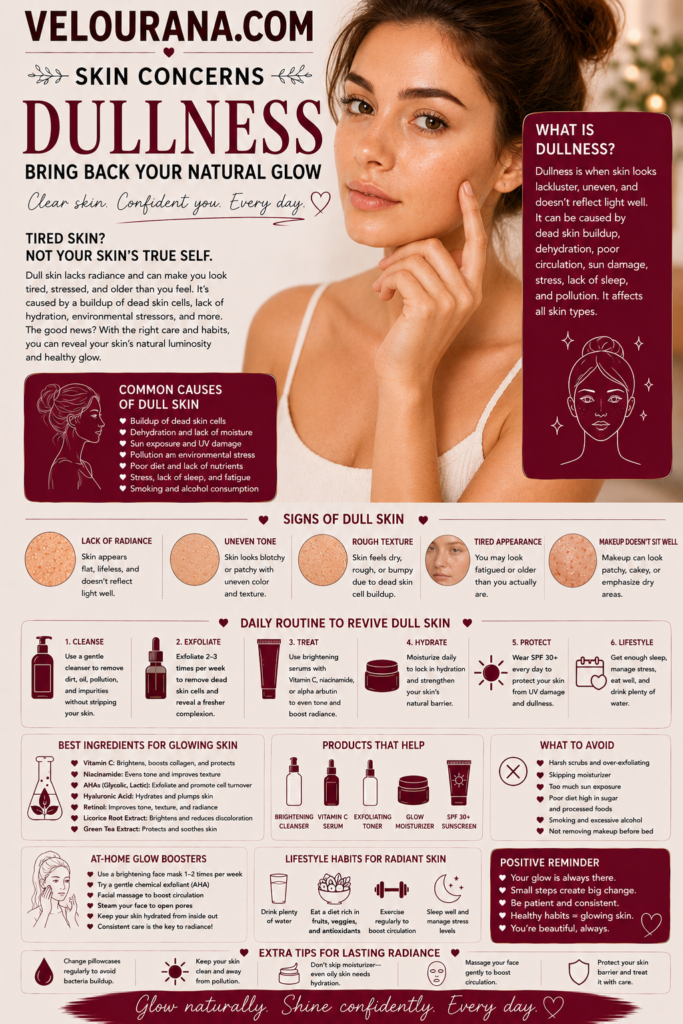
CATEGORY: Dullness
There is a tendency to treat glow as something that must be added to the skin.
A brightening serum adds radiance. A highlighter adds luminosity. An exfoliant reveals freshness. A facial oil creates sheen. The language surrounding dullness encourages the idea that brightness exists somewhere underneath the surface and only needs to be uncovered.
Yet mature skin often becomes more luminous for a different reason.
It becomes healthier.
This is where the skin barrier enters the conversation. Although it is frequently discussed in relation to sensitivity, dryness or irritation, barrier condition also has a profound visual effect. A well-functioning surface tends to hold water more effectively, maintain greater flexibility and present a smoother arrangement of cells. When that environment deteriorates, the complexion may become rougher, tighter, flaky, reactive and less able to reflect light evenly.
The result is often described simply as dullness.
This means that one of the most powerful brightening strategies for ageing skin may not involve stimulating it at all. It may involve protecting what already exists.
The concept is less dramatic than resurfacing. Barrier repair rarely creates the instant satisfaction of a peel. There is no visible layer being removed and no tingling sensation announcing that something active is happening.
Its effects are quieter.
The skin stops feeling tight.
Moisturiser lasts longer.
Makeup settles less noticeably into dry areas.
Redness becomes less prominent.
Texture appears calmer.
Eventually the complexion begins to look clearer because the surface is no longer constantly fighting irritation and water loss.
The relationship between barrier health and radiance is therefore one of the most useful ideas in mature skincare. It shifts attention away from endless correction and toward creating the conditions in which the skin can function more effectively.
The Outer Surface Is Not Dead Weight
The phrase “dead skin cells” has caused considerable confusion in beauty.
Technically, the outermost cells of the epidermis have completed most of their biological activity. But describing them simply as dead material makes them sound useless, like dust that should be removed as quickly as possible.
They are anything but useless.
The outermost layer of the epidermis, known as the stratum corneum, forms part of the skin's essential protective barrier. Its cells are organised within a lipid-rich environment that helps limit excessive water loss while reducing penetration by irritants and environmental substances.
A popular analogy compares this arrangement to bricks and mortar.
The corneocytes function like bricks, while the surrounding lipids help form the mortar that maintains cohesion.
The analogy is imperfect but useful because it explains why the appearance of the surface depends on organisation rather than simply thickness.
If the barrier is functioning well, water remains more effectively retained and the surface stays relatively flexible.
When it becomes disrupted, water escapes more readily.
Dryness increases.
Microscopic cracks and irregularities appear.
The skin becomes more vulnerable to irritation.
This deterioration immediately influences the way light interacts with the complexion.
Instead of a cohesive, hydrated surface reflecting light relatively smoothly, the face becomes optically irregular.
What appears in the mirror as dullness may therefore be partly a barrier problem.
This is particularly relevant as skin ages because mature skin is more prone to dryness and may recover more slowly from aggressive treatment.
The older complexion often requires a different relationship with its outer layers.
Rather than constantly attempting to remove them, it may benefit from preserving them more intelligently.
Why Mature Skin Becomes More Vulnerable to Water Loss
Ageing changes the skin gradually rather than through one dramatic transformation.
The sebaceous glands may produce less oil. Natural lipid composition shifts. Epidermal renewal changes. Hormonal transitions can alter dryness significantly, particularly during and after menopause. Environmental damage accumulated across decades adds further stress.
The result is often a complexion that no longer maintains moisture as effortlessly as it once did.
This can be surprising for people who spent most of their lives managing oily skin.
A person who once needed blotting papers may suddenly find foundation catching around the mouth.
Someone who avoided creams for decades may begin experiencing tightness by afternoon.
The change can feel inconsistent because not every area of the face ages identically.
The forehead may remain oily while the cheeks become dry.
The nose may still develop congestion while the eye area becomes fragile.
This mixed behaviour encourages people to continue treating the entire face according to its oiliest region.
They cleanse more aggressively.
Use lightweight products everywhere.
Avoid richer moisturisers.
The drier regions gradually become increasingly dehydrated.
Eventually the complexion looks shiny in some areas and dull in others.
This is not unusual.
It is simply evidence that mature skin often requires more nuanced management than the broad categories of dry, oily and combination suggest.
Water Is Part of the Appearance of Youthfulness
Much of what we casually call plumpness is related to hydration.
When the outer skin contains adequate water, it becomes more flexible and visually smoother. Fine dehydration lines can appear softer. The surface reflects light more evenly.
When water content falls, those same microscopic irregularities become easier to see.
This does not mean hydration can remove structural wrinkles.
A crease created by years of facial movement and collagen changes will not disappear because moisturiser has been applied.
But dehydration can exaggerate existing lines.
Imagine fabric stretched smoothly compared with the same fabric when dry and crumpled. The material has not fundamentally changed, but its surface looks different.
The skin behaves in a similarly complex way.
This is why moisturising mature skin can create an immediate cosmetic improvement even though deeper ageing processes remain untouched.
Hydration improves the presentation of the surface.
That effect should not be dismissed as superficial.
The outermost surface is precisely what light encounters.
Improving it can change the overall impression of the face considerably.
A Moisturiser Is Really a System
Moisturisers are often judged by texture.
A thick cream feels powerful.
A lightweight gel feels refreshing.
A facial oil feels nourishing.
But sensory richness does not necessarily reveal how effectively a product supports the skin.
Good moisturising formulations generally combine different types of ingredients performing different roles.
Humectants help attract and hold water.
Emollients soften and smooth the surface.
Occlusive ingredients help reduce water loss.
Barrier-supporting lipids can complement components naturally present in the skin.
The balance between these functions matters more than whether the product comes in a jar or pump, feels luxurious or inexpensive, contains ten ingredients or forty.
Mature dry skin may benefit from a formula combining several of these approaches.
Someone with oilier mature skin may prefer a lighter product that still contains effective humectants and barrier-supporting ingredients.
There is no single ideal texture for ageing skin.
The correct moisturiser is the one that leaves the complexion comfortable, flexible and adequately hydrated for a meaningful period.
If skin feels dry again twenty minutes after application, the formula may be insufficient.
If it remains greasy for hours and causes congestion, it may be unnecessarily heavy.
If it burns every time it is applied, the problem may extend beyond moisturiser choice and suggest underlying irritation or barrier damage.
Listening to those signals is more useful than following age categories printed on packaging.
Ceramides Matter Because Structure Matters
Ceramides have become one of the most recognizable barrier-focused ingredients in skincare.
Their popularity is not purely marketing.
Ceramides are lipid molecules naturally present in the outer skin and contribute to the organisation of the barrier.
With age and certain skin conditions, changes in barrier lipids can contribute to increased dryness.
Topical formulations containing ceramides are therefore often used to support hydration and barrier function.
But they should not be thought of as magical repair molecules capable of rebuilding ageing skin overnight.
They work as part of formulation.
The surrounding ingredients, texture and overall product architecture still matter.
This distinction is useful because skincare frequently isolates one ingredient and turns it into the entire story.
Ceramides become “the barrier ingredient.”
Hyaluronic acid becomes “the hydration ingredient.”
Vitamin C becomes “the brightening ingredient.”
Retinol becomes “the anti-ageing ingredient.”
Real skin does not organise itself according to marketing categories.
It responds to entire formulations and complete routines.
A ceramide-rich moisturiser can be valuable, but its success still depends on how it interacts with cleansing, exfoliation, climate and the person's individual skin.
Hyaluronic Acid Can Hydrate, but It Cannot Do Everything
Few ingredients illustrate skincare mythology better than hyaluronic acid.
It is frequently described as though it literally injects water into the skin.
Its real role is more modest and still useful.
Hyaluronic acid is a humectant capable of binding water and is commonly included in hydrating formulations.
When incorporated effectively into a product, it can contribute to improved surface hydration.
But applying a hyaluronic acid serum alone does not guarantee sustained moisturisation.
Water attracted to the surface still needs an environment that reduces excessive evaporation.
This is why many people find a humectant serum more effective when followed by moisturiser.
The serum contributes hydration.
The moisturiser helps create conditions in which that hydration is better maintained.
Again, the lesson is systemic.
No single ingredient performs the entire job.
Why Facial Oils Sometimes Help and Sometimes Disappoint
Facial oils have a strong association with mature skin because they create immediate softness and sheen.
For dry complexions, they can be useful.
Oils act primarily as emollient and sometimes occlusive components, reducing roughness and helping limit water loss depending on the oil and formulation.
But oil is not water.
A person can apply a beautiful botanical oil to profoundly dehydrated skin and still feel dry underneath it.
The surface may look glossy without becoming genuinely hydrated.
This creates a particular kind of false glow.
Light reflects from the oil film, but the texture beneath remains rough.
The effect disappears when the oil is removed.
This does not make facial oils ineffective.
It simply clarifies their role.
They often work best as part of a broader moisturising strategy rather than as replacements for hydration.
Mature skin that enjoys oils may benefit from applying them over a moisturiser or using creams that already combine oils with humectants and barrier-supporting ingredients.
The final choice depends on preference.
Some people love the sensory richness.
Others find oils uncomfortable or congesting.
Skincare does not become more effective merely because it feels luxurious.
Cleansing Can Damage the Barrier Before Treatment Even Begins
Many routines sabotage themselves during the first step.
A strong foaming cleanser removes oil so effectively that the skin feels tight.
A cleansing brush adds mechanical friction.
Hot water increases discomfort.
The face emerges extremely clean—and already stressed.
Everything that follows is then used partly to repair the consequences of cleansing.
This is inefficient skincare.
Mature skin rarely needs to feel stripped.
Effective cleansing should remove sunscreen, makeup, excess oil and environmental debris while respecting the surface.
A gentle cleanser can still cleanse properly.
The absence of tightness does not mean impurities remain trapped inside the skin.
This misconception comes from decades of beauty advertising associating aggressive foam with cleanliness.
The face is not cleaner because it feels uncomfortable.
For many people with mature dullness, simply changing to a gentler cleanser can improve the complexion within weeks because daily barrier disruption decreases.
That improvement may appear to be brightening.
In reality, the skin has simply become less dehydrated and irritated.
Double Cleansing Is Useful Only When There Is Something to Remove
Double cleansing can be practical for removing heavy makeup, water-resistant sunscreen or substantial oil-based products.
It is not inherently superior for every face every night.
A person who wears minimal sunscreen and no makeup may not require two separate cleansing stages.
Repeating cleansing unnecessarily increases total surfactant exposure and mechanical handling.
Mature dry skin may respond poorly to this.
The principle should therefore be purpose rather than ritual.
Cleanse enough to remove what needs removing.
Stop when the job is complete.
Skincare routines become unnecessarily complicated when practices originally designed for particular circumstances become universal commandments.
Barrier-friendly care is often about reducing what does not need to happen.
The Exfoliation Paradox
Exfoliation genuinely can improve dullness.
That is precisely why it is so easy to overuse.
After an exfoliating treatment, surface roughness may decrease and the complexion can feel exceptionally smooth.
The effect is immediate enough to be rewarding.
So the treatment is repeated.
Then repeated more often.
A stronger version is purchased.
Another exfoliating ingredient is added.
Eventually the surface becomes irritated.
Water loss increases.
Flaking develops.
The skin becomes reactive.
Luminosity decreases.
The strategy that initially improved dullness has become one of its causes.
This paradox is especially relevant for mature skin because tolerance may change with age.
A frequency that felt effortless at thirty may become irritating at fifty.
The skincare routine therefore needs continuous adjustment.
There is no virtue in maintaining the same active schedule when the skin is clearly asking for something different.
Exfoliating Acids Should Have a Defined Job
Chemical exfoliants are often accumulated without a specific purpose.
A glycolic toner appears in one routine because glycolic acid is associated with glow.
A lactic acid serum is added because it sounds hydrating.
A salicylic cleanser is included for pores.
Then a peeling mask is used weekly.
Each product has a theoretical rationale.
Together, they may produce excessive total exfoliation.
A better strategy begins by defining the job.
If the primary concern is superficial roughness, one carefully chosen exfoliating product may be sufficient.
If congestion is the dominant problem, a different ingredient may be more appropriate.
If pigmentation is the main concern, exfoliation may support the routine but should not automatically dominate it.
Once an exfoliant has a specific purpose, frequency becomes easier to control.
The question changes from “How often should everyone exfoliate?” to “How often does this skin require this product to achieve this goal?”
That is a much more intelligent question.
Retinoids and Barrier Health Must Coexist
Retinoids are among the most valuable ingredients available for visible skin ageing, but they are also among the easiest to misuse.
Their potential benefits for texture, fine lines and uneven pigmentation make them attractive when dullness accompanies multiple age-related changes.
Yet they can cause dryness and irritation, particularly during the adjustment period.
The wrong response is to interpret this discomfort as proof of effectiveness.
Persistent irritation does not improve the long-term value of a retinoid.
It often reduces it because the person eventually stops using the product.
Barrier support allows retinoids to become sustainable.
This may involve beginning at a lower strength, reducing frequency, applying moisturiser generously and avoiding unnecessary exfoliation on the same evenings.
Some people tolerate frequent retinoid use comfortably.
Others do better using it several times weekly.
Both approaches can be rational.
The skin's tolerance determines the schedule.
The objective is not winning a competition for nightly use.
It is maintaining the treatment long enough for gradual improvement to occur.
Brightening Ingredients Work Better on Calm Skin
Vitamin C, niacinamide, azelaic acid and other ingredients may support the appearance of uneven tone or dullness depending on the formulation.
But the presence of these ingredients cannot compensate for constant irritation.
Imagine trying to improve the appearance of pigmentation while the skin is inflamed.
Inflammation itself can make the complexion look uneven.
In some skin tones it can also contribute to post-inflammatory hyperpigmentation.
This creates another counterproductive cycle.
A person uses strong brightening products.
The skin becomes irritated.
Pigmentation becomes more noticeable.
Additional brightening products are added.
The cycle intensifies.
Barrier stability therefore creates the background against which corrective treatments can work more effectively.
Calm skin is easier to treat than chronically reactive skin.
Sunscreen Is Also Barrier-Friendly Ageing Care
Sun protection is usually discussed in relation to pigmentation and collagen.
Its role in maintaining an overall healthy surface is equally important.
Repeated ultraviolet exposure contributes to inflammation, dryness, uneven pigmentation and structural damage.
A complexion constantly recovering from UV exposure is unlikely to maintain optimal luminosity.
Broad-spectrum sunscreen therefore protects more than future wrinkles.
It helps preserve the conditions required for even tone and resilient skin.
For mature dullness, this is essential because correction without protection produces a constant tug-of-war.
Treatments attempt to improve texture and pigmentation.
Ultraviolet exposure continues pushing them in the opposite direction.
Daily protection reduces that conflict.
Why Sunscreen Texture Matters for Mature Skin
The best sunscreen is not necessarily the one with the most elegant advertisement or the highest price.
It is the one that provides appropriate protection and is comfortable enough to use consistently.
Texture becomes particularly important with mature skin.
A very drying matte sunscreen may emphasize roughness.
An excessively greasy formula may feel uncomfortable and interfere with makeup.
Some products leave a cast that changes the visual appearance of the complexion, particularly on deeper skin tones.
Finding a formula that integrates comfortably with moisturiser and makeup can transform daily adherence.
This is where cosmetic elegance becomes functionally important.
A product used every day protects better than one left in the drawer because it feels unpleasant.
Makeup Can Tell You More About the Barrier Than the Mirror
Makeup is often one of the first places barrier problems become obvious.
Foundation begins separating.
Concealer catches beneath the eyes.
Powder makes the cheeks look rough.
Tinted products cling around the nose.
The instinct is often to blame the makeup formula.
Sometimes that is correct.
But when several different foundations suddenly behave badly, the surface beneath them deserves attention.
Makeup requires a relatively stable canvas.
Dehydrated, flaky skin creates an uneven film.
Pigment collects around microscopic irregularities, making them easier to see.
This is why improving barrier condition can make existing makeup products perform better without changing the makeup itself.
The complexion becomes easier to work with.
Primers Cannot Repair Dehydration
A smoothing primer can temporarily fill tiny irregularities and help foundation glide more evenly.
This is useful.
But primer is an optical tool.
It does not repair the underlying barrier.
If the skin is profoundly dehydrated, applying increasingly silicone-rich primers may disguise the problem for several hours without improving it.
This distinction is not criticism.
Cosmetic camouflage has legitimate value.
The important thing is knowing which problem is being solved.
Primer improves presentation.
Moisturising improves condition.
Both may be used.
They simply should not be confused.
Hormonal Change Can Make an Old Routine Suddenly Wrong
For many women, perimenopause and menopause create significant changes in skin behaviour.
Declining estrogen levels can influence hydration, collagen and overall skin quality.
A routine that worked beautifully for years may begin feeling inadequate.
The face becomes drier.
Sensitivity increases.
Fine lines appear more noticeable.
Recovery from irritation takes longer.
This can be unsettling because the change feels sudden even though ageing itself is gradual.
The answer is not necessarily increasing treatment intensity.
Often the opposite is useful.
Gentler cleansing, richer moisturising, more careful retinoid use and stronger attention to sun protection can help the routine adapt to the skin's new baseline.
The mature complexion is not betraying the products that once worked.
Its needs have changed.
The Environment Can Undo Barrier Work Quickly
Climate strongly influences skin hydration.
Low humidity increases evaporation from the surface.
Cold weather and wind can worsen dryness.
Indoor heating creates another dry environment.
Air conditioning can have similar effects.
Travel between climates can therefore make skin appear dramatically duller within days.
This is not sudden ageing.
It is environmental dehydration.
Understanding this can prevent unnecessary product panic.
A richer moisturiser, reduced cleansing intensity or additional occlusive support may be useful temporarily.
When the environment changes again, the routine can become lighter.
Flexible skincare respects context.
Nighttime Is Not Automatically Repair Time
Beauty advertising often describes sleep as a magical period when the skin enters a special repair mode and therefore requires elaborate night products.
There is some biological truth behind circadian changes in skin physiology, but the marketing conclusion is frequently exaggerated.
The practical value of nighttime skincare is simpler.
Evening is when sunscreen, makeup and debris are removed.
It is also a convenient time to use ingredients such as retinoids that may fit better into a nighttime routine.
A moisturiser can then support hydration during hours when the face is not being washed, exposed to makeup or repeatedly touched.
There is no requirement for a completely separate universe of products labelled “night.”
If the same moisturiser works well morning and evening, it can be used twice.
Barrier health depends more on formulation and consistency than the time printed on the jar.
Occlusion Can Be Powerful but Should Be Used Intelligently
Occlusive products reduce water loss by creating a more substantial film over the surface.
Petrolatum is one of the best-known examples.
For very dry areas, this can be extremely useful.
The practice sometimes called slugging uses an occlusive layer over other skincare to reduce evaporation.
Mature dry skin may benefit in certain circumstances, particularly on vulnerable areas.
But occlusion is not automatically suitable over every active ingredient.
Applying a heavy occlusive over potentially irritating treatments can sometimes increase their penetration and discomfort.
As always, context matters.
A technique that beautifully supports one simple hydrating routine may become problematic when layered over strong acids or retinoids.
Skincare practices should never be separated from the products beneath them.
Barrier Repair Is Not a Three-Day Reset
The phrase “barrier repair” has become commercial language.
Products promise to reset or restore the barrier almost immediately.
Some formulations can indeed improve hydration quickly.
But a chronically irritated complexion may require considerably longer to become stable.
The practical signs of improvement emerge gradually.
Stinging decreases.
Dry patches become less frequent.
Tolerance improves.
Moisturiser lasts longer.
Redness settles.
Texture becomes smoother.
The urge to constantly treat the skin disappears because it simply feels more comfortable.
This slower process is valuable.
It creates a stable baseline from which genuine anti-ageing treatments can later be reintroduced if desired.
How to Recognise That the Routine Is Too Aggressive
Mature skin rarely needs to announce distress through dramatic swelling before the routine deserves adjustment.
Smaller signals matter.
Moisturiser suddenly stings despite having been comfortable previously.
The face feels tight throughout the day.
Flaking appears repeatedly around the mouth or nose.
Redness persists rather than appearing temporarily.
Products that were once tolerated begin burning.
Makeup looks worse despite no formula change.
The skin feels simultaneously oily and dry.
These signs do not prove a damaged barrier in every case, and persistent symptoms may deserve professional assessment.
But they are enough to question whether treatment intensity has exceeded tolerance.
Skincare should not require daily endurance.
Simplicity Is Especially Valuable During Recovery
When irritation develops, the impulse to fix it with another specialised serum is understandable.
A barrier serum is purchased.
Then a calming essence.
Then a recovery mask.
Soon the supposedly simplified routine contains twelve products.
But reducing variables is often more informative.
A gentle cleanser, straightforward moisturiser and appropriate sunscreen provide a useful baseline.
Once the skin becomes comfortable, targeted products can be reintroduced gradually.
This makes it easier to identify what the complexion genuinely tolerates.
The strategy resembles troubleshooting.
Remove unnecessary complexity.
Establish stability.
Add one variable at a time.
Observe.
This approach lacks excitement but produces clarity.
Dullness Can Sometimes Be a Sign That Skin Needs Less
This is perhaps the most counterintuitive lesson.
A complexion can look dull because it is being under-treated.
But it can also look dull because it is being over-treated.
The visual result may be surprisingly similar.
Both can produce roughness.
Both can create flaking.
Both can reduce luminosity.
The history of the routine helps distinguish them.
Someone who uses only water and never moisturises may need more support.
Someone who exfoliates daily, alternates several retinoids and performs weekly peels may need restraint.
The appearance alone does not reveal the answer.
Context does.
Professional Procedures Still Require a Healthy Surface
Professional resurfacing can improve certain forms of texture and photodamage.
Chemical peels, laser treatments and other dermatological procedures can produce changes that home skincare cannot.
But professional treatment does not make barrier health irrelevant.
Preparation and aftercare are essential precisely because procedures intentionally create controlled stress or injury to achieve their effects.
The skin needs to recover.
A patient who continues aggressive home exfoliation immediately around a procedure may increase irritation or complications.
This is why procedural skincare should follow professional guidance rather than internet routines.
The more powerful the treatment, the more important appropriate recovery becomes.
Pigmentation and Barrier Damage Can Become Connected
Inflammation can stimulate pigment production in susceptible skin.
This is particularly relevant in medium and deeper skin tones, where post-inflammatory hyperpigmentation may become a significant concern.
An aggressive brightening routine can therefore create the very unevenness it was intended to treat.
Excessive acids irritate the skin.
Inflammation develops.
Pigmentation follows.
Stronger brightening products are added.
The cycle continues.
This is one reason gentle treatment is not merely about comfort.
It can influence cosmetic outcome.
A calm complexion provides a better environment for managing pigmentation.
Mature Skin Benefits From Predictability
A stable routine allows the skin to adapt.
Constantly changing products introduces new variables.
One week contains retinol.
The next contains glycolic acid.
Then a new cleansing balm.
Then a strong vitamin C serum.
Then a peel.
When irritation develops, there is no clear cause.
Mature skin often responds better to predictability.
This does not mean products can never change.
It means changes should have a reason.
A routine should evolve because the skin's needs change, not because marketing creates boredom with what already works.
The Strongest Product Is Rarely the Most Important Decision
Skincare discussions often focus on concentration.
What percentage of retinol?
What strength glycolic acid?
How much vitamin C?
These questions have value, but they can distract from something more important: whether the product can be used consistently.
A lower-strength treatment used comfortably for months may outperform a stronger one that causes repeated interruptions.
Tolerability is not secondary to efficacy.
In real life, tolerability partly determines efficacy.
Mature skincare becomes far more rational once this is understood.
Barrier Health Changes the Way Every Other Product Feels
One of the clearest signs of improved barrier condition is increased tolerance.
Products stop burning.
Moisturiser feels soothing rather than necessary for emergency relief.
Sunscreen applies more smoothly.
Foundation behaves predictably.
The complexion becomes less reactive to small changes in temperature and humidity.
This stability may not create dramatic before-and-after photographs.
But it changes daily life with the skin.
And because dullness is partly a reflection of instability, that stability often becomes visible as greater luminosity.
Radiance Is a Property of Order
Glow is usually marketed as brightness.
But perhaps a better word is order.
A hydrated surface is more orderly.
A stable barrier is more orderly.
Pigmentation that is not constantly being stimulated by inflammation is more orderly.
A routine that does not repeatedly damage and repair the skin is more orderly.
When the surface becomes more organised, light behaves differently.
The complexion appears smoother.
More even.
Less tired.
More dimensional.
This is radiance emerging from function rather than decoration.
The Most Mature Approach to Mature Skin
Ageing skincare becomes more effective when the relationship with the skin changes.
Younger routines often focus on control.
Control oil.
Control breakouts.
Strip away roughness.
Accelerate turnover.
Correct everything.
Mature skin frequently responds better to cooperation.
Support hydration.
Protect the barrier.
Introduce active ingredients with restraint.
Respect recovery.
Protect from ultraviolet exposure.
Adjust when climate or hormones change.
Accept that some visible texture is normal.
This does not mean abandoning effective treatment.
It means placing treatment inside a healthier framework.
When Healthy Skin Begins to Look Like Itself Again
The improvement of dullness is rarely dramatic from one morning to the next.
It accumulates.
The cheeks stop feeling rough after cleansing.
Foundation no longer gathers around dry areas.
The complexion maintains softness into the afternoon.
Fine dehydration lines become less noticeable.
Redness settles.
A retinoid becomes tolerable because it is no longer competing with excessive exfoliation.
Pigment treatments can work without constant inflammation.
Sunscreen prevents new ultraviolet stress from continually undermining progress.
Gradually, the face begins reflecting light differently.
Not because it has been polished.
Because the surface is functioning more coherently.
This is the barrier–glow connection.
It is easy to underestimate because it does not come packaged as a dramatic transformation. It is built from gentle cleansing, appropriate moisturisation, intelligent restraint and daily protection.
Yet those apparently ordinary choices influence almost everything that determines how luminous mature skin appears.
The lesson is not that active ingredients are unnecessary.
Retinoids, antioxidants, exfoliants and pigment-targeting treatments can all have legitimate roles.
The lesson is that they work best on skin capable of tolerating them.
Barrier health is the platform.
Everything else is built upon it.
And when that platform becomes stronger, the complexion often develops something no highlighter can quite reproduce: the soft, even luminosity of skin that is comfortable in its own surface.
The End Velourana.
 Discover More From Our Family of Websites
 ZodiacBearing (Astrology, Tarot, Numerology, Angel Numbers & Spiritual Guidance)
 Velourana (Beauty, Makeup, Hair Care, Skincare & Beauty Tips)
 HavenBearing (Home, Living, Organization, Décor & Everyday Inspiration)
 PawBearing (Pet Care, Dog Breeds, Animal Health, Training & Pet Products)
 PsyCatherine (Notes From the Journal of a Psychologist on Real Life)

