
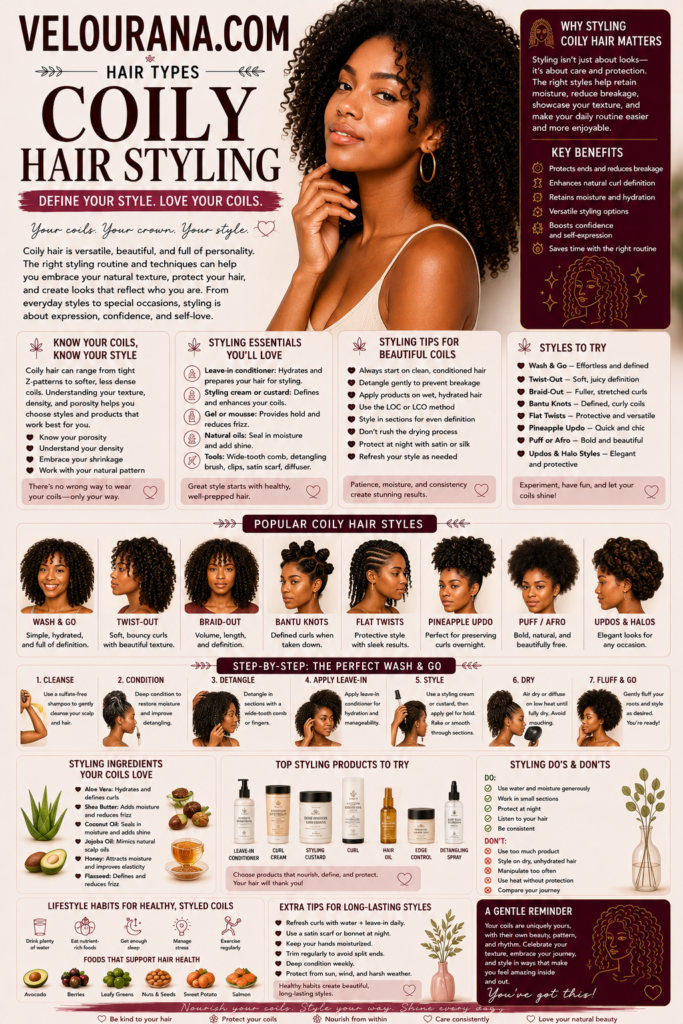
CATEGORY: Coily Hair Styling
The twist-out occupies an unusual place in coily hair styling. It looks effortless when finished well: soft spirals separate across the head, the hair appears fuller and longer, and the pattern seems to move naturally between definition and volume. Yet the finished style conceals a carefully controlled process. A successful twist-out depends not simply on twisting the hair, but on how the hair is prepared, how moisture is balanced, how sections are constructed, how tension is maintained, how thoroughly the set dries, and how deliberately it is released.
This is what makes the twist-out more than a technique for producing curls. It is a method of temporarily reorganizing the natural architecture of coily hair.
Unlike a wash-and-go, which generally attempts to preserve and emphasize the existing coil pattern, a twist-out overlays a new pattern onto it. The natural coils remain present within the strands, but they are encouraged to dry in larger, more uniform formations. The result can reduce visible shrinkage, create a more predictable silhouette, and produce a scale of definition that differs considerably from the hair's untouched texture.
The technique is also remarkably adaptable. A twist-out can be compact and highly defined or expansive and almost cloud-like. It can emphasize length or fullness. It can begin on wet hair, damp hair, or previously stretched hair. It can be created with relatively few large twists or many carefully constructed smaller ones.
Those choices are not incidental. They determine the final result.
Understanding the twist-out therefore means understanding the relationship between preparation and outcome. The hairstyle seen at the end is largely decided before the first twist is ever unraveled.
A Twist-Out Is a Set, Not Simply a Collection of Twists
The fundamental principle behind a twist-out is straightforward. Hair that contains sufficient moisture and flexibility is placed into a temporary shape and kept there while it dries. As water leaves the fiber, the hair retains much of the imposed configuration until moisture, manipulation, washing, or time gradually disrupts it.
This is why the quality of the twists matters.
If the sections are loosely organized, unevenly tensioned or allowed to unravel before drying, the resulting pattern will reflect those inconsistencies. If each twist is smooth and deliberately constructed, the released hair is more likely to display an organized pattern.
Two-strand twisting creates a particularly recognizable result because two sections of hair repeatedly wrap around one another from root to end. When released, each side retains a curved impression of that structure.
But the natural coil pattern has not disappeared.
Instead, two geometries coexist. The original small-scale coil remains within the fiber while the twist creates a larger-scale wave or spiral. This combination is one reason twist-outs on coily hair can have such visual complexity. The hair does not resemble conventionally curled straight hair. It retains texture within texture.
This also explains why two people following apparently identical twisting instructions can produce very different results. Their natural patterns, densities, strand thicknesses, shrinkage tendencies and section sizes all influence how the imposed twist pattern interacts with the underlying hair.
The technique provides structure, but the hair determines how that structure is interpreted.
Preparation Determines Whether the Set Begins With Order or Tangles
A polished twist-out usually begins long before styling product is applied.
Hair that is heavily tangled, unevenly saturated or coated with substantial buildup can make the twisting process unnecessarily difficult. The stylist may compensate by pulling harder, applying more product or repeatedly combing sections, introducing manipulation that could have been reduced through better preparation.
Cleansing creates a more predictable foundation. Product films, oils, environmental residue and previous styling layers can alter how new products distribute and how the hair feels during manipulation. Starting from adequately cleansed hair allows the behavior of the new styling system to be assessed more clearly.
Conditioning then provides flexibility and slip.
Coily hair is particularly vulnerable to mechanical stress when strands become intertwined. The repeated curves along the fiber create numerous opportunities for neighboring hairs to catch against one another. Detangling with adequate lubrication and patience helps separate those strands before they are organized into twists.
The objective is not to make every strand perfectly straight or stretched during detangling. It is simply to remove significant knots and shed hairs so that each styling section can be handled without repeated obstruction.
This matters later during takedown as well. When a twist begins with smoothly separated strands, its two halves tend to release more cleanly. When tangled hairs cross repeatedly between the two sides, unraveling can become difficult and encourage frizz.
Preparation therefore creates the hidden order beneath the finished style.
Wet, Damp or Stretched Hair Produces Three Different Interpretations
One of the most important decisions in a twist-out is how much water the hair should contain when the twists are created.
Starting on wet hair generally encourages the strongest reset. Water makes the hair more flexible and allows it to be reorganized thoroughly into the twist. The resulting definition can be pronounced, but wet coily hair may also shrink substantially as it dries. Dense sections can require considerable time to dry completely.
A damp set occupies the middle ground.
The hair contains enough moisture to remain flexible and responsive but does not carry the full weight of water from a fresh wash. Drying may be faster, and the finished result may preserve somewhat more apparent length. For many routines, damp hair provides an effective balance between definition, practicality and drying time.
Previously stretched hair creates another aesthetic entirely.
When coily hair has already been elongated through banding, braiding, tension drying or another controlled technique, twisting begins from a longer baseline. The finished twist-out often displays greater visible length and a looser pattern because the hair was not allowed to contract fully before being set.
None of these approaches is intrinsically correct.
They simply answer different styling priorities.
A person seeking juicy, compact definition may prefer a wetter set. Someone prioritizing elongation may deliberately begin with stretched hair. Someone who needs the style to dry overnight may discover that damp sections are considerably more practical than fully saturated twists.
The mistake is assuming that "twist-out" describes one fixed result. The moisture state alone can change the character of the hairstyle dramatically.
Section Size Is Really a Decision About Scale
The number of twists placed across the head determines much more than how long installation takes.
It determines the scale of the final pattern.
Small sections allow each twist to organize fewer strands. When released, the hair tends to form numerous smaller defined pieces. This can create intricate texture and strong pattern consistency, although excessive subdivision may produce less immediate volume.
Large twists gather more hair into each unit. They can create broader waves and a fuller result, but they demand sufficient tension and product distribution to ensure that the larger section dries in an organized shape.
There is a practical limit in both directions.
Extremely small twists can make installation and takedown disproportionately time-consuming. Very large twists can remain damp internally long after the outer surface appears dry, particularly on dense hair.
The most useful section size is therefore not the smallest possible one. It is the size that creates the desired pattern while allowing each section to be controlled and dried reliably.
Consistency also affects the visual result.
If some sections are tiny while neighboring sections are several times larger, the final texture may vary considerably across the head. That can be intentional, especially when different areas naturally behave differently, but random inconsistency can make the finished style appear less cohesive.
Section placement influences the silhouette too. A rigid grid can leave visible part lines after takedown. Staggered or less geometric sections may allow the roots to blend more easily.
The scalp pattern is temporary. The finished hair is the objective.
Product Should Create Cooperation Between the Strands
A twist-out does not necessarily require a complicated stack of styling products.
What it does require is enough lubrication, conditioning and hold for the hair to remain manageable during installation and organized after release.
A cream may provide softness and help strands move smoothly around one another. A gel or styling custard may contribute additional hold. A mousse can offer lighter control and potentially faster drying. Different hair responds differently to these textures, and the desired finish should influence the choice.
The central question is whether the product helps the strands remain together.
A twist that begins to frizz before it has even been completed may need more water, better smoothing, more appropriate product distribution, or a smaller section. Simply adding increasing amounts of heavy product is not always the answer.
Too much product can create its own problems.
The hair may remain tacky for longer, drying time can increase, and incompatible layers can sometimes produce visible residue. Fine strands may lose volume beneath rich formulations, while a very light product may not provide enough control for another head of hair.
Distribution is more important than surface coating.
Each section should feel consistently prepared from root to end. If product sits primarily on the outer hairs while the interior remains comparatively dry, the twist may look smooth externally yet release into an uneven pattern.
Working deliberately through sections makes it easier to notice these differences before they become visible in the finished style.
Tension Creates Elongation, but It Must Remain Controlled
The physical construction of the twist influences both definition and length.
As two strands are wrapped around one another, a moderate amount of tension helps keep the section organized. The hair is held in an elongated state relative to its fully contracted form, and this temporary stretching can contribute to the twist-out's ability to display more visible length.
Insufficient tension may allow the twist to become loose or puffy before it has dried. Excessive tension, however, is not an improvement.
The objective is control, not pulling.
The roots are especially important. A twist that begins loosely several centimeters away from the scalp can create a defined length with a comparatively undefined root area. That may be desirable when substantial root volume is wanted. If a more uniform pattern is preferred, the twist can be constructed closer to the scalp without being painfully tight.
Some stylists begin with a small braid at the root before transitioning into a two-strand twist. This can secure the base and create additional root definition, although it also introduces a slightly different pattern near the scalp.
Others use flat twists, which incorporate hair progressively along the scalp before releasing into a free-hanging twist. Flat-twist-outs can produce distinctive directional patterns and may provide greater control over where the hair eventually falls.
The ends deserve equal attention.
A beautifully smooth twist can be visually undermined by a rough or poorly secured end. The final centimeters may be finger-coiled, gently wrapped or otherwise encouraged to remain organized.
The end of the twist becomes the end of the visible curl. Treating it as an afterthought often shows.
Drying Is Where the Temporary Shape Becomes a Hairstyle
Many disappointing twist-outs fail for one remarkably simple reason: they are opened too soon.
Hair can feel dry on the surface while retaining moisture inside the twist. This is particularly common when sections are thick, products are rich, the hair is dense, or the environment slows evaporation.
When a damp twist is released, the carefully imposed pattern has not fully stabilized. The strands begin returning toward their natural arrangement, often creating frizz, shrinkage and loss of definition.
Patience at this stage has an unusually high styling return.
Air-drying works when enough time is available, but the required duration varies enormously. A lightly damp set on relatively low-density hair may dry quickly. Thick twists installed on soaking-wet, dense hair can remain moist for many hours.
A hooded dryer can make the process more predictable by surrounding the set with controlled warm air. A handheld dryer or diffuser can also assist, provided airflow does not unnecessarily disturb the twists.
The objective is not extreme heat. It is complete, even drying.
This is particularly important when setting the hair before sleep. Installing wet twists late at night and assuming they will be ready by morning can be unreliable. Bedding restricts airflow around some sections, and dense twists may remain damp despite hours having passed.
A better routine works backward from the required takedown time.
If the style must be ready in the morning, installation should allow enough time for the specific hair, section size and drying method involved.
The twist-out cannot be rushed at the exact stage when its pattern is being established.
Takedown Is a Styling Stage of Its Own
The moment the twists are opened is often treated as the conclusion of the process. In reality, takedown is another construction stage.
The pattern has been created, but it can still be preserved or destroyed.
Hands should move deliberately. Each twist can be unwound in the opposite direction from which it was created rather than pulled apart from the middle. This allows the two original sections to separate with less disruption.
At first, the released pieces may look too large and too deliberate. This is normal.
Additional separation creates fullness.
The crucial point is that separation should follow the hair rather than fight it. A released section often naturally divides into smaller groups. Allowing it to separate where it wants to can preserve more definition than forcing it into arbitrary pieces.
Every division involves a tradeoff.
One separation creates more volume. Another creates still more. Eventually, continued separation begins to replace defined texture with generalized fullness.
There is no universally correct stopping point.
For a highly defined result, relatively few separations may be needed. For a large, soft twist-out, considerable separation may be intentional. The desired aesthetic determines where the balance sits.
Root manipulation should usually wait until the lengths have been organized. Once the pattern is established, the roots can be gently lifted or massaged to obscure part lines and create height.
This is where the twist-out begins to look less like a collection of released twists and more like a coherent hairstyle.
The First Day Does Not Have to Be the Best Day
A freshly released twist-out often appears extremely defined and relatively compact. This can disappoint someone expecting the large, airy appearance seen in photographs of mature styles.
But coily hairstyles evolve.
During the first day, individual sections begin to move more independently. The roots expand. Some smaller clumps separate naturally. By the second or third day, the hairstyle may have significantly more volume while retaining enough of the original set to remain visibly defined.
For many people, this stage is more attractive than the initial result.
This evolution should influence how aggressively the hair is separated on day one. If maximum volume is created immediately, there may be little structural definition left to support the style several days later. Leaving some sections comparatively intact gives the hair room to expand gradually.
Humidity, movement and sleep will contribute whether invited or not.
The objective is not necessarily to prevent this transformation but to make it graceful.
A twist-out with adequate hold can become softer without collapsing. A carefully preserved style can increase in size without becoming completely disorganized.
Longevity therefore depends partly on accepting that the hairstyle will not remain visually identical from one morning to the next.
Nighttime Preservation Is About Maintaining Pattern Without Crushing Shape
Sleeping on a twist-out introduces an unavoidable challenge. The hair must spend hours against another surface without losing the organization created during styling.
Smooth fabrics can reduce friction. Satin bonnets, scarves and pillowcases are commonly used for this reason.
But fabric alone does not determine preservation.
The way the hair is arranged overnight can influence the morning silhouette. Longer hair may benefit from being gathered loosely upward so that the lengths are not trapped beneath the head. Shorter hair may require minimal repositioning.
Some people retwist the hair every night.
This can restore definition and maintain elongation, but it also increases manipulation. A complete nightly reset may not be necessary when the original style remains structurally sound.
Others place the hair into several loose sections or use gentle bands to preserve length. The best method is one that protects the pattern without introducing uncomfortable tension or excessive handling.
Morning refreshing should be similarly selective.
A flattened area may need only gentle root lifting. A distorted section can sometimes be lightly dampened and retwisted. Applying water to the entire head can reactivate substantial shrinkage and undo the stretched character of the style.
The question each morning should therefore be simple: what actually needs correction?
Preservation becomes easier when the whole hairstyle is not automatically treated as damaged simply because it no longer looks exactly as it did immediately after takedown.
When a Twist-Out Fails, the Failure Usually Contains Information
A twist-out that becomes frizzy, limp, undefined or unexpectedly shrunken is not merely a bad hair day. It reveals something about the relationship between technique and the hair.
If the pattern disappears almost immediately, hold may have been insufficient or the set may have been opened before drying completely.
If the roots are undefined while the lengths remain beautifully patterned, the installation may have begun too loosely near the scalp.
If the style feels coated and heavy, product quantity or richness may have exceeded what the hair required.
If the ends appear rough, they may not have been adequately smoothed or secured during twisting.
If the hair shrinks far more than desired, the starting moisture level or drying method may need adjustment.
If the twist-out lacks volume, the sections may simply require additional separation and root lifting rather than an entirely different product routine.
The useful response is diagnosis rather than wholesale reinvention.
Changing shampoo, conditioner, leave-in, cream, gel, section size, twisting technique and drying method simultaneously makes it impossible to determine which variable mattered.
A better approach changes one or two meaningful elements at a time.
Coily hair styling becomes more predictable when unsuccessful results are treated as experiments rather than verdicts.
A Twist-Out Can Be Designed Around the Face
Technical definition is only one dimension of a successful hairstyle.
The overall shape should also complement the person wearing it.
A twist-out can be directed during installation. Twists positioned forward can encourage a fringe-like effect. Sections directed away from the face create openness. A side part can be established before the hair dries rather than forced into place afterward.
The size and location of sections can also influence volume distribution.
More expansion around the sides produces width. Root lifting at the crown creates height. Stretching the lower sections can create a longer outline. Leaving the upper layers less separated can maintain definition while the underneath provides fullness.
This is where styling becomes design rather than merely technique.
The same perfectly executed twist pattern can appear completely different depending on how the finished hair is shaped.
Coily hair offers unusual freedom in this respect because it can retain volume away from the scalp. It does not necessarily fall according to gravity in the same way as straighter textures. The stylist can use that structural quality to create silhouettes with height, width, asymmetry or rounded balance.
Definition attracts attention to individual strands. Shape determines how the entire hairstyle is perceived.
The strongest twist-outs usually understand both.
The Real Mastery Is Knowing How Much Control to Release
There is a paradox at the center of the twist-out.
The style begins with control. Hair is detangled, divided, smoothed, tensioned, twisted and dried in a deliberately imposed pattern. Yet the finished result often becomes most beautiful when some of that control is released.
The twists are opened. Sections are separated. Roots are expanded. Perfect uniformity begins to disappear. Natural texture reasserts itself within the imposed pattern.
That interaction is the character of the hairstyle.
A twist-out that is never separated may retain extraordinary definition but look overly segmented. A twist-out manipulated without restraint may lose the very pattern that made the technique worthwhile. The artistry lies between those extremes.
This balance cannot be reduced to a universal number of twists, a specific quantity of cream or a fixed drying time.
It comes from understanding the hair.
Once the relationship between moisture, section size, tension, hold, drying and separation becomes familiar, the twist-out stops feeling unpredictable. Each decision produces a recognizable consequence.
More water can create a stronger reset but greater shrinkage. Stretching can preserve length but soften the natural pattern. Smaller sections can increase detail but require more time. Stronger hold can extend longevity but create greater initial firmness. More separation can build volume while sacrificing some definition.
These are not problems to solve. They are creative variables.
And that is ultimately why the twist-out remains such an enduring technique for coily hair. It does not erase the natural texture or merely preserve it unchanged. It works with that texture, reorganizing it temporarily while allowing its density, elasticity and character to remain visible.
The finished style belongs neither entirely to the twist nor entirely to the natural coil.
It is created in the conversation between them.
The End Velourana
 Discover More From Our Family of Websites
 ZodiacBearing (Astrology, Tarot, Numerology, Angel Numbers & Spiritual Guidance)
 Velourana (Beauty, Makeup, Hair Care, Skincare & Beauty Tips)
 HavenBearing (Home, Living, Organization, Décor & Everyday Inspiration)
 PawBearing (Pet Care, Dog Breeds, Animal Health, Training & Pet Products)
 PsyCatherine (Notes From the Journal of a Psychologist on Real Life)

