
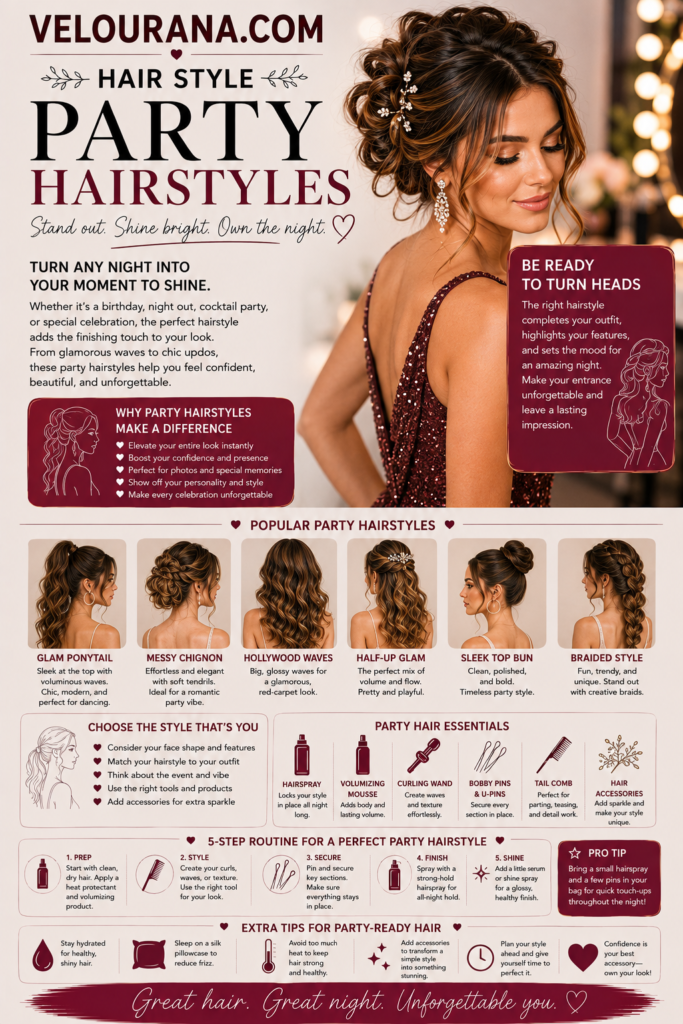
CATEGORY: Party Hairstyles
Choosing a hairstyle for a party can appear to be one of the easier parts of getting ready. There are no strict ceremonial expectations, the atmosphere is usually more relaxed than at a wedding or formal reception, and there is considerably more freedom to experiment with texture, volume, accessories and movement. Yet that freedom is precisely what can make the decision more complicated.
A successful party hairstyle is rarely successful because it follows a particular formula. It works because it belongs to the complete appearance of the person wearing it.
Hair does not exist separately from the face, clothing, jewelry, makeup and personality. It changes how all of those elements are perceived. Loose hair can soften a structured outfit. An exposed neckline can become dramatically more noticeable when the hair is lifted. A sleek hairstyle can give visual discipline to elaborate clothing. Natural curls can bring movement to a minimalist dress. A high ponytail can change not only the appearance of the hair but the posture and energy of the entire silhouette.
This is why choosing party hair should begin with a broader question than whether the hair should be straight, curled, tied or pinned.
The more useful question is what kind of presence the complete look should have.
Some evenings call for glamour that feels effortless and fluid. Others invite something sharper and more deliberate. There are parties where enormous texture feels completely natural and others where the most powerful choice is almost severe simplicity. The hairstyle can support the mood rather than trying to prove how much styling has taken place.
When this relationship is understood, party hair becomes less about collecting ideas and more about developing one coherent visual direction.
Party Hair Is Part of the Outfit
People often choose clothing first and hair second, but the two decisions are more connected than that sequence suggests.
Hair occupies a substantial amount of visual space. Long hair may cover the shoulders, neckline and back of an outfit. Dense curls can change the width of the upper silhouette. A high bun adds height. A ponytail creates a moving line behind the head. A short bob leaves considerably more clothing visible than waist-length waves.
The hairstyle therefore changes the outfit even though nothing about the clothing itself has changed.
Consider a simple black dress. With sleek center-parted hair, the overall impression can become clean and modern. With large waves, the same dress acquires more traditional glamour. With a high textured ponytail, it can feel energetic and youthful. With a sculptural natural hairstyle, the hair can become the dominant feature of the entire appearance.
The dress has remained identical.
The visual language has not.
This is particularly important with party clothing because evening pieces frequently contain stronger design elements than everyday clothes. There may be sequins, metallic fabrics, dramatic shoulders, open backs, unusual necklines or highly decorative surfaces. Hair can either reveal those details, soften them, reinforce them or hide them completely.
None of those choices is automatically correct.
What matters is that the relationship appears intentional.
If an open-back dress was chosen because its back is extraordinary, allowing all of that detail to disappear beneath loose hair may weaken the effect. A ponytail or lifted style can preserve the length of the hair while revealing the garment. On the other hand, if the dress is extremely minimal, long waves falling across the back may provide exactly the movement and visual richness that the outfit needs.
Party styling becomes more sophisticated when hair is treated as part of the clothing composition rather than something added after everything else has been decided.
The Neckline Quietly Changes Everything
The relationship between hair and neckline is particularly important because both occupy the same upper area of the body.
A high neckline already creates visual density around the neck. Adding large amounts of hair in the same area can create a rich, enveloping effect, but it can also make the upper silhouette feel crowded. Pulling the hair upward or backward changes that relationship immediately. Suddenly the neckline becomes visible as a deliberate design feature rather than simply the fabric beneath the hair.
Open necklines create the opposite possibility.
A strapless or off-the-shoulder outfit leaves considerable space around the neck and shoulders. Loose waves can soften that openness and create movement against the skin. A bun exposes it completely, emphasizing the collarbones and shoulders. A ponytail provides an interesting middle ground because the front remains open while the length continues to move behind the wearer.
The most interesting choice is not necessarily the most predictable one.
A romantic neckline does not require romantic curls. Sleek hair can create beautiful tension against soft clothing. A sharp architectural neckline does not require an equally sharp hairstyle. Natural texture can prevent the complete appearance from becoming too rigid.
Contrast can be as sophisticated as harmony.
What matters is understanding what the hair is doing to the space around the neckline.
Once that becomes visible, many hairstyle decisions begin to make sense naturally.
The Most Memorable Looks Usually Know Where the Attention Should Go
Party styling allows more drama, but drama becomes less effective when every element competes for attention simultaneously.
Large earrings, a jeweled hair accessory, intense eye makeup, voluminous curls and an embellished dress can all be beautiful individually. When combined without hierarchy, however, the eye may have nowhere to settle.
The strongest party looks often contain a deliberate focal point.
Sometimes that focal point is the hair.
A spectacular curly silhouette can dominate an otherwise simple outfit. A sculptural high ponytail can become the defining feature of the appearance. An exceptionally sharp bob can provide all the visual identity required.
At other times the hairstyle becomes the supporting element.
If the earrings are extraordinary, exposing them may be more effective than adding another decorative feature to the hair. If the dress is covered in intricate embellishment, clean hair can give those details room to exist. If the makeup is intentionally dramatic, moving the hair away from the face can make the makeup more powerful.
This does not require minimalism.
A maximalist party look can contain several strong elements and still feel coherent. The difference is that those elements appear to belong to the same idea rather than competing randomly.
The hairstyle should participate in that hierarchy.
It can lead, support or provide contrast.
It does not always need to be the loudest part of the room.
Jewelry and Hair Share the Same Visual Territory
Earrings are particularly important when choosing party hair because they occupy almost exactly the same area as the sides of the hairstyle.
Long loose hair can conceal them almost entirely. A side tuck can suddenly make one earring highly visible. A ponytail or bun exposes both and gives them more visual importance. A bob can frame them. A pixie naturally creates space around them.
This interaction can be used deliberately.
A pair of dramatic earrings may eliminate the need for a decorative hair accessory. Instead of asking what else can be added to the hairstyle, it may be more effective to create enough space for the jewelry already being worn.
The same principle applies to necklaces, although the relationship occurs lower down.
Long hair falling forward over the shoulders can cover part of a statement necklace. Large waves can visually compete with an elaborate piece. Moving the hair behind the shoulders or gathering it can reveal the jewelry completely.
There is no obligation to display every accessory fully. Hair partially covering jewelry can create softness and movement. The important distinction is between intentional concealment and accidental concealment.
When an accessory was chosen because it contributes significantly to the outfit, the hairstyle should at least acknowledge its presence.
This is one reason it is often useful to decide on jewelry before finalizing the hair. A hairstyle that looked perfect in isolation may suddenly seem excessive once large earrings and a decorative neckline are added.
The complete composition matters more than any individual element.
Makeup Changes the Character of the Same Hairstyle
Hair frames the face, which means its relationship with makeup is immediate.
A sleek hairstyle exposes more of the features and can make strong makeup appear even more deliberate. A bold lip paired with hair pulled away from the face creates a clear focal point. Dramatic eyes can gain additional intensity when there is less hair surrounding them.
Loose texture creates a different effect.
Waves around the face can soften stronger makeup. Natural curls can create depth and movement around a smoky eye. A few loose sections around an updo can make a highly polished makeup look feel less severe.
Neither approach is inherently more glamorous.
They simply create different kinds of glamour.
Someone who prefers understated makeup can also allow the hair to carry more of the evening transformation. Large waves, a dramatic ponytail or sculptural natural texture can make the complete appearance unmistakably party-ready without requiring equally dramatic makeup.
This is particularly useful because not everyone wants every aspect of their appearance to change for an evening event.
The hair can become the statement while the face remains familiar.
Or the reverse can happen.
The strongest result usually comes from deciding where the transformation should occur rather than assuming that every element must become more intense simply because the occasion is a party.
Texture Creates Mood Before It Creates Technique
The texture chosen for party hair affects the emotional character of the look.
Straight hair can feel clean, confident and deliberate. Broad waves introduce glamour and movement. Tousled texture creates relaxation and energy. Defined curls can produce richness and dimension. Natural coils can create extraordinary architecture and presence.
These are not rigid meanings, but they demonstrate why texture should be considered as part of the mood rather than merely as a styling technique.
Someone wearing a highly structured outfit may deliberately choose soft waves because the contrast prevents the appearance from becoming too severe. Someone wearing flowing clothing may choose sleek hair because the precision gives the complete silhouette more definition.
Natural texture introduces another important possibility.
The hair does not have to undergo a dramatic transformation to become party hair.
Curly hair can remain curly and simply gain a stronger shape. Coily hair can retain its natural pattern while the volume is repositioned. Wavy hair can have its existing movement amplified. Straight hair can become more polished without being curled.
This often produces an appearance that feels more connected to the wearer.
The evening version is recognizably different, but it does not feel like someone else's hair has been placed on the person.
That sense of continuity can be more stylish than transformation for transformation's sake.
Movement Is One of the Most Powerful Elements of Party Hair
Party hairstyles are experienced in motion.
The wearer turns her head, walks through a room, talks, dances and moves between different environments. The hair interacts with all of that movement.
A ponytail swings.
Waves shift over the shoulders.
Curls bounce.
A loose bun becomes slightly softer.
A short textured cut changes subtly as the head turns.
This is one reason party hair should not necessarily be judged by the standards of a perfectly still photograph.
Movement can make the hairstyle more attractive.
Long hair is particularly expressive in this respect because its length exaggerates motion. A high ponytail can look relatively simple while the wearer is standing still, then become dramatically energetic once she begins moving.
Curly and coily hair create another type of motion because individual sections respond independently. The silhouette remains recognizable while the texture changes constantly.
Even short hair participates. A fringe moves. A textured crown catches light differently. A sleek bob swings around the jaw.
Party hair should therefore have enough freedom to move.
The structural parts need stability, but the visible hair does not need to behave like an object fixed permanently into one position.
A style that can move naturally often looks more luxurious because it retains the qualities of healthy, living hair.
There Is a Difference Between Effortless and Unfinished
Many contemporary party hairstyles aim for an effortless appearance.
Waves are softer.
Buns are less rigid.
Ponytails have movement.
Natural texture is allowed to remain visible.
A few sections may frame the face rather than being secured perfectly.
Yet effortless-looking hair still needs an underlying idea.
A loose bun should have a recognizable silhouette. Tousled waves should have enough direction that they appear intentional. A relaxed ponytail should sit at a deliberate height. Face-framing sections should flatter the hairstyle rather than appearing to have escaped accidentally.
The difference is subtle but important.
Unfinished hair lacks visual decisions.
Effortless hair contains decisions that are not aggressively displayed.
This is why a hairstyle can appear simple while still feeling polished. The part is considered. The volume is balanced. The front relates to the face. The ends have direction. The structure is secure.
Once those foundations exist, the surface can become freer.
Party styling is particularly suited to this balance because it does not need the immaculate finish associated with some ceremonial hairstyles.
A little imperfection can add energy.
The hairstyle can look as though it belongs to a real evening rather than a mannequin.
Hair Accessories Work Best When They Have a Reason to Be There
Party accessories can be irresistible because evening styling creates an opportunity to wear pieces that might feel excessive during the day.
A jeweled clip can catch the light beautifully. A metallic barrette can transform one side of a bob. A headband can give a simple hairstyle immediate character. A bow can change the mood of a ponytail or half-up style.
The danger is treating the accessory as an automatic final step.
A hairstyle that already contains substantial volume, texture and detail may not need another focal point.
An accessory becomes more powerful when there is visual space around it.
A sleek side section can provide the perfect setting for a decorative clip. A simple half-up style can make a beautiful barrette appear intentional. A restrained ponytail can support a bow because the accessory is not competing with several other styling ideas.
Natural curls and coils can create particularly interesting relationships with accessories because smooth metallic or jeweled surfaces contrast against the texture.
Again, the objective is not to decorate every available area.
It is to decide whether the accessory contributes something the hairstyle does not already have.
If it does, it can transform the look.
If it does not, leaving it out may make the hairstyle stronger.
The Shape of the Hair Changes the Proportions of the Person
Volume is often discussed as though more of it automatically means more glamour.
In reality, the placement of volume matters far more than the quantity.
Height through the crown lengthens the upper silhouette.
Width through the sides creates greater presence around the face.
Volume concentrated behind the head changes the profile.
A high bun adds vertical emphasis without increasing width significantly.
A low, broad style creates a completely different balance.
This is particularly relevant when the clothing already has strong proportions.
Large shoulders combined with very wide hair create an intentionally dramatic silhouette. The same shoulders combined with a sleek ponytail become more architectural. A flowing dress combined with large waves produces softness throughout the appearance, while a compact bun creates contrast.
None of these combinations can be reduced to a universal rule about body type or face shape.
Personal preference matters too much.
The useful principle is simply to observe where the visual weight is accumulating.
If everything is expanding in the same area, the look may become heavier than intended.
If the hair creates balance somewhere else, the entire silhouette can become more interesting.
This is styling as composition rather than correction.
Short Hair Does Not Need to Manufacture Drama
Party styling is sometimes discussed as though short hair offers fewer possibilities because there is less material to curl, braid or gather.
In reality, short hair often makes styling decisions more visible.
Move the part of a bob and the entire shape changes.
Lift the crown of a pixie and the profile changes.
Tuck one side behind the ear and the relationship between the hair, face and jewelry changes instantly.
Turn the ends outward and a familiar haircut acquires a completely different personality.
Short hair therefore creates drama through precision rather than quantity.
A beautifully sleek bob can become the strongest feature of a party look precisely because there is no unnecessary detail. A textured pixie can create movement through a relatively small area of hair. Natural short curls can create extraordinary volume around the face without needing additional length.
Accessories also become more visible.
A single clip may be enough.
The haircut itself is already providing structure.
Party styling only needs to decide which part of that structure should be emphasized.
Long Hair Does Not Need to Demonstrate Everything It Can Do
Long hair creates the opposite temptation.
Because it can support waves, curls, braids, twists, ponytails, buns and elaborate combinations, it is easy to assume that a party hairstyle should use several of those possibilities at once.
Often the more sophisticated decision is to choose one.
Extra-long straight hair can be dramatic simply because of its uninterrupted line.
Large waves can make the length itself the feature.
A high ponytail can convert the length into movement.
A braid can turn it into structure.
A bun can remove the length visually and completely change the person's proportions.
Each approach has a clear identity.
Combining every available technique may weaken that clarity.
Long hair already has presence.
It does not need to prove its versatility in a single evening.
Natural Curls and Coils Can Carry the Entire Look
There are party hairstyles where the texture itself should remain the central event.
Natural curls can create movement, volume and dimension without needing additional decorative techniques. A different part or a slightly stronger crown may provide all the transformation required.
Coily hair can create extraordinary silhouettes through its natural volume. The hair can be shaped upward, outward or asymmetrically without being made smoother or smaller.
This is particularly effective with simple clothing because the texture gains visual space.
The opposite can also work. Natural hair beside an elaborate outfit can create richness without requiring additional hair accessories.
The important point is that party glamour is not defined by transforming texture into something else.
Polish can mean thoughtful shape.
It can mean balanced volume.
It can mean a beautifully considered front.
It can mean allowing the natural pattern to remain expressive while giving the complete silhouette intention.
This understanding opens far more possibilities than treating one texture as the default standard of evening hair.
Comfort Is Part of the Aesthetic Even Though It Cannot Be Seen
A hairstyle can look perfect and still be wrong for the evening if it is uncomfortable.
A painfully tight ponytail changes how the wearer behaves. A heavy bun encourages constant adjustment. Loose sections repeatedly falling into the eyes become irritating. An accessory that presses against the scalp eventually becomes impossible to ignore.
These problems rarely remain invisible.
People touch uncomfortable hair.
They loosen it.
Move it.
Push it behind their ears.
Remove pins.
Eventually the hairstyle changes because the wearer has been forced to interact with it.
Comfort therefore supports longevity.
A secure style does not need to be excessively tight. A bun can distribute weight across a broader area. A ponytail can sit at a height that remains comfortable. Face-framing pieces can be positioned so that they do not continually interfere with vision.
The best party hairstyle eventually disappears from the wearer's attention.
It remains visible to everyone else, but the person wearing it no longer needs to think about it.
That is an underrated form of success.
The Environment Should Influence the Hairstyle Without Controlling It
Party conditions are not always gentle.
A venue can become warm as it fills with people. Dancing increases heat. Outdoor areas introduce wind and humidity. Travel to the event may involve coats, scarves or car headrests.
These details can affect the hairstyle long before the evening ends.
Long loose hair can become hot against the neck. A low bun can press uncomfortably against a headrest. Waves may interact with a high collar. Hair that reacts strongly to humidity may begin recovering its natural texture.
The answer is not to choose hairstyles purely according to weather.
It is to create a style with some tolerance.
A textured hairstyle can often absorb environmental changes more naturally than one dependent on absolute uniformity. A ponytail can preserve movement while keeping the neck clearer. A half-up style can control the front without removing all the loose hair.
Natural curls and coils can be styled around the possibility that volume may increase.
A hairstyle that expects the real environment is more likely to remain attractive than one designed only for the mirror at home.
Party Hair Should Be Designed to Become Slightly Softer
There is an unrealistic expectation that a hairstyle should look exactly the same at midnight as it did when it was completed several hours earlier.
Hair moves.
Gravity acts on it.
Humidity changes it.
The wearer touches it occasionally.
The lengths interact with clothing.
Waves relax.
Curls shift.
Volume settles.
None of this automatically means the hairstyle has deteriorated.
In many cases, party hair becomes more attractive after the first hour because some initial precision disappears.
Waves blend more naturally.
A textured bun softens.
Curls become freer.
The crown settles into a more relaxed shape.
The difference between graceful softening and collapse lies in the underlying structure.
If the ponytail base remains secure, the lengths can evolve.
If the bun remains anchored, the surface can loosen.
If the half-up section remains stable, the lower hair can become softer.
If loose waves retain their general direction, individual sections do not need to remain identical.
The hairstyle should preserve its identity rather than every original detail.
That is a far more realistic definition of longevity.
Photographs Reveal Relationships That Mirrors Sometimes Hide
Party styling is often experienced through photographs as much as through mirrors.
A front-facing mirror provides only one perspective.
From the side, crown volume may appear very different. From behind, loose hair may conceal the most interesting part of an outfit. A large accessory may dominate more than expected. A ponytail may sit at a different visual height than it appeared from the front.
Taking a few photographs before leaving can reveal these relationships quickly.
This is not about pursuing photographic perfection.
It is about seeing the complete styling decisions objectively.
If the earrings were intended to be visible, are they?
If the neckline is important, can it actually be seen?
Does the hair merge visually into clothing of a similar color?
Does the hairstyle retain a coherent shape from the side?
These questions are more useful than examining whether every individual strand is perfectly positioned.
A successful party hairstyle should look like the same idea from multiple angles even though each angle reveals something slightly different.
Personal Style Matters More Than the Supposed Rules of Party Hair
The most important reason to consider the entire appearance is not to create another collection of rules.
It is to make rules less necessary.
Once the wearer understands what she wants the complete look to communicate, many traditional prescriptions become irrelevant.
A high neckline does not automatically require an updo.
A strapless dress does not automatically require loose hair.
Statement earrings do not automatically require the hair to be pulled back.
A simple dress does not automatically require dramatic styling.
Those combinations are possibilities, not obligations.
Personal style can override them.
Someone who feels most confident with long straight hair may look far more convincing wearing it that way than adopting elaborate curls simply because the evening is special.
Someone who loves natural volume may feel diminished by an excessively controlled hairstyle.
Someone who dislikes hair around the face will not enjoy romantic loose pieces no matter how attractive they looked in an inspiration photograph.
Someone who prefers minimalism may create more impact with a sharp ponytail and extraordinary earrings than with an intricate updo.
The hairstyle needs to belong to the wearer before it belongs to the occasion.
The Complete Look Should Feel Intentional Without Feeling Overdesigned
There is a point at which styling stops adding and begins interfering.
Party hair is particularly vulnerable to this because there are so many opportunities to introduce more.
More volume.
More curl.
More accessories.
More braids.
More shine.
More loose pieces.
More height.
Yet the final stage of good styling is often subtraction.
If the waves already create enough movement, perhaps they do not need a decorative clip.
If the earrings already dominate the sides of the face, perhaps the hair can become cleaner.
If natural curls already create spectacular volume, perhaps the outfit does not need another competing detail near the neckline.
If the dress is visually complex, perhaps a simple hairstyle makes both the hair and clothing look more sophisticated.
This does not mean party hair should be restrained.
It means drama becomes stronger when it has direction.
The same principle applies to simplicity.
Simple hair should not look neglected. A sleek style still needs a deliberate part, balanced shape and finished ends. Natural texture still benefits from thoughtful placement. A ponytail still needs the correct height and proportion.
Effortlessness is most convincing when the decisions behind it are invisible.
The Best Party Hairstyle Completes the Person Rather Than Completing a Formula
There is no single hairstyle that defines party glamour.
It may be waist-length waves moving across a minimalist dress.
It may be a sharp bob beside dramatic earrings.
It may be natural curls framing understated makeup.
It may be a high coily puff creating the strongest silhouette in the room.
It may be a sleek ponytail revealing an extraordinary neckline.
It may be a textured bun that becomes softer as the evening continues.
The technique matters less than the relationship between all the elements.
Hair should interact with clothing rather than accidentally obscure it. Jewelry should have enough visual space to contribute when it is intended to matter. Makeup and hair should frame the face together. Volume should be placed according to the desired silhouette rather than added automatically. Natural texture should be treated as a styling asset. Movement should be expected. Comfort should be protected.
Most importantly, the hairstyle should still feel connected to the person wearing it.
A party is an opportunity to amplify personal style, not abandon it.
The transformation can be dramatic without becoming unfamiliar.
Hair that is normally straight can become extraordinarily sleek rather than suddenly curly. Natural volume can become larger instead of being suppressed. A familiar ponytail can move higher and gain a more polished finish. A bob can change through nothing more than a deep side part, a controlled wave and one exposed earring.
These changes work because they begin with something recognizable and push it further.
That is often where the most convincing party glamour comes from.
Not from accumulating techniques.
Not from following a formula.
Not from choosing a hairstyle because it appears on a list of appropriate evening looks.
It comes from understanding the complete appearance and deciding what role the hair should play within it.
Sometimes the hair should dominate.
Sometimes it should frame.
Sometimes it should reveal.
Sometimes it should soften.
Sometimes it should provide contrast.
Sometimes its greatest contribution is simply getting out of the way and allowing another beautiful element to become visible.
Once that role is clear, the hairstyle itself becomes easier to choose.
The result feels coherent because nothing appears accidental.
The outfit, hair, jewelry and makeup do not need to match perfectly, but they appear to understand one another.
That is what separates a collection of individually attractive choices from a genuinely successful party look.
And when that balance is achieved, the hairstyle does not look as though it was selected independently and added at the end.
It looks as though it belonged to the evening from the beginning.
The End
Velourana.
 Discover More From Our Family of Websites
 ZodiacBearing (Astrology, Tarot, Numerology, Angel Numbers & Spiritual Guidance)
 Velourana (Beauty, Makeup, Hair Care, Skincare & Beauty Tips)
 HavenBearing (Home, Living, Organization, Décor & Everyday Inspiration)
 PawBearing (Pet Care, Dog Breeds, Animal Health, Training & Pet Products)
 PsyCatherine (Notes From the Journal of a Psychologist on Real Life)

