
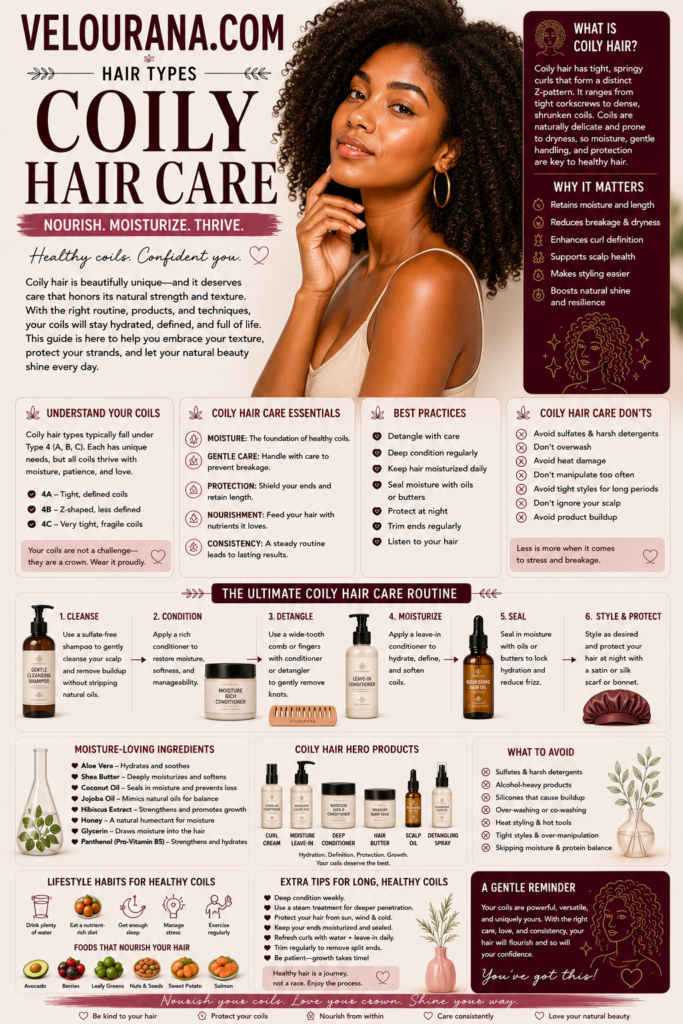
CATEGORY: Coily Hair Care
Coily hair is often discussed as though it presents a collection of problems waiting to be solved: dryness, shrinkage, tangling, breakage, difficulty retaining length. Yet this way of describing it begins from the wrong premise. The defining characteristics of coily hair are not defects. They are consequences of an extraordinary physical structure—one in which each strand repeatedly bends, curves, contracts, and changes direction from root to tip.
Understanding that architecture changes the meaning of hair care. Moisture becomes less about correcting supposedly "dry hair" and more about supporting a strand along which natural oils cannot easily travel. Detangling stops being an inconvenient preliminary step and becomes an important form of mechanical protection. Shrinkage can be recognized as evidence of elasticity rather than an enemy of length. Protective styling becomes useful not because coily hair must be hidden, but because reducing repeated manipulation can help preserve vulnerable fibers.
Good coily hair care therefore begins with interpretation rather than products. The objective is not to force the hair to behave like a straighter texture. It is to understand what its geometry asks of cleansing, conditioning, handling, styling, and protection—and to build a routine around those realities.
The Geometry That Changes Everything
A relatively straight strand provides a comparatively direct route from the scalp toward the ends. Coily hair follows a much more complex path. Depending on the individual, the fiber may form recognizable spirals, tiny loops, tight curves, angular bends, or patterns so compact that their shape is difficult to see unless the hair is wet or stretched.
Those repeated changes in direction influence almost everything that follows.
Sebum produced by the scalp does not distribute effortlessly along a highly curved strand. This helps explain why the scalp can feel comfortable—or occasionally oily—while the lengths and ends still feel dry. Applying increasingly aggressive cleansing because the scalp becomes oily can therefore worsen the condition of the lengths without addressing the underlying difference between scalp and fiber.
Bends also create points at which the strand experiences mechanical stress. A comb, brush, finger, elastic, towel, collar, pillowcase, or neighboring strand can place tension against these points. No single encounter necessarily causes visible damage. Repetition is what matters.
This is why coily hair routines often succeed or fail through accumulation. A harsh wash once may not transform the hair. Neither will one careless detangling session necessarily cause dramatic breakage. But repeated stripping, friction, pulling, drying, and manipulation can gradually reduce the integrity of the fiber.
Conversely, small protective habits accumulate too.
Gentler cleansing, adequate conditioning, careful detangling, less friction, strategic styling, and nighttime protection may seem individually modest. Together they create an environment in which the hair has a better opportunity to remain intact.
Dryness Is Not a Verdict on Hair Health
Coily hair's reputation for dryness deserves careful interpretation because "dry" can describe several different experiences.
Hair may feel dry because it has recently been cleansed and has little surface lubrication. It may feel rough because the cuticle has become weathered. It may lose softness because styling products have accumulated. Environmental humidity can alter its feel. Chemical processing, heat, ultraviolet exposure, friction, and ordinary aging of the strand can all affect its surface.
The answer cannot therefore always be "add more oil."
Oil can reduce friction, provide lubrication, enhance shine, and help slow water loss from the surface. It does not, however, replace water. A strand coated repeatedly with rich oils and butters can still feel inflexible if the overall routine is not working well.
For many people, conditioning is more important than simply layering heavier products.
A well-formulated rinse-out conditioner can improve slip during detangling and make strands easier to separate. Leave-in products may provide additional softness and manageability after washing. Styling creams, gels, mousses, or other products can then be selected according to the desired result rather than treated as universal requirements.
The useful question is not whether coily hair needs the richest possible routine. It is whether the routine leaves the hair sufficiently flexible, manageable, and protected without creating unnecessary buildup.
Some heads of coily hair flourish with creams and oils. Others become coated and dull under the same approach. Fine, dense coils can behave very differently from coarse, lower-density coils even when their visible patterns appear similar.
Texture describes only part of the hair.
Cleansing the Scalp Without Treating the Lengths as an Afterthought
The scalp is living skin. The visible hair fiber is not. A successful wash routine has to respect both.
The scalp accumulates sebum, sweat, environmental debris, dead skin, and residues from products. Leaving those materials indefinitely is not inherently protective. Cleansing is part of maintaining a comfortable scalp environment, and coily hair does not need to be kept perpetually unwashed simply because the lengths are vulnerable to dryness.
At the same time, cleansing products and techniques can influence how the lengths feel.
The practical balance is to clean thoroughly enough for the scalp and hair to feel refreshed without repeatedly subjecting the fiber to unnecessary roughness. Shampoo is generally most important at the scalp, where buildup originates. The lather that moves through the lengths during rinsing may often provide sufficient routine cleansing there, although heavier buildup may occasionally require more deliberate attention.
Frequency is individual.
Someone who exercises frequently, uses substantial styling products, experiences scalp oiliness, or wears the hair exposed may prefer relatively frequent washing. Someone whose scalp remains comfortable and whose styling routine produces little buildup may wash less often.
The calendar matters less than the condition of the scalp and hair.
What should be avoided is turning wash day into a battle. Piling long coily hair on top of the head and vigorously rubbing it together can encourage tangling. Working systematically through sections can make cleansing easier, particularly for dense or long hair.
Sectioning is not merely an organizational trick. It reduces the amount of uncontrolled interaction between strands, and that principle will appear repeatedly throughout effective coily hair care.
Conditioning Is Also Mechanical Protection
Conditioner is commonly described in terms of softness or moisture, but for coily hair one of its most important roles is mechanical.
When strands slide past one another easily, less force is required to separate them. When less force is required, there is less opportunity for unnecessary stretching, snapping, and abrasion.
This is why "slip" matters.
During conditioning, the hair can often be divided into manageable sections and gently detangled while adequately lubricated. Fingers may work well for some people. Others prefer a wide-tooth comb or a flexible detangling brush. The ideal tool is the one that removes tangles efficiently without requiring excessive force.
Starting at the ends and gradually moving upward remains useful because tangles are resolved progressively rather than pushed downward into a larger knot.
But technique matters more than ritualistic rules.
If a tool repeatedly catches, if the hair is audibly snapping, or if detangling requires force, the answer is rarely to pull harder. More water, additional conditioner, smaller sections, or slower separation may be necessary.
Coily hair can shed significantly between wash days, particularly when it has been worn in a style for several days. Shed hairs may remain trapped among neighboring coils instead of falling away naturally. When finally released during detangling, the quantity can appear alarming.
This is one reason context matters when judging hair loss. Hair accumulated over many days should not automatically be interpreted in the same way as an equivalent amount lost every day.
Shrinkage Reveals Something Important
Few characteristics of coily hair are as misunderstood as shrinkage.
Hair that reaches well below the shoulders when stretched may contract dramatically when wet and allowed to dry naturally. This can make progress in length seem invisible and can complicate certain styles, but shrinkage itself is not evidence that the hair has stopped growing.
It is an expression of the fiber returning toward its natural configuration.
Healthy elastic strands can contract substantially. Trying to eliminate every sign of shrinkage may lead to a cycle of excessive stretching, brushing, tension, or heat that creates more damage than the shrinkage ever did.
That does not mean stretched styles are inappropriate.
Stretching can make coily hair easier to handle, reduce some forms of tangling, display length, and provide a different aesthetic. Braids, twists, banding, threading, roller sets, or carefully controlled heat can all change the degree of contraction.
The important distinction is between choosing to stretch the hair and believing it must remain stretched to be acceptable.
A healthy relationship with coily hair allows both possibilities.
Detangling Is Where Length Is Often Won or Lost
Hair grows from the scalp, but visible length depends partly on how much of that growth remains attached.
This distinction explains why someone can experience normal growth while feeling that the hair "never gets longer." If the oldest ends break at approximately the same pace that new length emerges from the scalp, overall length changes little.
For coily hair, manipulation is therefore central to length retention.
Detangling is one of the moments when manipulation becomes concentrated. Hundreds or thousands of fibers are being separated, aligned, stretched, and moved. The objective should not simply be to finish quickly. It should be to remove tangles while sacrificing as few healthy strands as reasonably possible.
Knots deserve particular patience.
Single-strand knots can occur when a strand loops around itself. Larger tangles can form when shed hairs intertwine with attached fibers. Attempting to rip through either can convert a manageable tangle into breakage.
Sometimes a knot cannot reasonably be saved and a tiny trim is preferable to prolonged pulling. Hair care does not require preserving every millimeter at any cost.
The broader principle is that force should never become the default technique.
If coily hair consistently requires substantial force to manage, something about the preceding routine—cleansing, conditioning, product choice, styling, frequency, section size, or technique—deserves reconsideration.
Product Layering Should Solve Problems, Not Create Rituals
Coily hair culture has produced many product-layering methods. Some people swear by leave-in, oil, and cream combinations. Others reverse the sequence. Some use butter after every wash. Others achieve excellent results with little more than conditioner and gel.
There is no contradiction here.
Hair responds to formulation, quantity, environment, styling goals, strand characteristics, and individual preference. A memorable acronym cannot account for all of those variables.
Layering should therefore be purposeful.
A leave-in may provide softness and easier handling. A cream may contribute lubrication and styling control. An oil may reduce friction or add shine. A gel may provide hold and encourage coils to remain grouped. A mousse may deliver lighter definition and faster drying.
Not every head needs every category simultaneously.
Excess product can make hair feel heavy, sticky, coated, or strangely dry despite the apparent abundance of conditioning ingredients. It can interfere with styling and increase the amount of cleansing required later.
This is particularly important because coily hair is often marketed to with an assumption that more richness is always better.
The better standard is performance.
Does the hair remain flexible? Is detangling manageable? Does the style last? Does the scalp remain comfortable? Is buildup appearing rapidly? Are the ends becoming rough? Does the hair feel better on wash day than it did under the previous routine?
Those observations provide more useful information than the number of products on the shelf.
Protective Styling Works Through Reduced Manipulation
Braids, twists, cornrows, tucked styles, buns, wigs, and other protective approaches can be valuable tools, but the word "protective" can create false confidence.
A hairstyle is protective only to the extent that it actually reduces damaging exposure.
A style installed with excessive tension is not protective merely because the ends are tucked away. Neither is a style that remains untouched while the scalp becomes uncomfortable, the hair becomes severely tangled, or the strands dry and mat underneath it.
The value of protective styling comes primarily from reducing repeated handling and environmental friction.
When hair does not need to be combed, brushed, restyled, and manipulated every morning, the cumulative mechanical burden may decrease considerably. Ends can also be positioned away from clothing, shoulders, wind, and habitual touching.
But protection and neglect are different concepts.
Hair beneath a long-term style still exists. The scalp still produces sebum and sweat. New growth still emerges. Shed strands still become trapped. The appropriate maintenance depends on the style and duration, but "leave it completely alone" should not automatically be interpreted as the highest form of care.
Tension deserves particular attention around the hairline.
Pain, persistent tenderness, bumps, or an unnaturally pulled appearance should not be treated as the necessary price of neat styling. A hairstyle does not need to hurt to last.
Heat Is a Tool, Not a Moral Question
Discussions of coily hair sometimes divide routines into "natural" and "damaging" practices so rigidly that heat becomes treated as inherently irresponsible.
The reality is more nuanced.
Heat can alter water within the fiber, influence the cuticle, and at sufficiently high temperatures damage hair proteins. Repeated excessive heat can reduce elasticity and may eventually prevent portions of the hair from returning fully to their original coil pattern.
That risk is real.
But risk depends on temperature, frequency, technique, hair condition, tool quality, number of passes, and other variables.
Occasional controlled heat is different from repeatedly pressing fragile hair at extreme temperatures. Blow-drying with thoughtful technique is different from repeatedly holding a very hot tool against the same small section.
People who enjoy stretched or straightened styles do not need to regard their preference as a failure to embrace their natural texture.
The sensible goal is to understand the trade-off.
When heat is used, hair should be handled carefully, appropriate thermal protection can be incorporated, and unnecessary repeated passes should be avoided. If the hair begins showing increasing breakage, roughness, or areas that no longer recoil normally after washing, the routine deserves reassessment.
Hair care is not a purity test. It is management of cumulative exposure.
The Ends Tell the History of the Routine
The tips of long hair may be several years old.
They have survived every wash, every detangling session, every night of sleep, every hairstyle, every encounter with clothing, weather, tools, products, and hands that occurred during that period.
It is therefore unsurprising that ends frequently become the most weathered part of coily hair.
Protecting them can improve length retention, but protection cannot make an indefinitely damaged end young again. Once splitting or severe weathering has occurred, cosmetic products may temporarily smooth the surface but cannot permanently reconstruct the fiber into untouched hair.
Trimming has a role precisely because of this.
The appropriate frequency is not identical for everyone. Hair that is manipulated frequently, chemically treated, or regularly heat styled may show wear sooner. Hair maintained in low-manipulation routines may need less frequent trimming.
Instead of following an arbitrary calendar, attention can be paid to persistent tangling at the ends, visible splits, increasing roughness, thinning ends, or difficulty creating clean-looking styles.
The purpose of trimming is not to accelerate growth from the scalp.
It is to remove portions that are no longer contributing positively to the overall condition and appearance of the hair.
Night Is Part of the Hair-Care Routine
Several hours of nightly friction become thousands of hours over the course of years.
That makes sleep an important but easily overlooked part of coily hair care.
Cotton bedding can create friction against loose strands and may absorb some surface moisture and product. Satin or silk bonnets, scarves, and pillowcases are popular because their smoother surfaces can reduce friction and help preserve styles.
The benefit is partly practical. A twist-out, braid-out, wash-and-go, or stretched style that survives the night more effectively requires less reconstruction the following morning. Less reconstruction means less manipulation.
How the hair is arranged also matters.
Loose long coils can become compressed and tangled during sleep. Depending on the style, loosely gathering the hair, creating large twists or braids, or using another low-tension nighttime arrangement may help.
Again, there is no single mandatory method.
Someone wearing a defined wash-and-go has different preservation needs from someone wearing mini twists or stretched hair. The common objective is simply to reduce unnecessary overnight friction and tangling without creating tension.
The Scalp Should Not Disappear Beneath the Hair Routine
Because coily hair often demands careful attention to the fiber, scalp health can become secondary. Yet healthy-looking hair and a persistently uncomfortable scalp should not be considered a successful outcome.
The scalp should be cleansed according to its needs rather than according to fear that washing will destroy the hairstyle.
Persistent itching, significant flaking, soreness, inflammation, unusual scaling, or sudden changes in hair density should not automatically be treated with more oils or increasingly complicated home remedies. Some scalp conditions require professional assessment.
Heavy oils can also complicate matters when applied reflexively.
A dry sensation does not always mean the scalp needs to be coated. Irritation, product buildup, environmental factors, or a dermatological condition may produce sensations that are interpreted as dryness.
This is another reason observation should precede intervention.
Coily hair routines can become elaborate enough that every difficulty seems to demand another product. Sometimes the more useful response is simplification and, where symptoms persist, appropriate professional guidance.
Porosity Helps Explain Behavior, but It Is Not a Diagnosis
Porosity has become one of the most influential concepts in textured-hair care.
At its simplest, it refers to how readily the hair interacts with and takes up water or other substances, influenced substantially by the condition of the cuticle. Chemical processing, heat, ultraviolet exposure, mechanical weathering, and ordinary wear can change the fiber over time.
The concept can be useful when it encourages observation.
Hair that wets slowly, takes a long time to dry, becomes saturated quickly, loses softness rapidly, or responds poorly to heavy products provides information that can help refine a routine.
Problems arise when porosity categories become rigid identities.
Popular home tests, particularly floating individual hairs in glasses of water, cannot provide a comprehensive scientific assessment of a person's entire head of hair. Product residue, surface tension, strand variation, and other factors complicate such interpretations.
It is usually more productive to watch what the hair actually does during washing, conditioning, drying, and styling.
If it takes substantial time for water to penetrate dense hair, sectioning and thorough saturation may help. If the hair becomes rough rapidly after washing, conditioning and styling choices can be adjusted. If heavy products consistently sit on the surface and create buildup, lighter application may be preferable.
Behavior is the useful information. The label is secondary.
Growth and Retention Must Be Separated
The desire for longer coily hair often leads people toward products marketed as growth accelerators. Yet two processes must be distinguished.
Growth occurs within the follicle.
Retention concerns what happens to the fiber after it emerges.
A person may have perfectly normal growth but poor retention because the older hair breaks. In that situation, chasing increasingly exotic scalp treatments can distract from the actual problem occurring several centimeters—or many centimeters—away from the scalp.
Retention is influenced by the entire routine.
How often is the hair manipulated? How much tension is used? Are ends rubbing constantly against clothing? Is detangling unnecessarily aggressive? Is chemical or thermal processing creating progressive weakness? Are damaged ends being allowed to split further? Are protective styles genuinely low tension?
This does not mean every person can achieve unlimited length through perfect technique. Genetics, growth-cycle characteristics, health, age, and individual biology influence what is possible.
It does mean that visible length is not determined by growth rate alone.
For many people with tightly coiled textures, learning to preserve existing fiber produces a more noticeable difference than searching endlessly for something that promises to make follicles work faster.
A Routine Should Become Simpler as Understanding Improves
The early stages of caring for coily hair can feel complicated because every variable appears important.
Shampoo type, conditioner, deep conditioner, leave-in, cream, oil, butter, gel, mousse, brush, comb, porosity, protein, moisture, protective styling, refresh routines, heat protection, scalp oils, masks, trims, nighttime techniques—the vocabulary alone can make hair care feel like a technical discipline.
Experience should gradually reduce that complexity.
Once someone understands how frequently their scalp needs cleansing, which conditioner provides sufficient slip, how their hair behaves during detangling, which styling products create the desired result, and how long a style remains comfortable, many unnecessary variables disappear.
A mature routine is often less dramatic than an experimental one.
Wash when necessary. Condition adequately. Detangle carefully. Style according to preference. Protect the hair from unnecessary friction and tension. Observe changes. Trim when the ends require it. Seek professional help when scalp or hair changes fall outside ordinary cosmetic concerns.
Products can support those actions, but they do not replace them.
Caring for the Hair You Actually Have
Perhaps the most important shift in coily hair care occurs when the routine stops being organized around comparison.
Two people can both have tightly coiled hair and require noticeably different approaches. One may have extremely dense, fine strands that become overwhelmed by heavy creams. Another may have coarse strands that remain comfortable with richer formulations. One may wash twice a week because of exercise and scalp needs. Another may prefer a longer interval. One may love wash-and-go styling. Another may find stretched twists dramatically easier to maintain.
None of those differences invalidate the texture.
The most useful routine is not the one with the greatest number of steps or the strongest online following. It is the one that consistently leaves the person's own scalp comfortable and their own hair manageable while supporting the appearance and styling freedom they value.
Coily hair asks for attention because its structure is intricate. But attention does not have to become anxiety.
Once its curves are understood, many apparently mysterious behaviors become predictable. Dry-feeling ends make sense when sebum distribution is considered. Tangling makes sense when neighboring coils repeatedly intersect. Shrinkage makes sense when elastic strands return toward their natural geometry. Breakage risk makes sense when repeated bends and years of manipulation are considered.
The routine can then stop fighting those realities and begin working with them.
That is ultimately what sophisticated coily hair care means: not controlling every coil, eliminating every knot, preventing every imperfect hair day, or forcing the texture into permanent submission, but creating conditions in which the fiber can remain as flexible, intact, comfortable, and expressive as possible.
The coils already possess their architecture.
Care exists to respect it.
The End
Velourana.
 Discover More From Our Family of Websites
 ZodiacBearing (Astrology, Tarot, Numerology, Angel Numbers & Spiritual Guidance)
 Velourana (Beauty, Makeup, Hair Care, Skincare & Beauty Tips)
 HavenBearing (Home, Living, Organization, Décor & Everyday Inspiration)
 PawBearing (Pet Care, Dog Breeds, Animal Health, Training & Pet Products)
 PsyCatherine (Notes From the Journal of a Psychologist on Real Life)

