
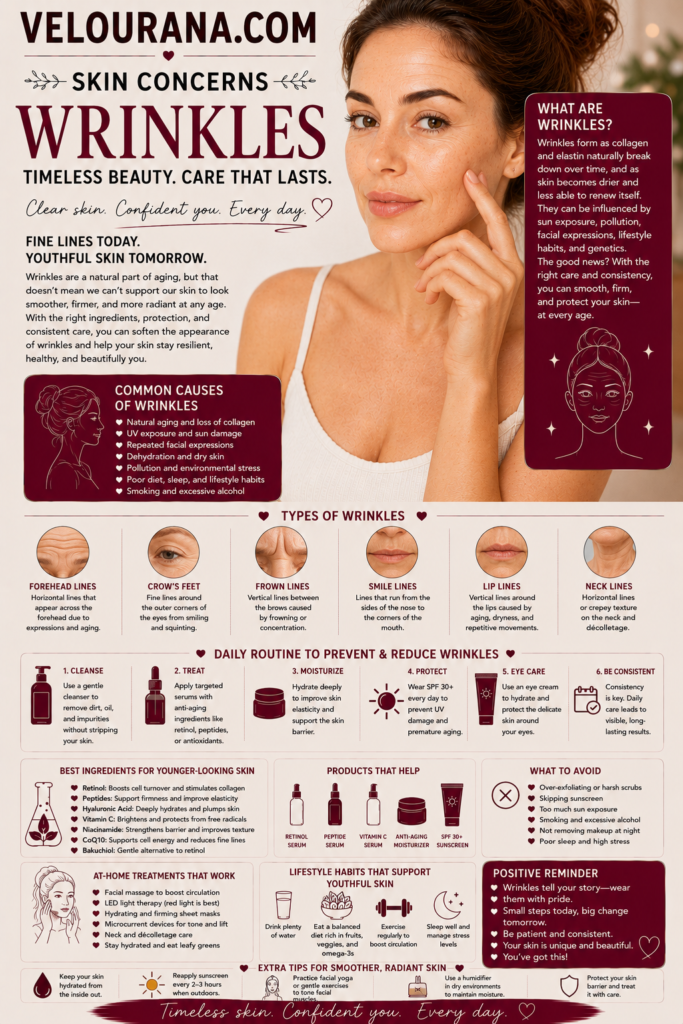
CATEGORY: Wrinkles
Wrinkles are usually noticed from the outside. A line appears beside the eye that was not obvious a few years earlier. A crease across the forehead begins remaining visible after the eyebrows relax. Makeup settles differently around the mouth. Under certain lighting, the skin seems to contain a network of fine lines that disappear almost completely when moisturizer is applied.
What we see, however, is only the final surface expression of a much deeper process.
Skin is not a flat covering stretched over the face. It is a living, layered structure connected to muscles, fat, connective tissue and bone. It bends thousands of times every day, responds continuously to the environment, loses and replaces water, produces structural proteins, repairs microscopic damage and adapts to changes occurring throughout the body. A wrinkle emerges from this moving architecture.
This is why the word wrinkle describes appearances that may have very different biological origins. A shallow dehydration line is not equivalent to a deep forehead crease. Crow's-feet produced largely by repeated expression do not behave exactly like the fine textural wrinkling associated with long-term ultraviolet exposure. A fold influenced by changing facial volume cannot be understood simply as a problem with the epidermis.
The distinction is more than scientific detail. It determines what skin care can realistically accomplish.
To understand wrinkles properly, it is useful to move beneath the mirror and examine the architecture responsible for them: the epidermis that forms the visible surface, the collagen-rich dermis that provides support, the elastic fibers that help skin recover after movement, the deeper tissues that influence facial contours, and the muscles that repeatedly fold everything above them.
A wrinkle is rarely the failure of one component.
It is the visible meeting point of many gradual changes.
Skin Is an Architecture, Not a Sheet
It is tempting to imagine facial skin as a single material. In reality, different layers perform different functions, and the appearance of a wrinkle can be influenced by changes occurring in several of them simultaneously.
The epidermis forms the outer portion of the skin. Its outermost barrier helps control water loss and protects the body from the surrounding environment. When this barrier is functioning well, the surface tends to appear smoother and more supple. When it becomes dry or disrupted, microscopic irregularities become more visible and fine lines can look deeper.
Beneath the epidermis lies the dermis.
This is where much of the structural story of wrinkles unfolds.
The dermis contains collagen, elastin, blood vessels, nerves, fibroblasts and a complex extracellular matrix. Rather than functioning as simple packing material, this matrix creates a supportive environment that gives skin strength, resilience and flexibility.
Beneath the skin are additional structures, including subcutaneous fat and the muscles responsible for facial expression. With age, changes can occur throughout this deeper landscape as well.
The face therefore does not age only because its surface becomes older.
The relationship among its layers changes.
A useful analogy is architecture. If the exterior of a building develops a visible depression, repainting the wall may improve its appearance but will not necessarily correct a structural shift beneath it. Conversely, if the apparent imperfection is merely superficial, rebuilding the foundation would be unnecessary.
Wrinkle treatment works according to the same logic.
Hydrating products are excellent at influencing the outer surface. Certain topical ingredients can gradually affect biological processes within accessible skin layers. Medical procedures can address deeper structural or muscular components. Each intervention has a different reach.
Confusion begins when a surface treatment is expected to solve a structural problem—or when a structural intervention is assumed necessary for a surface problem that might respond beautifully to basic skin care.
Understanding depth is therefore the beginning of understanding wrinkles.
Collagen: The Framework That Gives Skin Strength
Few words in modern skin care are used as frequently as collagen.
It appears on creams, masks, supplements, drinks and advertising campaigns. Yet collagen's genuine biological importance is much greater than many of the simplistic claims attached to its name.
Collagen is a major structural protein in the dermis. Its fibers help provide tensile strength and support, contributing to the firmness and organization associated with younger-looking skin.
The important issue in aging is not merely the amount of collagen present.
Its production, breakdown and organization matter as well.
Fibroblasts within the dermis are involved in producing collagen and other components of the extracellular matrix. As skin ages, collagen synthesis becomes less efficient, while accumulated environmental damage can accelerate degradation and disturb the organization of the collagen network.
Ultraviolet exposure is particularly important in this process.
Repeated exposure to ultraviolet radiation contributes to the breakdown of collagen and to changes within elastic tissue. Over years, this can produce a characteristic form of premature aging in which skin becomes rougher, less resilient, unevenly pigmented and increasingly wrinkled.
This helps explain why chronological age alone is a poor predictor of how wrinkled someone will appear.
Two people can have lived exactly the same number of years while their skin has experienced dramatically different environmental histories.
Someone who has spent decades regularly exposed to intense sunlight without protection may develop considerably more visible photoaging than someone of the same age whose ultraviolet exposure has been lower and more consistently protected.
Genetics, smoking, skin characteristics and other influences complicate the comparison further.
Collagen should therefore be understood not as a beauty substance that can simply be "put back" into the skin, but as part of an intricate biological framework.
That distinction also exposes one of the most common misunderstandings surrounding collagen cosmetics.
Applying a product containing collagen does not mean intact collagen molecules simply travel through the surface and rebuild the dermal framework like replacement beams inserted into a building. Topical collagen-containing products may have moisturizing or film-forming cosmetic properties depending on their formulation, but this is not the same as reconstructing native dermal collagen.
When skin-care ingredients are discussed as supporting collagen, the meaningful question is not whether the word collagen appears on the label.
It is whether the ingredient or treatment can influence the biological processes associated with collagen production, preservation or remodeling.
That is a much higher standard.
Elastin and the Ability to Return
If collagen provides strength, elastin contributes something equally important: the ability of skin to stretch and recover.
Facial skin needs this quality constantly.
Every smile changes its shape. Every raised eyebrow stretches and compresses different regions. Squinting creates folds around the eyes. Speaking changes the skin around the mouth. Sleeping places pressure on parts of the face for hours at a time.
Young skin generally handles this movement with remarkable efficiency.
It bends, folds and returns.
With age and accumulated environmental damage, elastic properties change. The skin may no longer recover from deformation as completely as it once did. Repeated folds that previously disappeared can begin leaving faint traces.
Those traces can gradually become established lines.
This is one reason wrinkles often seem to emerge slowly and then suddenly become obvious.
The process may have been developing for years before crossing the threshold at which the line remains visible in ordinary light while the face is at rest.
Elastin also illustrates why sun protection has consequences extending far beyond preventing sunburn.
A sunburn is an acute event: redness, heat, discomfort and inflammation that appear relatively quickly after excessive exposure.
Photoaging is cumulative.
The visible consequences can emerge years or decades after the exposure responsible for them.
Someone may therefore believe that the sun "never damaged" their skin because they rarely experienced dramatic burns, while cumulative ultraviolet exposure has nevertheless been influencing collagen, elastin, pigmentation and other components of skin biology.
The face eventually reveals a history that was largely invisible while it was being written.
Facial Movement Writes Repeated Patterns Into the Skin
A completely motionless face would age differently from an expressive one.
Fortunately, human faces are not designed to remain still.
Facial expression is fundamental to communication. Before a word is spoken, tiny muscular movements can communicate amusement, concern, surprise, skepticism, affection or anger. These movements repeatedly fold the skin along predictable pathways.
The horizontal lines of the forehead are associated with raising the eyebrows. Vertical lines between the brows are influenced by muscles involved in frowning and concentration. Crow's-feet appear where the skin folds during smiling and squinting. Lines around the mouth develop within another intensely mobile region.
Early in life, many of these lines exist only during expression.
Smile, and they appear.
Relax, and they disappear.
These are dynamic lines.
Over time, repeated mechanical folding interacts with changes in collagen, elasticity, hydration and other structural characteristics. A line that once existed only during movement can gradually remain visible after the movement stops.
It has become increasingly static.
This transition explains why certain treatments aimed at the skin surface cannot completely correct expression-related wrinkles.
The skin is not acting alone.
A muscle beneath it continues producing the movement.
Topical products may improve surface texture, hydration and fine lines, but they cannot selectively stop a facial muscle from contracting. This is why professional treatments designed to alter muscular activity occupy a fundamentally different category from cosmetic creams.
The distinction is especially obvious on the forehead.
Imagine a person who frequently raises the eyebrows. Each contraction produces folds across the forehead. If the skin remains highly elastic and structurally resilient, those folds flatten efficiently. As the tissue becomes less resilient, the same movement leaves more persistent evidence.
The muscle did not necessarily become stronger.
The material moving above it changed.
This relationship between movement and material is central to wrinkle formation.
Fine Lines Are Not Simply Smaller Deep Wrinkles
Fine lines are often discussed as though they are miniature versions of deeper wrinkles.
That can be misleading.
Some fine lines are heavily influenced by surface hydration. Others reflect early structural changes, photodamage or repeated movement. Still others arise from combinations of these factors.
The difference becomes obvious when dehydrated skin is moisturized.
A network of tiny lines can sometimes soften remarkably quickly. Biological remodeling of collagen cannot happen within minutes. What has changed is primarily the condition of the outer skin.
Water has altered its flexibility and optical smoothness.
This is why hydration deserves more respect in anti-aging routines.
Moisturizer is sometimes treated as basic skin care for people who have not yet discovered "real" active ingredients. In mature skin, however, hydration is not an optional decorative step.
As the skin becomes drier with age, maintaining the barrier can have a meaningful effect on appearance and comfort.
Humectants help increase water within the outer layers. Emollients help smooth spaces between surface cells. Occlusive ingredients can reduce water loss. Well-designed moisturizers may combine several of these functions.
None of this means moisturization permanently removes wrinkles.
It means that part of what the eye interprets as wrinkling can be influenced by surface condition.
This is particularly important when evaluating whether a treatment is working.
A person who begins an aggressive active ingredient and develops significant dryness may look temporarily more lined despite using a product intended to improve aging skin over the long term.
If that increased wrinkling is misinterpreted as a need for even stronger treatment, the routine can spiral into chronic irritation.
The mature skin barrier often benefits more from consistency than combat.
Photoaging Creates a Different Kind of Aging Landscape
Chronological aging and photoaging overlap, but they are not identical.
Intrinsic aging reflects biological processes associated with the passage of time. Photoaging refers to changes produced or accelerated by repeated ultraviolet exposure.
The distinction can often be observed on the same individual.
Compare an area that has received decades of regular sunlight with an area usually protected by clothing. The difference can be striking. Sun-exposed skin may show more uneven pigmentation, roughness, visible vascular changes, altered elasticity and wrinkling.
This is one reason the face, neck, upper chest and hands frequently reveal age so prominently.
They are environmental records.
Ultraviolet radiation affects skin through several mechanisms, including oxidative stress and damage to structural components. Over time, the normal organization of the dermal matrix can become disrupted.
The resulting wrinkle is therefore not simply an old line.
It may be a line developing within photodamaged tissue.
This distinction matters for prevention because chronological aging cannot be eliminated. Nobody can prevent the passage of time.
A meaningful portion of extrinsic aging, however, is influenced by behavior.
Sun protection cannot make someone biologically younger, but it can reduce continuing ultraviolet injury. That makes it fundamentally different from a product marketed primarily to improve the appearance of damage after it has already occurred.
A well-designed wrinkle strategy should therefore operate in two directions at once.
It should support the skin that already exists while reducing avoidable forces that continue aging it prematurely.
Trying to repair photoaging without addressing ongoing ultraviolet exposure is rather like drying a floor while leaving the tap running.
Why Retinoids Occupy a Special Position
The beauty industry contains thousands of ingredients associated with youthfulness.
Very few possess the history and evidence associated with topical retinoids.
Retinoids are derivatives of vitamin A. Different forms vary in strength, formulation, stability and regulatory status, but their importance in aging skin comes from their ability to influence cellular behavior and processes associated with collagen and epidermal renewal.
This does not make every retinol product equivalent.
Concentration matters, but so do formulation, packaging, stability and skin tolerance. More importantly, stronger treatment is not automatically better treatment for a particular person.
Retinoids can irritate.
Dryness, peeling, redness and sensitivity are familiar problems, particularly during introduction or when a product is used too frequently.
This is where anti-aging enthusiasm can become counterproductive.
Wrinkles encourage urgency. Someone sees a line becoming deeper and naturally wants maximum intervention. A strong retinoid is introduced every night. An exfoliating acid is added because texture also needs improvement. A strong cleanser removes the resulting flakes. Another serum is added to address pigmentation.
Within weeks, the skin is tight, inflamed and uncomfortable.
The routine contains excellent ingredients.
The routine itself is poor.
Biologically active skin care has to be tolerable enough to continue. Gradual introduction allows the skin's response to be observed. Moisturization can help support comfort. Other potentially irritating products may need to be reduced while tolerance develops.
There is no prize for reaching the strongest concentration fastest.
The relevant outcome is improvement achieved without repeatedly destabilizing the skin.
Retinoids also illustrate why wrinkle care requires patience.
Collagen remodeling and meaningful changes in photodamaged skin are not overnight processes. A product that genuinely influences skin biology may require months of consistent use before its value can be judged fairly.
The internet's preference for seven-day transformations is poorly matched to the timescale of human tissue.
The Changing Shape Beneath the Skin
Not every apparent wrinkle is primarily a skin problem.
The face itself changes with age.
Fat compartments can change in volume and position. Bone undergoes age-related remodeling. Ligaments and other supporting structures change. Soft tissues may redistribute. These deeper transformations alter the contours over which the skin is draped.
The result can be folds, shadows and creases that become increasingly visible even if the surface of the skin is reasonably healthy.
This is crucial when discussing areas such as the nasolabial folds running from the sides of the nose toward the mouth.
A person may purchase a "deep wrinkle cream" and repeatedly apply it to the fold expecting the crease to flatten. The product may hydrate the skin beautifully, but the visible fold can be strongly influenced by three-dimensional facial anatomy.
No moisturizer can reposition facial volume.
This is not a criticism of moisturizers.
It is a classification problem.
Expecting a topical cosmetic to correct a structural contour change guarantees disappointment because the intervention and the cause exist at different anatomical levels.
The same principle explains why professional aesthetic treatments are not interchangeable.
A treatment designed to reduce muscle activity addresses a different mechanism from a filler intended to alter volume. A resurfacing treatment addresses different features again. Surgery operates at another level entirely.
Before asking what treatment is strongest, the more intelligent question is: What is producing the feature I want to change?
Without that question, anti-aging becomes random experimentation.
Wrinkles Around the Eyes Reveal the Entire Process in Miniature
The eye area provides an almost perfect demonstration of how multiple mechanisms combine.
The skin is relatively delicate. The area moves continuously. Smiling and squinting create repeated folds. Sunlight reaches it easily. People rub their eyes, remove makeup, apply cosmetics and sometimes neglect sunscreen close to the orbital region because of stinging.
Then there is hydration.
Fine lines under the eyes can become dramatically more visible when the skin is dry.
All these influences coexist within a small area.
This is why an "eye wrinkle" is not a diagnosis.
One person may primarily have dynamic crow's-feet. Another may have pronounced dehydration lines. Another may show substantial photodamage. Someone else may have changes in volume that create shadows interpreted as wrinkles.
Most people have combinations.
The correct cosmetic strategy depends on which component is dominant.
Gentle moisturization may make a major visual difference to dryness-related creasing. Sun protection helps limit further photodamage. Carefully tolerated active ingredients may improve fine textural aging.
But deep expression-related crow's-feet will not disappear because an eye cream contains luxurious botanical extracts.
Recognizing that limitation protects consumers from one of the most expensive assumptions in beauty: that a product designed for a specific anatomical area must therefore be capable of correcting every age-related change occurring there.
The Forehead Shows How Wrinkles Become Established
Forehead lines provide another useful model.
Raise your eyebrows while looking in a mirror.
Several horizontal folds appear.
Now relax.
In younger or highly resilient skin, they may vanish almost completely. Later, faint lines remain. With further structural change and repeated movement, those lines can deepen.
The progression demonstrates the interaction between mechanics and tissue quality.
The movement itself is normal. The forehead is doing exactly what it is designed to do.
What changes is the skin's ability to recover from the movement without leaving a persistent crease.
This also explains why people sometimes first notice forehead wrinkles during periods of dryness or fatigue. The structural line may already exist, but altered hydration or lighting makes it suddenly more apparent.
Once noticed, it can become psychologically difficult to unsee.
This is an underappreciated aspect of wrinkle care.
The more closely someone inspects aging skin, the more irregularities become visible. Magnifying mirrors, high-resolution phone cameras and harsh overhead lighting can turn completely ordinary texture into something that appears alarming.
Human skin has pores, follicles, lines, pigmentation and microscopic variation.
A successful anti-aging routine should not require pretending otherwise.
The Neck Reminds Us That Skin Care Cannot Stop at the Jaw
Many people build sophisticated facial routines while treating the neck almost as an afterthought.
Yet the neck experiences its own combination of movement, ultraviolet exposure, dryness and structural aging.
It bends throughout the day. Horizontal creases may be present even in relatively young people because neck movement naturally folds the skin. With time, changes in elasticity, texture and laxity can make these lines more noticeable.
The neck can also be more sensitive to ingredients that are well tolerated on the face.
This makes aggressive transplantation of an entire facial routine unwise.
A strong retinoid or exfoliating treatment applied too frequently may create significant irritation. Gradual introduction and careful attention to tolerance are particularly important.
Sun protection should extend beyond the facial boundary as well.
The face does not end biologically at the jawline, even if skin-care marketing often behaves as though it does.
The ears, neck and upper chest accumulate environmental exposure too.
Wrinkle prevention is more coherent when exposed skin is treated as a connected landscape rather than a collection of marketing zones.
Why More Products Do Not Create More Collagen
The modern anti-aging routine can become extraordinarily complicated.
A cleanser is followed by an essence, toner, peptide serum, vitamin C serum, exfoliating acid, growth-factor product, retinol, eye treatment, moisturizer, facial oil and sleeping mask.
Each product may have a plausible rationale.
Together, they may create chaos.
Skin does not calculate the number of expensive ingredients applied to it and reward effort accordingly.
Formulations interact. Irritating ingredients can have additive effects. Multiple active products make it difficult to identify the cause when redness or dermatitis develops. A routine so complicated that it cannot be followed consistently may be less useful than a simple one maintained for years.
There is also an important conceptual error behind excessive layering.
People often imagine each product adding a separate percentage of anti-aging power, as though benefits accumulate mathematically.
Biology rarely works that way.
Once hydration is adequate, adding four more moisturizers does not necessarily produce four times the hydration. Once an effective retinoid is being tolerated, stacking multiple retinoid-like products may primarily increase irritation rather than accelerate remodeling.
A focused routine respects diminishing returns.
The foundation is gentle cleansing appropriate to the skin, effective moisturization when needed, and consistent sun protection. Evidence-supported treatment can then be added according to the individual's priorities and tolerance.
Everything beyond that should earn its place.
This is not minimalism for aesthetic reasons.
It is biological efficiency.
The Difference Between Softening and Erasing
Language shapes expectations.
Wrinkle products are frequently described using words such as erase, reverse, lift, rebuild and transform. These words imply structural changes that cosmetic products may not be capable of producing.
A more useful vocabulary includes soften, smooth, hydrate, improve and reduce the appearance of.
These phrases may sound less dramatic, but they describe outcomes that can genuinely matter.
Consider a mature complexion with fine lines, dryness, rough texture and uneven tone.
If consistent care improves hydration, reduces roughness, supports more even-looking tone and softens fine lines, the face may look substantially fresher even though deeper expression wrinkles remain.
That is not failure.
It is a realistic cosmetic improvement.
In fact, wrinkle depth is only one component of perceived skin age. Texture, luminosity, pigmentation, firmness and hydration all influence how the complexion is interpreted.
Someone can retain visible crow's-feet and look vibrant.
Someone can have relatively few deep wrinkles but significant photodamage and look considerably older.
Treating aging skin therefore becomes more rewarding when attention expands beyond individual lines.
When Professional Treatment Becomes the More Logical Tool
Topical skin care has a natural ceiling.
Once wrinkles become substantially influenced by muscular activity, deep structural change, tissue laxity or volume loss, professional interventions may produce effects that cosmetics cannot.
Different procedures target different mechanisms.
Neuromodulators can reduce selected muscular contractions responsible for certain dynamic wrinkles. Dermal fillers can alter volume and support in appropriate areas. Resurfacing procedures can address aspects of texture and photodamage. Other energy-based technologies attempt to influence deeper tissue remodeling. Surgical procedures can address structural changes at a level entirely beyond topical care.
None is universally appropriate.
All involve considerations that a jar of moisturizer does not: practitioner expertise, medical suitability, complications, cost, downtime, expected duration and the possibility that the result will not match expectations.
This is why professional assessment matters.
The correct question is not simply, "What removes wrinkles?"
It is, "What kind of wrinkle is this, what structures are involved, and what degree of change is realistic?"
That diagnostic way of thinking prevents the endless escalation of cosmetics against a problem cosmetics were never designed to solve.
Aging Skin Does Not Need to Become Expressionless
There is a philosophical problem hidden inside the modern war against wrinkles.
If every line is treated as damage, normal facial expression eventually becomes the enemy.
Smiling creates crow's-feet.
Concentration can create brow lines.
Surprise folds the forehead.
Speech moves the mouth.
Life itself becomes implicated.
A more balanced understanding recognizes that wrinkles emerge partly because skin ages and partly because faces move. Environmental damage can be reduced. Dryness can be treated. Fine lines can sometimes be improved. Collagen can be supported through evidence-based strategies. Professional procedures can alter deeper features when desired.
But a face does not need to become visually silent in order to be well cared for.
Healthy mature skin can contain wrinkles.
This distinction matters because skin health and visual youth are overlapping but different goals.
A routine focused exclusively on eliminating every sign of age can become increasingly aggressive as the biological reality of aging continues. A routine focused on preserving function, comfort, resilience and overall appearance can remain productive throughout life.
The Most Powerful Strategy Is Architectural Thinking
Once wrinkles are understood as architectural changes rather than isolated marks, the logic of skin care becomes clearer.
Surface dryness should be treated as surface dryness.
Photodamage should be addressed with rigorous prevention and appropriate evidence-based treatment.
Dynamic wrinkles should be recognized as partly mechanical.
Deep folds should be understood within the context of changing facial structure.
No single cream needs to carry the impossible responsibility of solving all four.
Collagen and elastin explain why skin possesses strength and resilience. Facial muscles explain why particular lines repeatedly appear in predictable places. Ultraviolet exposure explains why environmental history can accelerate structural deterioration. Hydration explains why the same wrinkle can appear dramatically different from one day to another. Deeper facial changes explain why some folds persist regardless of how luxurious the surface treatment becomes.
Together, these mechanisms create the face we see.
This knowledge also creates more realistic optimism.
There is much that can be done for aging skin.
Daily sun protection can reduce continuing ultraviolet damage. Moisturization can improve surface smoothness and comfort. Retinoids and other appropriately selected treatments can improve certain signs of photodamage and fine wrinkling over time. Gentle routines can protect the barrier rather than repeatedly disrupting it. Professional treatments can address specific deeper mechanisms when topical care reaches its limits.
None of these requires believing that aging itself can be abolished.
Wrinkles are not simply lines painted onto the surface by time. They are the visible geometry of a living structure that has moved, adapted, repaired itself and interacted with the world for decades.
Understanding that architecture makes wrinkle care less mysterious.
It also makes it more intelligent.
Instead of asking how to erase every line, we can ask what created it, what part of it can realistically be changed, what should be protected from further damage, and what the skin needs in order to remain healthy while it continues to age.
Those questions lead to better choices than any promise of overnight transformation.
Because the most sophisticated approach to wrinkles begins not with fighting the surface, but with understanding everything beneath it.
The End Velourana
 Discover More From Our Family of Websites
 ZodiacBearing (Astrology, Tarot, Numerology, Angel Numbers & Spiritual Guidance)
 Velourana (Beauty, Makeup, Hair Care, Skincare & Beauty Tips)
 HavenBearing (Home, Living, Organization, Décor & Everyday Inspiration)
 PawBearing (Pet Care, Dog Breeds, Animal Health, Training & Pet Products)
 PsyCatherine (Notes From the Journal of a Psychologist on Real Life)

