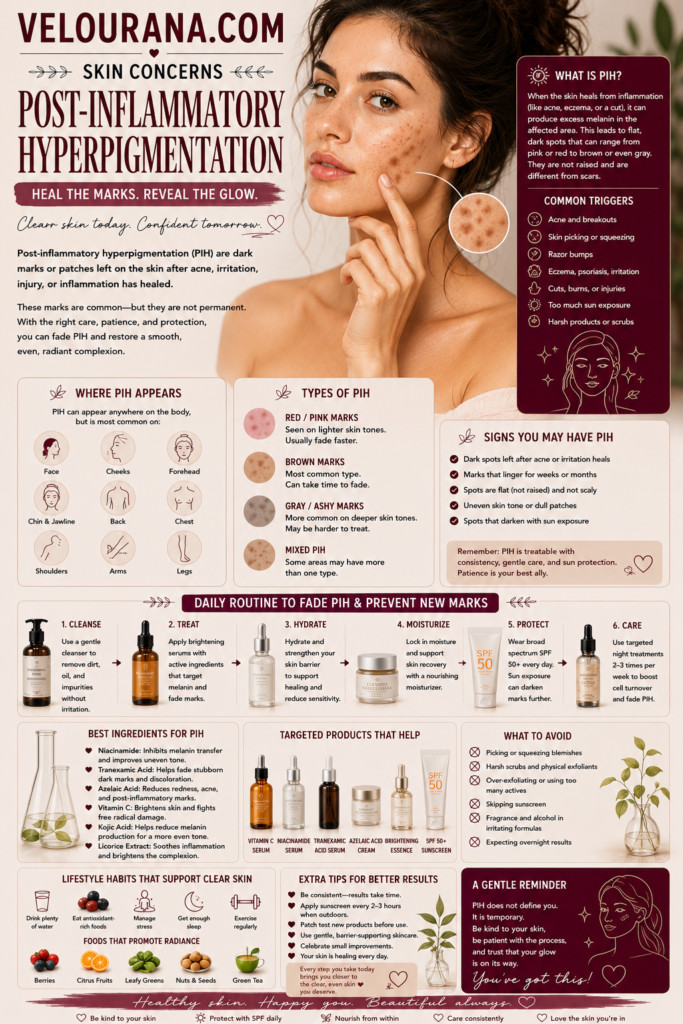
CATEGORY: Post-Inflammatory Hyperpigmentation
There is a particular kind of frustration that begins after a blemish has technically healed.
The swelling has disappeared. The tenderness is gone. The surface is smooth again. There is no active spot to treat, no obvious inflammation to calm and sometimes not even a noticeable change in texture. Yet when the face is seen in daylight, a brown or grey-brown mark remains exactly where the blemish used to be.
Weeks later, it may still be there.
This is one of the defining characteristics of post-inflammatory hyperpigmentation, or PIH: the event that caused the problem can be much shorter than the visible evidence it leaves behind.
That difference in timing creates enormous confusion. People often continue treating the mark as though the original blemish were still present. They dry it, scrub it, exfoliate it repeatedly or cover it with increasingly powerful spot treatments. Yet the biological problem has changed. The skin is no longer primarily dealing with an inflamed follicle. It is dealing with pigment produced in response to the inflammation that occurred there.
Understanding that transition—from active inflammation to pigmentary aftermath—is one of the most useful ideas in caring for blemish-prone skin.
It explains why a complexion can look as though it is still breaking out even after acne has improved. It explains why some marks disappear relatively quickly while others remain stubborn for months. It explains why picking makes certain blemishes leave disproportionately dark traces. And it explains why an aggressive attempt to erase pigmentation can sometimes create more of it.
The acne may be gone.
But the skin has not yet finished processing what happened.
A Blemish Can Have Two Very Different Lives
We tend to think of a pimple as one event.
Biologically, it is more useful to think of it as a sequence.
During the first phase, there is an active inflammatory lesion. Depending on the type of acne, the follicle may become clogged, inflamed, swollen and tender. The surrounding skin participates in an immune response designed to manage the disturbance and begin repair.
Eventually, that active episode resolves.
But resolution of the lesion does not necessarily mean immediate restoration of the skin's previous colour.
Inflammation can stimulate melanocytes, the cells responsible for producing melanin. This increased pigmentary activity can leave an area of discoloration after the original inflammatory process has settled. That residual pigmentation is post-inflammatory hyperpigmentation.
The distinction matters because the two phases require different thinking.
An active inflammatory blemish may require acne management. A flat brown mark left behind afterward is not simply an inactive pimple waiting to be dried out further.
Applying harsh acne treatments repeatedly to a healed mark may therefore accomplish very little. Worse, if those treatments irritate the area, they can create additional inflammation around skin that is already prone to responding to inflammation with pigment.
This is one of the reasons PIH can become caught in a self-perpetuating cycle.
The person sees pigment and interprets it as an unresolved blemish. They intensify treatment. The treatment irritates the skin. Irritation produces inflammation. The inflammatory response encourages further pigmentation.
What began as an attempt to make the mark disappear can inadvertently give the skin another reason to keep it visible.
Recognising when a blemish has entered its pigmentary phase allows the strategy to change with it.
Why the Colour Remains After the Swelling Has Disappeared
Melanin is essential to normal skin function. It contributes to skin colour and helps protect skin cells against ultraviolet radiation.
The problem in PIH is not the existence of melanin. It is its increased or altered production and distribution following inflammation.
Inflammatory signals can stimulate melanocytes to increase melanin synthesis. The pigment is transferred to keratinocytes within the epidermis, producing an area that appears darker than the surrounding skin.
If inflammation affects the junction between the epidermis and dermis more substantially, melanin can also become deposited deeper in the skin. Macrophages may engulf this pigment in the dermis, creating pigmentation that often has a grey, blue-grey or deeper brown appearance.
This distinction helps explain why PIH does not always look the same.
Some marks are warm brown.
Some are dark brown.
Others have a cooler greyish cast.
The colour can offer clues about where pigment is located, although visual self-diagnosis has limitations and professional examination may be needed when pigmentation is persistent or unclear.
The depth also influences how quickly the mark can change.
Superficial epidermal pigment can gradually move upward as epidermal cells renew and shed. Deeper dermal pigment does not follow the same straightforward route and can consequently be considerably more persistent.
This is why comparing one person's PIH timeline with another person's can be misleading.
Even marks that appear similar in photographs may differ biologically.
One person's pigmentation may be relatively superficial and responsive. Another person's may have followed a deeper inflammatory lesion and require considerably more time.
The skin is not being stubborn.
The pigment may simply be located somewhere that takes longer to resolve.
Why One Tiny Pimple Leaves Nothing and Another Leaves a Mark for Months
Not every blemish produces PIH.
Some disappear almost without evidence. Others leave pigmentation dramatically larger and more noticeable than the original lesion.
Several factors influence that difference, but the intensity and duration of inflammation are particularly important.
A small superficial lesion that resolves quickly creates a different biological event from a large, deeply inflamed nodule. The latter involves more extensive inflammation and tissue disruption, increasing the opportunity for pigmentary changes afterward.
Then there is what happens to the blemish while it exists.
A lesion that is squeezed repeatedly, scratched, pierced or aggressively extracted is no longer experiencing only the inflammation generated by acne itself. Mechanical trauma has been added.
The inflammatory footprint becomes larger.
This helps explain a common experience: someone notices a small blemish, attempts to extract it before it is ready, spends several minutes squeezing the surrounding skin, wakes the following morning with a swollen red area and eventually develops a dark mark much larger than the original spot.
The mark seems disproportionate only if we remember the original pimple and forget everything that happened afterward.
From the skin's perspective, the relevant event was not merely the clogged follicle.
It was the entire inflammatory episode.
Repeated manipulation can transform something small into something biologically much more significant.
There is also individual variation. Some skin simply responds to inflammation with more obvious pigment production. This tendency is particularly relevant in medium to deeper skin tones, in which PIH can be both more noticeable and more persistent.
That means two people can experience almost identical acne lesions and emerge with very different pigmentary consequences.
PIH is not a reliable measure of how severe someone's acne currently is.
Sometimes it is a record of how strongly their skin responds to acne that has already ended.
The Difference Between a Dark Mark and an Acne Scar
One of the most important distinctions in post-acne skincare is the difference between pigmentation and scarring.
They are frequently grouped together under the phrase “acne scars,” but they are not the same thing.
Post-inflammatory hyperpigmentation is primarily a change in colour. If you run a finger across uncomplicated PIH, the skin is generally flat. The texture may feel essentially the same as the surrounding area.
A true acne scar involves structural change.
Atrophic scars create depressions in the skin and may appear as ice-pick, rolling or boxcar scars. Hypertrophic and keloid scars involve raised tissue. These changes result from alterations in the healing process and collagen architecture rather than pigment alone.
This difference has practical consequences.
A treatment designed to influence pigmentation cannot be expected to reconstruct a deep depressed scar.
Likewise, a procedure designed to remodel scar texture may not be the most appropriate first-line strategy for uncomplicated PIH.
The confusion is understandable because both can occur in exactly the same location after exactly the same acne lesion. A person can also have pigmentation and textural scarring simultaneously.
But separating colour from texture makes treatment goals more realistic.
Stand in soft, even light and observe the area from different angles. If the mark remains visible primarily because its colour differs from the surrounding skin while the surface remains flat, pigmentation is likely contributing substantially. If shadows change dramatically as the light moves across depressions or elevations, structural scarring may also be present.
Professional assessment is valuable when the distinction is uncertain, particularly before spending significant money on procedures.
A brown mark does not automatically require scar treatment.
And a scar will not disappear merely because the pigmentation covering it becomes lighter.
The Complexion Can Look Worse Even While the Acne Is Getting Better
PIH creates an unusual visual illusion.
Imagine someone who previously developed fifteen inflammatory blemishes every month. After adopting an effective acne routine, that number falls to three.
Biologically, this is major progress.
But perhaps the face already contains forty dark marks accumulated during previous months. Those marks remain visible while the new acne is decreasing. Looking in the mirror, the person may still perceive a face covered with “spots.”
The visual improvement lags behind the biological improvement.
This can lead people to abandon routines that are actually working.
They judge success according to the total number of visible marks rather than the number of new inflammatory lesions. Because pigmentation disappears more slowly than inflammation, the skin can look almost unchanged for a period even though the process creating future pigmentation has dramatically improved.
A better way to evaluate progress is to separate the two problems.
First ask: are fewer new inflammatory blemishes appearing?
Then ask: are fewer new dark marks being created?
Finally ask: are older marks gradually becoming lighter?
These changes may happen sequentially rather than simultaneously.
This is one reason photographs taken several weeks apart can be more informative than daily mirror inspection. PIH changes slowly enough that gradual fading can become difficult to perceive when the skin is examined every morning.
The person sees the marks continuously and adapts to tiny improvements.
A photograph preserves an earlier reference point.
Sometimes the most important evidence of progress is not that every old mark has disappeared.
It is that the face has stopped accumulating new ones.
Why Picking Is Especially Expensive for Pigmentation-Prone Skin
There is often a moment during the life of a blemish when extraction seems irresistible.
Perhaps a white centre appears. Perhaps the lesion feels raised. Perhaps makeup sits awkwardly over it. The temptation is to solve the problem immediately.
For skin prone to PIH, however, a few seconds of squeezing can have consequences lasting far longer than the blemish itself.
Mechanical pressure damages surrounding tissue. Fingernails can break the surface. Repeated attempts can expand inflammation beyond the original follicle. If the contents do not release easily, people often press harder, turning a relatively localised lesion into a broader area of trauma.
The resulting pigmentation may follow the area that was manipulated rather than the original dimensions of the pimple.
This is why the aftermath sometimes looks almost like a fingerprint of the extraction attempt.
Avoiding manipulation does not guarantee that a blemish will leave no mark. Some inflammatory lesions produce PIH even when they are never touched.
But unnecessary trauma is a modifiable factor.
The same logic applies to repeatedly scratching healing blemishes, peeling off crusts or picking at flaking skin around acne treatments.
Healing tissue needs time to complete its repair.
Continually reopening or disturbing it repeatedly resets part of that process.
For someone who develops pigmentation easily, preventing additional inflammation can be as important as applying ingredients intended to fade existing marks.
The most effective PIH treatment sometimes begins with what the hands do not do.
The Sunscreen Step That Becomes More Important After the Blemish Heals
People often associate sunscreen with preventing sunburn, premature ageing and sun-induced pigmentation.
Its role in PIH deserves equal attention.
Ultraviolet exposure can stimulate melanogenesis and contribute to the darkening or persistence of existing pigmentation. This means a mark created by acne can remain biologically connected to how the skin is subsequently exposed to light.
The acne caused the mark.
Sun exposure did not necessarily create it.
But photoprotection can influence what happens next.
This is why a pigmentation routine containing multiple brightening treatments but inconsistent sunscreen use has a structural weakness.
Corrective ingredients are attempting to reduce visible discoloration while ultraviolet exposure continues stimulating pigmentary pathways.
Daily broad-spectrum sunscreen helps shift that balance.
For someone who spends substantial time outdoors, sunscreen should also be considered alongside behavioural photoprotection: shade, hats and sensible management of intense sun exposure.
The objective is not to eliminate normal life outdoors.
It is to stop asking pigment-prone skin to fade while repeatedly exposing it to one of the environmental signals that encourages pigmentation.
This is particularly relevant during summer and in sunny climates, but PIH management is not exclusively seasonal. Ultraviolet exposure occurs throughout the year.
Consistency matters more than occasional perfection.
A sunscreen used reliably becomes part of treatment even though it does not feel like a treatment.
Why a Stronger Routine Can Produce a Darker Result
PIH encourages impatience.
Impatience encourages escalation.
A person begins with one brightening serum. After two weeks, the mark is still visible, so an exfoliating toner is added. Then a retinoid. Then an acid mask. Then a scrub because the skin is flaking and the flakes seem as though they should be removed.
Soon the routine contains multiple effective ingredients but has become collectively intolerable.
The skin begins to sting.
Moisturiser burns on application.
There is persistent tightness around the mouth and nose. Small patches become red or flaky. Breakouts may increase as the barrier becomes stressed.
For someone susceptible to PIH, this is not merely uncomfortable.
It is strategically counterproductive.
Inflammation produced by skincare can itself contribute to pigmentary changes. The routine intended to erase evidence of previous inflammation can therefore become a source of new inflammation.
This does not mean active ingredients are inherently harmful.
It means their value depends on dose, frequency, combination and individual tolerance.
A retinoid used appropriately can be valuable.
An exfoliating acid used appropriately can be valuable.
Azelaic acid can be valuable.
But the existence of evidence for several ingredients does not mean all of them must be applied together at maximum frequency.
Skincare is not improved by turning it into a chemistry endurance test.
When treating PIH, tolerability is part of efficacy because a routine that continually inflames the skin undermines its own objective.
The Case for a Deliberately Boring Foundation
There is something almost unfashionable about recommending a gentle cleanser, moisturiser and sunscreen in an era of elaborate routines.
Yet these basic products create the environment in which more targeted treatments become usable.
Cleansing should remove sunscreen, makeup, oil and daily debris without leaving the skin persistently tight or irritated.
Moisturiser should support comfort and barrier function.
Sunscreen should provide dependable daily photoprotection.
None of these steps needs to be dramatic.
Their value comes partly from making everything else less dramatic.
Once that foundation is stable, a targeted treatment can be selected according to the larger problem.
If inflammatory acne remains active, treating acne is essential because every prevented lesion represents a potential prevented mark.
If acne is largely controlled and pigmentation is the main concern, the routine can place greater emphasis on pigment-modulating ingredients.
If the skin is already irritated, restoring tolerance may need to come before intensifying treatment.
This kind of routine can feel slow because it lacks the immediate sensation associated with strong acids or aggressive exfoliation.
But PIH is a long-term problem.
A routine that feels spectacular for four days and becomes unbearable by day ten has less practical value than one that can be followed for months.
The best pigmentation routine is not the one that produces the strongest sensation.
It is the one that creates the most favourable biological conditions consistently.
Choosing Corrective Ingredients Without Creating an Ingredient Competition
Several topical ingredients have legitimate roles in managing acne-related pigmentation.
Retinoids are particularly interesting because they can influence both acne and pigmentation. By helping normalise follicular keratinisation and affecting epidermal turnover, they can contribute to preventing new acne while supporting gradual improvement in post-inflammatory marks.
Azelaic acid occupies similarly useful territory. It is used in acne management and can also influence abnormal pigmentation, making it particularly attractive when active blemishes and PIH coexist.
Other ingredients commonly incorporated into pigmentation routines include niacinamide, vitamin C and alpha hydroxy acids.
Prescription options may include stronger depigmenting agents depending on the individual and jurisdiction, while dermatologists can construct combination strategies for more persistent cases.
But ingredient selection should follow a question:
What problem is this product solving?
If the answer is unclear, the product may not be necessary.
Someone using a retinoid for acne and pigmentation may not automatically need a strong exfoliating acid every night. Someone with extremely sensitive skin may benefit more from a modest routine used consistently than from theoretically more powerful ingredients that repeatedly cause dermatitis.
The elegance of a pigmentation routine lies in avoiding unnecessary overlap.
One product may address acne.
Another may provide targeted pigment support.
A moisturiser maintains tolerance.
Sunscreen protects the progress.
That may be enough.
More products can always be added later if there is a clear reason.
It is much harder to identify what caused irritation when six new actives were introduced simultaneously.
Why PIH Often Looks Different Across Different Skin Tones
Post-inflammatory hyperpigmentation occurs across skin tones, but its visibility and clinical significance are particularly pronounced in more deeply pigmented skin.
Melanin-rich skin can respond strongly to inflammatory signals, making pigmentation a major consequence of acne even when the acne itself is not exceptionally severe.
This creates an important treatment consideration.
An aggressive intervention that might produce temporary redness in lighter skin can potentially produce more troublesome pigmentary consequences in someone highly susceptible to PIH.
That does not mean deeper skin tones cannot use effective actives or undergo dermatological procedures.
It means inflammation must be managed carefully.
Treatment should respect the pigmentary behaviour of the skin rather than applying a universal intensity standard.
This is particularly relevant to chemical peels, lasers and other procedures capable of producing controlled injury. Practitioner experience with the patient's skin type and pigmentation tendency becomes important because inappropriate treatment parameters can worsen discoloration.
The same principle applies at home on a smaller scale.
A product does not know someone's skin tone.
A percentage printed on a bottle does not automatically determine whether the treatment is appropriate.
The skin's response remains the final measure.
Persistent burning, inflammation and irritation should not be accepted simply because the product is marketed as effective for pigmentation.
The Psychological Trap of Examining the Mark Every Day
PIH is slow enough to distort perception.
When a mark is examined every morning and every evening, changes occurring over several weeks are almost impossible to appreciate.
The person remembers how the skin looked yesterday, not how it looked two months ago.
This creates the impression of stagnation.
Stagnation creates frustration.
Frustration creates experimentation.
A routine is replaced. A new serum is added. An exfoliant is increased from twice weekly to nightly. A professional treatment is booked prematurely.
The skin never receives a stable period in which progress can be evaluated.
A better approach is to think in longer intervals.
If a treatment is appropriate and well tolerated, evaluate the direction of change over weeks rather than expecting meaningful visual transformation every few days.
Look at the whole pattern rather than one stubborn mark.
Are older areas becoming softer in colour?
Are fewer new lesions appearing?
Does foundation or concealer require less coverage than before?
Is the contrast between marks and surrounding skin gradually decreasing?
Progress in pigmentation often appears as a reduction in contrast before complete disappearance.
A dark brown mark becomes medium brown.
Medium brown becomes lighter.
Its edges become less obvious.
Eventually the eye stops noticing it.
The process is gradual enough that the final disappearance may feel almost anticlimactic.
One day, the mark that dominated attention for months simply no longer demands it.
When the Mark Is Not Behaving Like Ordinary PIH
Not every area of pigmentation following acne should automatically be self-treated indefinitely.
Some marks are not PIH.
Red or pink post-acne marks may represent post-inflammatory erythema rather than increased melanin. Textural changes can indicate scarring. Persistent patches may have another pigmentary diagnosis.
This becomes particularly important when pigmentation appears without a clear inflammatory trigger, changes unexpectedly, develops unusual colours or borders, becomes symptomatic, or fails to behave as expected.
Professional assessment can establish whether the problem really is PIH and whether pigment is predominantly superficial or deeper.
A dermatologist may also recommend prescription treatments when over-the-counter skincare is insufficient.
Procedures can sometimes be considered for resistant pigmentation, but they should not be approached casually. Chemical peels and laser-based treatments interact directly with the inflammatory biology that created PIH in the first place.
The goal of a procedure is controlled improvement.
Too much inflammation can produce the opposite result.
This is why choosing the correct treatment is not simply a matter of finding the strongest technology.
It is a matter of balancing potential benefit against the skin's tendency to pigment after injury.
What Progress Actually Looks Like
The most useful way to understand acne-related PIH is as a sequence of victories rather than one dramatic transformation.
First, inflammatory acne becomes less frequent.
Then fewer fresh dark marks appear.
Older marks gradually lose intensity.
The overall complexion begins to look more uniform.
Some particularly persistent areas may remain after most others have faded.
Eventually, the visual history of the acne becomes less dominant.
This sequence matters because it changes the definition of success.
If someone develops ten fewer inflammatory lesions this month than last month, that is pigmentation prevention even though no brightening product was involved.
If someone stops squeezing blemishes and consequently develops smaller, lighter marks, that is progress.
If sunscreen becomes consistent and existing pigmentation stops darkening dramatically during periods of high sun exposure, that is progress.
If a routine becomes gentler and the skin no longer experiences repeated episodes of irritation, that is progress.
PIH improves not through one mechanism but through the accumulation of these advantages.
The skin receives fewer inflammatory signals.
Fewer melanocytes are stimulated unnecessarily.
Existing pigment is protected from additional environmental stimulation.
Normal epidermal renewal continues.
Targeted ingredients provide additional support where appropriate.
Time does the part that no cosmetic product can compress completely.
When the Acne Is Gone, the Strategy Must Change
There is something misleading about a post-acne dark mark.
Because it occupies the exact location where a blemish existed, the mind continues to interpret it as part of the blemish.
But biologically, the story has moved on.
The active lesion and the residual pigmentation are connected, yet they are not identical problems.
Once this is understood, PIH care becomes more rational.
The objective is no longer to attack every visible mark. It is to prevent unnecessary inflammation, control the condition that produced the inflammation, protect the skin from pigment-stimulating exposure, maintain a resilient barrier and use corrective ingredients with enough restraint that treatment does not become another source of injury.
It also becomes easier to accept the time involved.
A blemish can appear overnight.
Its pigmentary aftermath does not have to disappear on the same schedule.
The skin is gradually reorganising evidence of an inflammatory event, and that process can be slow—particularly when pigment lies deeper within the skin or when new inflammation continues to occur.
The most important question is therefore not whether every mark has vanished today.
It is whether the skin is moving in the right direction.
Fewer breakouts.
Less manipulation.
Less irritation.
Fewer new marks.
Gradually lighter old ones.
That is how a complexion covered with the memory of previous acne slowly becomes a complexion in which that history is harder and harder to see.
The acne may have disappeared first.
Given the right conditions, the mark can follow.
The End Velourana.
 Discover More From Our Family of Websites
 ZodiacBearing (Astrology, Tarot, Numerology, Angel Numbers & Spiritual Guidance)
 Velourana (Beauty, Makeup, Hair Care, Skincare & Beauty Tips)
 HavenBearing (Home, Living, Organization, Décor & Everyday Inspiration)
 PawBearing (Pet Care, Dog Breeds, Animal Health, Training & Pet Products)
 PsyCatherine (Notes From the Journal of a Psychologist on Real Life)