
CATEGORY: Pixie Cuts
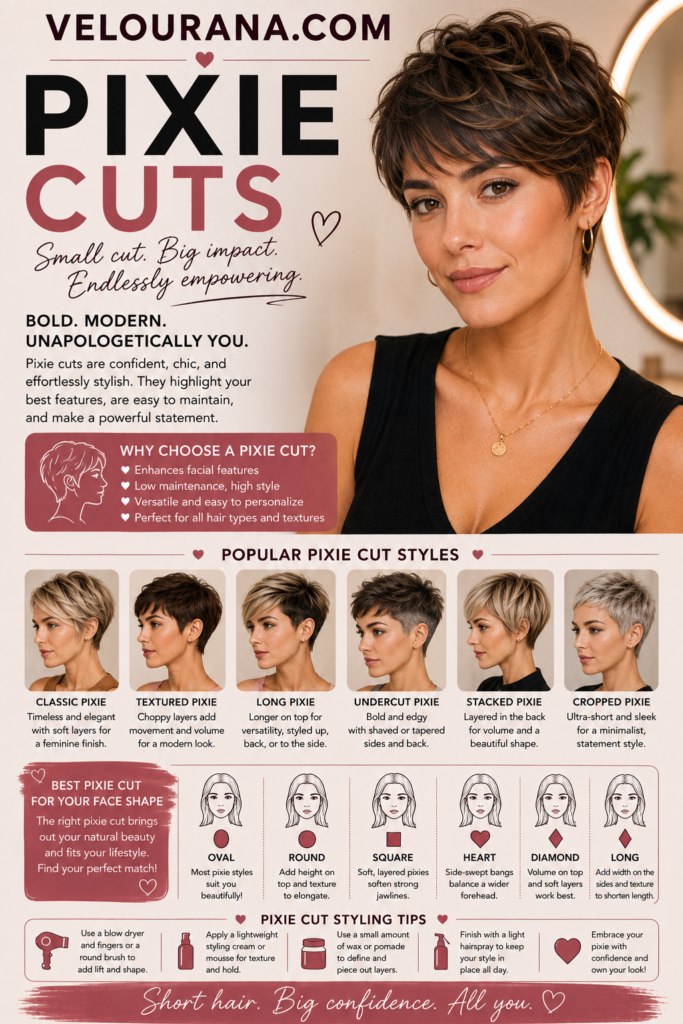
A textured pixie is one of the clearest examples of how a short haircut can contain enormous visual variety without relying on length. The hair may occupy only a small area around the head, yet differences of a few centimeters can determine whether the result feels soft, airy, tousled, polished, sculpted or deliberately undone.
Texture is what gives those differences visibility.
Instead of every strand lying together in one smooth surface, sections separate. Some lift from the crown. Others move across the forehead. Shorter pieces around the sides create definition, while longer pieces can bend, wave or sweep in another direction. The haircut becomes less about one continuous outline and more about the relationship between many small areas of movement.
This does not mean that a textured pixie should look chaotic.
The most successful versions have a clear underlying shape. The nape, sides, crown and fringe are connected deliberately, even when the finished styling appears effortless. Texture works because the structure underneath it is controlled.
That distinction matters.
Simply removing large amounts of hair or cutting numerous random short pieces does not automatically produce beautiful texture. It can leave the haircut uneven, difficult to control or unexpectedly sparse. Effective texture comes from understanding where the hair needs freedom and where it still needs enough weight to hold the silhouette together.
On fine hair, that may mean creating separation without removing too much density. On thick hair, it may mean redistributing weight so that the crown can move without the sides becoming bulky. Natural waves and curls can provide much of the texture themselves, while straight hair can reveal it through carefully placed differences in length and direction.
The result is a pixie that rarely looks exactly the same twice.
That variability is part of its character.
Texture Begins With the Structure of the Cut
Before styling products, drying techniques or deliberate tousling enter the picture, the haircut itself determines how much movement is possible.
If almost every section is kept at a similar short length, the hair tends to create a relatively uniform surface. It can still have natural texture, but there is less variation in the way different sections move.
Introduce differences in length and the behavior changes.
A slightly longer crown can lift above shorter sides. A longer fringe can sweep while the surrounding sections remain compact. Small variations through the upper layers can create separation rather than one solid mass.
These differences do not need to be dramatic.
On a pixie, even subtle changes are visible because the total length is limited.
The objective is to create enough variation for the hair to respond individually while preserving a coherent overall silhouette.
The Crown Is Often Where Texture Becomes Most Visible
The crown provides a natural area for movement because the hair grows away from the scalp in several directions.
Keeping some additional length here allows that movement to become part of the style.
Straight hair can develop lift and separation.
Waves may form more strongly after the weight of longer hair has been removed.
Curls can create compact areas of volume.
The crown can be styled upward for a more dramatic silhouette or allowed to settle into softer movement.
Natural growth patterns become especially important.
A crown that naturally spirals should not necessarily be forced to lie completely flat. The direction can instead become part of the texture.
This usually creates a haircut that is easier to reproduce because the hair is being encouraged to follow its own behavior rather than being constantly redirected.
The Fringe Controls Much of the Mood
A textured crown may provide volume, but the fringe is often what determines the immediate personality of the haircut.
Short irregular bangs can create a cropped, energetic appearance.
A longer fringe introduces softness and can be separated into individual pieces.
Side-swept sections create asymmetry.
A fringe directed forward can make the haircut feel more compact.
Because textured styling reveals individual strands, the front does not need to form one perfectly continuous line.
Small differences in length can contribute to the effect.
However, deliberate irregularity is different from accidental unevenness.
The fringe should still have an overall shape that relates to the rest of the haircut.
Fine Hair Needs Texture Without Excessive Removal
Fine hair can respond beautifully to a pixie because shortening the strands removes much of the weight that previously pulled them downward.
The crown may gain lift.
The hair can appear more active.
The absence of thin, long ends can make the overall style feel stronger.
But fine hair also demonstrates why texture should not automatically mean aggressive thinning.
If too much density is removed, the scalp may become more visible and the haircut can lose the fullness it was intended to create.
Texture can instead come from controlled differences in length.
Some pieces remain slightly longer.
Others are shortened enough to create movement.
The fringe can retain enough density to feel substantial.
The crown can be shaped to lift naturally.
The haircut becomes textured because the sections behave differently, not because large amounts of hair have been eliminated.
Thick Hair Can Create Dramatic Separation
Dense hair provides considerable material for a textured pixie.
The crown can carry substantial volume.
The fringe can remain full.
The sides can contain enough hair to create softness without appearing sparse.
Yet density also means that a poorly balanced short cut can become bulky very quickly.
Long hair may have used its own weight to pull thick strands downward. Once shortened, they can expand away from the scalp.
Texture should therefore be created strategically.
Reducing weight in selected areas can allow movement while preserving enough density to maintain the shape.
The sides may need to remain more controlled while the crown carries greater freedom.
The result should still communicate the natural richness of thick hair.
The goal is not to make dense hair behave as though it were fine.
Straight Hair Makes Every Piece Visible
Straight hair can display textured cutting with remarkable clarity.
Because the strands do not naturally curl into one another, individual sections can become easy to identify.
This can create a crisp, piece-like finish.
The haircut may appear almost smooth when left untouched, then become dramatically more textured when the sections are separated during styling.
This gives straight hair considerable flexibility.
A textured pixie does not have to look deliberately messy at all times.
It can be worn relatively sleek for a polished appearance and then transformed by changing the direction and separation of the strands.
The underlying haircut supports both versions.
Wavy Hair Often Creates Texture Without Much Assistance
Waves can become significantly stronger when hair is cut short.
A bend that was stretched almost straight at shoulder length may become obvious once the strand is only several centimeters long.
This can give a pixie natural separation.
The crown develops movement.
The fringe may curve without styling.
The sides can form soft irregular shapes.
Instead of trying to make every section behave identically, the haircut can use these differences.
One area may be nearly straight while another forms a strong wave.
The resulting variation can make the haircut more interesting.
A textured pixie does not require perfect repetition.
It often benefits from natural irregularity.
Curly Hair Turns Texture Into the Architecture
On curly hair, texture is not simply a finish added after cutting.
It becomes the structure itself.
The silhouette depends on where curls are allowed to retain length and where they are shortened.
Longer curls through the crown can create height.
Shorter sides can control width.
A curly fringe can introduce movement around the forehead.
The nape can taper into a cleaner finish.
The haircut should be evaluated according to the natural resting position of the curls.
Shrinkage can change the apparent length dramatically, particularly once the weight of longer hair disappears.
A curl that seems moderately long while stretched may become very compact after release.
The shape should therefore be developed with the finished texture in mind.
Texture Does Not Have to Mean Messy
The words “textured pixie” often bring to mind deliberately tousled hair, but texture can be much more refined.
A sleek pixie can still contain subtle separation.
A polished side-swept fringe may reveal several defined sections rather than one solid piece.
The crown can carry controlled volume without looking disordered.
Texture simply means that the hair contains visible dimension and movement.
How strongly that movement is emphasized determines the final character.
Someone who prefers a refined appearance can choose softer texture.
Someone who enjoys an intentionally undone style can exaggerate the separation.
The haircut does not need to choose permanently between the two.
Soft Texture Creates a More Relaxed Pixie
A softer version keeps the transitions relatively connected.
The crown may be longer than the sides, but the difference is gradual.
The fringe blends naturally into the surrounding hair.
The nape tapers rather than ending abruptly.
Individual pieces become visible mainly when the hair moves.
This can make the pixie feel approachable for someone moving from longer hair.
The silhouette is clearly short, but the edges do not feel severe.
Natural texture can further soften the result.
The haircut retains definition without becoming highly geometric.
Strong Texture Creates More Contrast
A more dramatic textured pixie allows the differences between sections to become obvious.
The crown may contain pronounced movement.
The fringe can break into distinct pieces.
The sides may be considerably shorter than the top.
Different directions can be emphasized deliberately.
This creates energy and visual contrast.
The style may change noticeably according to how the hair is arranged each morning.
A section pushed upward creates one silhouette.
The same section directed sideways creates another.
This flexibility is particularly attractive for someone who enjoys changing their hair frequently without changing the actual haircut.
The Sides Keep the Texture From Becoming Overwhelming
When the crown and fringe contain significant movement, the sides often provide visual balance.
Keeping them relatively compact prevents the entire haircut from expanding equally in every direction.
This creates a stronger silhouette.
The sides do not necessarily need to be extremely short.
Soft pieces can remain around the ears.
The important point is that their volume should relate deliberately to the upper section.
Fuller sides create a rounder shape.
Closer sides emphasize height and make the textured crown appear more dramatic.
A small difference in this area can change the proportions substantially.
The Nape Provides a Clean Ending
Texture through the crown does not require an equally textured nape.
A softly tapered back can provide a calm finishing point beneath the movement above it.
This contrast often makes the haircut appear more deliberate.
The upper sections have freedom.
The lower back establishes control.
Natural hairlines influence how this should be achieved.
Some napes grow neatly downward.
Others contain strong upward or sideways patterns.
A good short haircut works with those directions so that the finish remains attractive as it begins growing.
A Textured Pixie Can Make Natural Volume Easier to Use
Volume is sometimes treated as something that must either be created or suppressed.
A pixie offers another possibility: positioning it.
Someone with naturally voluminous hair may not need less volume everywhere.
They may simply need it concentrated in areas where it contributes positively to the silhouette.
The crown can carry height.
The fringe can carry movement.
The sides can remain more controlled.
This creates intentional proportion.
The haircut uses the natural abundance rather than trying to flatten the entire head.
Styling Can Be Surprisingly Minimal
A textured pixie may look complicated, but when the cut cooperates with natural growth and texture, everyday styling can be relatively simple.
The short length dries quickly.
Natural waves or curls may already create separation.
Straight hair may need only a small amount of direction through the crown and fringe.
The key is that the haircut provides the foundation.
Styling should reveal the structure rather than create it from nothing.
If enormous effort is required every morning simply to make the haircut resemble its intended shape, the structure may not be well matched to the natural hair.
Air-Drying Can Produce the Most Individual Version
Allowing a textured pixie to air-dry can reveal patterns that polished styling hides.
A wave may appear near the temple.
The crown may lift naturally in one direction.
The fringe may separate slightly.
A curl may fall differently each time.
These variations can give the haircut personality.
Someone who enjoys a highly controlled finish may prefer deliberate styling, but a softer textured pixie can benefit from this unpredictability.
The haircut remains recognizable while the details change naturally.
Blow-Drying Can Change the Direction of the Entire Style
Because the hair is short, redirecting the roots can have a dramatic effect.
Lift the crown and the silhouette becomes taller.
Dry the hair flatter and it becomes more compact.
Move the fringe toward one side and the haircut gains asymmetry.
Bring it forward and the style becomes more cropped.
These changes require far less time than comparable transformations on long hair because there is very little length to manipulate.
The small scale makes each directional choice more powerful.
Texture Can Help a Pixie Grow More Gracefully
Highly precise short haircuts can reveal growth quickly because their lines begin moving away from their intended positions.
A textured pixie can sometimes tolerate this evolution more naturally.
The crown becomes slightly longer and gains additional movement.
The fringe becomes softer.
The sides become fuller.
The haircut changes, but the irregular texture can disguise some of the transition.
Eventually the proportions still need adjustment if the goal is to maintain a pixie.
But the style may remain visually coherent for longer than a very rigid, closely defined crop.
Growing Toward a Bixie Can Feel Natural
If the wearer decides not to maintain the short length, a textured pixie already provides a useful foundation for growth.
The upper sections gain length.
The sides begin moving toward the ears.
The nape becomes fuller.
The fringe can sweep more dramatically as it grows.
Gradually the haircut moves into bixie territory.
Rather than trying to make every section reach the same length immediately, periodic shaping can preserve proportion while the overall haircut becomes longer.
The texture continues providing movement throughout the process.
Color Can Make Texture More Visible
Differences in tone can emphasize the separation between sections.
Highlights can make movement through the crown easier to see.
Variation in the fringe can draw attention to its direction.
Natural dimensional color may become more noticeable after long hair is removed because the visible sections are concentrated close to the head.
The effect can be subtle or dramatic depending on the color placement.
A textured haircut does not require color variation, but when both are present they can amplify one another.
Gray and Silver Hair Can Look Particularly Dimensional
Naturally gray hair often contains multiple tones rather than one uniform shade.
Some strands may be bright silver.
Others remain darker.
A textured pixie can make these differences highly visible because individual sections separate and catch the light differently.
Instead of attempting to hide variation, the haircut can allow it to become part of the visual texture.
The compact shape keeps the effect concentrated around the face and crown.
This can create considerable dimension without relying on long lengths.
Texture Should Reflect the Person's Actual Routine
A photograph of a highly styled pixie may involve careful drying, deliberate separation and finishing products.
Someone who enjoys that routine may find the process quick and satisfying.
Someone who wants to wash the hair and leave it alone needs a different version.
The natural texture should then provide more of the movement.
The haircut should follow the growth patterns rather than requiring them to be corrected.
Neither approach is superior.
The important thing is choosing the version that will exist successfully on ordinary mornings rather than only immediately after a salon appointment.
The Haircut Can Change From Day to Day
Long hairstyles often gain variety through braids, ponytails, buns and other arrangements.
A pixie creates variety differently.
The silhouette changes.
One day the crown can be lifted.
Another day it can lie flatter.
The fringe can move sideways, forward or away from the forehead.
The sides can be smooth or deliberately separated.
Natural texture can be emphasized or controlled.
These may sound like small adjustments, but on short hair they can transform the entire appearance.
The limited length magnifies every change in direction.
A Textured Pixie Should Still Have a Clear Silhouette
The freedom of textured hair should not erase the underlying design.
From a distance, the haircut should still have a recognizable overall shape.
Perhaps the crown carries most of the volume.
Perhaps the sides remain close.
Perhaps the fringe creates a strong diagonal.
Perhaps curls produce a rounded silhouette.
The individual pieces contribute interest within that larger structure.
Without it, texture can become visual noise.
With it, the haircut feels spontaneous while remaining intentional.
The Difference Between Texture and Randomness
Good texture has relationships.
The shorter sections support the longer ones.
The crown connects with the fringe.
The sides balance the upper volume.
The nape provides an ending.
Individual strands may appear irregular, but the overall distribution is deliberate.
Random cutting has no such logic.
It may remove density where it was needed and preserve bulk where it was not.
This is why a textured pixie requires as much structural thought as a sleek one, even when the finished result appears casual.
Short Hair Can Reveal Texture That Length Had Hidden
One of the most interesting outcomes of cutting hair short is discovering how it behaves without weight.
Someone who believed their hair was straight may discover bends.
Someone with loose waves may suddenly see stronger movement.
Curls may become tighter.
The crown may develop natural lift that was impossible at longer lengths.
This can make the first pixie an exploration as much as a haircut.
The texture revealed after the initial change may influence how the style evolves afterward.
A conservative approach allows the newly released movement to become visible before deciding whether additional shortening is necessary.
A Small Amount of Hair Can Create a Large Amount of Character
The textured pixie demonstrates that visual interest is not dependent on having a great deal of hair length.
A few centimeters at the crown can create volume.
A longer fringe can create movement across the entire front.
A small wave near the temple can soften the silhouette.
Several defined curls can determine the shape of the upper section.
Because the haircut is compact, every element becomes significant.
There is very little excess.
Each section contributes something to the whole.
When Texture Becomes the Personality of the Pixie
A textured pixie succeeds when the movement feels inseparable from the haircut itself.
The strands do not appear to have been disturbed simply for the sake of looking casual.
The crown lifts because the structure allows it.
The fringe separates because its length and direction support that movement.
Natural waves or curls occupy places where they improve the silhouette.
The sides and nape provide enough control to keep the entire shape coherent.
This creates a haircut that can look polished without becoming rigid and relaxed without becoming shapeless.
It can respond to natural texture instead of suppressing it. It can change according to styling without losing its identity. It can grow slightly and become softer rather than immediately appearing unfinished.
Most importantly, it demonstrates how expressive short hair can be.
A textured pixie may contain far less length than almost any other hairstyle, but the reduced scale does not reduce its possibilities.
It makes every piece matter more.
The End
Velourana.
 Discover More From Our Family of Websites
 ZodiacBearing (Astrology, Tarot, Numerology, Angel Numbers & Spiritual Guidance)
 Velourana (Beauty, Makeup, Hair Care, Skincare & Beauty Tips)
 HavenBearing (Home, Living, Organization, Décor & Everyday Inspiration)
 PawBearing (Pet Care, Dog Breeds, Animal Health, Training & Pet Products)
 PsyCatherine (Notes From the Journal of a Psychologist on Real Life)

