
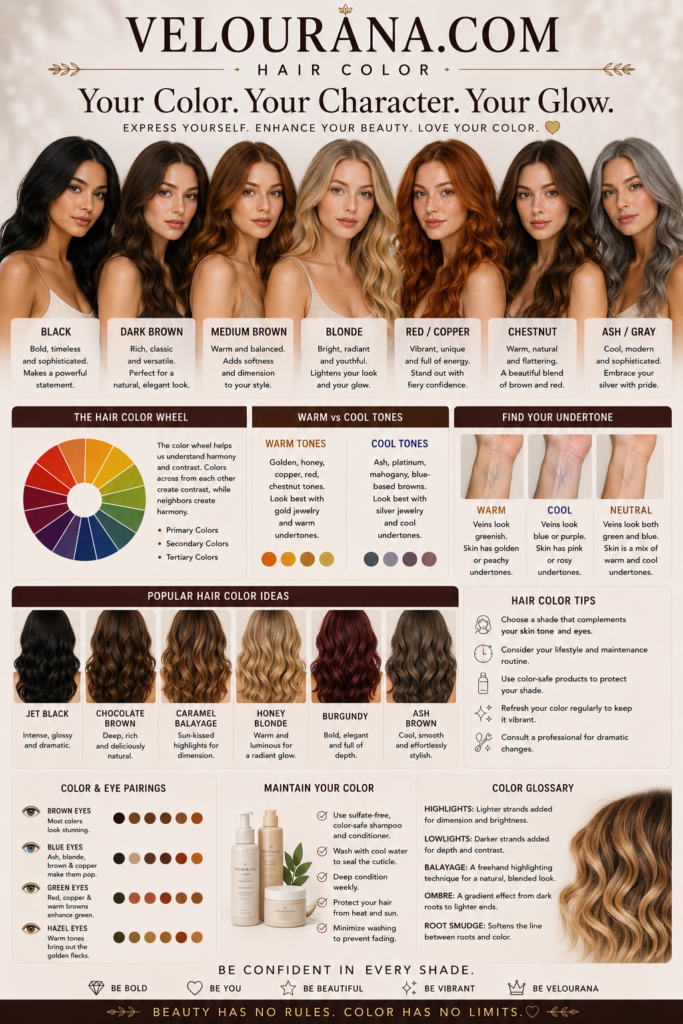
CATEGORY: Temporary Hair Color
There is a particular kind of confidence in choosing a hair color precisely because it will not last forever. Permanent color is often discussed through the language of transformation and commitment, while temporary color belongs to a more fluid philosophy. It allows hair to participate in a moment without requiring that moment to become an identity. A smoky violet can exist for a series of evenings. Copper can warm the hair for a season. Pink can appear across pale ends and gradually soften into almost nothing. A brunette can acquire a wine-colored reflection that becomes visible in sunlight and then quietly recedes through subsequent washes.
This impermanence does not make temporary color superficial. In many ways, it makes the relationship between color and appearance more interesting because the shade is expected to evolve. The freshly applied result is only the beginning. Pigment changes with washing, light, styling, and the underlying color of the hair. What begins as saturated may become translucent; what initially looks cool may reveal warmer undertones as it fades. Temporary color is therefore not a single visual event but a short color journey.
Understanding that journey requires looking beyond the simple promise of washability. Temporary color encompasses multiple cosmetic approaches, and their behavior can vary substantially. Some effects remain almost entirely on the surface and disappear rapidly. Others use direct pigments capable of remaining visible for several shampoos. Highly porous hair may hold onto certain shades much longer than expected. Temporary color offers flexibility, but intelligent use begins with understanding that flexibility rather than assuming absolute reversibility.
Color Without Lightening: The Principle That Defines the Result
Perhaps the most important principle in temporary hair color is also the one most likely to prevent disappointment: depositing pigment is not the same as lightening hair.
Hair appears dark because of the amount and distribution of pigment within the fiber. Creating a substantially lighter foundation generally requires a process capable of reducing that pigment. A temporary deposit-only product does not normally perform this function. It places color onto or near the existing surface, which means the original depth continues to influence everything visible above it.
This explains why photographs of vivid temporary shades can be misleading when the starting base is ignored. Electric pink over pale blonde and electric pink over dark brown are not two versions of the same result. On the blonde base, the pink pigment can dominate visually. On dark brown, the underlying depth may overwhelm most of the pink, leaving only a subtle red-violet reflection in favorable lighting.
The same principle applies to pastels. Pale peach, baby blue, lavender, mint, and delicate rose require enough lightness beneath them to remain visible. A pastel pigment cannot make dark hair pastel simply by being applied more heavily. Increasing the quantity may intensify surface deposit, but it does not remove the dark natural pigment beneath it.
This limitation is not a weakness of temporary color. It is simply part of the medium. In fact, some of the most sophisticated temporary effects on brunette hair depend precisely on this translucency. Burgundy over brown can create a rich dimensional reflection rather than a flat block of red. Deep violet over dark hair may emerge only where light catches the surface. Copper can amplify existing warmth without making the hair appear artificially bright.
Temporary color becomes more successful when the existing base is treated as one of the colors in the composition rather than as an obstacle that the product is expected to erase.
When Hair Becomes the Canvas
The metaphor of hair as a canvas is useful only when the canvas itself is acknowledged. Hair is not a uniform white surface waiting for pigment. It has depth, undertone, texture, porosity, previous color, and physical damage patterns, all of which influence the final appearance.
Natural blonde hair may contain substantial gold or yellow. A cool temporary shade interacts with that warmth. Blue layered over yellow can shift toward green; violet can reduce the visual impression of yellow before becoming strongly violet itself. A warm pink may become peachier, while copper can merge naturally with the existing golden foundation.
Previously lightened blonde hair introduces another variable because the hair may no longer have uniform porosity. Highlights, old balayage, overlapping bleach applications, and weathered ends can each accept pigment differently. A temporary fashion shade applied across this varied surface can create beautiful multidimensional color, but it may also reveal every difference in the underlying hair.
Brunette hair offers a different canvas. Because the background is deeper, saturated pigments generally work more visibly than pale ones. Reds, wines, aubergines, coppers, and deep jewel-like tones can interact with brown to produce complex reflections. The effect may change dramatically between indoor and outdoor environments because direct light reveals colored reflections that diffuse interior lighting suppresses.
Gray and white hair can function almost like naturally lightened sections, but their behavior is not always predictable. Some gray fibers possess a resistant cuticle and accept temporary pigment reluctantly. Others are porous enough to become strongly stained. Mixed gray hair can therefore produce a naturally dimensional effect because pigmented and non-pigmented strands respond differently.
Even texture changes the canvas. A single temporary shade can look substantially different on sleek straight hair and densely curled hair. Straight surfaces create longer reflective planes, while curls repeatedly interrupt and redirect light. Coils create small regions of brightness and shadow, making color appear to move through the pattern.
Temporary coloring becomes visually richer when these characteristics are incorporated into the intention rather than treated as inconsistencies to be eliminated.
The Emotional Appeal of a Color That Can Leave
Permanent hair color often carries an unusual psychological weight. A person may like a shade but hesitate because they immediately imagine regrowth, maintenance, correction, expense, fading, and the difficulty of returning to the previous color. Temporary color changes the emotional calculation because it reduces the sense that every experiment must become a project.
This can encourage choices that would otherwise feel too dramatic. Someone who has worn neutral brunette for years may be willing to experience a plum reflection if it is expected to fade. A blonde who would never permanently commit to pink may enjoy several washes of rose. Someone curious about copper can explore additional warmth before deciding whether a more enduring transformation feels appropriate.
The experience can also challenge assumptions about what is flattering. People often develop rigid ideas about their own appearance: cool colors do not suit me, red is too strong, dark hair is more serious, bright colors are too youthful, or unconventional shades belong to a particular style. A reversible change provides an opportunity to test these beliefs visually rather than accepting them as rules.
Sometimes the experiment confirms the original preference. Sometimes it reveals an unexpected possibility. Either outcome has value because the temporary color has provided information without requiring a major correction afterward.
There is also an important distinction between experimenting with a shade and previewing a permanent service. Temporary color can demonstrate the emotional and aesthetic effect of a color family, but it cannot always reproduce the exact appearance of a permanent transformation. If permanent coloring would require lifting the natural base, the final result may have different brightness, undertones, dimension, and maintenance requirements.
Temporary pigment is therefore best treated as an exploration rather than a guarantee. It allows someone to experience a direction in color while preserving the freedom to reconsider it.
The First Day Is Not the Whole Color Story
A newly applied temporary shade can be unusually saturated. Pigment may sit densely across the surface, making the first result feel stronger, darker, brighter, or less nuanced than expected. Judging the entire experience from this initial stage ignores one of the defining qualities of temporary color: it is designed to move.
After cleansing begins, excess and loosely attached pigment gradually leave the hair. The shade becomes more translucent, and the underlying base begins to show through more strongly. This can create softness and dimension that were not visible immediately after application.
For certain colors, the intermediate stages are particularly beautiful. A strong rose may become dusty pink. Deep copper can soften toward warm gold. Violet can become a muted lilac on a sufficiently pale base. Burgundy may transition through softer red or berry tones. These changes depend on the formulation and foundation, so they cannot be predicted universally, but they demonstrate why temporary color should be considered across its entire lifespan.
Not every fade is perfectly graceful. Different dye components can disappear at different speeds, producing tonal shifts. Porous ends may remain colored while healthier roots fade more quickly. Previously highlighted areas can retain pigment after the surrounding hair has largely returned to its original appearance.
This is particularly important when using highly saturated cool colors on very pale, porous hair. Blue and green residual tones can sometimes be stubborn, while certain pinks and reds can leave warmth behind. The possibility of staining increases when the hair has been heavily lightened or structurally compromised.
The language of temporary color can create the expectation of a simple before-and-after sequence: natural hair, temporary shade, natural hair again. Reality can be more gradual. Between those points may be several distinct versions of the color, each shaped by the remaining pigment and the re-emerging foundation.
Rather than seeing this progression as an inconvenience, it can be incorporated into the aesthetic intention. A temporary shade can be chosen partly for the way it is expected to soften, not merely for its first-day intensity.
Surface Condition, Shine, and the Perception of Color
Hair color is inseparable from light. Two strands containing similar pigment can look very different when one has a smooth reflective surface and the other is rough, dry, or heavily weathered. Temporary color makes this relationship especially visible because much of its effect occurs close to the cuticle.
A smooth surface tends to reflect light more coherently, which can make color appear richer and more luminous. Roughness scatters reflection, potentially making even an attractive shade appear dull. This is one reason conditioning temporary color formulas can create a noticeable cosmetic improvement beyond the pigment itself. By improving slip and surface feel, they may contribute to a more polished visual finish.
The reverse is also important. A temporary color product cannot repair serious structural damage simply because the hair looks glossy after application. Cosmetic conditioning can reduce friction, improve manageability, and create temporary smoothness, but previously damaged hair remains previously damaged. The distinction matters because the appearance of health and the structural condition of the fiber are related without being identical.
Temporary color can actually make the condition of hair easier to notice. Porous areas may darken more strongly. Dry ends may absorb additional pigment. Rough regions may reflect the shade differently. Instead of producing one uniform veil, color can expose variations that were less visible when the hair remained closer to its natural tone.
Preparation therefore has aesthetic consequences. Hair carrying heavy styling residue, oils, minerals, or uneven product buildup may not accept a deposit uniformly. At the same time, aggressively clarifying already fragile hair immediately before coloring can alter its feel and porosity. Successful temporary color depends on balance rather than maximum cleansing or maximum conditioning.
The healthiest-looking result usually comes from respecting the existing condition of the fiber. Color can enhance the hair that is present; it cannot make structural history disappear.
Temporary Color as Part of Modern Hair Design
Temporary color becomes especially interesting when it is considered alongside haircut, texture, and styling rather than as a separate layer applied uniformly across the head.
Placement can completely change the character of a shade. Color concentrated around the face draws attention toward the eyes and complexion. Pigment placed on the ends emphasizes length and movement. Selected sections beneath the upper layers may remain discreet when the hair is still and become visible when it moves. Temporary color across curls can emphasize the geometry of the curl pattern, particularly when lighter areas and pigmented sections interact.
This creates possibilities beyond the conventional full-head transformation. Color can function almost architecturally, emphasizing the structure already created by the cut. A temporary pigment can make layers more visible, strengthen contrast between sections, or create the impression of additional dimension without requiring every strand to carry the same intensity.
The effect is especially compelling when temporary color is used on hair that already contains highlights or balayage. Lighter pieces become receptive areas for stronger pigment, while the darker base remains comparatively subdued. A single deposited shade can therefore produce several apparent tones because each underlying level modifies it differently.
This is one of the reasons temporary color can appear unexpectedly sophisticated. The product may contain one principal color direction, but the hair itself creates variation. Lightness, porosity, texture, and placement collaborate to produce a result that changes across the head.
Temporary color can also alter styling choices. A hidden section becomes visible when hair is tied up. Colored ends become more prominent in braids. A vivid face frame changes the visual balance of a ponytail. Curls separate colored surfaces into individual points of movement. The shade is therefore not static; its visibility depends partly on how the hair is arranged.
Color and style become part of the same composition.
When Temporary Does Not Mean Consequence-Free
The reassuring language surrounding temporary color can sometimes obscure the need for caution. A non-permanent product may represent a lower level of commitment, but it is still a cosmetic formulation being applied to hair and often to areas close to the skin.
Manufacturer instructions remain important because formulations differ. A product designed for hair should be used according to its intended application, and required allergy precautions or patch testing should not be dismissed simply because the color is described as temporary. Previous uneventful use of hair color does not guarantee that sensitivity cannot occur later.
The physical environment also matters. Highly pigmented temporary colors can transfer to towels, pillowcases, clothing, bathroom surfaces, or skin, particularly while the hair is damp or during the first stages after application. Strong fashion pigments can be visually spectacular precisely because they contain enough colorant to create intense deposit, and that intensity may have practical consequences outside the hair itself.
Porous hair deserves particular caution because removal may not follow the expected schedule. Someone who must return to a completely neutral hair color for work, an event, photography, or another chemical service should not assume that a vivid temporary shade will disappear on a precise date. A strand test offers far more useful information than the category name alone.
Future color plans should also be considered. Residual direct pigment can complicate later lightening or color correction because remaining artificial tones may behave unpredictably when exposed to other chemical processes. A temporary experiment made shortly before a major salon transformation can therefore influence what is technically possible afterward.
None of these realities undermine the value of temporary color. They simply replace the unrealistic idea of consequence-free coloring with a more accurate concept: lower commitment combined with informed experimentation.
The Luxury of Not Choosing Forever
Beauty culture often treats permanence as evidence of seriousness. A permanent transformation seems more decisive than a temporary one, as though commitment gives a color greater legitimacy. Temporary hair color suggests another possibility: a choice can be meaningful precisely because it is allowed to end.
There is freedom in wearing a shade without needing to build an identity around it. Hair can be burgundy during one period and neutral later. Blonde can carry a lavender veil for several washes without becoming permanently lavender. Gray hair can be given a cool blue cast simply because the effect is interesting. A temporary copper can make autumn light feel warmer without becoming a year-long maintenance obligation.
This approach reflects a broader understanding of personal style. People are rarely visually static. Clothing changes, makeup changes, seasons change, preferences change, and the way someone wants to present themselves can change as well. Temporary hair color allows hair to participate in that movement.
Its sophistication lies not in pretending to offer everything permanent color can achieve, but in embracing what permanent color cannot offer as easily: reversibility, experimentation, short-lived intensity, and the freedom to allow a look to exist without preserving it indefinitely.
The best temporary color experience begins with understanding the existing hair. Its depth determines which pigments can become visible. Its undertone influences how those pigments are perceived. Its porosity affects both intensity and fading. Its texture shapes the way color moves through light. Its history determines how predictably the pigment may leave.
Once these factors are respected, temporary color stops looking like a lesser category of hair dye. It becomes its own form of color design.
A shade does not have to last for months to transform an appearance. It may only need to last long enough to create a new relationship between the hair, the face, and the person looking back from the mirror. The ability to return, change again, or choose something entirely different is not a compromise. It is the defining beauty of temporary hair color.
The End Velourana
 Discover More From Our Family of Websites
 ZodiacBearing (Astrology, Tarot, Numerology, Angel Numbers & Spiritual Guidance)
 Velourana (Beauty, Makeup, Hair Care, Skincare & Beauty Tips)
 HavenBearing (Home, Living, Organization, Décor & Everyday Inspiration)
 PawBearing (Pet Care, Dog Breeds, Animal Health, Training & Pet Products)
 PsyCatherine (Notes From the Journal of a Psychologist on Real Life)

