
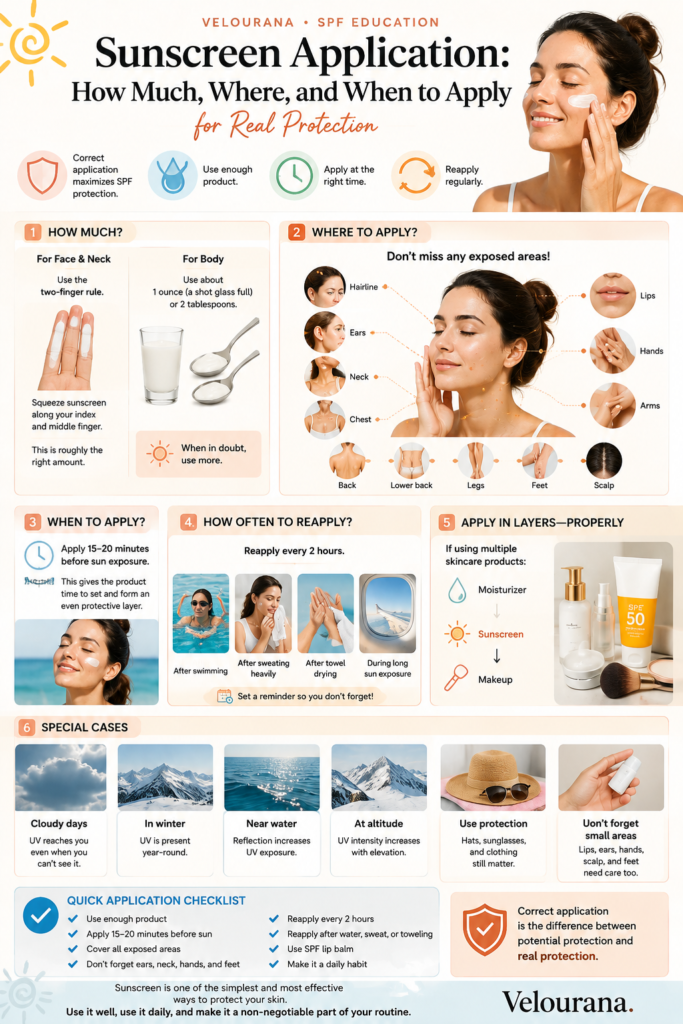
CATEGORY: Sunscreen Application
Applying sunscreen correctly in the morning is an important part of sun protection, but it is not always the end of the process.
Sunscreen exists as a protective film on the surface of the skin. During the day, that film can be affected by water, perspiration, towels, clothing, touching, washing, and ordinary movement. When exposure continues after the protective layer has been disturbed, reapplication becomes important.
This is particularly relevant during beach days, outdoor sports, swimming, hiking, gardening, sightseeing, and other activities involving prolonged exposure.
The subject can become confusing because people sometimes interpret sunscreen reapplication as an inflexible rule that requires everyone to cover themselves with sunscreen repeatedly regardless of what they are doing.
Real life is more practical than that.
Reapplication should take into account the sunscreen's directions, the amount of UV exposure, the activities performed, and what has happened to the sunscreen since it was originally applied.
What Reapplication Actually Means
Reapplication means restoring sunscreen coverage after the original layer has been reduced, disturbed, or exposed for a prolonged period.
It is not about stacking SPF numbers.
Applying SPF 50 again does not transform it into SPF 100.
The objective is to restore an adequate protective film.
Why the Morning Application May Not Last All Day
Think about everything that can happen to your skin during an ordinary day.
You touch your face.
You wash your hands.
You wipe your mouth.
You change clothing.
You perspire.
You wear sunglasses.
You use a phone.
During outdoor activities, the disruption can become much greater.
You swim.
You dry yourself with a towel.
You sweat heavily.
You wipe your forehead.
You lie on a beach towel.
Sunscreen is not permanently attached to the skin.
SPF Does Not Measure How Long Sunscreen Stays on the Skin
This distinction is essential.
SPF describes tested UVB protection.
It should not be interpreted as a measure of physical durability.
SPF 50 does not automatically remain on the skin longer than SPF 30.
SPF 100 does not mean the product lasts twice as long as SPF 50.
Follow the Sunscreen's Directions
The product label should be your primary guide for reapplication.
Sunscreens may provide specific instructions regarding timing, swimming, perspiration, and water resistance.
Follow those instructions rather than inventing a schedule based solely on the SPF number.
The Common Two-Hour Guidance
During continued outdoor exposure, sunscreen is commonly recommended for reapplication approximately every two hours.
However, this should not be misunderstood as meaning that nothing can affect sunscreen before those two hours have passed.
Swimming, toweling, heavy perspiration, or rubbing can require earlier attention.
Product-specific instructions remain important.
Reapplication After Swimming
Swimming is one of the clearest situations in which sunscreen needs additional attention.
Water exposure can affect the sunscreen layer.
Even products designed to resist water are tested for specific periods rather than unlimited immersion.
After swimming, follow the product's reapplication instructions.
Water-Resistant Does Not Mean Waterproof
The term water-resistant has a specific purpose.
It indicates that the sunscreen has demonstrated protection during a defined period of water exposure under standardized testing.
It does not mean the sunscreen becomes permanently bonded to the skin.
There is no sunscreen that should be interpreted as requiring no attention after unlimited swimming.
Check the Water-Resistance Label
Depending on the market, sunscreen may state the period for which water resistance has been demonstrated.
This information is especially useful when choosing sunscreen for swimming, water sports, or heavy exercise.
Reapply After Towel Drying
Towel drying creates physical friction.
The towel can remove sunscreen from the skin.
This means that even if the sunscreen tolerated the water well, the act of drying yourself may disturb the protective layer.
Restore protection before returning to prolonged exposure.
Do Not Wait for the Skin to Feel Unprotected
You cannot reliably feel when sunscreen protection has declined.
The skin may still feel moisturized.
It may still look slightly shiny.
It may still smell like sunscreen.
None of these observations proves that the original protective film remains uniform.
Reapplication After Heavy Perspiration
Exercise and hot weather can produce substantial perspiration.
Sweat can affect sunscreen.
Wiping sweat away creates additional friction.
If you are exercising outdoors for an extended period, choose a suitable water-resistant sunscreen and follow its reapplication directions.
Runners Should Carry Sunscreen on Long Sessions
A short morning run is different from a marathon, long-distance training session, or several hours of trail running.
For prolonged activity, portable sunscreen becomes useful.
A small tube or stick can make reapplication easier.
Cyclists Face Prolonged Exposure
Cyclists can spend several hours outdoors while wind keeps the skin feeling cool.
The face, neck, ears, arms, hands, and legs may receive sustained exposure.
Carry sunscreen during long rides.
Hiking Requires a Reapplication Plan
Hiking can combine prolonged sunlight, altitude, perspiration, and limited shade.
Sunscreen buried at the bottom of a backpack is unlikely to be reapplied.
Keep it accessible.
Reapplication During Skiing
Skiing creates a different but important exposure environment.
Altitude can increase UV exposure.
Snow reflects UV.
Cold temperatures can disguise the intensity of sunlight.
Carry a facial sunscreen or stick that can be reapplied conveniently.
Reapply Lip SPF Frequently
Lip products are removed easily.
Eating.
Drinking.
Licking the lips.
Wiping the mouth.
Swimming.
These activities can reduce coverage.
Keep an SPF lip product accessible.
Hands Require Their Own Reapplication Routine
Hand washing can remove sunscreen.
If you are spending significant time outdoors, reapply sunscreen to the backs of the hands after washing as appropriate.
Driving and Hand Protection
Hands can receive repeated exposure while driving.
If you wash them during a long journey, consider restoring sunscreen before continuing.
Face Washing Removes Sunscreen
If you wash your face during the day, the morning sunscreen should no longer be assumed to remain intact.
If further UV exposure is expected, apply sunscreen again.
Showering Removes the Previous Application
After showering during the day, sunscreen needs to be reapplied before returning to significant outdoor exposure.
Clothing Can Rub Sunscreen Away
Straps, collars, sleeves, bags, and shoes can create friction.
This is particularly relevant during hiking and sport.
Pay attention to areas where clothing repeatedly moves against exposed skin.
Backpack Straps Can Disturb Shoulder Coverage
A backpack can rub sunscreen from the shoulders and upper arms.
If clothing does not cover those areas, check protection during prolonged outdoor activity.
Sand Can Disturb Sunscreen
Beach sand sticks to sunscreen.
Brushing it away can remove some of the protective layer.
If you repeatedly rub sand from the skin, reapplication may be necessary.
Reapplication at the Beach
A beach day is one of the most demanding sunscreen situations.
A practical routine is straightforward.
Apply sunscreen thoroughly before significant exposure according to the product directions.
Use a suitable water-resistant formula.
Swim.
Dry yourself.
Reapply as directed.
Use shade and clothing between periods of exposure.
Do Not Depend on One Morning Beach Application
A sunscreen applied at breakfast should not automatically be expected to provide unchanged protection through hours of swimming, sweating, toweling, and afternoon sunlight.
Take the sunscreen with you.
Bring Enough Sunscreen
Reapplication requires product.
A tiny bottle may be insufficient for several people spending an entire day outdoors.
Plan accordingly.
Family Beach Days Require More Product
When sunscreen is shared among several adults and children, a bottle can empty quickly.
That is normal when large exposed areas are covered properly.
Bring enough rather than rationing application.
Reapplication at the Pool
Pool days create the same basic issues.
Water exposure.
Towels.
Long periods outside.
Use water-resistant sunscreen and follow the instructions for reapplication.
Reapplication During Water Sports
Surfing, paddleboarding, kayaking, sailing, and similar activities can involve substantial exposure.
Water reflection and long periods outside increase the importance of comprehensive protection.
Protective clothing can be especially valuable.
UPF Clothing Reduces Reapplication Work
One of the easiest ways to simplify sun protection is to cover more skin.
UPF shirts and other protective garments can reduce the areas requiring sunscreen.
This can be particularly useful during water sports and long outdoor activities.
Hats Reduce Dependence on Facial Reapplication
A broad-brimmed hat provides physical shade to the face, ears, scalp, and neck.
It does not eliminate the usefulness of sunscreen, but it adds another protective layer.
Sunglasses Protect the Eyes
Sunscreen reapplication should not distract from eye protection.
Wear appropriate UV-protective sunglasses during significant exposure.
Reapplication During an Ordinary Office Day
Suppose you apply sunscreen correctly in the morning, commute to work, spend most of the day away from direct sunlight, and return home later.
This situation is very different from spending eight hours on a beach.
Reapplication needs should reflect actual exposure.
If you are going outside for significant afternoon exposure, refreshing sunscreen beforehand can be sensible.
Reapplication Before an Outdoor Lunch
If several hours have passed since the morning application and you are about to spend an extended lunch outdoors, consider refreshing your sunscreen.
This is especially relevant under strong UV conditions.
Reapplication Before the Commute Home
A person leaving work while UV levels remain significant may benefit from reapplication before going outside.
This can be particularly useful if the original sunscreen layer has been disturbed during the day.
Use the UV Index as Context
The UV Index helps provide environmental context.
Reapplication during a long outdoor period under high UV conditions deserves more attention than reapplication shortly before sunset when UV levels are minimal.
Reapplication Does Not Need to Become Obsessive
Sensible sun protection is the objective.
You do not need to panic because exactly two hours have passed while you have been sitting in an interior office.
Consider exposure and activity.
Continuous Outdoor Exposure Is Different
If you are outdoors continuously, particularly under substantial UV, regular reapplication becomes much more important.
Follow public-health guidance and the sunscreen's directions.
Reapplying Sunscreen Over Makeup
This is one of the biggest practical challenges.
A morning sunscreen can be applied easily beneath makeup.
Repeating the same application over foundation, blush, bronzer, and powder is more difficult.
The solution depends on your priorities and exposure.
Fluid Sunscreen Over Makeup
Some lightweight sunscreens can be reapplied carefully over makeup.
Instead of rubbing aggressively, small amounts can be pressed onto the skin.
The cosmetic result varies according to the sunscreen and makeup.
Sunscreen Sticks Over Makeup
Sticks can make reapplication convenient.
However, they need adequate application.
One quick swipe is unlikely to provide complete coverage.
Repeated passes may be necessary according to the product directions.
Be Careful About Makeup Transfer Onto the Stick
Dragging a stick directly across foundation can transfer makeup onto its surface.
Clean the stick according to appropriate product hygiene practices if necessary.
Cushion Sunscreens
Cushion formats can make facial reapplication cosmetically convenient.
They allow product to be pressed over makeup.
As with every format, sufficient quantity and complete coverage remain important.
Sunscreen Sprays Over Makeup
Facial sunscreen sprays can provide convenience.
Use only products designed for appropriate facial application.
Follow directions carefully.
Avoid inhaling the spray or spraying directly into the eyes.
Powder SPF Over Makeup
Powder sunscreen is appealing because it can be applied without disturbing foundation significantly.
The limitation is quantity.
Achieving enough powder to reproduce the labeled SPF may be difficult.
For this reason, powders are often better considered supplementary rather than the sole method of reapplication during intense exposure.
Makeup With SPF Can Contribute Protection
Foundation and powder containing SPF can add another protective layer.
But they should not be used to mathematically increase the sunscreen SPF.
SPF values do not add together.
SPF 50 Plus SPF 30 Does Not Equal SPF 80
This remains true during reapplication.
Layering different SPF products does not create an additive SPF rating.
The purpose of reapplication is restoring coverage.
Reapplying the Same Sunscreen Is Simple
When practical, using the same sunscreen again removes unnecessary complexity.
You already know how the formula behaves.
You know whether it irritates your skin.
You know how it spreads.
You Can Use a Different Sunscreen for Reapplication
There is no requirement that the second application must always be the exact same product.
A facial cream may be convenient in the morning while a portable stick is easier during outdoor activity.
Both should provide appropriate protection and be used correctly.
Do Not Mix the Products Together
Layering one sunscreen over another is different from mixing them in your hand.
Avoid creating homemade sunscreen mixtures.
Use products as formulated.
Reapplication for Oily Skin
Oily skin can become shiny during the day.
Adding another layer of rich sunscreen may feel uncomfortable.
A lightweight fluid, gel, or suitable reapplication format can help.
Do not deliberately use an inadequate quantity solely to avoid shine.
Blotting Before Reapplication
If the skin is extremely oily or sweaty, gently blotting excess moisture before applying more sunscreen can improve comfort.
Avoid aggressive rubbing.
Then restore protection.
Reapplication for Dry Skin
Dry skin may tolerate repeated sunscreen application easily, particularly with moisturizing formulas.
If the skin begins feeling tight, a hydrating sunscreen can provide both comfort and protection.
Reapplication for Sensitive Skin
Repeated application can irritate highly sensitive skin if the formula itself is unsuitable.
Choose a well-tolerated sunscreen.
If persistent irritation occurs, consult a dermatologist rather than abandoning sun protection.
Reapplication for Acne-Prone Skin
Acne-prone skin may prefer lightweight formulas for repeated application.
Heavy buildup can feel uncomfortable.
The solution is an appropriate formulation rather than skipping necessary protection.
Reapplication for Deeper Skin Tones
White cast can become more noticeable with repeated applications.
Transparent or tinted formulations can make reapplication more cosmetically acceptable.
Tinted Sunscreen and Reapplication
Tinted sunscreen can be reapplied, but repeated layers may deepen the cosmetic color.
If this becomes problematic, consider a transparent sunscreen for later applications.
Reapplication Around the Eyes
Use care around the eye area.
Perspiration can cause some sunscreens to migrate into the eyes.
A suitable sunscreen stick may work well for some people around this area.
Sunglasses add additional protection.
Reapplication Around Facial Hair
Beards and moustaches can make even application difficult.
Concentrate on exposed skin and areas with sparse hair.
Physical protection can complement sunscreen where direct application is impractical.
Reapplication on the Scalp
An exposed scalp can receive substantial UV.
Sunscreen sprays, sticks, or suitable lotions may be used according to product directions.
A hat is often the easiest protective option.
Reapplication to the Ears
Ears are easily forgotten during the first application and even more easily forgotten during reapplication.
Include them deliberately.
Reapplication to the Neck
Do not reapply only to the face.
If the neck remains exposed, restore protection there too.
Reapplication to the Chest
Low necklines expose the upper chest.
Include this area when refreshing sunscreen.
Reapplication to the Feet
At the beach or pool, sunscreen on the feet can be removed by water, sand, towels, and footwear.
Reapply when appropriate.
Reapplication Around Sandals
Sandal straps create friction and can move during walking.
Check exposed skin around the straps.
Reapplication During Sightseeing
Travelers can spend entire days walking outdoors without realizing how much exposure they are receiving.
Carry portable sunscreen.
Reapply during the day according to exposure.
A hat can make sightseeing considerably easier from a sun-protection perspective.
Reapplication During Outdoor Dining
If you spend several hours at an outdoor restaurant or café, shade is valuable.
If direct sunlight remains significant, refresh sunscreen as needed.
Reapplication While Gardening
Gardening can easily extend beyond the planned duration.
If the morning turns into several hours outdoors, reapply sunscreen.
Remember the neck, hands, ears, and forearms.
Reapplication During Outdoor Work
Outdoor workers need a routine that can function during a working day.
Sunscreen should be accessible.
Protective clothing should be used where practical.
Scheduled breaks can provide opportunities to restore protection.
Reapplication During Sports Competitions
Competition can make sunscreen easy to forget.
Apply thoroughly before the event.
Carry a portable product.
Use breaks or intervals for reapplication when practical.
Reapplication for Children
Children may swim repeatedly, dry themselves, play in sand, and perspire heavily.
Parents and caregivers should follow age-appropriate public-health guidance and sunscreen instructions carefully.
Protective clothing and shade can simplify the routine.
Rash Guards Are Particularly Useful for Children
A suitable swim shirt can cover a large portion of the torso and shoulders.
This reduces the surface area requiring repeated sunscreen application.
Do Not Forget Children's Ears
Ears are frequently missed.
Hats can provide additional protection.
Reapply Children's Sunscreen After Water Exposure
Follow the product directions.
Do not assume a water-resistant children's sunscreen lasts through an entire day of swimming.
Reapplication and Photosensitive Medications
Some medications can increase sensitivity to sunlight.
People using them may require particularly careful protection.
Follow healthcare advice and medication instructions.
Reapplication After Dermatological Procedures
Certain procedures can make the skin more vulnerable to sunlight.
Follow the aftercare instructions provided by the treating professional.
These may include strict sunscreen and physical protection requirements.
Reapplication and Hyperpigmentation
People managing hyperpigmentation may place particular importance on maintaining broad-spectrum protection throughout periods of exposure.
UVA protection should be considered alongside SPF.
Reapplication and Melasma
Melasma management often requires careful photoprotection.
A dermatologist may recommend high broad-spectrum protection, tinted sunscreen, physical shade, or other measures.
Reapplication and Photoaging
Cumulative UV exposure contributes to photoaging.
Consistent sunscreen use helps reduce this exposure.
For people spending significant time outdoors, reapplication is part of maintaining that protection.
Sunscreen Cannot Protect Skin Where It Has Been Removed
This is perhaps the simplest reason to reapply.
If sunscreen has been washed, wiped, or rubbed away, the SPF number printed on the bottle cannot protect the exposed area.
The protective material needs to be present on the skin.
Higher SPF Does Not Change This
SPF 50 cannot protect an area where the sunscreen has been completely removed.
SPF 100 cannot either.
Physical presence matters.
Reapplication Does Not Repair Previous Exposure
Applying sunscreen at midday cannot undo excessive UV exposure received during the morning.
Reapplication protects against subsequent exposure.
This is why the first application remains important.
Do Not Wait Until You Burn
Sunburn is evidence that excessive UV exposure has already occurred.
Reapply proactively rather than waiting for redness.
Sunscreen Does Not Replace Shade
Reapplication should be combined with sensible exposure management.
Move into shade when possible.
This reduces the amount of UV reaching the skin.
Sunscreen Does Not Replace Clothing
Protective clothing can provide continuous coverage.
It is particularly valuable when frequent sunscreen reapplication would be difficult.
Sunscreen Does Not Replace Hats
A broad-brimmed hat provides shade to several difficult-to-protect areas.
Use it alongside sunscreen.
Sunscreen Does Not Replace Sunglasses
Protect the eyes as well as the skin.
Do Not Use Reapplication as Permission to Extend Exposure
Repeated sunscreen application does not make unlimited intentional sun exposure safe.
The purpose is to maintain protection during necessary or enjoyable outdoor activity, not to create permission for excessive UV exposure.
Reapplication and Tanning
Sunscreen does not make deliberate tanning risk-free.
If cosmetic color is desired, self-tanning products provide an alternative that does not require intentional UV tanning.
Reapplication on Cloudy Days
Clouds do not necessarily eliminate UV exposure.
If you are outside for an extended period and UV levels remain significant, reapplication may still be appropriate.
Reapplication in Winter
Cold temperatures do not prevent UV exposure.
During skiing and other mountain activities, reapplication can be particularly important.
Reapplication at Altitude
Higher altitude can increase UV exposure.
Hikers, climbers, and skiers should carry sunscreen and use physical protection.
Reapplication Near Water
Reflection from water can contribute to exposure.
Boating, fishing, and waterside activities often involve long periods outside.
Maintain protection.
Wind Can Make You Forget
Wind cools the skin.
This can make strong sunlight feel comfortable.
Do not use skin temperature as an indicator of UV intensity.
Set Practical Reminders During Long Outdoor Days
If you routinely forget sunscreen during long outdoor activities, a phone reminder can be useful.
This is particularly practical at the beach or during hiking.
The reminder should complement rather than replace attention to swimming, toweling, and other events that may require earlier reapplication.
Keep Sunscreen Where You Can Reach It
Accessibility influences behavior.
Keep sunscreen in your beach bag.
Your hiking pack.
Your sports bag.
Your handbag.
The easier it is to reach, the more likely you are to use it.
Store It Appropriately
Accessibility should not mean leaving sunscreen in extreme heat unnecessarily.
Follow storage instructions.
Avoid prolonged exposure to very hot environments when possible.
Check Expiration
A reapplication product that has expired should not automatically be relied upon.
Check dates and period-after-opening information.
Carry Enough Product
A tiny sunscreen stick may work well for facial touch-ups but may not be enough for full-body reapplication.
Choose the amount according to the activity.
Separate Face and Body Sunscreens
Using two products can make reapplication easier.
A cosmetically elegant facial sunscreen can be used on the face.
A larger affordable bottle can cover the body.
This can reduce the temptation to ration expensive facial sunscreen.
Reapplication Should Be Realistic
A routine that is theoretically perfect but impossible to maintain is not useful.
Choose products and methods that fit your lifestyle.
Build the Routine Around Your Day
Office day?
A comfortable morning application may be the foundation.
Beach day?
Bring water-resistant sunscreen and enough for repeated body application.
Hiking?
Carry a portable tube.
Makeup day?
Choose a practical facial reapplication format.
Swimming?
Plan to restore protection after water exposure according to the product directions.
The Goal Is Maintaining Coverage
This is the central idea behind reapplication.
The sunscreen film needs to remain sufficiently complete across exposed skin.
When it is disturbed, restore it.
A Simple Outdoor Reapplication Routine
Check what has happened since the previous application.
Have you been swimming?
Have you dried yourself with a towel?
Have you perspired heavily?
Have you wiped the skin repeatedly?
Has clothing rubbed the sunscreen away?
Are you continuing to spend substantial time outdoors?
If so, restore protection according to the sunscreen's directions.
A Simple Everyday Reapplication Routine
Apply sunscreen correctly in the morning.
Consider your exposure during the day.
If you remain mostly indoors, your needs differ from continuous outdoor exposure.
Before significant afternoon outdoor activity, refresh protection where appropriate.
A Simple Beach Reapplication Routine
Apply before significant exposure.
Use water-resistant sunscreen.
Cover every exposed area.
Swim.
Dry yourself.
Reapply according to directions.
Continue using shade, clothing, hats, and sunglasses.
A Simple Sport Reapplication Routine
Apply before exercise.
Choose water resistance when appropriate.
Carry sunscreen.
Restore coverage after heavy perspiration or wiping according to directions.
The Biggest Reapplication Mistakes
Do not assume SPF 50 lasts all day because the number is high.
Do not assume water-resistant means waterproof.
Do not ignore towel drying.
Do not forget the ears and neck.
Do not reapply only a microscopic amount.
Do not depend entirely on SPF powder during intense prolonged exposure.
Do not leave the sunscreen at home during a full outdoor day.
Reapplication Should Support Your Sunscreen, Not Complicate It
Sun protection does not require constant anxiety.
The principles are straightforward.
Apply correctly.
Maintain the layer during meaningful exposure.
Restore it when activities remove it.
Use physical protection to reduce dependence on sunscreen alone.
The Final Principle
Sunscreen reapplication exists because sunscreen is a physical product sitting on living, moving skin.
Throughout the day, that product encounters water, perspiration, towels, clothing, hands, sand, washing, makeup, and movement.
Its protective layer does not remain untouched indefinitely.
Reapplication restores coverage.
During prolonged outdoor exposure, follow the sunscreen's directions and commonly recommended reapplication guidance. Reapply sooner when swimming, towel drying, heavy perspiration, or other activities disturb the sunscreen.
Do not interpret a higher SPF as permission to skip reapplication.
Do not interpret water resistance as permanent waterproof protection.
And do not rely on sunscreen alone when shade, clothing, hats, and sunglasses can reduce exposure further.
A good sunscreen routine has two parts.
The first is applying enough sunscreen correctly.
The second is keeping meaningful protection in place for as long as the exposure continues.
When reapplication becomes a practical habit rather than an afterthought, the SPF on the bottle has a much better opportunity to provide the protection it was designed to deliver.
The End
Velourana.
 Discover More From Our Family of Websites
 ZodiacBearing (Astrology, Tarot, Numerology, Angel Numbers & Spiritual Guidance)
 Velourana (Beauty, Makeup, Hair Care, Skincare & Beauty Tips)
 HavenBearing (Home, Living, Organization, Décor & Everyday Inspiration)
 PawBearing (Pet Care, Dog Breeds, Animal Health, Training & Pet Products)
 PsyCatherine (Notes From the Journal of a Psychologist on Real Life)

