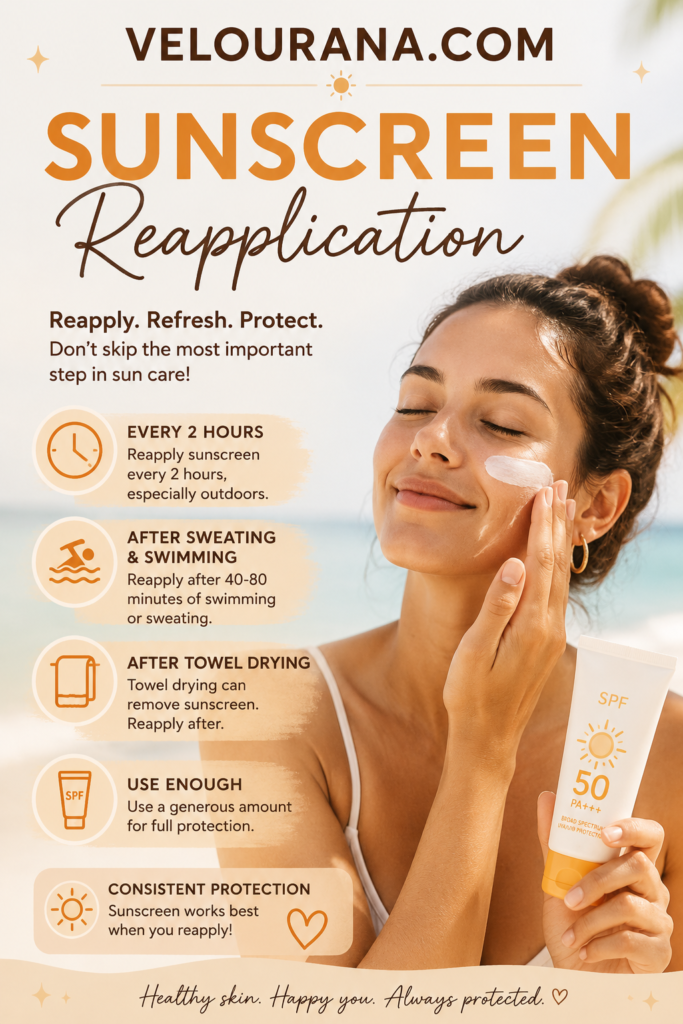
CATEGORY: Sunscreen Reapplication
Reapplying sunscreen sounds straightforward.
Put sunscreen on again and continue with your day.
Yet reapplication is one of the easiest parts of sun protection to misunderstand. Some people never reapply, even after swimming for hours. Others believe that applying SPF 50 in the morning guarantees protection until evening. Some refresh only the nose and cheeks while forgetting the ears and neck. Others use a tiny amount of SPF powder and assume they have completely restored the original sunscreen layer.
There is also the opposite problem.
Some people interpret general reapplication advice so rigidly that they believe sunscreen must be reapplied constantly even while spending an entire day indoors away from meaningful ultraviolet exposure.
Effective sunscreen use requires a more practical understanding.
Reapplication exists to maintain protection during continued exposure and to restore sunscreen that has been removed or disturbed.
Avoiding the most common mistakes makes that process considerably easier.
Mistake: Assuming One Morning Application Always Lasts All Day
A carefully applied morning sunscreen provides an important foundation.
It should not automatically be assumed to remain unchanged until bedtime regardless of what happens during the day.
Water, perspiration, washing, towels, hands, clothing, and friction can disturb sunscreen.
Correct It by Considering Your Exposure
Think about what your day actually involves.
An indoor office day is different from a beach day.
A ten-minute commute is different from a three-hour hike.
Reapplication should respond to exposure and activity.
Mistake: Treating SPF as a Measure of Duration
SPF 50 does not mean the sunscreen lasts fifty units of time.
SPF 30 does not automatically disappear sooner than SPF 50.
SPF measures tested UVB protection under standardized conditions.
Correct It by Separating Protection Level From Durability
A high-SPF sunscreen can still be washed or rubbed from the skin.
Follow reapplication directions regardless of the SPF number.
Mistake: Believing Higher SPF Eliminates Reapplication
Someone using SPF 50+ or SPF 100 may feel that reapplication is unnecessary.
That is incorrect.
Higher SPF does not make the sunscreen physically permanent.
Correct It by Maintaining the Protective Film
When prolonged exposure continues or the sunscreen has been disturbed, restore coverage according to the product instructions.
Mistake: Adding SPF Numbers Together
Applying SPF 50 in the morning and SPF 50 later does not create SPF 100.
Similarly, SPF 50 sunscreen underneath SPF 30 foundation does not create SPF 80.
Correct It by Understanding the Purpose of Reapplication
The new layer restores coverage.
It does not mathematically accumulate SPF.
Mistake: Treating the Two-Hour Rule as the Only Rule
Approximately two-hour reapplication guidance is useful during prolonged outdoor exposure.
However, sunscreen may need attention sooner after swimming, toweling, or heavy perspiration.
Correct It by Watching What Happens to the Sunscreen
Consider both time and activity.
If the sunscreen has been physically disturbed, waiting for a clock may not make sense.
Mistake: Treating Two Hours as Mandatory Indoors
The opposite misunderstanding is believing that sunscreen must be reapplied every two hours regardless of exposure.
Someone working in an interior office has different circumstances from someone outdoors continuously.
Correct It by Considering Actual UV Exposure
If you spend most of the day indoors, think about your next meaningful period outside.
Refreshing sunscreen before that exposure can be more practical.
Mistake: Ignoring the Product Directions
General advice is useful, but the individual sunscreen provides important instructions regarding application, water resistance, and reapplication.
Correct It by Reading the Label
Use the sunscreen according to its intended purpose.
This is especially important for water-resistant and sport formulations.
Mistake: Assuming Water-Resistant Means Waterproof
Water resistance improves sunscreen durability during water exposure.
It does not create permanent protection.
Correct It by Checking the Water-Resistance Claim
Follow the product's instructions regarding swimming and reapplication.
Mistake: Spending the Entire Day Swimming Without Reapplying
Repeated swimming creates demanding conditions for sunscreen.
Even water-resistant products have limits.
Correct It by Restoring Protection
Follow the sunscreen's directions after water exposure and before continued significant exposure.
Mistake: Forgetting About the Towel
A towel physically rubs the skin.
This can remove sunscreen even if the product survived the water reasonably well.
Correct It by Reapplying After Towel Drying
Restore coverage as directed before returning to prolonged exposure.
Mistake: Rubbing the Skin Aggressively
Repeated towel rubbing removes more than water.
It can disturb the sunscreen film substantially.
Correct It by Drying More Gently
Patting rather than vigorous rubbing may reduce friction.
Still follow the product's reapplication directions.
Mistake: Ignoring Heavy Perspiration
Exercise and hot weather can challenge sunscreen.
The problem becomes greater when perspiration is repeatedly wiped away.
Correct It by Choosing Water Resistance
For outdoor sport and heavy perspiration, select a suitable water-resistant sunscreen.
Mistake: Wiping the Forehead Repeatedly Without Restoring Sunscreen
Runners, cyclists, hikers, and outdoor workers frequently wipe sweat from their faces.
This can remove sunscreen from exactly the areas receiving significant exposure.
Correct It During Breaks
Restore protection according to the product directions during prolonged activity.
Mistake: Leaving Sunscreen at Home
You cannot reapply a product that is not available.
This is particularly common during sightseeing, hiking, outdoor events, and beach days.
Correct It by Carrying Sunscreen
Choose a portable product appropriate for the activity.
Mistake: Carrying Sunscreen but Making It Impossible to Reach
A tube buried underneath everything at the bottom of a large backpack is technically available but practically inconvenient.
Correct It by Keeping Sunscreen Accessible
Use an outer compartment, handbag pocket, running belt, or another convenient location.
Mistake: Bringing Too Little Sunscreen
Full-body reapplication consumes significant product.
One small bottle may not be sufficient for an entire family spending a full day at the beach.
Correct It by Planning Quantity
Bring enough sunscreen for the expected number of applications and users.
Mistake: Rationing Sunscreen Because the Bottle Is Running Out
Once supplies become limited, people begin spreading sunscreen increasingly thinly.
This reduces protection.
Correct It by Carrying Backup Product
For long outdoor days, an extra bottle can prevent this problem.
Mistake: Reapplying Too Little
A few tiny dots across the face may feel like reapplication.
They may not restore an adequate protective layer.
Correct It by Using an Appropriate Quantity
Follow the manufacturer's directions and cover the entire exposed surface.
Mistake: Reapplying Only to the Nose
The nose receives substantial exposure, but protecting it alone leaves the rest of the face untreated.
Correct It by Working Systematically
Forehead.
Temples.
Cheeks.
Nose.
Chin.
Jawline.
Ears.
Neck.
Mistake: Forgetting the Hairline
Midday reapplication often becomes hurried.
The center of the forehead is covered while the hairline is ignored.
Correct It by Working to the Edge
Apply carefully without unnecessarily coating the hair.
Mistake: Forgetting the Temples
Glasses and sunglasses can make this area easy to overlook.
Correct It by Applying Around Eyewear
Remove glasses temporarily when practical and cover exposed skin carefully.
Mistake: Forgetting the Ears
Ears are commonly missed during both initial application and reapplication.
Correct It by Making Them Part of the Facial Routine
Every time you refresh the face during significant exposure, check the ears.
Mistake: Reapplying to the Face but Not the Neck
The neck may remain exposed to exactly the same sunlight.
Correct It by Treating the Neck Separately
Apply an adequate amount rather than using facial leftovers.
Mistake: Forgetting the Upper Chest
Low necklines expose an area that is often ignored during facial touch-ups.
Correct It by Checking Clothing
Protect every exposed area according to the clothing you are wearing.
Mistake: Forgetting the Shoulders
Swimwear and sleeveless clothing expose the shoulders continuously.
Correct It During Body Reapplication
Cover the entire shoulder and areas around straps.
Mistake: Forgetting the Arms
People sometimes refresh facial sunscreen repeatedly while leaving exposed arms untouched for an entire outdoor day.
Correct It by Considering All Exposed Skin
Protection should follow exposure rather than beauty routines.
Mistake: Forgetting the Hands
Hand sunscreen is removed frequently by washing.
Correct It After Washing
If substantial UV exposure continues, restore protection to the backs of the hands.
Mistake: Forgetting the Legs
At beaches and outdoor events, legs may remain exposed for many hours.
Correct It by Covering the Complete Limb
Front.
Sides.
Back.
Knees.
Calves.
Mistake: Forgetting the Feet
Water, sand, towels, and footwear can all disturb sunscreen on the feet.
Correct It by Including Them
Protect the tops of the feet, ankles, and exposed toes.
Mistake: Ignoring Clothing Friction
Bag straps, collars, swimwear, sleeves, and shoes can rub sunscreen away.
Correct It by Checking High-Friction Areas
Pay attention during prolonged exposure.
Mistake: Ignoring Sand
Sand can stick to sunscreen.
Brushing it away can remove product.
Correct It by Restoring Coverage
If an area has been rubbed repeatedly, reapply sunscreen before continued exposure.
Mistake: Assuming You Can Feel When Sunscreen Stops Protecting
Sunscreen does not produce a reliable physical warning when coverage becomes inadequate.
The skin may still feel moisturized.
It may still smell like sunscreen.
Correct It by Using Activity and Exposure as Guides
Do not wait for a sensation.
Mistake: Waiting for the Skin to Feel Hot
Wind and water can cool the skin even during intense UV exposure.
Correct It by Checking UV Conditions
Temperature is not a substitute for the UV Index.
Mistake: Waiting Until You Begin to Burn
Visible redness means excessive exposure has already occurred.
Correct It by Reapplying Preventively
Maintain protection before damage becomes visible.
Mistake: Assuming Clouds Mean Reapplication Is Unnecessary
Cloud cover can reduce some sunlight without eliminating ultraviolet radiation.
Correct It by Considering the UV Index
A cloudy day can still involve meaningful UV exposure.
Mistake: Assuming Cold Weather Means No Reapplication
Skiers and mountain hikers can receive substantial UV exposure despite cold temperatures.
Correct It by Considering Altitude and Reflection
Snow can reflect UV.
Higher altitude can increase exposure.
Mistake: Reapplying Only When You Are at the Beach
Sunscreen maintenance can also matter during ordinary activities.
Outdoor work.
Gardening.
Sightseeing.
Cycling.
Walking.
Driving.
Outdoor dining.
Correct It by Thinking Beyond Holidays
Sun exposure occurs during everyday life.
Mistake: Reapplying Before Going Indoors but Forgetting Before Going Outside
This reverses the practical priority.
Correct It by Connecting Reapplication With Upcoming Exposure
Before leaving the office.
Before outdoor lunch.
Before gardening.
Before an afternoon walk.
Before sightseeing.
These are useful moments to consider sunscreen.
Mistake: Making Reapplication Entirely Clock-Based
A clock cannot tell whether you have spent the last two hours swimming or sitting in a windowless room.
Correct It by Combining Time With Context
Ask what has happened to the sunscreen and what exposure is coming next.
Mistake: Depending Entirely on Makeup SPF
Foundation and powder containing SPF can contribute protection.
Most people do not apply makeup in the quantities used during sunscreen testing.
Correct It by Maintaining Dedicated Sunscreen
Treat cosmetic SPF as supplementary.
Mistake: Assuming SPF Foundation Restores the Morning Sunscreen Completely
A normal foundation touch-up may involve very little product.
Correct It by Using a Dedicated Reapplication Method
Consider a suitable fluid, stick, cushion, spray, or another sunscreen format.
Mistake: Depending Entirely on SPF Powder
Powder sunscreen is convenient.
The difficulty is applying enough product uniformly.
Correct It by Treating Light Powder Applications as Supplementary
During substantial prolonged exposure, use a more reliable sunscreen reapplication method.
Mistake: Using One Quick Swipe of a Sunscreen Stick
A stick may deposit less product than expected.
Correct It With Multiple Overlapping Passes
Follow the manufacturer's directions.
Mistake: Using a Tiny Facial Mist and Assuming Complete Coverage
A fine spray can feel as though it has covered everything.
Actual quantity may be limited.
Correct It by Following Spray Instructions
Apply the amount specified and ensure complete coverage.
Mistake: Spraying Sunscreen in Strong Wind
Much of the sunscreen can disappear into the air.
Correct It by Finding Shelter
Apply where the product can reach the skin effectively.
Mistake: Spraying Directly Into the Eyes
Convenience should not override safe application.
Correct It by Following Facial Spray Directions
Use only appropriate products and application methods.
Mistake: Mixing Sunscreen With Moisturizer for Reapplication
This may create a lighter texture, but it also changes the sunscreen formulation.
Correct It by Layering Products Separately
If you want a lighter product, choose a lighter sunscreen.
Mistake: Mixing Sunscreen With Foundation
The resulting mixture does not have a predictable SPF.
Correct It by Keeping Sunscreen Separate
Apply sunscreen first and repair makeup afterward.
Mistake: Diluting Sunscreen With Facial Mist
Adding water or mist does not create a reliable sunscreen formulation.
Correct It by Using the Product as Designed
Do not modify sunscreen in an attempt to make reapplication easier.
Mistake: Applying Sunscreen Over Extremely Wet Skin Without Checking the Instructions
Many conventional sunscreens are intended for application to dry skin.
Correct It by Following Product Directions
Some specialized sunscreens are designed for wet-skin application.
Use those when appropriate.
Mistake: Applying Over Heavy Sweat Without Preparation
Excess perspiration can make even coverage difficult.
Correct It by Gently Removing Excess Moisture
Move into shade.
Blot the skin.
Then restore sunscreen according to directions.
Mistake: Rubbing Too Hard During Reapplication
Aggressive rubbing can disturb the remaining sunscreen and makeup.
Correct It With Controlled Application
Spread enough product evenly and then allow it to settle.
Mistake: Applying Less Because the Second Layer Feels Greasy
Repeated application can feel heavy with some formulas.
Reducing quantity solves the cosmetic problem by creating a protection problem.
Correct It by Choosing a Better Formula
Lightweight fluids and gels may be more comfortable for reapplication.
Mistake: Using an Unsuitable Facial Sunscreen for Sport
A delicate daily sunscreen may run into the eyes during heavy exercise.
Correct It by Matching the Product to the Activity
Choose water resistance and appropriate durability when needed.
Mistake: Using an Expensive Product You Are Afraid to Reapply
Cost can influence behavior.
If every application feels financially painful, you may use too little.
Correct It by Separating Face and Body Products
Use an elegant facial sunscreen where necessary and an affordable body sunscreen for larger areas.
Mistake: Ignoring White Cast During Reapplication
A sunscreen that becomes increasingly white after repeated layers may discourage adequate use.
Correct It by Choosing a More Compatible Formula
Transparent or tinted options may work better.
Mistake: Applying Less Tinted Sunscreen Because the Color Builds Up
Tinted sunscreen can resemble foundation.
Repeated layers may deepen the shade.
Correct It by Changing the Reapplication Product
Use tinted sunscreen initially and a transparent sunscreen later if that works better.
Mistake: Letting Makeup Prevent Reapplication Entirely
This is common during weddings, events, workdays, and travel.
People avoid sunscreen because they do not want to disturb foundation.
Correct It by Developing a Makeup-Compatible Method
A fluid pressed onto the skin, a stick, cushion, or appropriate spray may make reapplication more practical.
Mistake: Prioritizing Perfect Makeup During Intense Exposure
Cosmetics can be repaired.
UV exposure cannot be reversed afterward.
Correct It by Putting Protection First
Refresh sunscreen and then touch up makeup.
Mistake: Ignoring Lip Protection
Lip sunscreen disappears easily through eating, drinking, swimming, and wiping.
Correct It by Carrying SPF Lip Balm
Reapply throughout meaningful exposure.
Mistake: Assuming Lipstick Automatically Provides UV Protection
Color does not equal tested SPF.
Correct It by Using an SPF-Labeled Lip Product
Apply cosmetic color over it if desired.
Mistake: Forgetting the Scalp
Hair parts and thinning areas can remain exposed.
Correct It With Sunscreen or a Hat
Physical protection is often easiest.
Mistake: Believing a Hat Makes Reapplication Unnecessary
A hat provides valuable protection but does not necessarily eliminate reflected and indirect UV exposure to the face.
Correct It by Combining Methods
Use sunscreen and appropriate physical protection together.
Mistake: Believing Sunscreen Makes a Hat Unnecessary
The opposite assumption is equally limiting.
Correct It With Layered Protection
A hat can reduce the amount of UV reaching the face, ears, neck, and scalp.
Mistake: Forgetting Sunglasses
Sun protection includes the eyes.
Correct It by Wearing UV-Protective Sunglasses
They also shade some surrounding skin.
Mistake: Ignoring Shade
Some people apply sunscreen repeatedly while remaining in intense direct sunlight for unnecessary periods.
Correct It by Reducing Exposure Too
Move into shade whenever practical.
Mistake: Using Sunscreen to Extend Sunbathing
Reapplication should not become permission for unlimited intentional UV exposure.
Correct It by Remembering Sunscreen's Purpose
The objective is reducing exposure, not maximizing the amount of time you can remain in intense sunlight.
Mistake: Assuming Reapplication Repairs Previous UV Damage
Sunscreen applied at 2 p.m. cannot erase excessive exposure received at noon.
Correct It by Maintaining Protection Proactively
The first application and subsequent maintenance both matter.
Mistake: Using After-Sun Lotion Instead of Reapplying Sunscreen
After-sun products may moisturize or soothe the skin.
They do not provide sunscreen protection unless specifically labeled and tested to do so.
Correct It by Keeping the Functions Separate
Use sunscreen for protection.
Use after-sun skincare for comfort and hydration when appropriate.
Mistake: Using Expired Sunscreen for Touch-Ups
Portable sunscreen can remain in bags for a long time.
Correct It by Checking Expiration Information
Replace old products when necessary.
Mistake: Storing Sunscreen in Extreme Heat
A product permanently stored inside a very hot car may experience inappropriate conditions.
Correct It by Following Storage Instructions
Carry sunscreen in a more suitable location where practical.
Mistake: Buying Sunscreen From Unreliable Sources
Counterfeit sunscreen may display impressive SPF claims without providing reliable tested protection.
Correct It by Purchasing From Reputable Retailers
Authenticity matters.
Mistake: Making Homemade Sunscreen for Reapplication
DIY mixtures cannot reliably reproduce tested SPF performance.
Correct It by Using Professionally Formulated Sunscreen
Protection depends on formulation, stability, distribution, and testing.
Mistake: Making the Routine So Complicated That You Abandon It
A theoretically perfect routine can become useless if it is impossible to maintain.
Correct It by Simplifying
Use a small number of reliable products.
Keep them accessible.
Connect reapplication to meaningful events.
Build Reapplication Around Your Lifestyle
An office worker may keep sunscreen at a desk.
A runner may keep a stick in a running belt.
A cyclist may carry a tube in a jersey pocket.
A parent may keep a large bottle in the beach bag.
A traveler may carry a compact facial sunscreen.
Connect Reapplication to Swimming
Leave the water.
Dry appropriately.
Restore protection according to the sunscreen instructions.
Connect Reapplication to Exercise
Finish a long interval.
Move into shade.
Blot excess perspiration.
Restore sunscreen where necessary.
Connect Reapplication to Work
Before leaving the office for significant afternoon exposure, refresh sunscreen.
Connect Reapplication to Travel
Before beginning several hours of sightseeing, check your coverage.
Connect Reapplication to Hand Washing
If the hands will remain exposed, restore protection after washing.
Connect Reapplication to Outdoor Meals
Before spending a long lunch outside, consider refreshing sunscreen.
A Better Beach Routine
Begin with generous water-resistant sunscreen.
Cover every exposed area.
Bring enough product.
Restore sunscreen after swimming and towel drying according to directions.
Use shade.
Wear a hat and sunglasses.
Use protective clothing where practical.
A Better Everyday Routine
Apply sunscreen correctly in the morning.
Consider actual exposure during the day.
Refresh before meaningful later exposure when appropriate.
Do not obsessively reapply during an entire day spent away from significant UV simply because a timer tells you to.
A Better Exercise Routine
Choose a suitable water-resistant sunscreen.
Apply before activity.
Carry sunscreen during prolonged sessions.
Restore coverage after heavy perspiration and wiping.
Use protective clothing.
A Better Makeup Routine
Apply sunscreen properly beneath makeup.
Choose a compatible reapplication format.
Press rather than aggressively rub when possible.
Allow sunscreen to settle.
Repair cosmetics afterward.
The Most Important Question
Instead of asking only, “Has it been two hours?” ask:
“Is my sunscreen still providing adequate coverage for the exposure I am about to receive?”
That question incorporates time, activity, environment, and physical disruption.
The Most Important Habit
Do not wait for visible sunburn.
Reapplication works best when it is preventive.
Maintain protection while exposure continues.
The Final Principle
Most sunscreen reapplication mistakes come from misunderstanding what reapplication is supposed to accomplish.
It is not about stacking SPF numbers.
It is not about obeying a clock regardless of circumstances.
It is not about applying a symbolic amount to the nose while ignoring the rest of the exposed skin.
Reapplication is about maintaining a reliable sunscreen film during meaningful ultraviolet exposure.
When water, towels, perspiration, washing, friction, or prolonged outdoor activity compromise that film, restore it.
When you are about to return outdoors after several hours inside, consider whether refreshing protection is appropriate.
When you remain indoors away from meaningful UV exposure, do not turn sunscreen into an unnecessary source of anxiety.
Use enough product when you apply it.
Cover every exposed area.
Follow the sunscreen's instructions.
Choose water resistance when swimming or sweating.
Carry sunscreen when you will need it.
Use shade, clothing, hats, and sunglasses to reduce exposure.
And remember that even the highest SPF cannot protect skin effectively if the sunscreen itself is no longer adequately present.
Good reapplication is not complicated.
It is simply the habit of keeping protection where and when your skin actually needs it.
The End
Velourana.
 Discover More From Our Family of Websites
 ZodiacBearing (Astrology, Tarot, Numerology, Angel Numbers & Spiritual Guidance)
 Velourana (Beauty, Makeup, Hair Care, Skincare & Beauty Tips)
 HavenBearing (Home, Living, Organization, Décor & Everyday Inspiration)
 PawBearing (Pet Care, Dog Breeds, Animal Health, Training & Pet Products)
 PsyCatherine (Notes From the Journal of a Psychologist on Real Life)