
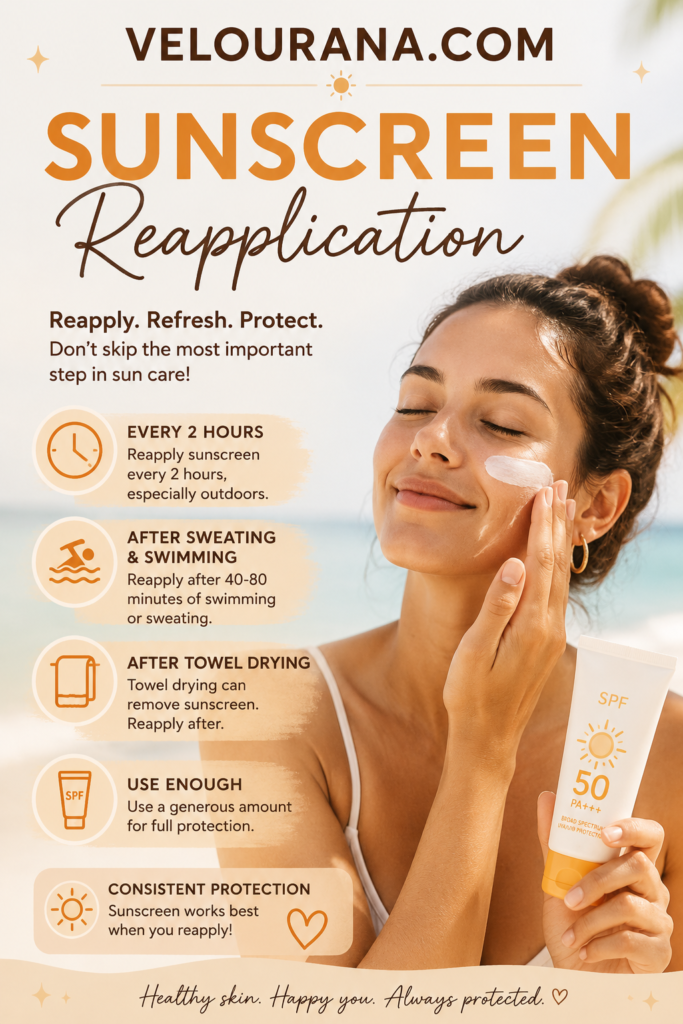
CATEGORY: Sunscreen Reapplication
Sunscreen reapplication is often explained with one simple instruction: apply sunscreen again every two hours.
That guidance is useful during sustained outdoor exposure, but everyday life is more complicated.
Most people do not spend every day sitting continuously in direct sunlight. They commute to work, enter buildings, sit in offices, drive, walk to lunch, shop indoors, exercise after work, travel between locations, and spend different amounts of time near windows or outside.
This creates an important practical question.
If you applied sunscreen correctly in the morning, when do you actually need to apply it again?
The answer depends largely on what happens after the original application.
How much ultraviolet exposure are you receiving?
Has the sunscreen been disturbed?
Have you been swimming?
Have you been sweating heavily?
Have you washed or wiped the skin?
Are you about to spend another significant period outdoors?
Thinking about reapplication in this way creates a much more practical routine than simply watching the clock.
Start With a Good Morning Application
Reapplication cannot compensate perfectly for an inadequate first application.
Begin the day with an appropriate broad-spectrum sunscreen.
Use enough.
Apply it evenly.
Cover all exposed areas.
The Morning Application Is Your Foundation
For many people, the morning sunscreen application provides the foundation of daily protection.
It should cover the entire face rather than only the center.
Include the hairline.
Include the temples.
Include the ears.
Apply separately to the neck.
Protect the upper chest if exposed.
Consider the Hands
If the hands will receive meaningful exposure, apply sunscreen to them too.
Remember that hand washing can remove the product later.
Your Day Determines Your Reapplication Needs
There is an enormous difference between spending eight hours on a beach and spending eight hours inside an office.
The sunscreen does not know what the clock says.
What matters is exposure and what has happened to the protective film.
The Two-Hour Rule Has Context
During prolonged outdoor exposure, regular sunscreen reapplication is important.
Approximately every two hours is commonly recommended as a practical guideline.
But this does not mean everyone must leave an indoor meeting exactly two hours after applying sunscreen to put on another layer.
Continuous Exposure Changes the Situation
If you are outside continuously, reapplication deserves much more attention.
Walking.
Gardening.
Sightseeing.
Working outdoors.
Attending an outdoor event.
Hiking.
Cycling.
These situations create sustained exposure.
Indoor Time Changes the Situation
If you spend most of the day inside away from significant sunlight, your circumstances are different.
You may not need to treat sunscreen reapplication exactly like someone spending the same hours outdoors.
Think About Your Next Exposure
One practical approach is to connect reapplication with upcoming outdoor activity.
If you are about to leave an indoor environment and spend significant time outside, consider refreshing sunscreen beforehand.
The Morning Commute
Suppose you apply sunscreen at 7:30 in the morning and commute to work at 8:00.
Your morning application is fresh.
If the commute is short, your routine may require nothing more complicated at that stage.
A Long Morning Commute
A long walk, bicycle commute, or extended drive can involve considerably more exposure.
Apply thoroughly before leaving.
Protect exposed hands, arms, and neck as appropriate.
Cycling to Work
Cycling creates direct exposure while wind keeps the skin cool.
Use appropriate sunscreen on all exposed areas.
If the journey is substantial, consider water resistance because of perspiration.
Walking to Work
A long walk can represent meaningful daily exposure.
Apply before leaving rather than waiting until arrival.
Driving to Work
Broad-spectrum sunscreen can be useful for people who spend substantial time driving.
UVA exposure through vehicle glass can vary according to the glass.
Protect exposed areas according to your circumstances.
Once You Reach the Office
If you spend the next several hours inside, the situation changes.
You are no longer experiencing the same continuous exposure as someone outdoors.
Sitting Deep Inside a Building
Someone working far from windows may receive very little direct environmental UV during working hours.
The need for repeated sunscreen application should reflect this reality.
Sitting Beside a Large Window
A workstation immediately beside a bright window creates a different environment.
Ordinary glass blocks much UVB, while UVA transmission can vary.
Broad-spectrum protection becomes particularly relevant.
Window Film Can Change Exposure
Some modern buildings and vehicles use glazing or films that reduce UV transmission.
The amount varies according to the material.
Do not assume every window behaves identically.
An Outdoor Coffee Break
A short coffee break outside does not necessarily create the same exposure as spending the entire morning outdoors.
However, repeated small exposures can accumulate.
Consider the UV conditions and duration.
An Outdoor Lunch
Lunch can occur during a period of strong UV.
If several hours have passed since the morning application and you plan to sit outside, refreshing sunscreen before lunch can be sensible.
Choose Shade at Lunch
Shade reduces direct exposure.
An umbrella, covered terrace, or indoor table can substantially change the situation.
Reapply Before Leaving the Office
For many people, this may be the most useful everyday reapplication habit.
If you leave work while UV levels remain significant and expect to walk, cycle, drive, shop outdoors, or exercise, refresh sunscreen before leaving.
Keep Sunscreen at Work
A sunscreen stored in your desk, handbag, or work bag can make this routine much easier.
Accessibility matters.
Choose a Convenient Work Sunscreen
The sunscreen you use for reapplication does not necessarily need to be identical to your morning product.
A portable fluid, stick, or other suitable format may be more convenient.
Reapplication After Hand Washing
Hands are washed repeatedly during an ordinary day.
Each wash can remove sunscreen.
If your hands will subsequently receive substantial UV exposure, restore protection.
Reapplication After Face Washing
If you wash your face during the day, assume the previous sunscreen layer has been substantially affected.
Apply sunscreen again before further meaningful exposure.
Reapplication After Showering
A shower removes the previous application.
If you shower after work and then go outside while UV levels remain relevant, apply sunscreen again.
Reapplication After Exercise
If you exercise outdoors, perspiration can disturb sunscreen.
Wiping the skin adds friction.
Use a suitable water-resistant sunscreen and reapply according to the product instructions.
Indoor Exercise Is Different
If you exercise entirely indoors and then remain indoors, your sunscreen needs are not the same as during an outdoor run.
Again, exposure matters.
Going for an Evening Run
The time of day alone does not tell you whether protection is necessary.
Check UV conditions.
In summer, meaningful UV can remain later in the day than people expect.
Use the UV Index
The UV Index provides useful environmental context.
It helps you distinguish between periods when UV protection deserves greater attention and periods when exposure is minimal.
Do Not Judge UV by Temperature
A cool day can have substantial UV.
A hot evening can have relatively little.
Temperature and UV intensity are different.
Do Not Judge UV Only by Brightness
Clouds can make the sky appear dull while ultraviolet radiation still reaches the ground.
Use environmental information rather than relying entirely on appearance.
Reapplication on Cloudy Workdays
If you remain indoors most of the day, cloud cover does not suddenly create a need for constant sunscreen reapplication.
If you are outside for prolonged periods, protection remains relevant even when clouds are present.
Reapplication During Winter
Winter does not eliminate UV.
Everyday needs still depend on exposure.
Mountain and snow environments require particular care.
A Short Walk to the Car
Not every brief movement outdoors requires an elaborate sunscreen ritual.
Sun protection should be practical and proportional to exposure.
A One-Hour Walk Is Different
If you plan to spend a substantial period walking outside, refreshing sunscreen beforehand can be worthwhile.
Shopping Outdoors
An afternoon spent moving between shops can involve more outdoor exposure than expected.
If you are walking through open shopping streets rather than remaining inside a mall, maintain protection accordingly.
Outdoor Markets
Markets can involve prolonged exposure with limited shade.
Apply or refresh sunscreen before visiting.
School Runs
Parents may spend repeated periods outdoors during drop-off and collection.
These short exposures can accumulate as part of everyday life.
Dog Walking
A short walk around the block and a ninety-minute walk are different exposure situations.
Adjust protection according to duration and UV conditions.
Gardening After Work
Gardening can easily extend longer than planned.
If UV remains significant, refresh sunscreen before beginning.
Eating Dinner Outdoors
In summer, outdoor dining may begin while UV levels are still relevant.
Check conditions rather than assuming evening automatically means no exposure.
Reapplication During Travel
Travel often disrupts normal routines.
People leave accommodation early, walk for hours, wait outdoors, sit beside windows, and spend much more time outside than during normal working days.
Carry sunscreen.
Airport Days
Most of an airport day may be indoors.
However, transfers, outdoor queues, and long journeys beside windows can change exposure.
Think about the actual itinerary.
Road Trips
Long periods inside vehicles can involve repeated UVA exposure depending on the glazing.
Broad-spectrum sunscreen on exposed skin can be useful.
Reapply After Rest Stops if Necessary
Hand washing, face washing, or heavy perspiration can disturb sunscreen.
Restore coverage before continuing substantial exposure.
Train Travel
Exposure varies according to seating position, window characteristics, direction of sunlight, and journey duration.
Someone beside a sunny window for hours has different circumstances from someone sitting away from windows.
Air Travel
Aircraft windows and high-altitude conditions create a specialized environment.
Frequent flyers and people sitting beside windows for long periods may choose to maintain broad-spectrum facial protection.
Sightseeing Days Need More Reapplication
Tourism often means spending most of the day outdoors.
In these circumstances, treat sunscreen more like an outdoor activity product than an ordinary office skincare product.
Apply Before Leaving the Hotel
Begin with complete coverage.
Do not wait until midday.
Carry a Portable Sunscreen
A small tube or stick makes reapplication easier during sightseeing.
Use Hats During Travel
A hat provides continuous physical protection and reduces dependence on sunscreen alone.
Reapplication at Outdoor Events
Concerts, festivals, weddings, sporting events, and fairs can involve several hours outdoors.
Plan sunscreen before attending.
Outdoor Weddings
Formal makeup and clothing can make sunscreen reapplication difficult.
Begin with a strong sunscreen layer.
Use shade when available.
Carry a compatible facial reapplication product.
Festivals
Festival days can involve prolonged sun, heat, perspiration, and limited shade.
Choose durable sunscreen.
Bring enough product.
Sporting Events
Spectators may remain seated in direct sunlight for hours.
Apply to exposed face, neck, ears, arms, hands, and legs.
Reapply During Breaks
Intervals provide convenient opportunities to restore sunscreen without missing the event.
Reapplication With Makeup
Makeup makes everyday reapplication more complicated but not impossible.
Lightweight sunscreen can sometimes be pressed over makeup.
Sticks, cushions, sprays, and powders may provide additional options.
Powder SPF Has Limitations
Powder can be convenient for touch-ups.
However, achieving sufficient quantity for the labeled protection can be difficult.
Treat a light cosmetic dusting cautiously.
Sunscreen Sticks Are Portable
A stick can be particularly convenient for the nose, cheeks, forehead, ears, and hands.
Apply enough according to the product directions.
Facial Sprays Can Be Convenient
Use products intended for facial application.
Follow instructions carefully.
Avoid the eyes and inhalation.
Reapply to the Neck Normally
Even if makeup complicates facial reapplication, the neck can usually receive ordinary sunscreen lotion or fluid.
Do Not Forget the Ears
They remain one of the most commonly neglected areas.
Reapply the Hands
If you have washed them repeatedly, the morning sunscreen is unlikely to remain unchanged.
Sunscreen at Home
If you spend the entire day indoors away from meaningful sunlight, repeated sunscreen application may provide little practical benefit.
The routine should reflect actual exposure rather than becoming automatic product consumption.
Working From Home Near a Window
If your desk receives strong sunlight through a nearby window for prolonged periods, broad-spectrum sunscreen may be useful.
Consider curtains, blinds, or UV-control measures as additional options.
Working From Home Away From Windows
Someone working in an interior space has substantially different exposure.
There is no need to pretend every indoor environment is identical.
Physical Protection Can Reduce Reapplication
Sunscreen is only one method of sun protection.
Clothing, hats, shade, sunglasses, and environmental choices can reduce UV exposure without requiring additional product.
Long Sleeves Simplify the Arms
If your arms are covered, you do not need to repeatedly apply sunscreen to the covered skin.
Hats Simplify Facial Protection
A broad-brimmed hat reduces direct exposure to several difficult areas.
It works alongside sunscreen.
Sunglasses Protect the Eyes
They also shade some of the surrounding skin.
Shade Changes the Equation
Choosing the shaded side of a street, sitting beneath an umbrella, or moving an outdoor meeting under cover can reduce exposure substantially.
Reapplication Should Not Become Anxiety
Sunscreen is a preventive health tool.
It should support normal life rather than creating constant fear of sunlight.
Understand the principles and build a realistic routine.
Do Not Chase Perfect Protection
No sunscreen blocks every photon of ultraviolet radiation.
The objective is meaningful reduction of exposure.
Consistency Matters More Than Perfection
A realistic routine followed regularly is more valuable than an extremely complicated routine abandoned after several days.
Avoid Symbolic Reapplication
If meaningful reapplication is required, a microscopic amount is not enough.
Use an adequate quantity.
Do Not Reapply Only to the Nose
The nose may receive strong exposure, but the rest of the face also needs coverage.
Include the Hairline
It can easily disappear from a rushed midday application.
Include the Temples
Glasses can make this area easy to overlook.
Include the Ears
Make them part of the sequence.
Include the Neck
Apply separately rather than using facial leftovers.
Include the Upper Chest
If clothing exposes it, protect it.
Include the Hands
Particularly after washing.
Reapplication and High SPF
High SPF does not eliminate the need to maintain coverage during significant exposure.
SPF 50 can be washed away.
SPF 100 can be rubbed away.
The number does not physically attach sunscreen to your skin.
Reapplication and Broad-Spectrum Protection
Remember that everyday protection should address UVA as well as UVB.
Look for appropriate broad-spectrum labeling or UVA protection information for your market.
UVA Is Particularly Relevant to Everyday Exposure
UVA contributes to cumulative skin damage and photoaging and can penetrate ordinary glass to varying degrees.
This makes broad-spectrum protection important for many daily routines.
Do Not Rely on SPF Foundation Alone
Makeup containing SPF can contribute protection.
Most people do not apply foundation in the quantity used for sunscreen testing.
Use dedicated sunscreen as your primary layer.
Do Not Mix Sunscreen Into Moisturizer
This creates an untested mixture.
Apply the products separately.
Do Not Mix Sunscreen Into Foundation
For the same reason, keep sunscreen as its own layer.
Do Not Dilute Sunscreen for Reapplication
Adding water, facial mist, or moisturizer does not create a lighter version with predictable SPF.
Use an appropriate lightweight sunscreen instead.
Choose a Sunscreen You Enjoy Reapplying
Texture matters.
If the sunscreen becomes unbearably greasy after a second application, you are unlikely to maintain the habit.
Lightweight Fluids Can Help
They can provide high protection while minimizing heaviness.
Gel Formulas Can Be Comfortable
Some people with oily or combination skin prefer gel-like textures.
Creams Can Suit Dry Skin
Dry skin may appreciate additional emollience during repeated application.
Tinted Sunscreen Can Provide Cosmetic Benefits
Tinted formulas can reduce white cast and provide light coverage.
However, repeated layers may deepen the visible shade.
Transparent Sunscreen Can Work for Touch-Ups
Some people use tinted sunscreen in the morning and a transparent formulation for later applications.
Separate Face and Body Sunscreens
There is no requirement to use the same product everywhere.
A smaller facial sunscreen can remain in a handbag.
A larger body sunscreen can be used for outdoor activities.
Keep Sunscreen in Useful Places
A product cannot help if it is never available.
Consider where reapplication most commonly becomes necessary.
A Sunscreen at Work
Useful before outdoor lunch or the journey home.
A Sunscreen in Your Bag
Useful for unexpected outdoor plans.
A Sunscreen With Sports Equipment
Useful when exercise moves outdoors.
Avoid Excessive Heat Storage
Do not automatically leave sunscreen permanently inside a very hot vehicle.
Follow storage instructions.
Check Expiration Dates
Portable sunscreen can remain forgotten for long periods.
Check it periodically.
Replace Empty Products Before You Need Them
Running out just before a holiday or outdoor event creates unnecessary inconvenience.
A Practical Office-Day Routine
Apply sunscreen properly in the morning.
Commute to work.
Spend the day indoors.
If you remain indoors with minimal exposure, repeated application may not be necessary simply because two hours have passed.
Before significant afternoon outdoor exposure, refresh sunscreen as appropriate.
A Practical Outdoor-Work Routine
Apply thoroughly before work.
Use protective clothing.
Keep sunscreen accessible.
Reapply during sustained exposure according to product directions and activity.
Restore sunscreen after heavy perspiration or washing.
A Practical Work-From-Home Routine
Consider your workspace.
If you spend the day away from meaningful sunlight, your exposure is limited.
If you sit beside a bright sunny window for hours, broad-spectrum protection may be more relevant.
A Practical Travel-Day Routine
Apply sunscreen before leaving.
Carry a portable product.
Assess how much of the day will actually be outdoors.
Refresh before long sightseeing periods.
Use a hat and sunglasses.
A Practical After-Work Routine
If UV remains significant and you plan outdoor exercise, gardening, walking, or dining, reapply sunscreen before beginning.
If it is already late and UV levels are minimal, additional sunscreen may provide little benefit.
The Question to Ask Is Not Only “Has It Been Two Hours?”
A more useful set of questions is:
How much UV exposure have I had?
Am I about to go outside?
How long will I remain outside?
Has my sunscreen been washed, rubbed, or wiped away?
Have I perspired heavily?
What are the current UV conditions?
Reapplication Becomes Easier When Connected to Events
Before outdoor lunch.
Before leaving work.
After swimming.
After showering.
After heavy exercise.
After washing exposed areas.
Before sightseeing.
Before gardening.
These events are easier to remember than arbitrary clock times.
You Do Not Need Sunscreen at Night
Once meaningful ultraviolet exposure has ended, sunscreen provides no nighttime skincare advantage simply because it contains SPF.
Remove it during your normal evening cleansing routine.
Cleanse Sunscreen at the End of the Day
Sunscreen, makeup, oil, perspiration, and environmental residue can be removed with your normal appropriate cleansing method.
Prepare for Tomorrow
Keeping sunscreen visible beside your morning skincare can make the next application automatic.
The Most Common Everyday Reapplication Mistake
There are actually two opposite mistakes.
One is never reapplying despite spending hours outdoors.
The other is treating sunscreen as though it must be reapplied obsessively during an entire day spent away from meaningful UV exposure.
A practical routine sits between these extremes.
The Final Principle
Sunscreen reapplication should reflect your real life.
If you are spending hours outdoors, maintain protection regularly.
If you swim, restore sunscreen according to the product directions.
If you sweat heavily or repeatedly wipe the skin, pay attention to coverage.
If you wash your hands or face and then return to significant exposure, apply sunscreen again.
If you spend most of your working day indoors, consider the exposure you will receive next rather than automatically reapplying because a clock says two hours have passed.
Before an outdoor lunch, afternoon walk, commute, exercise session, gardening period, or sightseeing trip, refreshing sunscreen can provide a practical way to maintain protection.
Use the UV Index for environmental context.
Use broad-spectrum protection.
Use enough sunscreen when application is required.
And combine sunscreen with shade, clothing, hats, and sunglasses.
The objective is neither neglect nor obsession.
It is reliable protection matched intelligently to your actual exposure.
Once sunscreen reapplication becomes connected to the events of your day rather than an inflexible timer, maintaining good sun protection becomes considerably simpler.
The End
Velourana.
 Discover More From Our Family of Websites
 ZodiacBearing (Astrology, Tarot, Numerology, Angel Numbers & Spiritual Guidance)
 Velourana (Beauty, Makeup, Hair Care, Skincare & Beauty Tips)
 HavenBearing (Home, Living, Organization, Décor & Everyday Inspiration)
 PawBearing (Pet Care, Dog Breeds, Animal Health, Training & Pet Products)
 PsyCatherine (Notes From the Journal of a Psychologist on Real Life)

