
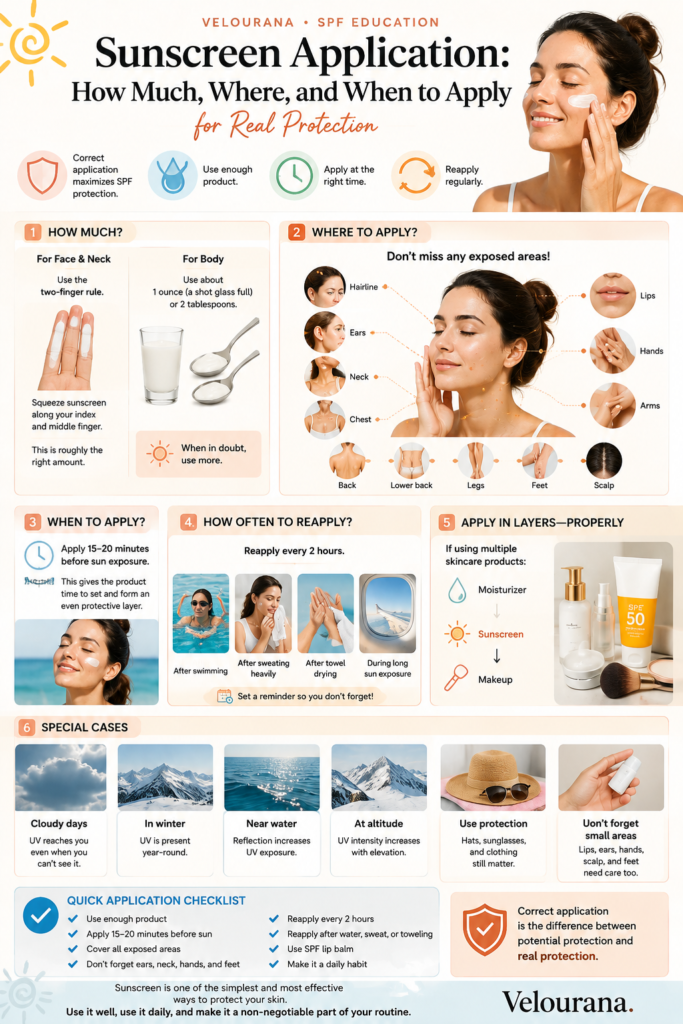
CATEGORY: Sunscreen Application
Using sunscreen seems simple.
Choose an appropriate SPF, spread it across the skin, and continue with your day.
In practice, sunscreen application involves many small decisions that can determine how effectively the product protects exposed skin. Someone can purchase an excellent broad-spectrum SPF 50 sunscreen and still receive considerably less protection than expected because of the way it is used.
The most common mistakes are surprisingly ordinary.
Applying too little.
Missing the ears.
Stretching facial sunscreen down the neck instead of applying enough product separately.
Forgetting the hands.
Applying sunscreen after arriving at the beach rather than as part of preparation.
Using one morning application through hours of swimming.
Assuming water-resistant means waterproof.
Mixing sunscreen with moisturizer.
Depending entirely on makeup containing SPF.
None of these mistakes means sunscreen is ineffective.
They demonstrate why application technique matters.
Understanding these errors makes them much easier to avoid.
Mistake: Applying Too Little Sunscreen
Underapplication is one of the most important sunscreen mistakes.
SPF ratings are established using standardized quantities during testing.
When substantially less sunscreen is used, the protection achieved in real life can be lower than the labeled SPF.
A tiny amount spread very thinly across the entire face should not automatically be expected to provide the protection printed on the bottle.
Correct It by Using an Adequate Amount
Follow the manufacturer's application instructions.
Use enough product to create even coverage across the entire exposed area.
If a generous amount feels difficult to apply at once, divide it into two passes.
Mistake: Treating Sunscreen Like a Concentrated Serum
Many skincare products require only a few drops.
Sunscreen is different.
Its job depends on creating a protective film over the skin.
Using the same tiny quantity you would use for a serum can result in inadequate coverage.
Correct It by Thinking in Terms of Coverage
Every exposed part of the skin needs sunscreen.
The objective is not merely to put some sunscreen somewhere on the face.
The objective is to create a continuous protective layer.
Mistake: Using High SPF to Compensate for Underapplication
Someone may deliberately choose SPF 50 or SPF 50+ and then apply very little, assuming the higher rating provides enough extra protection to compensate.
This is unreliable.
The SPF rating assumes appropriate application.
Correct It by Separating SPF From Quantity
Choose the protection level you want.
Then apply the sunscreen correctly.
High SPF should provide additional protection, not permission to use less product.
Mistake: Assuming Half the Amount Means Half the SPF
Sunscreen does not work through such simple arithmetic.
Half the intended amount of SPF 50 cannot reliably be described as SPF 25.
Protection may decrease in a more complicated way.
Correct It by Avoiding Homemade SPF Calculations
There is no need to estimate the resulting SPF.
Apply an adequate amount from the beginning.
Mistake: Missing the Hairline
People often stop sunscreen application before reaching the hairline because they want to avoid making their hair greasy.
This can leave an exposed border around the forehead.
Correct It by Applying Carefully to the Edge
Work sunscreen toward the hairline without unnecessarily coating the hair.
Take particular care around the temples.
Mistake: Forgetting the Ears
The ears are among the easiest areas to miss.
Hair may cover them temporarily, making them seem protected.
Later, the hair may be tied back or moved by wind.
Correct It by Making Ears Part of the Routine
Apply sunscreen deliberately to exposed ear surfaces.
Do not rely on accidental transfer from the cheeks.
Mistake: Stopping at the Jawline
Facial skincare routines often end at the jaw.
Sunlight does not.
An exposed neck receives ultraviolet radiation just as the face does.
Correct It by Extending Protection Downward
Apply sunscreen separately to the neck.
If the upper chest is exposed, include it as well.
Mistake: Giving the Neck Only Leftover Sunscreen
After finishing the face, many people rub whatever remains on their fingertips onto the neck.
That small residue may be insufficient.
Correct It by Dispensing More Product
Treat the neck as an additional area requiring its own adequate application.
Mistake: Forgetting the Back of the Neck
The front of the neck receives attention because it is visible in the mirror.
The back is easily forgotten.
This can become particularly important when wearing short hair, tying hair up, gardening, hiking, cycling, or spending time at the beach.
Correct It by Checking All Exposed Areas
If the back of the neck is uncovered, protect it.
A broad-brimmed hat or clothing can provide additional coverage.
Mistake: Forgetting the Upper Chest
Open-neck clothing can expose a substantial area below the neck.
This region is often excluded from facial sunscreen routines.
Correct It by Looking at Your Clothing
Apply sunscreen according to the skin that will actually remain exposed.
Mistake: Forgetting the Hands
Hands receive frequent incidental exposure.
They are also washed repeatedly.
Correct It by Applying Sunscreen Deliberately
Cover the backs of the hands and exposed fingers.
Restore sunscreen after washing when significant outdoor exposure continues.
Mistake: Assuming Sunscreen Transfers to the Hands Automatically
Your palms may touch sunscreen while applying it to the face and body, but this does not guarantee adequate protection on the backs of the hands.
Correct It With a Separate Application
Finish your routine by intentionally covering the hands.
Mistake: Forgetting the Feet
At the beach or while wearing sandals, the tops of the feet can receive significant sunlight.
They are commonly missed because they are normally covered by shoes.
Correct It Before Putting on Sandals
Apply sunscreen to exposed feet and toes.
Remember that straps may move during walking.
Mistake: Missing the Backs of the Legs
People frequently apply sunscreen only to the surfaces they can see easily.
The backs of the thighs and calves can remain untreated.
Correct It by Applying Around the Entire Limb
Work systematically.
Front.
Sides.
Back.
Mistake: Missing the Shoulders
Shoulders receive direct sunlight during many outdoor activities.
Swimwear and sleeveless clothing leave them highly exposed.
Correct It With Deliberate Coverage
Apply generously across the entire shoulder area and around clothing edges.
Mistake: Ignoring the Scalp
Hair provides some physical coverage, but exposed parts, thinning areas, and shaved scalps can receive significant UV.
Correct It With Sunscreen or Physical Protection
Use a suitable sunscreen on exposed scalp areas according to directions.
A hat is often the easiest solution.
Mistake: Forgetting the Lips
Facial sunscreen does not automatically protect the lips.
Correct It With an SPF Lip Product
Use a suitable lip balm with SPF and reapply after eating, drinking, swimming, or wiping the mouth.
Mistake: Mixing Sunscreen With Moisturizer
Combining sunscreen and moisturizer in your hand may appear to save time.
It creates an untested mixture.
The sunscreen was formulated to create a particular film on the skin.
Diluting or changing it may interfere with that film.
Correct It by Layering Instead
Apply moisturizer first if needed.
Allow it to settle.
Then apply sunscreen separately.
Mistake: Mixing Sunscreen With Foundation
This is another popular shortcut.
The resulting mixture may look attractive, but it does not have a tested SPF corresponding to the original sunscreen.
Correct It by Applying Makeup Afterwards
Apply sunscreen as its own layer.
Allow it to settle.
Then apply foundation.
Mistake: Adding SPF Numbers Together
SPF 50 sunscreen beneath SPF 20 foundation does not create SPF 70.
SPF values are not additive.
Correct It by Treating Sunscreen as the Primary Protection
Makeup containing SPF can provide supplementary protection.
Do not use mathematical addition to estimate the result.
Mistake: Depending Entirely on Foundation SPF
Foundation may display SPF 15, SPF 30, or even higher.
The problem is application quantity.
Most people do not apply foundation as generously as sunscreen is applied during SPF testing.
Correct It With Dedicated Sunscreen
Use an appropriate sunscreen underneath makeup.
Treat makeup SPF as supplementary.
Mistake: Depending Entirely on SPF Powder
Powder sunscreen is convenient for touch-ups.
However, obtaining enough powder uniformly across the skin to reproduce the labeled SPF can be challenging.
Correct It by Using Powder as Supplementary Protection
Start with a properly applied sunscreen layer.
Use powder for convenient additional coverage when appropriate.
Mistake: Using One Swipe of a Sunscreen Stick
Sticks can create a false impression of generous application because the product feels solid and substantial.
One quick pass may deposit relatively little sunscreen.
Correct It With Multiple Passes
Follow the product directions.
Apply systematically with overlapping passes.
Mistake: Spraying Sunscreen Too Lightly
A quick cloud of sunscreen around the body may smell strongly enough to feel convincing.
That does not prove enough product reached the skin.
Correct It by Ensuring Complete Coverage
Follow spray directions carefully.
Apply generously enough.
Spread the product when instructed.
Mistake: Spraying Sunscreen in Strong Wind
Much of the product can be carried away before reaching the skin.
Correct It by Moving Somewhere Sheltered
Apply where the spray can reach the intended area effectively.
Mistake: Applying Spray Directly Toward the Face
Spray products can enter the eyes or be inhaled.
Correct It by Following Facial Application Directions
Use the method specified by the manufacturer.
Do not improvise with aerosol products around the eyes and mouth.
Mistake: Applying Sunscreen Too Late
Waiting until you are already sitting in strong sunlight makes careful application more difficult.
At the beach, sand and perspiration can interfere.
Children may already want to enter the water.
Correct It by Making Sunscreen Part of Preparation
Apply according to the product's directions before significant exposure.
Mistake: Waiting Until the Skin Feels Hot
Skin temperature is not a UV detector.
Wind, water, and cool air can disguise strong exposure.
Correct It by Using Environmental Information
Consider the UV Index and expected exposure rather than waiting for physical discomfort.
Mistake: Assuming Clouds Eliminate UV
A grey sky can create false confidence.
Clouds do not necessarily block all ultraviolet radiation.
Correct It by Checking UV Conditions
Protection should reflect actual UV levels and exposure duration.
Mistake: Assuming Winter Means No Sunscreen
Cold temperatures and ultraviolet radiation are separate things.
Skiers can experience substantial UV exposure because of altitude and reflection from snow.
Correct It by Thinking Beyond Temperature
Protect exposed skin according to the UV environment.
Mistake: Applying Sunscreen Only in Summer
Cumulative exposure occurs throughout the year.
Correct It With a Consistent Routine
Use sunscreen when UV exposure warrants it rather than relying only on the calendar.
Mistake: Assuming Water-Resistant Means Waterproof
Water-resistant sunscreen is designed to retain protection for a specified period under defined water conditions.
It is not permanently waterproof.
Correct It by Reading the Label
Understand the water-resistance claim and follow the reapplication instructions.
Mistake: Swimming Repeatedly Without Reapplying
Even a high-SPF water-resistant sunscreen requires attention after water exposure.
Correct It by Restoring Protection
Follow the sunscreen's directions after swimming.
Mistake: Forgetting What Towels Do
A towel physically rubs the skin.
It can remove sunscreen.
Correct It by Reapplying After Toweling
If continued exposure is expected, restore protection according to product instructions.
Mistake: Assuming SPF 50 Lasts Longer Than SPF 30
SPF describes protection level against UVB under standardized testing.
It is not a durability rating.
Correct It by Separating Strength From Wear
An SPF 50 product can still be removed by water or rubbing.
An SPF 30 product does not automatically disappear sooner.
Mistake: Assuming Very High SPF Eliminates Reapplication
SPF 50+ or SPF 100 does not create permanent protection.
Correct It by Following the Same Application Principles
Use enough.
Cover evenly.
Reapply when necessary.
Mistake: Applying Sunscreen Only Once During a Beach Day
A full beach day may include hours of exposure, swimming, perspiration, towels, and sand.
The morning layer experiences a great deal.
Correct It With a Beach Routine
Bring sunscreen with you.
Use water-resistant protection.
Reapply according to directions.
Use shade and protective clothing.
Mistake: Bringing Too Little Sunscreen
A small bottle may not be enough for several people requiring repeated full-body applications.
Correct It by Planning Ahead
Take enough product for the number of people and duration of exposure.
Mistake: Rationing Expensive Sunscreen
If you are afraid of finishing an expensive facial sunscreen, you may subconsciously use too little.
Correct It by Choosing a Sustainable Product
Protection is more important than luxury packaging.
Choose sunscreen you can afford to use adequately.
Mistake: Using Expensive Facial Sunscreen Everywhere
There is no requirement to use a premium facial fluid on your arms, legs, and back.
Correct It With Separate Face and Body Products
Use the elegant formula where cosmetic appearance matters.
Use an affordable broad-spectrum body sunscreen for larger areas.
Mistake: Assuming Greasy Means Protective
A thick or oily feeling does not tell you the SPF.
Correct It by Reading the Label
Protection depends on tested formulation and correct application, not heaviness.
Mistake: Assuming Lightweight Means Weak
Modern high-SPF fluids can feel almost weightless.
Correct It by Judging Protection Separately From Texture
Choose a texture you enjoy while checking the actual SPF and UVA protection.
Mistake: Applying Less Because of White Cast
This is a major practical issue.
If the correct amount leaves an obvious white layer, people may reduce the quantity until the sunscreen disappears.
Correct It by Changing the Formula
Look for transparent or tinted sunscreen suitable for your skin tone.
Do not solve cosmetic incompatibility through chronic underapplication.
Mistake: Using Too Little Tinted Sunscreen
Tinted sunscreen can resemble makeup.
This may encourage cosmetic-style application using a small amount.
Correct It by Remembering Its Primary Function
It is sunscreen first.
Use the quantity required for protection.
Choose a suitable shade so adequate application remains cosmetically acceptable.
Mistake: Using Too Many Products Under Sunscreen
Several serums, oils, creams, and primers can create a slippery surface.
Sunscreen may pill or move.
Correct It by Simplifying
Use only the skincare layers you actually need.
Allow them to settle.
Then apply sunscreen.
Mistake: Reducing Sunscreen Because It Pills
If sunscreen pills when the proper quantity is used, applying less may hide the problem but reduce protection.
Correct It by Finding the Cause
Try fewer underlying products.
Allow more setting time.
Experiment with compatible formulas.
Mistake: Rubbing Sunscreen for Too Long
Sunscreen needs even spreading, but continuous rubbing after it begins setting may disturb the film.
Correct It With Deliberate Application
Distribute the product thoroughly and then allow it to settle.
Mistake: Immediately Buffing Foundation Aggressively
A dense makeup brush can move sunscreen underneath.
Correct It With Gentler Makeup Application
Allow sunscreen to set.
Press or lightly blend makeup where practical rather than repeatedly dragging the skin.
Mistake: Forgetting Sunscreen Because Makeup Is Already Finished
Sometimes people complete their makeup and then realize sunscreen was forgotten.
Skipping sunscreen to preserve the makeup leaves the skin without the intended protection.
Correct It by Establishing a Fixed Order
Skincare.
Sunscreen.
Makeup.
Make the sequence automatic.
Mistake: Reapplying Only to the Center of the Face
During touch-ups, people often concentrate on the cheeks and nose.
The edges disappear from the routine.
Correct It by Repeating the Coverage Check
Hairline.
Temples.
Ears.
Jaw.
Neck.
Mistake: Forgetting Body Reapplication
Facial SPF receives enormous attention in beauty routines.
The shoulders, arms, legs, chest, hands, and feet may remain exposed for hours.
Correct It by Treating All Exposed Skin Seriously
Protection should follow exposure, not beauty marketing.
Mistake: Ignoring Sunscreen Removed by Hand Washing
The face may remain protected while the hands lose sunscreen repeatedly throughout the day.
Correct It by Reapplying to Exposed Hands
This is particularly relevant during prolonged outdoor activity or driving.
Mistake: Ignoring Friction From Clothing
Bag straps, collars, sleeves, shoes, and swimwear can rub sunscreen away.
Correct It by Checking High-Friction Areas
Restore protection when necessary.
Mistake: Ignoring Sand
Sand sticks to sunscreen and is often brushed away aggressively.
This can remove product.
Correct It by Reapplying After Significant Rubbing
Maintain coverage during prolonged beach exposure.
Mistake: Assuming Shade Makes Sunscreen Unnecessary
Shade reduces direct sunlight but may not eliminate reflected or scattered UV.
Correct It by Combining Protection Methods
Shade and sunscreen work together.
Mistake: Assuming a Hat Replaces Facial Sunscreen
A hat provides valuable shade.
It does not necessarily block all reflected and indirect UV.
Correct It by Using Both
Wear a suitable hat and apply sunscreen to exposed facial skin.
Mistake: Assuming Sunscreen Replaces a Hat
The opposite error is equally problematic.
Correct It by Layering Protection
A broad-brimmed hat can reduce exposure to the scalp, ears, face, and neck.
Mistake: Ignoring Sunglasses
Sun protection includes the eyes.
Correct It by Choosing UV-Protective Sunglasses
They also provide additional shade to the surrounding skin.
Mistake: Using Sunscreen to Extend Deliberate Sunbathing
High SPF can create a false sense of security.
People may stay outside much longer because they feel protected.
Correct It by Remembering the Purpose of Sunscreen
Sunscreen reduces UV exposure.
It does not make unlimited intentional exposure harmless.
Mistake: Believing a Tan Means Sunscreen Failed
Some UV exposure may still occur while wearing sunscreen.
No sunscreen blocks 100 percent of UV.
Correct It by Avoiding Tanning as the Goal
Protection should be measured by reduced exposure, not whether the skin changes color.
Mistake: Believing No Sunburn Means No UV Damage
UVA exposure may contribute to skin damage without producing immediate dramatic redness.
Correct It With Broad-Spectrum Protection
Consider UVA as well as UVB.
Mistake: Choosing SPF Without Checking UVA Protection
A large SPF number attracts attention.
UVA information can be overlooked.
Correct It by Reading the Complete Label
Look for broad-spectrum protection or the appropriate UVA rating for the market.
Mistake: Buying Counterfeit Sunscreen
A fake sunscreen can display any SPF number on its packaging.
That number provides no reliable guarantee.
Correct It by Purchasing From Reputable Sources
Product authenticity is fundamental.
Mistake: Using Very Old Sunscreen
An expired product should not automatically be trusted to provide its original protection.
Correct It by Checking Dates
Replace sunscreen when necessary.
Mistake: Storing Sunscreen Poorly
Extreme heat and inappropriate storage can affect products.
Correct It by Following Storage Directions
Avoid leaving sunscreen unnecessarily in very hot environments.
Mistake: Making Homemade Sunscreen
DIY sunscreen recipes may appear natural or economical.
They cannot reliably reproduce standardized SPF performance.
Correct It by Using Tested Products
Sunscreen formulation involves filter distribution, stability, film formation, and testing.
Mistake: Adding Zinc Oxide to Moisturizer
Adding a UV filter does not create a predictable SPF.
The ingredient must be correctly dispersed in a tested formulation.
Correct It by Avoiding DIY SPF Mathematics
Use professionally formulated sunscreen.
Mistake: Making Sunscreen So Complicated That You Stop Using It
The opposite of careless application is unnecessary perfectionism.
If the routine becomes exhausting, consistency may disappear.
Correct It by Keeping the Fundamentals Simple
Choose appropriate broad-spectrum protection.
Apply enough.
Cover all exposed areas.
Reapply when necessary.
Use shade and protective clothing.
Mistake: Searching for a Perfect Sunscreen Forever
There will always be another formula.
Another filter.
Another SPF rating.
Another viral product.
Correct It by Using a Good Sunscreen Consistently
A suitable sunscreen used correctly today is more useful than the theoretically perfect sunscreen you never actually buy.
Mistake: Ignoring Personal Comfort
If a sunscreen stings, feels unbearably greasy, or creates unacceptable white cast, you may use it inconsistently.
Correct It by Finding a Better Match
Texture matters because adherence matters.
Mistake: Assuming One Sunscreen Must Work Everywhere
The perfect office sunscreen may not be the perfect swimming sunscreen.
Correct It by Using Different Products for Different Situations
A lightweight facial SPF can work for daily life.
A water-resistant body sunscreen can work for sport and swimming.
A stick can provide portable touch-ups.
Mistake: Forgetting to Carry Sunscreen
You cannot reapply a product that is sitting in your bathroom.
Correct It by Planning for the Day
If significant outdoor exposure is expected, take sunscreen with you.
Mistake: Hiding Sunscreen at the Bottom of a Bag
Technically carrying sunscreen is not enough if retrieving it is inconvenient.
Correct It by Keeping It Accessible
Convenience improves consistency.
Mistake: Running Out During the Day
Full-body sunscreen use consumes more product than many people expect.
Correct It by Bringing Enough
This is particularly important for families and long beach days.
Mistake: Treating Sunscreen as the Entire Sun-Protection Strategy
Sunscreen is extremely useful, but it is only one tool.
Correct It With Layered Protection
Use shade.
Wear protective clothing.
Wear a hat.
Use sunglasses.
Reduce unnecessary intense exposure.
A Better Application Routine
Good sunscreen application can become automatic.
Prepare the skin.
Apply an adequate amount.
Cover the entire face.
Reach the hairline.
Cover the ears.
Apply separately to the neck.
Protect exposed chest and hands.
Cover exposed body areas.
Allow the sunscreen to settle.
Apply makeup if desired.
Reapply according to exposure and activity.
A Better Beach Routine
Apply sunscreen before significant exposure according to directions.
Use water-resistant protection.
Cover the entire exposed body.
Bring enough product.
Reapply after swimming and towel drying as directed.
Use shade.
Wear a hat.
Use protective clothing where practical.
A Better Everyday Routine
Choose a sunscreen comfortable enough for daily use.
Apply it properly in the morning.
Consider your expected exposure.
Refresh protection before significant later outdoor activity when appropriate.
A Better Sport Routine
Choose a suitable water-resistant sunscreen.
Apply before activity.
Carry it.
Restore coverage after heavy perspiration or wiping according to directions.
Use clothing and hats to reduce exposed areas.
The Most Important Error to Correct
If only one sunscreen habit could be improved, inadequate application would be an excellent place to begin.
A sunscreen cannot provide its intended protection when barely any product reaches the skin.
Once adequate quantity becomes normal, the next priorities are complete coverage and maintaining that coverage during exposure.
The Final Principle
Most sunscreen application mistakes are not dramatic.
They are small habits repeated every day.
A little too little product.
An untreated ear.
A forgotten neck.
A hand washed without reapplication.
A beach day with only one morning application.
A sunscreen diluted with moisturizer.
A high SPF trusted too much.
Each mistake can reduce the protection that an otherwise excellent sunscreen was designed to provide.
The solution is not a complicated ritual.
Apply enough sunscreen.
Spread it evenly.
Cover every exposed area.
Use the product as formulated.
Follow its reapplication directions.
Restore protection after swimming, toweling, heavy perspiration, or other activities that disturb the sunscreen.
Check broad-spectrum UVA protection as well as SPF.
And combine sunscreen with shade, clothing, hats, and sunglasses.
Sunscreen works best when the application is treated as seriously as the number printed on the bottle.
Correcting a few common mistakes can transform an inconsistent sunscreen habit into a reliable everyday protection routine.
The End
Velourana.
 Discover More From Our Family of Websites
 ZodiacBearing (Astrology, Tarot, Numerology, Angel Numbers & Spiritual Guidance)
 Velourana (Beauty, Makeup, Hair Care, Skincare & Beauty Tips)
 HavenBearing (Home, Living, Organization, Décor & Everyday Inspiration)
 PawBearing (Pet Care, Dog Breeds, Animal Health, Training & Pet Products)
 PsyCatherine (Notes From the Journal of a Psychologist on Real Life)

