
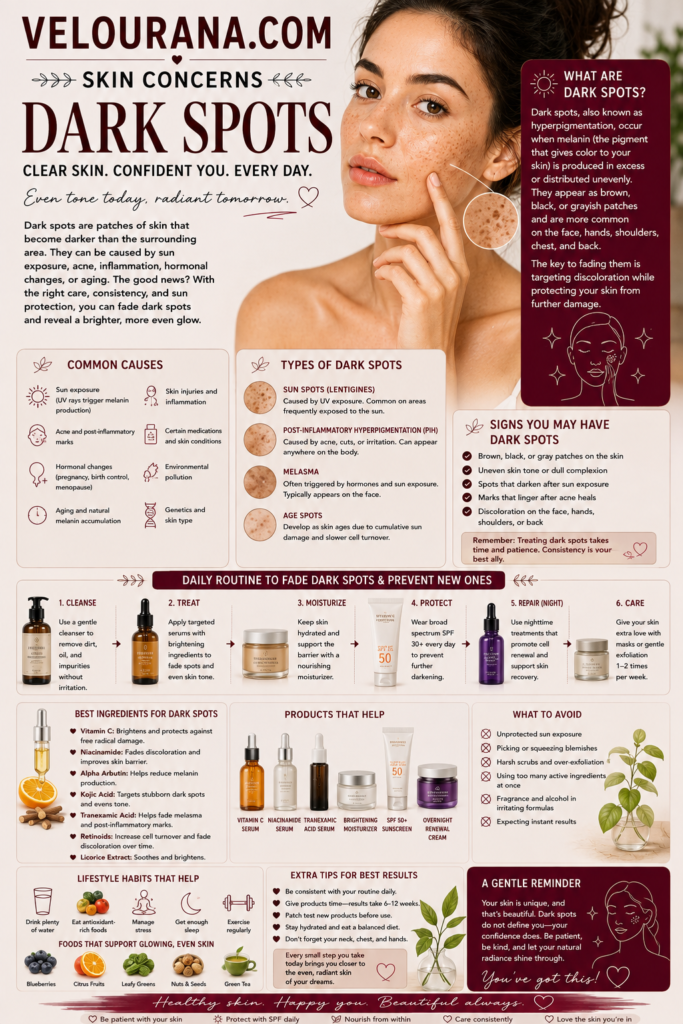
CATEGORY: Dark Spots
Dark spots rarely appear without a reason, yet the reason is often oversimplified. A person may blame the sun, a blemish, age, hormones, or even a particular skincare product, but pigmentation usually develops through an interaction between several biological forces rather than one isolated trigger.
The visible result may look simple: one area of skin is darker than another.
The process behind it is not.
Pigment production is regulated by melanocytes, specialised cells that respond to signals from ultraviolet radiation, inflammation, hormones and surrounding skin cells. When those signals become stronger, more persistent or unevenly distributed, melanin production can increase in specific areas.
This means that dark spots are often better understood as a response than as a defect.
The skin is reacting to something.
The practical importance of this idea is substantial. If pigmentation is being maintained by sunlight, no brightening serum can perform at its best without photoprotection. If inflammation is the trigger, harsh treatment may worsen the problem. If hormones are involved, the pigmentation may behave differently from an ordinary post-acne mark.
Understanding what creates dark spots therefore becomes the foundation of treating them intelligently.
Melanin Is a Protective Pigment, Not an Enemy
Melanin exists for biological reasons.
It contributes to the colour of the skin, hair and eyes, but within the skin it also plays an important protective role. After ultraviolet exposure, melanocytes can increase melanin production, helping absorb and disperse some of the energy associated with ultraviolet radiation.
The process begins inside melanocytes, where melanin is synthesised within structures known as melanosomes. These pigment-containing structures are then transferred to surrounding keratinocytes.
The distribution of melanin across the epidermis contributes to visible skin tone.
In hyperpigmentation, this system becomes locally more active or pigment becomes distributed in a way that makes one area appear darker than its surroundings.
This does not mean the pigment-producing system is malfunctioning in a simplistic sense. Often, it is responding exactly as biology designed it to respond.
Ultraviolet exposure sends a protective signal.
Inflammation sends another kind of signal.
Hormonal influences can alter melanocyte activity.
The resulting pigmentation may be cosmetically unwanted, but the mechanism itself reflects the skin's ability to respond to its environment.
This distinction encourages a more measured approach to treatment.
The objective is not to eliminate melanin.
It is to regulate excessive or uneven pigment production while preserving healthy skin function.
Ultraviolet Radiation Is One of the Most Powerful Pigment Triggers
Among all the influences on pigmentation, ultraviolet radiation is one of the most important.
Both UVA and UVB radiation can contribute to changes associated with pigmentation, although they interact with the skin in different ways.
UVB is strongly associated with sunburn and direct damage to the more superficial layers of the skin. UVA penetrates more deeply and contributes significantly to photoageing and pigmentary changes.
The pigment response to sunlight does not always appear immediately.
Some people notice that freckles or existing dark spots become more visible after summer. Others gradually develop lentigines over years of repeated exposure. Melasma may become dramatically more noticeable during sunnier months.
What connects these different experiences is repeated melanocyte stimulation.
This explains why pigmentation can return after apparently successful treatment.
A dark spot may fade during months of careful skincare, only to darken again during a period of increased exposure. The product has not necessarily stopped working. The skin has simply received renewed signals to produce pigment.
This is why sun protection occupies such a central position in pigmentation management.
It is not merely preventing future damage.
It is reducing one of the biological forces capable of maintaining the pigmentation already present.
Visible Light Can Matter More Than Many People Realise
Pigmentation research has also expanded attention beyond ultraviolet radiation.
Visible light, particularly higher-energy visible light, can contribute to pigmentation in certain skin types and conditions. This appears particularly relevant in melasma and in people with more deeply pigmented skin.
This has practical consequences.
Traditional sunscreens are designed primarily around protection from ultraviolet radiation. Broad-spectrum products help protect against UVA and UVB, but visible-light protection may require additional consideration.
Tinted sunscreens containing iron oxides can provide useful protection against visible light.
This is one reason tinted photoprotection is often discussed in the management of melasma and persistent hyperpigmentation.
The idea is not that everyone with one small post-acne mark requires a specialised tinted sunscreen.
Rather, pigmentation should be approached according to its biology.
If visible light is contributing to the condition, protection that addresses only ultraviolet exposure may not provide the most complete strategy.
This is another example of why identifying the type of pigmentation matters before selecting treatment.
Inflammation Can Turn a Temporary Problem Into a Long-Lasting Mark
A pimple may remain visible for a week.
The pigmentation it leaves behind may remain for months.
This difference illustrates the relationship between inflammation and melanocyte activity.
When the skin becomes inflamed, signalling molecules are released within the affected tissue. These signals can stimulate melanocytes, leading to increased production and transfer of pigment.
Once the inflammation resolves, the visible redness or swelling disappears, but the excess pigment may remain.
The result is post-inflammatory hyperpigmentation.
Acne is one of the most familiar triggers, but it is not the only one.
Eczema, insect bites, burns, scratches, allergic reactions, shaving irritation and cosmetic procedures can all create sufficient inflammation to leave residual pigmentation.
The severity of the original inflammation often influences how noticeable the resulting mark becomes.
Repeated injury can make matters worse.
A blemish that is squeezed, scratched and manipulated experiences more trauma than one that is left relatively undisturbed.
This is why picking acne can increase the risk of persistent marks.
The behaviour may shorten the person's tolerance for the blemish, but it can lengthen the skin's recovery from it.
Irritation From Skincare Can Become Its Own Pigmentation Trigger
A brightening routine can paradoxically create more pigmentation when it is too aggressive.
This is one of the most important and least intuitive principles in treating dark spots.
Many ingredients used for pigmentation work by increasing turnover, influencing pigment production or modifying the behaviour of skin cells. Retinoids, exfoliating acids and other active ingredients can be highly useful.
But all active treatment exists within the skin's tolerance.
When irritation becomes excessive, inflammation follows.
If inflammation stimulates pigmentation, then an overly aggressive brightening routine can undermine itself.
This often occurs gradually.
A person introduces an acid toner, then a retinoid, then an exfoliating cleanser. A vitamin C serum stings slightly, but that is interpreted as normal. The skin begins feeling tight after washing. Moisturiser burns for several seconds.
None of these signs may appear severe enough to trigger concern.
Together, however, they can suggest a compromised barrier.
The problem becomes especially relevant in skin tones that are highly prone to post-inflammatory hyperpigmentation.
The correct response is not necessarily to abandon every active ingredient.
It is to reconsider frequency, concentration, layering and overall routine complexity.
Treatment should influence pigmentation without repeatedly creating the inflammatory conditions that stimulate it.
Hormones Can Change the Behaviour of Pigment-Producing Cells
Hormonal influences add another layer of complexity.
Melasma is the most familiar example.
It commonly develops as symmetrical brown or grey-brown patches on areas such as the cheeks, forehead and upper lip. Pregnancy, hormonal medications and genetic predisposition can contribute to its development.
Hormones do not act alone.
Sunlight remains an important trigger.
This interaction explains why melasma can emerge or worsen during periods of hormonal change but often becomes more pronounced after sun exposure.
It also explains why treatment can be frustrating.
Removing one trigger does not necessarily eliminate the others.
A person may no longer be pregnant, for example, yet the pigmentation can persist. Another may stop a hormonal medication but continue to experience recurrence during sunny periods.
This behaviour differs considerably from a single post-inflammatory mark.
Melasma often needs to be managed as a chronic pigmentary tendency rather than a one-time stain.
That distinction changes expectations.
Improvement can be substantial, but maintenance becomes part of the strategy.
Genetics Influence How Readily Skin Produces Pigment
Not everyone responds to the same trigger in the same way.
Two people may experience similar acne inflammation but develop very different amounts of post-inflammatory pigmentation.
Genetics contributes to this variation.
Baseline skin tone, melanocyte activity and the way pigment is produced and distributed all influence how visible hyperpigmentation becomes.
People with medium and deep skin tones frequently experience post-inflammatory hyperpigmentation more readily and for longer periods.
This does not mean lighter skin is immune.
Fair skin can develop significant pigmentation from sun exposure, inflammation and hormonal conditions as well.
The difference lies in how the pigmentary system responds.
Understanding this variation is important because it makes one-size-fits-all advice unreliable.
An exfoliating treatment that is easily tolerated in one person may provoke pigmentation in another.
A professional procedure that works well on one skin type may require different settings or may carry greater risk in another.
Pigmentation treatment should therefore reflect the characteristics of the individual complexion rather than rely on universal assumptions.
Heat May Influence Certain Pigmentation Disorders
Heat is sometimes overlooked in conversations about pigmentation.
It does not create every dark spot, and its role should not be exaggerated. However, heat can contribute to worsening melasma in some people, particularly when combined with other triggers.
This is relevant because heat exposure can occur without direct sunlight.
Cooking over high temperatures, saunas, hot environments and certain occupational exposures may affect individuals whose melasma is especially reactive.
The practical message is not to avoid ordinary warmth or become fearful of temperature.
It is to recognise patterns.
If pigmentation repeatedly worsens after certain environmental exposures, that observation may provide useful information.
Pigmentation is highly individual.
What is irrelevant for one person can become a meaningful trigger for another.
Repeated Friction Can Produce Pigmentation Gradually
Not every inflammatory event is dramatic.
Repeated rubbing or friction can create low-grade irritation that eventually contributes to darker areas.
This may occur where clothing repeatedly rubs against skin, where shaving is frequent, where a mask or accessory creates friction, or where the same area is habitually touched.
The pigmentation may develop so slowly that the connection is missed.
By the time the area becomes noticeably darker, the underlying behaviour feels completely normal.
This is one reason treating colour alone can fail.
If friction continues every day, a brightening ingredient is working against a constant source of irritation.
Changing the physical environment can sometimes be more important than adding another topical treatment.
Again, the principle is upstream control.
Pigmentation is often easier to manage when the trigger is reduced.
Age Changes the Pattern of Pigmentation
Dark spots become more common with age, but age itself is not always the direct cause.
The more important factor is accumulated exposure.
Years of ultraviolet radiation can lead to areas of increased pigmentation such as solar lentigines, particularly on the face, hands and other chronically exposed regions.
The term "age spots" can therefore be misleading.
They are associated with age because exposure accumulates over time, not because a particular birthday activates pigment production.
This distinction matters because it reinforces the preventive role of sun protection.
Someone in their twenties may not yet see significant sun-related pigmentation, but cumulative exposure is already contributing to what may become visible later.
Conversely, established lentigines in later life reflect years of biological history.
Topical treatments may improve their appearance, but professional therapies are sometimes required for more noticeable change.
As always, distinct or changing pigmented lesions should be medically assessed rather than automatically assumed to be harmless sun spots.
Acne and Pigmentation Often Form a Self-Sustaining Cycle
Acne-related pigmentation deserves special attention because it commonly produces repeated dark spots in the same person.
The cycle usually begins with inflammation.
A blemish develops. It becomes red, swollen or tender. Pigment production increases during the inflammatory response. The blemish resolves, leaving a mark.
Before the mark has had time to fade, another blemish appears.
The complexion then contains active acne alongside older pigmentation and sometimes early scarring.
This creates an understandable temptation to treat everything at once with aggressive products.
But uncontrolled acne means the supply of new pigmentation continues.
Effective management therefore requires a dual strategy.
Existing marks can be treated, but preventing future inflammatory lesions is equally important.
Ingredients such as retinoids or azelaic acid may be useful because they can contribute to both acne management and pigmentation improvement.
The larger lesson is that the cause and consequence should not be separated.
Treating post-acne dark spots while ignoring acne itself is incomplete.
Why the Upper Lip and Cheeks Can Be Particularly Difficult Areas
Certain facial regions seem especially prone to stubborn pigmentation.
The upper lip is one example.
Melasma frequently affects this area, but irritation from hair removal, shaving or waxing can also contribute to darker colour.
This can make diagnosis difficult.
Someone may assume a darkened upper lip is purely hormonal when repeated hair-removal irritation is contributing as well.
The cheeks present another common pattern.
They receive substantial sun exposure and are frequent sites of melasma, post-acne pigmentation and sun-related lentigines.
Multiple forms of pigmentation may therefore overlap in the same region.
This overlap is another reason professional assessment can be useful when pigmentation appears unusually persistent.
One treatment may not address every component.
The visible colour may represent several mechanisms at once.
Why Pregnancy Can Change Pigmentation So Dramatically
Pregnancy produces significant hormonal changes, and pigmentation is one of the visible ways skin can respond.
Some individuals develop melasma, sometimes referred to as the "mask of pregnancy," while others notice darkening in areas that were already more pigmented.
The precise experience varies widely.
For some, pigmentation fades substantially after pregnancy.
For others, melasma remains.
The persistence reflects the fact that once the pigment-producing system has been activated, removing the initial hormonal trigger does not necessarily reverse every downstream effect immediately.
Light exposure can continue maintaining pigmentation after hormonal levels have changed.
This is why photoprotection remains important even when the original hormonal influence has diminished.
Treatment during pregnancy also requires additional caution because certain skincare ingredients are not appropriate during pregnancy.
Medical guidance is valuable when pigmentation becomes a significant concern during this period.
Stress Is Often Blamed, but the Relationship Is Indirect
People sometimes report that dark spots worsen during stressful periods.
The relationship is difficult to simplify.
Stress is not usually considered a direct equivalent of ultraviolet radiation or inflammation when discussing pigmentation. However, stress can influence behaviours and conditions that affect skin.
Acne may worsen.
Eczema may flare.
Sleep and skincare routines may deteriorate.
Picking and touching the skin may increase.
All of these can indirectly create more inflammation and therefore more pigmentation.
This is a useful reminder that skin conditions rarely exist in isolation from everyday life.
The pathway from trigger to dark spot may involve several steps.
Treating the Trigger Can Be More Powerful Than Treating the Colour
The most effective pigmentation strategies frequently operate before pigment becomes visible.
If acne is controlled, fewer post-inflammatory marks form.
If eczema is managed, fewer inflamed patches develop pigmentation.
If the skin barrier is protected, treatment itself is less likely to trigger new marks.
If sun exposure is managed, existing pigmentation receives less ongoing stimulation.
If friction is reduced, low-grade inflammation may decrease.
This approach may feel slower because it does not produce the immediate satisfaction of applying a product directly to a dark spot.
Yet it changes the biological conditions that created the problem.
That is a deeper form of treatment.
Correction Works Best After the Biological Environment Is Stabilised
Once major triggers are controlled, corrective treatments can work in a more favourable environment.
Ingredients that influence melanin synthesis, pigment transfer or cellular turnover may gradually reduce visible contrast between the dark spot and surrounding skin.
The exact choice depends on the pigmentation type, skin tolerance and overall routine.
Vitamin C, azelaic acid, retinoids, niacinamide, alpha-hydroxy acids, kojic acid and medically supervised treatments all have potential roles.
But the effectiveness of these ingredients cannot be separated from the environment in which they are used.
A powerful brightening serum applied to repeatedly inflamed skin is working against biology.
The same serum used on calm, protected skin has a better opportunity to contribute to improvement.
This is why treatment should be seen as an ecosystem rather than an ingredient competition.
Dark Spots Tell You What the Skin Has Been Responding To
Pigmentation is often treated as an isolated visual imperfection.
In reality, it is frequently a record.
A mark after acne records inflammation.
A sun spot records cumulative ultraviolet exposure.
Melasma reflects a more complex interaction between pigment biology, hormones, genetics and environmental light.
A darker patch after repeated rubbing records mechanical irritation.
The colour tells part of the story.
Understanding the rest of that story changes how treatment is approached.
Instead of immediately asking which product will remove the mark, it becomes possible to ask what created the signal, whether that signal is still present, and what can be done to reduce it.
That sequence prevents a great deal of unnecessary experimentation.
It also explains why successful pigmentation treatment often looks surprisingly calm.
The skin is protected.
Inflammation is controlled.
The barrier is supported.
A small number of appropriate active ingredients are used consistently.
Progress is measured over months.
This is not a dramatic approach, but dark spots rarely respond best to drama.
They respond to biology.
And biology becomes far easier to work with once the trigger behind the pigment is understood.
The End Velourana
 Discover More From Our Family of Websites
 ZodiacBearing (Astrology, Tarot, Numerology, Angel Numbers & Spiritual Guidance)
 Velourana (Beauty, Makeup, Hair Care, Skincare & Beauty Tips)
 HavenBearing (Home, Living, Organization, Décor & Everyday Inspiration)
 PawBearing (Pet Care, Dog Breeds, Animal Health, Training & Pet Products)
 PsyCatherine (Notes From the Journal of a Psychologist on Real Life)

