
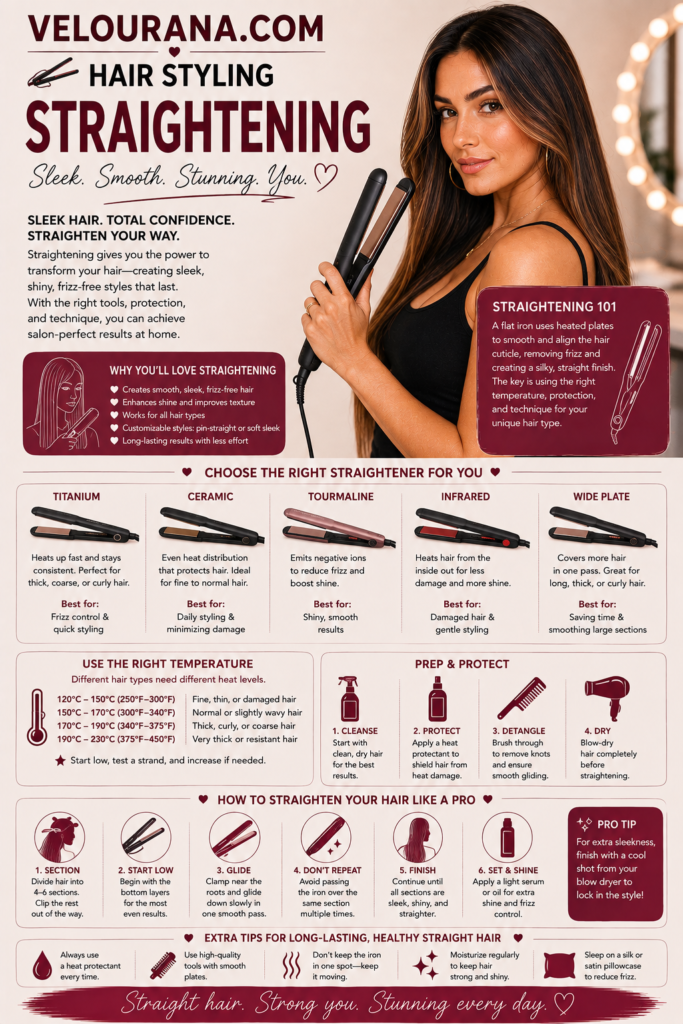
CATEGORY: Straightening
Long hair can make straightening look especially dramatic. When the lengths fall smoothly, the surface reflects light cleanly, and the ends move in one controlled direction, the hairstyle can appear exceptionally polished. Yet long hair also introduces challenges that shorter styles do not have to manage to the same degree.
The most obvious is weight.
Long hair naturally pulls downward. This can help create a sleek silhouette, but it can also flatten the crown and make the hairstyle feel heavy if every section is straightened in exactly the same direction. The oldest ends may also behave very differently from the newer growth near the scalp because they have lived through far more washing, brushing, environmental exposure and previous styling.
Straightening long hair well therefore requires more than simply making the entire length smooth.
The roots need enough control to integrate with the style, but they do not always need to be flattened. The middle lengths need consistent direction. Layers should remain visible where the haircut contains them. The ends need to look deliberate without being repeatedly reheated simply because every pass travels through them.
This becomes even more important when the hair is very dense, color-treated, highlighted or frequently styled. A technique that ignores the different needs of the roots, middle lengths and ends can create unnecessary repetition.
The better approach is to think of long hair as several connected styling zones.
The crown determines the profile.
The upper lengths determine whether the style feels full or flat.
The middle creates most of the visual smoothness.
The ends finish the silhouette.
Once those areas are treated according to what they actually need, long straight hair can look sleek without becoming lifeless and polished without appearing overworked.
Long Hair Benefits From a Smooth Foundation Before Direct Straightening
The condition of the hair before the straightener is introduced can have a major effect on the amount of work required afterward.
If long hair has been dried without direction, the lengths can contain irregular bends, tangles and sections that move against one another. A flat iron then has to correct all of that while also creating the final finish.
A controlled blow-dry can simplify the task.
For naturally straight or lightly wavy hair, the blow-dry may already create most of the desired smoothness. The straightener can then be used selectively through the most visible sections, the ends or any areas that remain irregular.
For stronger waves, curls or coils, blow-drying can stretch and organize the texture before direct heat is introduced.
This division of work becomes particularly useful with long hair because the styling process is already time-consuming. There is little value in asking one tool to perform every stage if another stage can make the final refinement easier.
The objective is not to create a perfect blowout before straightening.
It is to create a manageable foundation.
Hair that is dry, detangled and moving in a relatively consistent direction is much easier to divide into clean sections.
Heat protection should also be incorporated according to the instructions of the chosen product and the tools being used. Long hair can require careful distribution simply because there is more surface area to cover.
The product should support the styling process without making the lengths unnecessarily heavy.
Fine long hair may respond poorly to excessive product accumulation, while dense or coarse-feeling hair may have different needs.
The preparation should make the hair easier to style, not more difficult.
Sectioning Prevents Long Hair From Becoming a Repetitive Styling Process
The greater the length and density, the easier it becomes to lose track of which areas have already been styled.
Long hair can fall back over the shoulders.
Finished sections can become mixed with unfinished ones.
A strand can accidentally receive another pass simply because it has returned to the working area.
Organized sectioning helps prevent this.
The lower hair can be separated and styled first while the upper layers remain clipped away. Once a section is completed, it can be kept apart from the hair that still requires work.
This creates a clear progression through the head.
Dense long hair benefits particularly because a large section may appear smooth on the outside while the interior remains wavy or textured. Smaller working sections allow the straightener to interact more consistently with the strands.
Fine long hair may require fewer divisions, but sectioning still provides control.
The section should be narrow enough for the tool to work effectively and broad enough that the process does not become unnecessarily fragmented.
The exact size depends on density, natural texture and the design of the straightener.
What matters is that one controlled pass can create the intended result.
If a section repeatedly emerges only partly straightened, the first question should be whether too much hair is being styled at once.
Increasing heat or automatically repeating the pass may not solve the underlying problem as efficiently as simply changing the section size.
Root Volume Should Be Preserved Before the Lengths Pull It Down
Long hair has enough weight to reduce root lift naturally.
If the roots are also deliberately straightened downward, the effect can become even stronger.
This may be appropriate for an extremely sleek, flat style. It is not necessary when the goal is straight hair with body.
The crown can retain a small amount of elevation.
The front can have movement around the part.
The upper lengths can remain smooth without being pressed tightly against the scalp.
This creates a more balanced silhouette.
A useful approach is to establish root shape during the blow-drying stage. The crown can be lifted slightly away from its natural resting position before the hair is fully dry.
When the straightener is later used, it does not necessarily need to begin directly at the scalp on every section if the roots are already smooth enough.
The tool can focus on the areas where additional refinement is needed.
This is especially effective on naturally straight and wavy long hair.
Curly and coily textures may need more root attention depending on the intended level of sleekness, but even then, root direction can be chosen deliberately.
Straight does not have to mean compressed.
A fuller straight finish can be exceptionally flattering on long hair because it prevents the length from visually dragging the hairstyle downward.
The Middle Lengths Carry Most of the Visual Smoothness
When people look at long straightened hair, much of the impression of sleekness comes from the middle lengths.
This large area reflects light, moves over the shoulders and creates the continuous flow that makes the hairstyle look polished.
The middle therefore deserves consistency.
Sections should move through the tool in a controlled direction rather than being repeatedly started, stopped and corrected.
A smooth pass produces a more even finish.
The section should also remain detangled. If the tool encounters knots, the movement becomes less consistent and the hair may need additional handling.
This is one reason preparation matters so much.
The middle lengths do not necessarily need dramatic shaping.
Often, they simply need to become smooth enough that the hair flows as one surface.
The ends and face-framing sections can provide most of the visible direction.
This allows the hairstyle to remain simple.
Long straight hair is often most elegant when the middle lengths are not overcomplicated.
The Ends of Long Hair Should Be Treated as Their Own Styling Zone
The ends may be the most visually important part of long straight hair after the face-framing sections.
They determine whether the hairstyle looks sharp, soft, heavy or fluid.
They are also usually the oldest part of the hair.
This combination makes them especially deserving of deliberate treatment.
A common straightening routine brings the tool from the roots through the ends during every pass. If the upper section needs additional correction, the complete root-to-tip motion may be repeated automatically.
The ends receive the heat again even if they were already smooth.
Over time, this can become one of the most repetitive parts of the routine.
A more precise technique recognizes when the ends are finished.
If they already fall correctly, they can be left alone while another area receives additional attention.
The desired shape should also be chosen deliberately.
Completely straight ends create a sharp, modern finish.
A slight inward curve produces softness.
A small outward movement can reveal layers.
The end does not need to be intensely manipulated to create a visible difference.
Long hair provides enough length that a subtle change in direction can look very elegant.
The strongest finish is usually the one that looks intentional without appearing stiff.
Long Layers Need Straightening That Preserves Their Architecture
Layered long hair can lose much of its visual depth when every section is straightened into the same vertical plane.
The haircut still contains different lengths, but the sections may overlap so completely that the layers become difficult to see.
A little variation in direction solves this.
Shorter layers near the crown can retain more volume.
Face-framing pieces can move away from the face.
Mid-length layers can be directed slightly outward or inward depending on the desired shape.
The longest hair can remain the smooth foundation underneath.
This creates straight hair that still looks layered.
The difference is particularly noticeable when the haircut contains long curtain bangs or pronounced face framing.
These sections should not be treated like the longest back pieces.
Their purpose is to create movement around the face.
The straightener can smooth them while preserving that direction.
A small outward sweep can be enough.
The section remains straight through most of its length but does not hang rigidly beside the cheek.
That distinction makes the haircut look more intentional.
Fine Long Hair Needs Smoothness Without Losing Air
Fine long hair can become visually flat very easily because both the strand diameter and the weight of the length encourage the hair to lie close to the head.
Straightening can intensify this if every section is pressed downward from the roots.
The better objective is often sleekness through the surface while preserving enough space at the crown and between the layers to maintain body.
Fine hair can respond quickly to the tool, so repeated passes are rarely useful once the section is smooth.
Preparation should also remain compatible with volume. Several rich smoothing products can make fine lengths appear heavier.
Heat protection remains part of the routine, but the complete product combination should leave the hair flexible.
A small amount of root lift can make a substantial difference.
Long layers can also help because the shorter sections carry less weight and can sit away from the hair underneath.
Straightening should reveal that separation rather than flatten it.
The ends may benefit from a slight curve instead of being pressed into a perfectly rigid line.
This creates more movement and can make the hair appear fuller.
Fine long hair often looks most polished when it remains fluid.
The smoothness should make the strands look refined, not compressed.
Dense Long Hair Needs More Organization Than More Aggression
Long dense hair can make straightening feel like a major project simply because of the volume of hair involved.
The temptation is to take larger sections to save time.
That often creates inconsistent results.
The outer strands become sleek while internal hair remains textured, and the section needs to be repeated.
More disciplined sectioning is usually more efficient.
The lower layers can be treated first, followed by the middle and visible upper sections.
This also allows different levels of refinement.
Internal sections need enough straightening to integrate into the overall silhouette. The surface, front and perimeter need greater cosmetic precision because they are more visible.
This hierarchy can reduce unnecessary work without compromising the final appearance.
Dense hair can also retain natural root volume beautifully.
There is little reason to eliminate all of that fullness unless a very flat finish is specifically desired.
Smooth dense hair with controlled volume can look especially luxurious.
The straightener organizes the texture while allowing the density to remain part of the style.
Long dense hair also holds broad directional movement well.
A slight inward curve at the ends can create a substantial flowing shape.
Layers can move outward without disappearing immediately.
The natural abundance of the hair supports the styling rather than working against it.
Wavy Long Hair Can Be Straightened More Selectively Than Expected
Long wavy hair often does not require the same amount of direct straightening in every area.
A good blow-dry may already soften much of the pattern.
Some sections may fall almost straight naturally.
Others may retain stronger bends.
The straightener can focus on those inconsistencies rather than automatically treating the entire head equally.
This selective approach can preserve more natural body.
The roots may remain slightly fuller.
The middle lengths become smoother.
The ends can be shaped.
A little of the original wave may remain underneath without being visually obvious.
This creates a finish that looks straight but not unnaturally flat.
Long wavy hair also benefits from preserving some layer separation.
Its natural body helps shorter sections sit away from the longest lengths.
Straightening should organize that volume, not automatically erase it.
The result can be particularly elegant because the hair still moves easily even after the wave pattern has been reduced.
Curly Long Hair Needs a Planned Transformation
Curly long hair requires more change in shape, and that makes planning essential.
The process is easier when divided into stages.
The hair can first be prepared and stretched appropriately according to the chosen routine. A controlled blow-dry may create a smoother, elongated foundation.
The straightener can then refine the sections.
This progressive approach can reduce the amount of correction required from direct heat.
Sectioning becomes particularly important because long curly hair can contain significant density.
The roots and internal sections need to be managed consistently if the final result is expected to appear cohesive.
The desired level of volume should be chosen before styling begins.
For an ultra-sleek finish, the roots may receive more refinement.
For a fuller straight style, some natural elevation can remain.
Both can look polished.
The difference is aesthetic.
Long curly hair can produce especially impressive straightened movement because the natural volume provides body even after the curl pattern has been elongated.
The goal should not automatically be to remove that body.
It can become one of the strengths of the finished hairstyle.
Coily Long Hair Can Become Smooth While Remaining Full
Long coily hair can create a striking straightened silhouette because the transformation affects both texture and volume.
The process benefits from clear organization.
Preparation creates manageability.
Appropriate stretching can reduce the original coil pattern.
Controlled sections allow the straightener to work efficiently.
The final finish can then be adjusted according to the desired degree of sleekness.
The hairline may require different treatment from the rest of the head because the strands can be finer or shorter.
The crown can retain volume if a fuller finish is wanted.
The lengths can become smooth while still occupying considerable space.
This creates straight hair that looks abundant rather than compressed.
The ends may also need more careful observation because long coily hair can have a substantial difference between newer growth and older lengths.
The styling routine should respond to the actual condition of each area rather than treating the entire strand as though it has one uniform history.
Precision is more useful than force.
If a section is not responding as expected, the cause should be examined before simply repeating the same action.
Long Color-Treated Hair Requires Particular Attention to the Oldest Ends
Color-treated long hair can contain several generations of processing on the same strand.
The newest growth may have experienced very little chemical treatment.
The middle lengths may have been colored several times.
The ends may have years of accumulated processing.
This makes condition-based straightening particularly important.
A technique that feels appropriate at the roots may be excessive for the ends.
If the ends smooth quickly, they should not be repeatedly reheated simply because another part of the section remains resistant.
Highlighted or lightened lengths may also respond differently from darker or untreated areas.
The styling routine should adapt when the hair changes.
If the hair begins feeling more fragile or the ends behave differently, the solution should not automatically be more heat.
Section size, preparation, tool settings and the overall routine may need reconsideration.
Long hair rewards observation because the differences along the strand are more pronounced.
The more precisely those differences are treated, the more polished the finished style can look.
The Front Sections Can Make the Entire Style Look Finished
Long hair contains many sections, but the front often has the greatest visual influence.
A beautifully straight back can still feel unfinished if the face-framing pieces sit awkwardly.
These sections should therefore be styled according to the face and haircut rather than according to the longest hair behind them.
Curtain bangs can remain smooth while sweeping outward.
Long layers can move backward from the cheekbones.
A side fringe can retain enough bend to sit naturally.
These directional changes can be subtle.
The hair remains straight.
The difference is that it no longer simply hangs.
Because front pieces are shorter, they may respond more quickly to the tool.
One controlled movement may be enough.
Repeated passes can flatten them or create too much curvature.
The best result usually looks effortless, as though the front naturally falls into that position.
Straightening Very Long Hair Should Become More Selective With Experience
When someone first begins straightening very long hair, the process can feel mechanical.
Divide.
Pass.
Repeat.
Over time, a more efficient routine should become increasingly selective.
Some sections may already look good after blow-drying.
Some roots may not need direct heat.
Certain internal layers may require only light refinement.
The visible surface and front may deserve more attention.
The ends may need shaping but not repeated reheating.
This knowledge reduces unnecessary work.
It also creates a better-looking result because the hairstyle retains more variation and movement.
Professional-looking straight hair is not defined by whether every strand received identical treatment.
It is defined by whether the finished silhouette looks coherent.
Second-Day Long Hair Rarely Needs Another Full Straightening Session
The length of the hair can actually help a straightened style survive because the weight keeps much of it falling in a relatively consistent direction.
What changes overnight is usually localized.
The crown can flatten.
The roots around the hairline may recover some natural texture.
One side can develop a bend from sleeping.
The front can lose its sweep.
The ends may remain almost unchanged.
A second-day routine should respond to those specific areas.
The entire length does not need to be straightened again simply because the front has changed.
A targeted refresh can restore the silhouette while preserving the softer movement that develops naturally after the first day.
This is particularly useful for long hair because a full restyle takes time and repeatedly exposes the oldest ends.
The style can also evolve into other hairstyles.
Smooth lengths work beautifully in ponytails, braids, half-up styles and buns.
A straightening session can therefore support several days of different looks rather than requiring the exact same loose style to be recreated every morning.
Long Straight Hair Should Move, Not Hang Like a Single Sheet
One of the risks of over-straightening long hair is that the individual sections begin behaving like one continuous flat surface.
The result can be technically smooth but visually heavy.
Movement prevents this.
The crown retains some lift.
Layers occupy slightly different positions.
The front moves around the face.
The ends have enough direction to complete the shape.
When the wearer turns their head, the hair shifts and settles again.
This is what makes long straight hair look luxurious rather than merely flattened.
The finishing stage should therefore preserve flexibility.
The sections can be blended without excessive brushing.
Products can support smoothness where appropriate but should not make the hair rigid or unnecessarily heavy.
The finished hairstyle should still respond naturally to movement.
Straightening Long Hair Well Is Ultimately About Knowing Where to Stop
Long hair makes restraint especially important because every unnecessary pass travels across a large amount of hair.
A successful routine becomes more precise over time.
The roots are treated according to the amount of texture and volume desired.
The middle lengths are smoothed consistently.
The ends are finished once they look correct.
Layers are allowed to remain visible.
The front is directed deliberately.
Areas that are already smooth are left alone.
The same principle applies to temperature and repetition.
If a section has reached the intended result, another pass does not make the hairstyle more complete.
It simply repeats work that has already been done.
This becomes even more important when the hair is fine, color-treated or very long because the ends have accumulated the most history.
The strongest technique is therefore not the most aggressive.
It is the most observant.
Fine long hair can remain sleek while preserving enough root lift to look full.
Dense long hair can become smooth without sacrificing its natural abundance.
Wavy hair can retain some body.
Curly and coily textures can be transformed progressively rather than treated as though every section must be forced immediately into straightness.
Layers can continue to create dimension.
The ends can provide polish without becoming rigid.
Second-day hair can be refreshed only where necessary.
All of these choices serve the same objective: straight hair that looks deliberate but still alive.
Long hair already has drama because of its length.
Straightening should not remove everything else that makes it beautiful.
The surface can become smooth.
The direction can become controlled.
The silhouette can become polished.
But the hair should still move.
It should still reveal the haircut.
It should still have enough volume to avoid looking dragged downward by its own length.
When the roots, middle lengths and ends are treated according to their different roles, long straightened hair becomes much more sophisticated.
The technique disappears.
What remains is the impression of clean, flowing length—sleek enough to look refined, soft enough to move naturally, and controlled enough that every part of the hairstyle appears intentionally placed.
The End
Velourana.
 Discover More From Our Family of Websites
 ZodiacBearing (Astrology, Tarot, Numerology, Angel Numbers & Spiritual Guidance)
 Velourana (Beauty, Makeup, Hair Care, Skincare & Beauty Tips)
 HavenBearing (Home, Living, Organization, Décor & Everyday Inspiration)
 PawBearing (Pet Care, Dog Breeds, Animal Health, Training & Pet Products)
 PsyCatherine (Notes From the Journal of a Psychologist on Real Life)

