
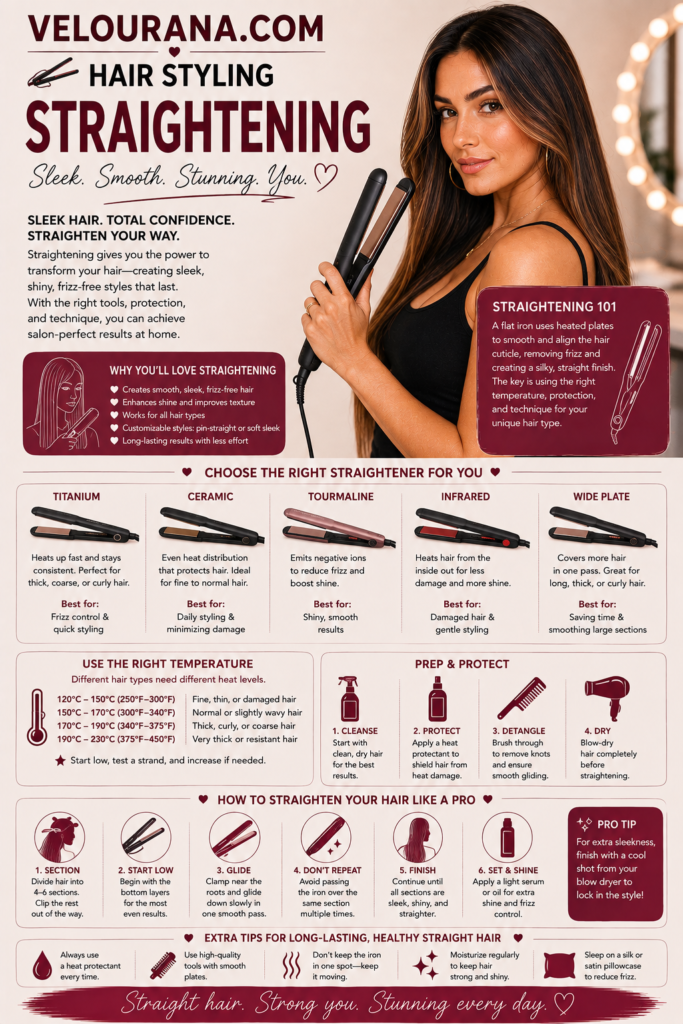
CATEGORY: Straightening
A straightened hairstyle can look extremely polished when it is first finished. The surface appears smooth, the ends fall in a controlled direction, the crown is shaped deliberately and the face-framing sections sit exactly where they should. The challenge comes later, when the style begins to change.
Humidity can affect the hairline. Sleeping can introduce bends. The roots may regain some of their natural texture. The crown can lose lift. One side may flatten more than the other. The ends may remain smooth while the front has already changed.
This does not mean the entire hairstyle has failed.
It means straightened hair, like any temporary style, evolves.
The most useful straightening routine is therefore not only about creating the first-day result. It is also about preserving enough structure that the hairstyle can remain attractive as it softens. A well-straightened style should not depend on every strand staying frozen in exactly the same position.
It should be able to relax and still look intentional.
This is where preparation, sectioning, root direction, end shape and selective refreshing become especially important. If the original style has been built thoughtfully, the following days usually require much less work than a complete restart.
The front can be refreshed without touching the back.
The crown can regain lift without reheating all of the ends.
One bend can be corrected while the remainder of the lengths stay untouched.
That approach preserves both the quality of the hairstyle and the natural movement that develops after the first day.
Lasting Straight Hair Starts With the First Styling Session
Longevity is influenced by how the style is created from the beginning.
If the hair is straightened in oversized sections and repeatedly passed through the tool, the immediate result may look smooth, but the underlying structure may be inconsistent. Some strands may be more polished than others, and hidden texture can begin reappearing quickly.
Working in manageable sections creates a more reliable foundation.
The tool can interact with the hair consistently.
The roots can be directed according to the intended volume.
The middle lengths can be smoothed evenly.
The ends can be finished with purpose.
Once a section is complete, it can be left alone.
This reduces the need for correction during the original session and gives the hairstyle a clearer shape to carry forward.
The straightening technique should also reflect the natural texture.
Naturally straight hair may need only refinement.
Wavy hair may need more smoothing through selected areas.
Curly or coily hair may benefit from an organized stretching or blow-drying stage before direct-contact straightening.
The stronger the original texture, the more important it becomes to make the transformation progressive rather than repetitive.
The goal is to create a foundation that can survive gradual softening without immediately losing its identity.
The Crown Should Be Built to Survive Some Relaxation
Root volume rarely remains exactly as high as it was immediately after styling.
This is especially true on long hair, where the weight of the lengths naturally pulls downward.
If the final goal is straight hair with some lift, the crown should be styled with enough structure to tolerate a little relaxation.
That does not mean creating exaggerated height.
It means avoiding unnecessary compression.
The roots can be dried or directed with some elevation before the straightener is used. The tool can then focus on refining the texture without flattening every section tightly against the scalp.
This creates a more resilient silhouette.
As the style settles, the volume becomes softer rather than disappearing completely.
Fine hair benefits particularly from this because a small amount of crown lift can make a substantial visual difference. Dense hair may require less deliberate elevation because it already contains natural volume.
The ideal amount depends on the haircut and the intended finish.
The important point is that root volume should be designed to soften gracefully.
If the style begins completely flat, there is no room for that evolution.
Face-Framing Sections Need More Longevity Than Perfect Uniformity
The front usually changes first.
These pieces are touched more frequently, exposed to skin and humidity, tucked behind the ears and moved constantly through the day.
Curtain bangs can lose their sweep.
Side sections can turn inward.
Long face-framing layers can flatten.
Because the front has such a strong visual influence, even small changes can make the entire hairstyle feel less polished.
The solution is not necessarily stronger initial straightening.
It is better directional styling.
If curtain bangs are intended to move outward, they should be straightened and shaped with that movement in mind from the beginning. Long front layers can be directed backward rather than simply pressed vertically downward.
This gives them a defined pathway.
As they soften, they are more likely to retain some of that directional character.
The front does not need to remain perfectly identical to its first-hour appearance.
It simply needs to continue framing the face attractively.
This is an important distinction because longevity should preserve the purpose of the section, not necessarily every millimeter of its original shape.
The Ends Should Be Styled for the Way They Will Relax
Ends behave differently depending on the shape created initially.
Perfectly straight ends can gradually become softer through movement and contact with clothing.
A slight inward curve can relax into a subtle polished finish.
An outward flick can become gentler while still revealing layers.
The intended second-day appearance should therefore be considered when the first-day shape is created.
Long hair often benefits from slightly more deliberate curvature because the weight of the lengths will soften it naturally.
Medium hair may retain the bend more strongly.
Short hair may need only a very subtle initial movement.
The ends should not be overworked in an attempt to make them last indefinitely.
Instead, the first shape should be appropriate to the length and expected relaxation.
Once that shape is achieved, the ends should be left alone.
Repeated passes simply to reinforce a bend can create more heat exposure without producing a proportionally better result.
Fine Hair Needs a Longevity Strategy Built Around Lightness
Fine straightened hair often looks most attractive when it remains airy.
The challenge is preserving that quality over multiple days.
Heavy product accumulation can reduce volume.
Repeated root straightening can compress the crown.
Constantly brushing the hair with heated tools can remove the subtle separation that makes the style appear fuller.
A fine-hair longevity strategy should therefore be selective.
The first-day style should use enough root lift to create body without relying on excessive product.
The middle lengths should be smoothed efficiently.
The ends should be shaped once.
The following day, the hair should be assessed before any heat is used again.
If the lengths remain smooth, they do not need to be restyled.
If only the crown is flat, the crown can be addressed.
If the front has changed, the front can be reshaped.
This preserves the lightness of the original style.
Fine hair often benefits more from maintaining movement than from maintaining absolute perfection.
A slightly softer second-day finish can actually look more natural and fuller than hair that has been repeatedly pressed back into an ultra-flat state.
Dense Hair Often Holds Straightness Better Than It Holds Shape
Thick and dense hair may remain smooth for a long time after straightening, but the silhouette can still change.
The crown may lose some direction.
The front may become less controlled.
The ends may soften.
The overall density remains, so the style can still look full even when the original shape has relaxed.
This is why second-day dense hair often needs shaping rather than complete straightening.
The visible upper sections deserve the most attention.
A surface layer that has developed an awkward bend can be corrected.
The face-framing pieces can be redirected.
The crown can be refined.
The internal sections usually do not need to be restyled simply because the outer shape has changed.
This is one of the advantages of dense hair.
Its natural volume can help the style remain impressive even after some of the first-day precision has disappeared.
The refresh should preserve that advantage.
There is little reason to compress the hair further every morning when the density itself contributes to the beauty of the straightened finish.
Wavy Hair Can Become More Natural as the Straight Style Softens
Wavy hair often creates one of the most attractive transitions between first-day and second-day straightness.
Immediately after styling, the hair may look very smooth and controlled.
As time passes, some of the natural body can begin reappearing underneath.
The roots may gain a little more movement.
The lengths may develop subtle bends.
If the style remains coherent, this can create a softer and more natural finish rather than a failed one.
The temptation to immediately erase every returning wave can lead to unnecessary re-straightening.
A better approach is to identify which sections genuinely disrupt the silhouette.
Perhaps one bend is too strong.
Perhaps the front is no longer sitting correctly.
Perhaps the crown has become uneven.
Those areas can be corrected selectively.
The rest can remain.
This allows some of the natural character of wavy hair to re-enter the hairstyle without destroying the straight effect.
The result can be polished and relaxed at the same time.
Curly and Coily Hair Need a Different Definition of Lasting Straightness
When naturally curly or coily hair is straightened, the contrast with the original texture is greater.
Humidity, moisture and time may encourage the natural pattern to begin returning, especially around the roots and hairline.
The goal should not be to pretend this possibility does not exist.
Instead, the style should be built and maintained with realistic expectations.
The first straightening session should create a strong, organized foundation through appropriate preparation and sectioning.
The roots should be treated according to the desired level of sleekness.
The lengths should be refined consistently.
The ends should be shaped.
Afterward, the hairstyle can be allowed to soften.
If the hairline changes first, the refresh can focus there.
If the roots begin recovering texture while the lengths remain smooth, the styling decision can focus on the upper area.
If humidity affects the entire style substantially, it may be more practical to transition into another hairstyle rather than repeatedly reheating the entire head.
This is especially useful because straightened curly and coily hair often remains an excellent foundation for ponytails, buns and half-up styles even after the roots begin changing.
Longevity does not need to mean keeping the hair loose and perfectly straight for as many days as possible.
It can mean extending the usefulness of the original styling session across several different looks.
Second-Day Straightening Should Be Diagnostic
The most important habit in maintaining straight hair is looking at the hairstyle before switching on the tool.
What actually changed?
Is the entire head less straight?
Or is one side bent from sleeping?
Are the ends still smooth?
Has only the front lost its direction?
Is the crown flatter?
Are the roots slightly more textured while the lengths remain polished?
The answer determines the refresh.
This diagnostic approach prevents automatic full-head restyling.
It also saves time.
A five-minute correction can sometimes restore the entire appearance.
The front and crown usually provide the greatest visual return for the least amount of work.
If those areas look intentional, the whole hairstyle often appears refreshed even when the lengths are softer than before.
This is where styling becomes more intelligent.
The goal is not to repeat yesterday's process.
It is to restore today's silhouette.
One Bend Does Not Require a Full Straightening Session
Sleeping can create localized bends in otherwise straight hair.
A section may curve around the shoulder.
One side may have been compressed under the head.
A strand tucked behind the ear may retain that shape.
These small changes can be corrected individually.
There is no need to straighten the neighboring hair if it already looks good.
The same applies to ends.
If one layer is turning outward awkwardly while the rest remain straight, only that section needs attention.
The ability to isolate a problem is one of the easiest ways to reduce unnecessary repetition.
It also preserves the natural softness that develops in the rest of the hairstyle.
A fully re-straightened section may look much more precise than the surrounding second-day hair.
Selective correction works best when the new refinement is blended gently into the softer areas around it.
The objective is coherence.
Not first-day perfection.
The Hairline Often Needs the Most Care and the Least Repetition
Hair around the hairline can be finer, shorter and more exposed to moisture than the lengths.
It can therefore change quickly.
This is also one of the areas most likely to be restyled repeatedly because it is visible.
A careful technique should balance those two realities.
If the hairline needs correction, the smallest amount of effective styling is preferable to repeatedly working it.
The section should be controlled.
The intended direction should be clear.
Once the hair sits properly, stop.
The entire front does not need to be reheated simply because one small area has changed.
This precision becomes particularly valuable for people who straighten frequently.
The front can accumulate far more styling attention than the back over time simply because it is visible every time the person looks in the mirror.
Awareness helps prevent that from becoming automatic.
Product Buildup Can Change the Way Second-Day Hair Responds
The hair used for a second-day refresh is not the same surface that existed immediately after washing.
It may already contain heat protectant, leave-in products, smoothing products or finishing products from the original session.
Adding another full layer of everything before each refresh can change how the hair behaves.
Fine hair may become heavy.
Dense hair may feel coated.
The straightener may move differently through the section.
The hair may appear less fluid.
This does not mean products should never be reapplied.
It means the instructions of the specific product should guide how and when it is used.
Some heat protectants are designed for particular conditions or repeated dry styling.
Others are intended mainly for damp hair before blow-drying.
The routine should follow those directions rather than assuming every refresh begins like wash day.
If the hair suddenly feels more difficult to style, product accumulation should be considered alongside temperature and technique.
More heat is not automatically the answer.
The surface itself may have changed.
Humidity Should Influence the Hairstyle Strategy, Not Just the Tool Setting
Humidity can alter straightened hair quickly, especially when the natural texture is wavy, curly or coily.
This is often treated as a battle to be won through repeated straightening.
A more practical approach is to consider how much correction makes sense for the environment.
If only the hairline changes, a localized refresh may be enough.
If the entire style is beginning to return toward its natural texture, repeatedly re-straightening the whole head throughout the day may not be the most useful strategy.
The hairstyle can evolve.
A ponytail can use the smooth lengths.
A bun can hide changing roots.
A half-up style can control the crown while preserving the straight lower hair.
The original styling work still has value even when the loose straight finish is no longer perfect.
This flexibility is part of long-lasting styling.
The goal is to extend the usefulness of the hair, not force it to remain permanently unchanged.
Straightened Hair Can Become More Beautiful on the Second Day
Freshly straightened hair can sometimes appear almost too precise.
The sections are highly separated.
The roots are freshly shaped.
The ends sit exactly as styled.
After several hours or a night of sleep, the hair can soften.
The sections blend.
The crown relaxes.
The movement becomes more natural.
For many hairstyles, this second-day softness is extremely attractive.
It can make long straight hair look fluid rather than formal.
Layers can begin interacting more naturally.
The ends can lose a little stiffness.
The front can look less deliberately styled.
The key is distinguishing attractive softening from genuine loss of structure.
If the hairstyle still feels balanced, there may be nothing to fix.
A slightly softer style can be the desired evolution rather than a problem.
This mindset reduces unnecessary heat and often produces a more natural result.
Straightened Hair Is an Excellent Foundation for Updos and Ponytails
One of the best ways to extend a straightening session is to stop expecting the hair to remain loose every day.
Smooth lengths create a strong foundation for many other hairstyles.
A low ponytail can look polished immediately because the surface is already controlled.
A high ponytail can use the straight lengths to create movement.
A half-up style can disguise changes at the crown while preserving the lower hair.
A bun can benefit from the smooth texture.
A French twist can use the straightened lengths to create a clean structure.
Braids can introduce another texture without requiring another full heat session.
This creates a useful progression.
The first day can feature loose straight hair.
The second can be a softer version.
The third can become a ponytail or half-up style.
The fourth can become an updo.
One straightening session can support several days of styling possibilities.
That is a more flexible form of longevity than trying to preserve one exact loose hairstyle indefinitely.
Heatless Techniques Can Change Straight Hair Without Starting Again
Straightened hair can also be transformed without immediately returning to direct heat.
Large rollers can introduce broad movement.
Braids can create waves.
Twists can create softer bends.
An overnight arrangement can give the ends curvature.
These changes allow the style to evolve while using the smooth foundation created earlier.
The result will not be identical to a curling iron or fresh blowout.
It does not need to be.
The purpose is to create another attractive stage.
Straightened hair is already organized, which makes it particularly suitable as a foundation for these techniques.
This can reduce the impulse to alternate repeatedly between straightening and curling tools over the same lengths.
The Ends Should Receive Less Attention as the Days Progress, Not More
By the second or third day, the ends may already be smooth enough.
They may have softened slightly, but that can be attractive.
Repeatedly passing the straightener through them simply because the roots need correction adds unnecessary repetition to the oldest part of the hair.
A more selective refresh can begin where the problem exists and stop before reaching the ends if the tool and technique allow.
If the ends genuinely need shape, they can be treated separately.
This distinction becomes especially important on long, lightened or frequently styled hair.
The ends should be finished when they need finishing.
They should not be automatically included in every correction made elsewhere.
A Lasting Straight Style Is One That Changes Gracefully
The most successful straightening routine does not create hair that never changes.
That is unrealistic.
It creates a hairstyle that remains attractive as it changes.
The roots soften.
The crown loses a little height.
The ends become less rigid.
The front requires occasional adjustment.
The natural texture may begin reappearing gradually.
Yet the overall silhouette remains coherent.
This is the real measure of longevity.
Fine hair can retain enough root movement to avoid looking flat.
Dense hair can keep its abundance while the surface remains controlled.
Wavy hair can allow a little natural body to return.
Curly and coily hair can use selective refreshing while the lengths remain smooth.
Long hair can preserve polished ends without reheating them unnecessarily.
Shorter styles can maintain their shape through targeted corrections.
Processed hair can be handled according to its current condition.
Second-day hair can be softer without looking unfinished.
Third-day hair can become another hairstyle entirely.
The straightening tool becomes less important as the days progress because the original styling continues doing part of the work.
The Best Straightening Routine Knows When Not to Straighten Again
Perhaps the most important skill in making straightened hair last is knowing when no further heat is required.
A small bend is not always a problem.
A softer end is not always a problem.
A slightly fuller root is not always a problem.
A natural wave returning underneath can sometimes improve the style.
The question is whether the hairstyle still looks intentional.
If it does, leave it.
If one area disrupts the shape, correct that area.
If the whole style has reached the end of its loose-hair phase, transition into another hairstyle.
This is more efficient than endlessly trying to restore the exact first-day finish.
It also preserves the qualities that make straight hair attractive.
Movement.
Softness.
Shine.
Layer separation.
A clean silhouette.
The goal of straightening should never be to make the hair look increasingly rigid with every refresh.
It should be to create a smooth foundation that remains useful.
A foundation that can soften.
A foundation that can be corrected selectively.
A foundation that can become a ponytail, bun, braid or half-up style later.
When straightening is approached this way, longevity stops being about how long every strand remains perfectly flat.
It becomes about how long the styling continues to serve the hair.
That is a more realistic and more sophisticated standard.
The first-day result is only the beginning.
The real success lies in how well the hairstyle continues to move, adapt and remain polished after the straightener has been put away.
The End
Velourana.
 Discover More From Our Family of Websites
 ZodiacBearing (Astrology, Tarot, Numerology, Angel Numbers & Spiritual Guidance)
 Velourana (Beauty, Makeup, Hair Care, Skincare & Beauty Tips)
 HavenBearing (Home, Living, Organization, Décor & Everyday Inspiration)
 PawBearing (Pet Care, Dog Breeds, Animal Health, Training & Pet Products)
 PsyCatherine (Notes From the Journal of a Psychologist on Real Life)

