CATEGORY: Straight Brows
Straight brows often appear effortless, but creating a convincing version can involve considerable visual judgment. Their apparent simplicity leaves little room for heavy-handed correction. With a dramatic arch, the peak itself becomes the focal point. With a straight eyebrow, attention shifts toward continuity, texture, thickness, and the subtle relationship between the upper and lower boundaries.
The objective is rarely to produce a perfectly horizontal strip of color. Natural faces contain curves, changes in bone structure, variations in hair direction, and asymmetry. An eyebrow that ignores these characteristics can appear artificial even when technically symmetrical. Successful straight-brow styling therefore works with anatomy rather than against it.
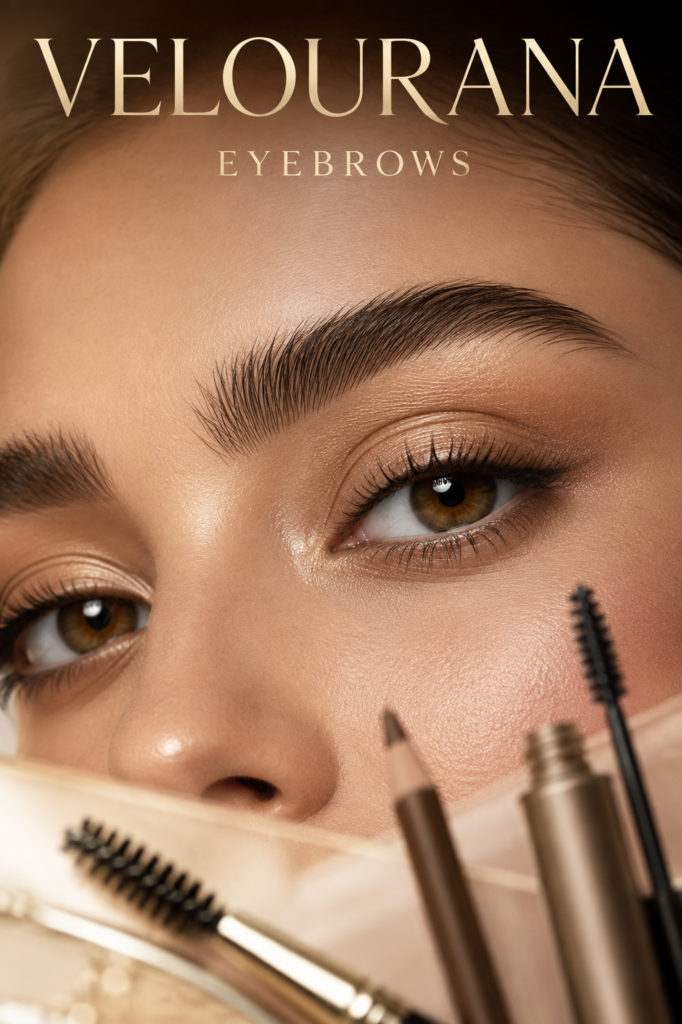
Cosmetics have expanded the possibilities considerably. Pencils can alter the apparent lower boundary, pens can recreate individual hairs, powders can establish soft density, and gels can redirect growth. These tools allow someone to explore a straighter silhouette without permanently removing substantial portions of a natural arch. They also make it possible to customize the result according to makeup style, hair color, eye shape, and occasion.
The most refined approach begins by recognizing what creates the existing brow shape. Sometimes the apparent arch comes from follicle placement. Sometimes it is produced primarily by sparse areas beneath the brow. In other cases, upward styling exaggerates a curve that becomes much flatter when the hairs are brushed sideways. Identifying the source determines which technique will create the most natural result.
Reading the Existing Brow Before Changing It
Before altering an eyebrow, it helps to view it without makeup and without forcing the hairs into an unusual direction. The natural brow should be brushed gently so that the growth pattern becomes visible.
The relationship between the brow head, body, highest point, and tail can then be assessed. A naturally straight eyebrow may show only a minimal difference in height between these areas. A moderately arched brow will rise more noticeably toward the outer third. A strongly arched brow may contain a significant elevation followed by a steeply descending tail.
This distinction determines how realistically the brow can be made to appear straight. A mild natural arch can often be softened cosmetically with very little hair removal. A strong arch may require either accepting a softly straight interpretation or making more extensive structural changes. In many cases, the former produces the better result because the brow continues to correspond with the underlying bone structure.
Density must be considered at the same time. Sparse areas can create optical illusions. If the underside of the central brow contains fewer hairs, the upper edge may dominate visually and make the eyebrow appear more arched than it actually is. Filling the sparse lower region can immediately flatten the perceived line.
Tail direction is another important diagnostic feature. Some brows remain relatively level through the body but turn sharply downward at the outer edge. Modifying the appearance of the tail may therefore produce a greater change than altering the arch itself.
Observing both eyebrows separately is essential. One may naturally sit higher or contain more curvature. Instead of choosing one as the absolute template and forcing the other to match it, it is usually more effective to identify a shared visual direction that both can achieve without excessive modification.
Using Makeup to Create a Straighter Lower Boundary
One of the most effective cosmetic methods for creating a straight-brow appearance involves adjusting the lower edge. The underside of the eyebrow strongly influences how its angle is perceived because it forms a visible line immediately above the eye.
If the lower boundary rises steeply toward the natural arch, adding subtle definition beneath that rise can reduce the apparent slope. This should be done gradually. Extending pigment too far below the natural hairs creates unnecessary thickness and can make the eyebrow look heavy.
A fine brow pencil provides control because small areas can be adjusted independently. Rather than drawing one uninterrupted line, short marks can establish a soft boundary while leaving some skin visible. This is especially useful when the natural brow contains gaps.
Brow pens can provide even greater textural realism when used carefully. Their fine tips allow individual strokes to be placed among existing hairs, creating the impression of additional growth beneath the arch. Stroke direction should correspond with surrounding hairs. Near the center, hairs may angle diagonally; farther outward, they usually become more horizontal.
Powder offers a different effect. Instead of imitating individual follicles, it creates a veil of density. This can be useful for naturally full brows where only a small amount of shadow is needed to smooth the lower edge. Powder also softens pencil or pen work that appears too precise.
The important principle is that the new boundary should integrate with the existing brow. Straightening is achieved through a series of subtle optical adjustments rather than a thick artificial underline.
Managing the Upper Edge Without Flattening the Brow Excessively
The upper boundary requires particular restraint because aggressive removal can permanently reduce brow thickness.
When someone wants a straighter shape, the highest portion of the natural arch may appear to be the obvious area to tweeze. Removing too many hairs there, however, can create a narrow patch and disrupt the relationship between the brow and forehead. The result may be technically flatter but visually weaker.
Isolated hairs that clearly sit outside the main brow structure can be treated differently from hairs that form the natural body. Removing a few distant strays may sharpen the silhouette without compromising density. The main upper line can then be influenced through styling rather than extensive extraction.
Brushing is particularly powerful. When central brow hairs are pushed strongly upward, they create vertical height and make the arch appear higher. Directing them diagonally outward reduces that elevation. The underlying follicles have not changed, yet the silhouette becomes noticeably straighter.
A transparent gel can maintain this direction without adding additional color. Tinted gel can simultaneously enhance density, although shade selection becomes important because excessive darkness may make a straight brow appear visually heavy.
Wax and brow soap can create stronger hold for coarse or resistant hairs. The objective does not necessarily need to be the highly laminated vertical effect frequently associated with these products. They can instead be used to guide hairs laterally, reinforcing the horizontal structure.
By controlling hair direction before removing hair, it becomes possible to determine whether permanent grooming is even necessary.
Creating a Soft Brow Head
The beginning of a straight brow can determine whether the entire design looks natural or overly constructed.
Because the main body is relatively flat, a sharply squared inner edge can make the eyebrow resemble a geometric block. Softening this region introduces organic texture and prevents the horizontal line from appearing severe.
Natural front hairs frequently grow upward. This vertical direction can be preserved even when the rest of the brow is brushed sideways. The contrast creates a gradual transition from the central face toward the horizontal body.
Pigment should usually be applied with less intensity here than through the middle. When using pencil or pen, individual strokes can be spaced apart. With powder, the remaining product on the brush is often sufficient to create a light shadow without producing a hard boundary.
The upper and lower edges should not necessarily begin at precisely the same vertical line. Slight irregularity can imitate natural growth. This becomes particularly important when the brow is full because a perfectly rectangular beginning can dominate the bridge of the nose.
The distance between the two brow heads also influences facial perception. Bringing them visually closer can strengthen the central frame, while creating more space can open the area above the nose. Adjustments should remain subtle because even small changes become noticeable when repeated on both sides.
A straight brow gains sophistication when the eye sees hairs first and geometry second. The structure should guide the shape without becoming the most obvious feature.
Controlling the Tail for a Straighter Finish
A straight eyebrow can lose its defining character if the tail drops dramatically. Tail styling is therefore one of the most important stages in maintaining horizontal movement.
Natural tail hairs are often finer and less dense than those through the body. This makes the area easier to modify cosmetically but also easier to overdraw. A solid line extending from the brow can appear disconnected from the textured hairs preceding it.
Fine strokes provide a more convincing continuation. They can extend slightly outward while gradually reducing the thickness of the brow. The upper and lower boundaries converge naturally toward the end rather than terminating abruptly.
When the natural tail curves downward, cosmetics can shift visual emphasis upward. The lowest hairs do not necessarily need to be concealed or removed completely. Instead, stronger definition can be placed along a slightly higher trajectory while the lower portion remains softly visible.
In some cases, selective grooming beneath the extreme tail can help. This should remain conservative because shortening or thinning the tail excessively can alter facial proportions.
Tail length must also correspond with the eye and temple area. Straight brows often encourage outward extension, but longer is not automatically better. Excessive length can visually drag the outer face sideways or make the brows appear disproportionately dominant.
The most balanced tail preserves the impression that the brow is moving toward the temple while acknowledging the natural curvature of the skull. A slight descent can therefore look more harmonious than an artificially rigid horizontal line.
Product Texture and Its Effect on Straight Brows
Different brow products can produce dramatically different interpretations of the same shape.
Pencils provide control and are particularly useful for adjusting boundaries. A fine pencil can imitate hairs or define specific sparse areas, while a softer pencil can create broader shading. Pressure is important. Heavy application can transform a naturally textured brow into a flat mass of pigment.
Brow powders create softness. Their diffused finish works particularly well when the objective is to make a straight brow look naturally dense rather than individually reconstructed. Because the edges remain less precise, powder can prevent the horizontal shape from appearing severe.
Pens are valuable for sparse brows because they can reproduce the directional character of hairs. They require a light hand, particularly near the brow head. Repeated strokes in identical lengths and angles can look artificial, whereas subtle variation produces greater realism.
Pomades provide strong definition and durability but can easily dominate a straight-brow design. Their opacity is useful for dramatic makeup, yet the product generally benefits from being applied in thin layers. Visible hair texture helps prevent the eyebrow from becoming a solid graphic bar.
Gels influence both color and direction. A tinted formula can increase the apparent density of existing hairs without extensively coloring the skin. Transparent gel concentrates entirely on structure and is especially effective when natural brow density is already sufficient.
Waxes and soaps offer greater control over stubborn hairs. They can flatten, lift, or redirect growth depending on brushing technique. For straight brows, lateral direction through the middle and outer sections often reinforces the desired silhouette.
The choice of product therefore changes more than durability. It determines whether the finished eyebrow appears airy, polished, dramatic, textured, or highly sculpted.
Choosing Color for a Balanced Result
Color intensity can influence the apparent weight of a straight eyebrow as strongly as thickness.
Very dark pigment creates a prominent horizontal line. This may be desirable with dramatic makeup, but it can overwhelm softer features when the brow is broad. Slightly softer color often allows natural hair variation to remain visible.
Hair color provides context but does not require an exact match. Brows naturally contain several tones because individual hairs, shadows, and skin create variation. A cosmetic product that is completely uniform can therefore appear less natural than one that harmonizes with the overall depth of the brow.
Undertone also matters. Excessively warm brow products may appear reddish against cooler hair, while very gray products can look dull against warmer coloring. Neutral or subtly balanced shades often provide flexibility.
The front of the brow generally benefits from lower saturation than the middle and tail. This gradient can be achieved through pressure rather than multiple products. A pencil applied lightly at the beginning and more firmly through sparse outer areas creates natural variation.
With very light brows, definition can be introduced without making them dramatically darker. A tinted gel may be enough to reveal individual hairs and establish the horizontal direction. With naturally dark brows, transparent styling products may provide all the structure required.
Straight brows do not need strong pigment to be visible. Their directional line already creates structure. Color should support that architecture rather than compete with it.
Straight Brows in Minimal and Natural Makeup
Straight brows are particularly compatible with minimal makeup because they can frame the face without introducing an obviously sculpted feature.
In a natural look, the emphasis can remain on hair texture. Sparse areas are filled only where necessary, and the boundaries are allowed to remain slightly irregular. The eyebrow still reads as straight because the overall direction is consistent.
Skin showing between hairs can be an advantage. It prevents the brow from becoming visually dense and creates continuity with bare or lightly covered skin elsewhere on the face.
A small amount of gel may be sufficient for naturally full brows. Hairs at the front can remain softly lifted, while the middle and tail are guided outward. This produces structure without the appearance of extensive cosmetic work.
When filling is required, concentrating pigment where density is genuinely missing usually produces a more convincing result than coloring the entire eyebrow. One area may require several hairlike strokes while another needs none.
This selective approach also preserves asymmetry. Rather than attempting to make both brows identical through increasingly heavy makeup, each can be refined according to its own growth pattern while maintaining comparable visual weight.
Minimal straight brows demonstrate that shape does not depend on sharp outlines. Direction, density, and proportion can establish architecture even when the edges remain soft.
Straight Brows in Polished and Dramatic Makeup
A straighter shape can also support sophisticated or dramatic makeup. The difference lies primarily in definition and contrast.
For a polished result, the lower boundary may be more clearly established, particularly through the central and outer sections. The upper line remains softer so that the brow retains dimension. Pigment can be concentrated toward the tail while the inner brow remains diffused.
With stronger eye makeup, additional brow intensity may be necessary to maintain balance. Smoky eyeshadow, graphic eyeliner, or substantial lashes create visual weight around the eyes. Brows that are too faint may appear disconnected from the overall composition.
Straight brows can complement elongated eyeliner particularly well because both elements direct attention toward the temples. The result can make the eye area appear wider and more extended.
Alternatively, lifted eyeshadow can provide contrast. The brow remains horizontal while the shadow moves diagonally upward, creating tension between two directional lines. This can introduce dimension without changing the eyebrow itself.
Highly graphic brows are another possibility. Crisp edges and stronger pigment transform the straight shape into a deliberate statement. This aesthetic is less concerned with imitating untouched hair and more concerned with precision. Even then, careful tapering and proportion remain important because an eyebrow of identical thickness from beginning to end can appear visually static.
Straightness is therefore compatible with many makeup intensities. What changes is the relationship between visible hair, pigment, and edge definition.
Avoiding an Artificially Flat Appearance
One of the most common problems with straight-brow styling is confusing straightness with absolute flatness.
A perfectly horizontal upper edge combined with a perfectly horizontal lower edge creates a rectangular form that rarely corresponds with natural growth. Human brows contain small changes in height and direction, even when their dominant shape is straight.
Allowing a slight rise through the middle or outer third can preserve dimension. The difference may be subtle enough that the eyebrow still appears straight at first glance.
Thickness should also change gradually. Natural brows commonly contain greater fullness through the inner and central sections before tapering. Maintaining this progression prevents the horizontal line from becoming monotonous.
Texture introduces another form of variation. Upward hairs at the front, diagonal hairs through the transition, and horizontal hairs toward the tail create movement within the broader shape. Styling every hair in exactly the same direction can remove this natural complexity.
The boundary between filled and unfilled areas should remain difficult to detect. When cosmetic additions beneath the arch are significantly darker than surrounding hairs, the attempt to straighten the brow becomes visible. Layering light strokes and soft shading generally produces a better integration.
The aim is not mathematical perfection. The most successful straight brows often contain tiny deviations that make the overall geometry believable.
Allowing the Shape to Evolve
Eyebrows change over time. Hair growth cycles, grooming habits, age, hormonal changes, cosmetic preferences, and hairstyle can all influence how a brow looks and how it is styled.
A shape that once required extensive filling may become easier to maintain after allowing previously removed areas to regrow. Conversely, naturally sparse regions may become more noticeable and require different products.
Beauty preferences also evolve. Someone may initially prefer an extremely flat eyebrow and later want a subtle arch. Maintaining as much natural hair as possible preserves this flexibility.
This is one of the strongest arguments for using cosmetics before committing to major structural grooming. Pencil, pen, powder, and gel can demonstrate how a new shape interacts with the face under different lighting and makeup conditions. If the effect remains appealing over time, grooming can be adjusted gradually.
Photography can provide useful perspective because brows seen closely in a mirror may appear different when viewed as part of the entire face. The broader view reveals whether they are proportionate, whether one appears heavier, and whether the horizontal direction complements other features.
Straight brows should ultimately feel integrated rather than imposed. Their purpose is not to satisfy a theoretical diagram but to establish a particular visual relationship across the upper face.
The Lasting Appeal of Straight Brow Styling
Straight brows have remained influential because they offer a distinctive alternative to strongly arched eyebrow architecture. Their horizontal movement can broaden the visual frame of the eyes, soften vertical emphasis, and create an expression that ranges from youthful and relaxed to precise and editorial.
Their apparent simplicity is deceptive. Small decisions about thickness, pigment, hair direction, tail length, and the position of the lower boundary can transform the final result. This sensitivity is precisely what makes straight-brow styling interesting.
A successful shape respects the natural eyebrow while gently reorganizing its visual direction. Instead of aggressively eliminating curvature, it reduces the dominance of the arch. Instead of drawing a rigid line, it builds continuity through hairs, shadows, and subtle adjustments.
For naturally straight brows, this may mean little more than preserving their original structure and resisting unnecessary shaping. For more arched brows, cosmetics can create a straighter interpretation without sacrificing substantial hair.
Ultimately, the category contains far more variation than its name suggests. Straight brows can be thick or thin, soft or defined, natural or graphic, short or elongated. What unites them is the predominance of horizontal movement.
When that movement is balanced with texture and facial proportion, the result feels deliberate without appearing forced. The eyebrow remains expressive, dimensional, and individual while retaining the calm geometry that defines the straight-brow aesthetic.
THE END VELOURANA
 Discover More From Our Family of Websites
 ZodiacBearing (Astrology, Tarot, Numerology, Angel Numbers & Spiritual Guidance)
 Velourana (Beauty, Makeup, Hair Care, Skincare & Beauty Tips)
 HavenBearing (Home, Living, Organization, Décor & Everyday Inspiration)
 PawBearing (Pet Care, Dog Breeds, Animal Health, Training & Pet Products)
 PsyCatherine (Notes From the Journal of a Psychologist on Real Life)