CATEGORY: SPF Ratings
SPF ratings are among the most visible pieces of information on any sunscreen label, but they are also surrounded by myths.
A higher number looks reassuring.
SPF 50 seems clearly stronger than SPF 30.
SPF 100 can appear almost unbeatable.
This encourages assumptions that sound logical but are often wrong.
Some people think doubling the SPF doubles the protection. Others believe a very high SPF lasts much longer, makes reapplication unnecessary, or allows them to remain in direct sunlight for many more hours.
SPF does matter.
But understanding what the number can and cannot tell you is essential if you want sunscreen to work properly in real life.
Myth: SPF 50 Gives Nearly Twice the Protection of SPF 30
This is one of the most common misunderstandings.
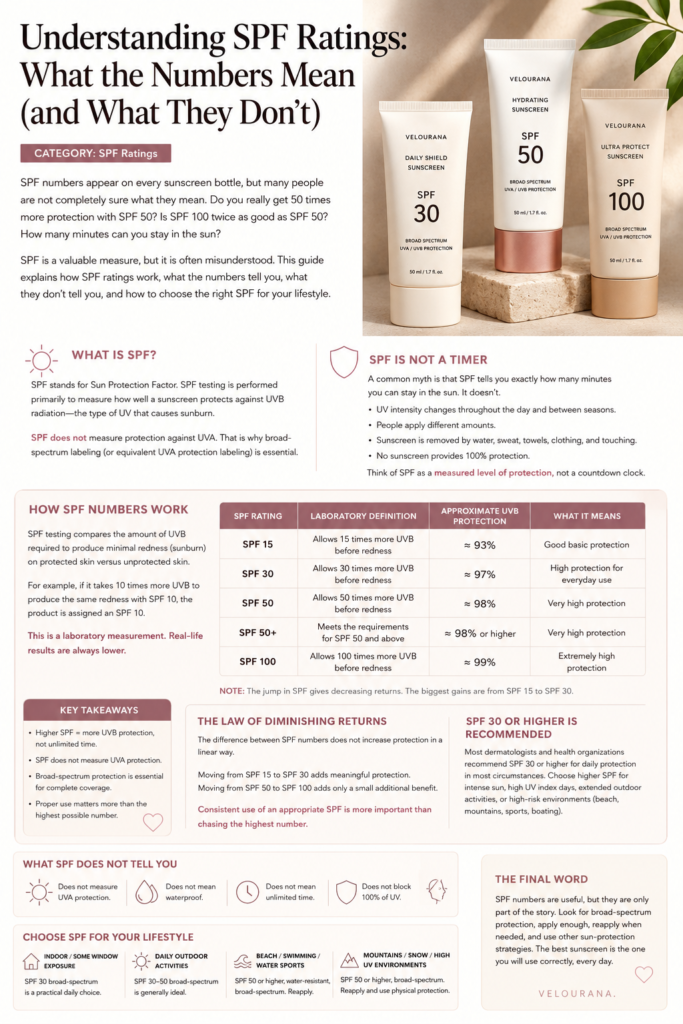
SPF numbers do not translate into a linear percentage of UVB blocked.
When applied correctly under standardized conditions, SPF 30 filters approximately 97 percent of UVB radiation.
SPF 50 filters approximately 98 percent.
This does not mean the difference is meaningless, but it is certainly not a doubling of protection.
Fact: SPF 50 Still Provides More Protection Than SPF 30
The additional protection is real.
Another way to understand it is by considering how much UVB reaches the skin.
SPF 30 allows more UVB through than SPF 50 under comparable test conditions.
This is why higher SPF can provide a useful additional margin.
Myth: SPF 100 Blocks All UV
No sunscreen blocks 100 percent of ultraviolet radiation.
Very high SPF can provide very high UVB protection, but complete blocking is not possible.
This is one reason sunscreen should be combined with shade, clothing, hats, and other forms of protection.
Fact: Higher SPF Reduces More UVB
Higher SPF ratings indicate greater tested protection against UVB-associated sunburn.
The increase becomes progressively smaller as SPF rises, but the additional protection can still matter.
Myth: SPF Measures UVA and UVB Equally
SPF primarily measures protection against UVB and sunburn.
It does not independently provide a complete measure of UVA protection.
This is why broad-spectrum or UVA-specific labeling matters.
Fact: A Good Sunscreen Should Address Both UVA and UVB
For balanced protection, check both the SPF rating and the relevant UVA or broad-spectrum information.
A high SPF without appropriate UVA protection does not provide a complete strategy.
Myth: SPF 50 Means You Can Stay in the Sun for Fifty Times Longer
This is a dangerous simplification.
SPF is not a clock.
Real-world ultraviolet intensity changes throughout the day.
Application amount varies.
Swimming, perspiration, rubbing, and towel drying can reduce protection.
No fixed time calculation can safely describe every situation.
Fact: SPF Is a Standardized Protection Rating
SPF tells you about tested UVB protection under defined conditions.
It is not permission to extend exposure indefinitely.
Myth: Higher SPF Lasts Longer
SPF 50 does not necessarily remain effective on the skin longer than SPF 30.
Durability is a separate issue.
Both can be removed by water, sweat, towels, clothing, or touching.
Fact: Reapplication Depends on Activity and Product Instructions
Water resistance, swimming, perspiration, and exposure conditions influence how often sunscreen needs attention.
Higher SPF does not eliminate this.
Myth: SPF 30 Is Too Weak for Everyday Use
Properly applied broad-spectrum SPF 30 provides high UVB protection.
For many ordinary daily situations, it can be a strong and practical choice.
Fact: SPF 50 Provides an Additional Margin
SPF 50 provides greater UVB protection and can be particularly useful during strong, prolonged, or high-risk exposure.
Myth: If You Use SPF 50, You Can Apply Less
This is incorrect.
The SPF rating assumes an adequate standardized application amount.
Applying too little reduces real-world protection.
Fact: Application Quantity Matters Greatly
The number on the bottle only becomes meaningful when enough product is applied evenly.
Myth: Half the Amount of SPF 50 Becomes SPF 25
The relationship is not that simple.
You cannot reliably calculate the resulting SPF at home.
Underapplication reduces protection unpredictably.
Fact: Use Sunscreen According to Directions
The correct solution is not mathematical guessing.
It is proper application.
Myth: Two Layers of SPF 30 Equal SPF 60
SPF values do not add together.
SPF 30 sunscreen plus SPF 30 foundation does not create SPF 60.
Fact: Layering May Add Practical Coverage but Not Additive SPF
A makeup product with SPF may provide supplementary protection, but the numbers cannot simply be added.
Myth: Mixing SPF 50 With Moisturizer Gives SPF 25
This is not reliable.
Mixing changes the sunscreen formulation and creates an untested product.
Fact: Apply Moisturizer and Sunscreen Separately
Use moisturizer first if needed.
Then apply sunscreen as formulated.
Myth: SPF Foundation Is Enough
Makeup with SPF can contribute to protection.
The problem is quantity.
Most people apply much less foundation than the amount required to achieve the labeled SPF under standardized testing.
Fact: Dedicated Sunscreen Usually Provides a More Reliable Base
A broad-spectrum sunscreen underneath makeup is often the more dependable approach.
Myth: SPF Powder Can Replace Regular Sunscreen
Powder SPF products can be convenient.
However, obtaining enough even coverage to reproduce the labeled protection can be difficult.
Fact: Powders Are Often Better as Supplementary Products
They may be useful for touch-ups rather than as the only sunscreen layer.
Myth: Sunscreen Sticks Work With One Swipe
A single light swipe may deposit too little product.
Fact: Sticks Need Careful, Repeated Application
Follow the manufacturer's directions and make sure the area is fully covered.
Myth: Spray Sunscreen Automatically Gives Even Coverage
Sprays are convenient, but convenience can hide underapplication.
A quick mist may leave gaps.
Fact: Spray Sunscreen Needs Enough Product
Apply according to instructions and ensure all exposed skin is covered.
Myth: Water-Resistant Means Waterproof
Water-resistant sunscreen is designed to maintain protection under defined water-exposure conditions for a limited period.
It is not permanent.
Fact: Reapply After Swimming
Follow the product directions.
Water resistance does not eliminate reapplication.
Myth: SPF 50 Survives Toweling Better Than SPF 30
The SPF number does not tell you how resistant the product is to rubbing.
A towel can remove either.
Fact: Toweling Can Disturb Any Sunscreen
Reapply when continued exposure is expected.
Myth: Sweat Does Not Matter if the Sunscreen Is High SPF
Perspiration can affect sunscreen regardless of the SPF rating.
Wiping sweat away can remove even more.
Fact: Outdoor Sport Requires Practical Reapplication
Choose a water-resistant product when appropriate and carry sunscreen with you.
Myth: Cloudy Days Need No SPF
Clouds can reduce some UV but do not necessarily eliminate it.
Fact: UV Exposure Can Occur Without Bright Sunshine
The UV Index is more useful than simply looking at the sky.
Myth: Cold Weather Means No UV
Temperature and ultraviolet radiation are different.
A cold day can still involve substantial exposure.
Fact: SPF Can Matter in Winter
This is particularly true at altitude and around snow, which can reflect UV.
Myth: Wind Reduces UV Exposure
Wind cools the skin but does not switch off UV radiation.
Fact: Wind Can Make Overexposure Easier
Because the skin feels comfortable, people may remain outside longer.
Myth: Water Protects You From the Sun
Swimming makes the body feel cool, but UV exposure continues.
Fact: Water Can Increase Practical Exposure Challenges
Reflection from water and sunscreen removal make protection particularly important.
Myth: Shade Means Sunscreen Is Unnecessary
Shade reduces direct exposure but does not always eliminate indirect or reflected UV.
Fact: Shade and Sunscreen Work Well Together
Use both when appropriate.
Myth: A Beach Umbrella Provides Complete Protection
UV can reflect from sand and water.
Fact: Physical Protection Should Be Layered
Umbrella, sunscreen, clothing, hat, and sunglasses can all contribute.
Myth: High SPF Replaces Protective Clothing
No.
Clothing provides continuous coverage over large areas and can be very useful during prolonged exposure.
Fact: Clothing Reduces the Burden on Sunscreen
Covering skin means fewer areas require repeated sunscreen application.
Myth: Hats Are Only for Comfort
Hats do much more than provide shade from heat.
Fact: A Broad-Brimmed Hat Protects Commonly Missed Areas
Scalp, ears, face, and neck can all benefit.
Myth: Sunglasses Are Only Cosmetic
Appropriate UV-protective sunglasses have an important protective role.
Fact: Sun Care Includes the Eyes
Broad-spectrum skin protection should be part of a wider strategy.
Myth: Darker Skin Does Not Need SPF
Darker skin contains more melanin and may burn less readily.
That does not make it immune to UV damage.
Fact: All Skin Tones Can Benefit From Protection
UV-related pigmentation, photoaging, and skin cancer can occur across skin tones.
Myth: Fair Skin Only Needs UVB Protection
Fair skin may burn quickly, which makes UVB particularly obvious.
UVA still matters.
Fact: Broad-Spectrum Protection Is Important for Fair Skin Too
The goal is protection from both major forms of UV reaching the skin.
Myth: White Cast Means You Should Use Less Sunscreen
Reducing the amount may make the product less visible, but it also reduces protection.
Fact: Choose a Better Formula
Tinted or more transparent sunscreens can improve cosmetic appearance without sacrificing quantity.
Myth: Mineral Sunscreen Is Always Better
Mineral sunscreen can be an excellent option.
It is not automatically superior in every situation.
Fact: The Final Formulation Matters
Broad-spectrum protection, tolerability, texture, application, and user preference all matter.
Myth: Organic or "Chemical" Filters Are Automatically Bad
The word chemical is often used in a misleading way.
Organic UV filters are regulated sunscreen ingredients.
Fact: Different Filter Systems Can Provide Excellent Protection
The finished tested sunscreen is what matters.
Myth: Mineral Sunscreen Never Irritates
Any formulation can potentially be unsuitable for a particular individual.
Fact: Sensitive Skin Should Evaluate the Entire Product
The UV filters are only part of the formula.
Myth: Higher SPF Means More Grease
SPF rating does not determine texture.
Fact: High-SPF Sunscreens Can Be Extremely Lightweight
Modern SPF 50 fluids and gels can feel lighter than some SPF 30 creams.
Myth: Higher SPF Always Leaves More White Cast
White cast is influenced by filter system and formulation.
Fact: Both SPF 30 and SPF 50 Can Be Transparent or Tinted
Choose according to cosmetic preference and skin tone.
Myth: Expensive Sunscreen Protects Better
Price does not automatically determine SPF performance.
Fact: Affordable Sunscreen Can Provide Excellent Protection
Protection depends on formulation, testing, and correct use.
Myth: Cheap Sunscreen Must Be Inferior
A lower price can reflect simpler packaging, branding, or distribution rather than poor protection.
Fact: Read the Label
Check SPF, UVA coverage, water resistance, and instructions.
Myth: Luxury Sunscreen Is Pointless
Not necessarily.
Fact: Cosmetic Elegance Can Improve Adherence
If a luxurious texture makes someone apply sunscreen properly every day, that experience has practical value.
Myth: Sunscreen Should Be Saved Because It Is Expensive
A sunscreen is designed to be used.
Fact: Rationing Can Lead to Underapplication
An affordable sunscreen used generously may be more useful than an expensive one applied sparingly.
Myth: The Same SPF Is Perfect for Every Situation
Exposure conditions vary enormously.
Fact: Context Matters
An office day, beach day, hiking trip, and swimming session may require different product characteristics.
Myth: SPF 30 Is Always Enough for Everything
SPF 30 provides high protection, but stronger exposure may justify SPF 50 or SPF 50+ and more aggressive physical protection.
Fact: Higher Exposure Requires Greater Care
The SPF number is only one part of that care.
Myth: SPF 50 Is Always Necessary Indoors
Exposure varies depending on windows, location, and time spent outside.
Fact: Sunscreen Strategy Should Reflect Real Exposure
There is no benefit in turning sun care into irrational fear.
Myth: Indoor Workers Never Need Sunscreen
Commuting, driving, outdoor lunches, windows, and errands can all create exposure.
Fact: Daily Broad-Spectrum Sunscreen Can Provide a Practical Baseline
A comfortable routine simplifies decision-making.
Myth: Drivers Do Not Need UVA Protection
Vehicle glass can allow UVA through depending on the glass.
Fact: Frequent Drivers Can Benefit From Broad-Spectrum Protection
Hands, arms, and the side of the face may receive repeated exposure.
Myth: Sunscreen Around Windows Is Always Unnecessary
The answer depends on actual exposure.
Fact: UVA Can Pass Through Ordinary Glass More Effectively Than UVB
Someone sitting directly beside a bright window for hours may have different needs from someone in an interior room.
Myth: SPF Prevents All Tanning
No sunscreen blocks all UV.
Fact: Some tanning can still occur
This does not mean sunscreen has failed.
Myth: If You Tan but Do Not Burn, the Exposure Is Safe
A tan is a biological response to UV.
Fact: The Absence of Burn Does Not Equal the Absence of Damage
UVA exposure in particular can occur without dramatic redness.
Myth: High SPF Makes Intentional Tanning Safe
No sunscreen makes deliberate prolonged UV exposure risk-free.
Fact: Sunscreen Is for Protection, Not Tanning Optimization
If cosmetic color is desired, self-tanning products avoid deliberate UV tanning.
Myth: Self-Tanner Replaces SPF
Most self-tanners do not provide meaningful sun protection unless specifically formulated and tested to do so.
Fact: Continue Using Sunscreen
A tan appearance is not UV protection.
Myth: Tanning Beds Are Safer Than Sunlight
Tanning beds expose the skin to ultraviolet radiation.
Fact: Artificial UV Exposure Also Carries Risk
They should not be treated as a safe alternative.
Myth: After-Sun Lotion Repairs UV Damage
After-sun products can improve comfort and hydration.
Fact: They Do Not Erase Exposure
Prevention remains more important than attempting to manage discomfort afterward.
Myth: Aloe Cancels Out Sunburn
Aloe gel may feel refreshing.
It does not reverse the ultraviolet injury that produced the burn.
Fact: Sunburn Should Be Prevented
Severe burns may require medical attention rather than cosmetic treatment.
Myth: Cooling Skin Means the Damage Is Gone
A cold gel can reduce discomfort.
Fact: Sensation and damage are different
Feeling better does not mean the exposure has been erased.
Myth: Reapplication Is Only for the Beach
Daily activities can also disturb sunscreen.
Fact: Reapplication Depends on Circumstances
Extended outdoor exposure, swimming, sweating, toweling, and washing can all make it relevant.
Myth: SPF on Hands Lasts All Day
Frequent washing removes sunscreen.
Fact: Hands May Need Reapplication
This matters particularly during driving or outdoor activities.
Myth: The Face Is the Only Area Worth Protecting
Beauty marketing often focuses heavily on facial SPF.
Fact: UV Reaches Every Exposed Area
Neck.
Chest.
Ears.
Hands.
Arms.
Legs.
Scalp.
Lips.
All deserve attention when exposed.
Myth: Ears Are Protected by Facial Sunscreen Automatically
Only if sunscreen actually reaches them.
Fact: Apply Deliberately
The ears are commonly missed.
Myth: Hair Always Protects the Scalp
Hair coverage varies.
Fact: Exposed Parts and Thinning Areas Need Attention
A hat can be particularly useful.
Myth: SPF Lip Balm Once in the Morning Is Enough
Lip products are easily removed.
Fact: Reapply
Eating, drinking, swimming, and wiping all reduce coverage.
Myth: Sunscreen Cannot Expire
It can.
Fact: Check Expiration and Period After Opening
The SPF rating assumes a stable product.
Myth: Storage Does Not Matter
Extreme heat can affect cosmetic products.
Fact: Follow Storage Instructions
Avoid leaving sunscreen in very hot environments unnecessarily.
Myth: A Bottle in the Car Is Always Convenient
It may be convenient, but cars can become extremely hot.
Fact: Convenience Should Not Compromise Storage
Choose another accessible location when appropriate.
Myth: Counterfeit Sunscreen Is Only a Branding Problem
It is also a protection problem.
Fact: Fake SPF Can Create False Confidence
Purchase from reputable sources.
Myth: You Can Make Reliable Sunscreen at Home
SPF formulation requires precise science and testing.
Fact: DIY Sunscreen Cannot Guarantee Protection
Use professionally formulated products.
Myth: Adding More Zinc Oxide Automatically Raises SPF Predictably
Uniform dispersion and formulation are critical.
Fact: You Cannot Calculate Reliable SPF in a Kitchen
Standardized testing is required.
Myth: SPF Labels Are Pure Marketing
SPF is a regulated tested claim in legitimate sunscreen markets.
Fact: The Number Has Real Meaning
The mistake is not trusting SPF.
The mistake is interpreting it incorrectly.
Myth: The Highest Number Is Always the Only Smart Choice
Very high SPF can be useful, but other factors matter.
Fact: Protection and Usability Should Be Balanced
Broad-spectrum coverage.
Adequate quantity.
Texture.
Water resistance.
Reapplication.
These are all important.
Myth: SPF 30 Is Pointless Because SPF 50 Exists
SPF 30 remains a strong protection level.
Fact: Both Can Have a Place
SPF 50 provides an additional margin, while SPF 30 can work very well in many everyday circumstances.
Myth: The Difference Between 30 and 50 Is So Small It Never Matters
The commonly quoted percentages can make the difference look trivial.
Fact: Less UVB Reaches the Skin With SPF 50
The additional protection is meaningful, particularly during strong exposure.
Myth: SPF 50 Is So Strong That Other Protection Is Unnecessary
No sunscreen is complete protection.
Fact: Physical Measures Remain Important
Shade.
Clothing.
Hats.
Sunglasses.
Behavior.
Myth: Sunscreen Means You Can Ignore the UV Index
The UV Index provides valuable environmental information.
Fact: High UV Requires More Care
SPF should be combined with appropriate behavior.
Myth: Sun Protection Has to Be Complicated
It does not.
Fact: A Good Routine Can Be Simple
Choose broad-spectrum SPF 30 or higher.
Apply enough.
Cover exposed skin.
Reapply when necessary.
Use shade and clothing.
Myth: You Need to Memorize Every UV Filter
Most consumers do not.
Fact: Understand the Label Instead
Check the SPF.
Check broad-spectrum or UVA protection.
Check water resistance.
Read the directions.
Myth: Sunscreen Education Means Fear of the Sun
The objective is not fear.
Fact: It Is About Informed Exposure
Outdoor life can be enjoyed with sensible protection.
How to Think About SPF Ratings More Clearly
Instead of asking only, "What is the highest SPF?"
Ask several questions.
What is the expected exposure?
Does the sunscreen provide broad-spectrum protection?
Will I be swimming or sweating?
Can I apply enough of this texture?
Can I reapply it when necessary?
Will I remember the commonly missed areas?
These questions create a much more useful sunscreen decision.
SPF Ratings Are Potential Protection
The number printed on the package tells you what the product can provide under standardized conditions.
That potential has to be translated into real use.
A high SPF applied poorly does not achieve its full potential.
A good SPF washed away in the sea cannot keep protecting indefinitely.
A perfect sunscreen left at home provides nothing.
Correct Use Makes the Rating Meaningful
Apply before exposure according to product directions.
Use enough.
Spread evenly.
Cover all exposed areas.
Reapply according to activity and instructions.
Maintain appropriate storage.
Replace expired products.
Broad-Spectrum Protection Completes the Picture
Never allow the SPF number to distract from UVA.
UVB and UVA both matter.
SPF ratings are only one component of complete sun protection.
The Best SPF Strategy
For many people, broad-spectrum SPF 30 or higher provides a practical starting point.
SPF 50 or SPF 50+ offers greater UVB protection and can be particularly valuable during prolonged or intense exposure.
But whichever number you choose, correct use determines real-world performance.
The Final Fact
SPF ratings are not misleading.
Misunderstanding them is.
SPF 30 is not thirty minutes.
SPF 50 is not fifty minutes.
SPF 100 is not complete protection.
Two SPF products do not add together.
A high SPF does not last forever.
A water-resistant sunscreen is not waterproof.
And no sunscreen makes deliberate excessive exposure harmless.
The number is still extremely useful.
It tells you the tested level of UVB protection the product can provide when used appropriately.
Read it together with broad-spectrum UVA information. Apply the sunscreen correctly. Reapply when necessary. Use physical protection as well.
Once the myths are removed, SPF ratings become much easier to understand.
Higher numbers mean greater UVB protection.
But the best protection always comes from combining a suitable SPF with correct application, broad-spectrum coverage, reapplication, and sensible behavior in the sun.
The End
Velourana.
 Discover More From Our Family of Websites
 ZodiacBearing (Astrology, Tarot, Numerology, Angel Numbers & Spiritual Guidance)
 Velourana (Beauty, Makeup, Hair Care, Skincare & Beauty Tips)
 HavenBearing (Home, Living, Organization, Décor & Everyday Inspiration)
 PawBearing (Pet Care, Dog Breeds, Animal Health, Training & Pet Products)
 PsyCatherine (Notes From the Journal of a Psychologist on Real Life)