
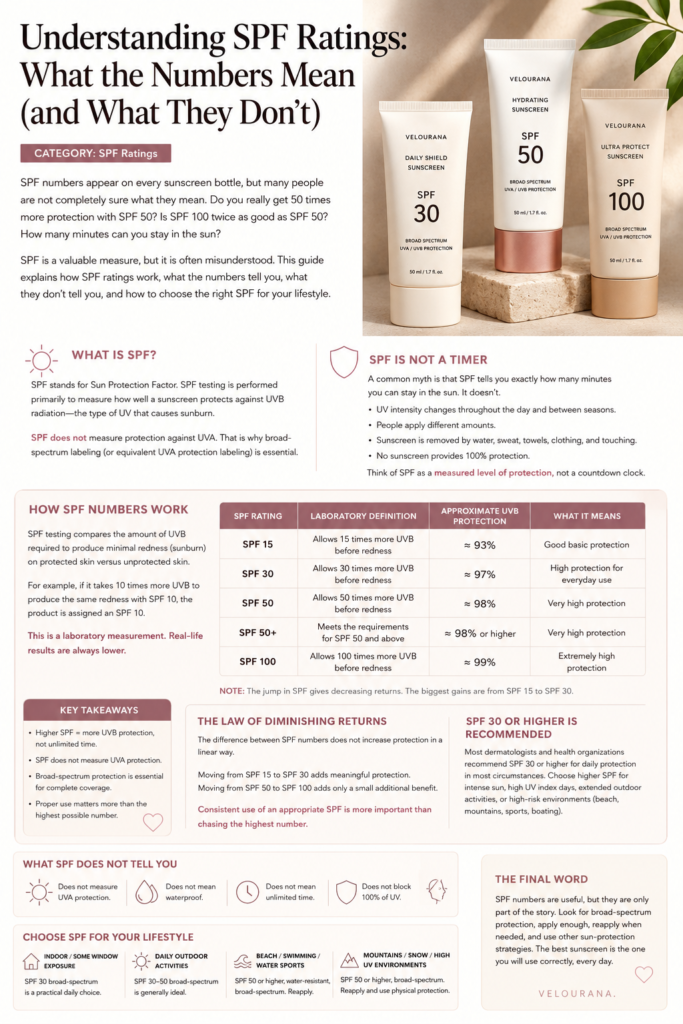
CATEGORY: SPF Ratings
SPF ratings become much easier to understand when they are connected to real situations rather than treated as abstract numbers on a bottle.
A sunscreen used during a short walk to work does not face the same conditions as one worn during a full day at the beach. A lightweight facial SPF used beneath makeup does not need to behave exactly like a water-resistant sunscreen used for swimming. Someone spending most of the day indoors may have different practical needs from someone hiking at altitude or working outdoors for several hours.
This does not mean that SPF becomes optional in lower-exposure situations.
It means that sunscreen selection should consider the combination of SPF rating, UVA protection, product texture, water resistance, application quantity, and actual exposure.
SPF 30 and SPF 50 are both widely used because both can provide high UVB protection when applied correctly.
The better choice depends on what the sunscreen is being asked to do.
Begin With the Basic Meaning of SPF
SPF stands for Sun Protection Factor.
It primarily describes protection against UVB radiation and sunburn under standardized testing conditions.
Higher SPF ratings provide greater tested UVB protection.
However, SPF does not directly tell you everything about UVA protection.
For complete sun protection, broad-spectrum or appropriate UVA coverage remains important regardless of whether the product is SPF 30, SPF 50, or SPF 50+.
Why Context Matters
Imagine two mornings.
On the first morning, you walk ten minutes to work, spend most of the day indoors, and walk home in the late afternoon.
On the second morning, you leave for the beach at 10 a.m., swim several times, sit outdoors for hours, dry yourself with a towel, and remain outside until evening.
The same sunscreen might technically be usable in both situations.
But the way it needs to be applied and reapplied is very different.
This is why SPF selection should never be separated completely from lifestyle.
Everyday Urban Exposure
Daily city life creates many small periods of ultraviolet exposure.
Walking.
Driving.
Commuting.
Shopping.
Outdoor lunches.
Sitting at a café.
Waiting for public transport.
Short exposures may seem insignificant individually.
Repeated over weeks, months, and years, they contribute to cumulative exposure.
SPF 30 for Everyday Use
Broad-spectrum SPF 30 can provide strong protection for everyday situations when it is applied correctly.
It is commonly recommended as a practical minimum for routine sun protection.
For someone who spends most of the day indoors and has limited direct outdoor exposure, SPF 30 may fit comfortably into the morning routine.
The most important requirement is that the sunscreen is actually used in an adequate amount.
SPF 50 for Everyday Use
There is also no reason to avoid SPF 50 for daily wear.
Modern formulations can be lightweight enough for everyday use beneath makeup or on oily skin.
SPF 50 provides greater UVB protection than SPF 30.
Someone who prefers the extra margin and enjoys the product texture can use it every day without needing a special occasion.
When Higher SPF Is Especially Useful
SPF 50 or SPF 50+ can be particularly attractive when exposure is stronger or prolonged.
Examples include full beach days, outdoor sports, hiking, boating, skiing, gardening, sightseeing, outdoor work, and travel in high-UV environments.
People who burn easily or have particular medical or pigmentation concerns may also prefer higher protection.
SPF at the Beach
The beach combines several factors that can reduce real-world sunscreen performance.
Strong direct sunlight.
Reflection from water and sand.
Swimming.
Perspiration.
Towel drying.
Long exposure periods.
For these reasons, high broad-spectrum protection and water resistance are particularly useful.
SPF 50 at the Beach
SPF 50 is a common choice for beach use because it provides very high UVB protection.
But the higher number does not remove the need for correct application.
It does not remove the need for reapplication.
And it does not replace shade, hats, protective clothing, or sunglasses.
Water Resistance Matters as Much as the SPF Number
Imagine choosing between two products.
One is SPF 50 but is not designed for swimming.
The other is broad-spectrum SPF 30 and water resistant.
For a swimming session, the second product may be more appropriate in practical terms.
The lesson is simple.
SPF cannot be evaluated alone.
Reapply After Swimming
Water-resistant sunscreen is not permanent.
Follow the product's directions regarding reapplication after water exposure.
Do not assume that the original layer remains intact after an hour in the sea.
Toweling Changes Protection
Drying the body with a towel physically removes sunscreen.
This is true regardless of whether the product is SPF 30 or SPF 50.
Reapply before returning to prolonged exposure.
SPF for Pool Days
Swimming pools create similar challenges.
Water.
Repeated drying.
Reflected sunlight.
Long outdoor periods.
Choose a broad-spectrum sunscreen appropriate for water exposure.
Apply enough.
Reapply as directed.
SPF for Outdoor Exercise
Running, cycling, hiking, tennis, football, and other outdoor activities combine UV exposure with perspiration.
Sweat can disturb sunscreen.
Wiping sweat away can remove more.
Water-resistant formulations may be particularly useful for these activities.
SPF 30 During Outdoor Exercise
SPF 30 can provide strong UVB protection when applied correctly.
However, the product should also be appropriate for heavy perspiration.
If the activity lasts for several hours, reapplication becomes important.
SPF 50 During Outdoor Exercise
SPF 50 provides additional UVB protection and can be particularly useful during long events or high-UV conditions.
Again, a high rating does not prevent sweat from moving the product.
The sunscreen still has to remain on the skin to work.
SPF for Hiking
Hiking can involve hours of exposure.
Altitude may increase ultraviolet intensity.
Sweat and wiping can reduce sunscreen coverage.
Hikers often benefit from higher broad-spectrum SPF together with hats, sunglasses, protective clothing, and regular reapplication.
Altitude Changes the Situation
Higher altitude generally means greater UV exposure.
This is why mountain activities deserve careful protection even when the air feels cool.
Temperature can be misleading.
You can feel cold while receiving significant ultraviolet radiation.
SPF for Skiing
Snow reflects ultraviolet radiation.
High altitude can increase exposure further.
The face may be the only area of skin visible, which can create the false impression that protection is easy.
In reality, reflected UV can reach the face from multiple directions.
High broad-spectrum SPF is commonly useful in these conditions.
Cold Weather Does Not Reduce the Need for SPF
People often associate sunscreen with heat.
Ultraviolet radiation and temperature are different.
A cold winter day can still involve significant UV exposure.
Choose protection based on UV conditions and activity rather than temperature alone.
SPF for Boating
Boating can create deceptively intense exposure.
Water reflects UV.
Wind cools the skin.
The cooling effect makes it easy to stay outside longer without noticing how much exposure is accumulating.
High broad-spectrum SPF, reapplication, hats, sunglasses, and protective clothing are important.
SPF for Gardening
Gardening often begins as a short activity and turns into several hours outside.
The neck, shoulders, hands, and arms can receive continuous exposure.
Broad-spectrum SPF 30 or higher can be useful depending on conditions.
A hat and light protective clothing can reduce the amount of exposed skin.
SPF for Outdoor Work
People who work outdoors face a very different exposure pattern from occasional sunscreen users.
A single morning application may be inadequate for a full working day.
Higher SPF, water resistance where appropriate, protective clothing, hats, and structured reapplication become especially important.
Sunscreen Should Fit the Job
An elegant facial SPF designed for office wear may not be the best product for heavy outdoor labor.
Likewise, a thick sport sunscreen may feel unnecessarily heavy beneath makeup.
Different situations can justify different products.
There is no rule saying one sunscreen must perform every task.
SPF for Driving
Driving is another situation where people can underestimate UVA exposure.
Vehicle glass blocks much of UVB but may allow more UVA to pass through depending on the glass.
Long-term drivers can therefore consider broad-spectrum sunscreen for the face, hands, and exposed arms.
Does SPF 30 Work for Driving?
Yes, provided it is broad spectrum and applied appropriately.
The more important issue is UVA protection because UVA can penetrate ordinary glass more effectively than UVB.
Does SPF 50 Work for Driving?
Yes.
SPF 50 provides higher UVB protection and can also be a good everyday choice.
Again, broad-spectrum UVA protection remains important.
SPF Near Windows
Someone sitting directly beside a large sunny window for hours may receive different exposure from someone working deep inside a building.
Window glass properties also vary.
Broad-spectrum sunscreen can be relevant according to the environment.
SPF for Office Workers
For office workers with limited exposure, a comfortable broad-spectrum daily sunscreen can provide a practical baseline.
The product should fit easily into the morning routine.
There is little value in choosing an extremely high SPF if the formula is so uncomfortable that it is barely used.
SPF for Commuters
Commuting often combines short outdoor periods with windows, traffic, walking, or cycling.
A broad-spectrum SPF 30 or SPF 50 can both work well.
Choose according to exposure, comfort, and personal preference.
SPF for Outdoor Lunches
Twenty or thirty minutes outside may seem insignificant.
But repeated daily exposure adds up.
A morning broad-spectrum sunscreen routine can help provide protection without requiring you to make a new decision every lunchtime.
SPF for Travel
Travel creates unusual exposure patterns.
Airport windows.
Long flights.
Driving.
Walking tours.
Outdoor sightseeing.
Beaches.
Mountains.
Unfamiliar climates.
Because plans change frequently, travel is one situation where carrying sunscreen is especially useful.
SPF for Tropical Travel
Tropical destinations can have intense UV conditions.
Higher broad-spectrum SPF can provide an additional margin of protection.
Reapplication, shade, hats, sunglasses, and suitable clothing remain important.
SPF for Mediterranean Summers
Mediterranean summers often combine strong sunlight with high temperatures and long outdoor days.
Lightweight SPF 50 facial sunscreen can be particularly comfortable for daily wear.
For beach use, water-resistant high-SPF products are useful.
SPF for Northern Climates
Lower temperatures do not mean sunscreen is unnecessary.
Summer days can be long.
UV can still be substantial.
Choose protection based on UV conditions rather than assuming cooler climate means minimal exposure.
SPF During Spring
Spring is a common time for accidental sunburn.
The weather feels pleasant and relatively cool, so people spend longer outdoors.
UV levels may already be significant.
Broad-spectrum SPF 30 or higher can provide useful protection.
SPF During Autumn
Autumn UV levels vary depending on location.
Mild sunny days can still create meaningful exposure.
Do not abandon sunscreen automatically when summer ends.
SPF During Winter
Winter exposure depends heavily on location and activity.
For ordinary low-UV indoor days, requirements may be different from summer.
For skiing or mountain activities, careful high-SPF protection can be essential.
Use the UV Index as Context
The UV Index provides information about expected ultraviolet radiation levels.
It can help you decide how carefully protection should be managed.
A high UV Index suggests stronger protection strategies.
SPF Does Not Change the UV Index
SPF describes the sunscreen.
The UV Index describes the environment.
They are different measurements.
An SPF 50 product does not make the environmental UV level lower.
It reduces the amount reaching protected skin when used correctly.
SPF for Oily Skin in Summer
Oily skin can struggle with heavy sunscreen.
This can lead to underapplication.
Instead of reducing the quantity, choose a lighter texture.
Fluid, gel, or matte SPF 30 and SPF 50 products can provide high protection without necessarily feeling greasy.
SPF for Dry Skin in Summer
Dry skin may prefer a moisturizing sunscreen.
A creamier SPF 30 or SPF 50 can sometimes replace daytime moisturizer.
The best routine is the one that allows adequate application without discomfort.
SPF for Combination Skin
Combination skin may use a lightweight sunscreen across the entire face.
A little moisturizer can be applied underneath dry areas.
This keeps the final sunscreen layer even.
SPF for Sensitive Skin
Sensitive skin may require experimentation with different formulations.
SPF rating alone does not predict irritation.
Choose a broad-spectrum product that the skin tolerates well.
Seek professional advice when persistent sensitivity makes sunscreen difficult to use.
SPF for Acne-Prone Skin
Acne-prone skin may prefer lightweight, non-heavy textures.
High SPF does not automatically mean pore-clogging.
Modern SPF 50 fluids can be very light.
Judge the complete formulation.
SPF for Mature Skin
Mature skin may appreciate moisturizing sunscreen textures.
Because cumulative UV exposure contributes to photoaging, daily broad-spectrum protection can be particularly relevant.
Both SPF 30 and SPF 50 can be appropriate.
SPF for Hyperpigmentation
People concerned about uneven pigmentation often prioritize high broad-spectrum protection.
UVA protection matters strongly.
Tinted sunscreens containing appropriate pigments can also be useful for certain visible-light-related pigmentation concerns.
SPF for Melasma-Prone Skin
Melasma management often includes careful photoprotection.
Broad-spectrum high-SPF sunscreen can be an important part of the strategy.
Professional dermatological guidance can help determine whether tinted products or additional visible-light protection are appropriate.
SPF for Very Fair Skin
Very fair skin may burn quickly.
SPF 50 can provide useful additional protection.
However, it should still be combined with physical protection and reduced unnecessary exposure.
SPF for Darker Skin Tones
Darker skin tones may burn less easily but are not immune to UV damage.
White cast can become a major practical issue.
Transparent or tinted formulations can make correct application easier.
Never Apply Less Because of White Cast
If the proper quantity of sunscreen looks unacceptable, choose a different product.
Do not reduce the quantity dramatically simply to make the sunscreen invisible.
Protection depends on adequate coverage.
SPF for Children
Children require careful sun protection.
Parents and caregivers should follow pediatric and public-health recommendations appropriate to age.
Shade, protective clothing, hats, and suitable sunscreen all play roles.
SPF for Babies
Very young babies require specific strategies.
Shade and protective clothing often take priority.
Parents should follow pediatric guidance regarding sunscreen use.
SPF and Photosensitive Medications
Certain medications can increase sensitivity to sunlight.
People taking them may require more careful sun protection than the general population.
Follow medication information and healthcare advice.
SPF and Dermatological Conditions
Some skin conditions require strict photoprotection.
A dermatologist may recommend high SPF, strong UVA protection, specific textures, protective clothing, or other measures.
Individual medical advice should take priority over general sunscreen guidance.
SPF After Cosmetic Procedures
Certain procedures can temporarily increase sun sensitivity.
Follow the aftercare instructions provided by the professional performing the treatment.
Sunscreen may be especially important during recovery.
SPF and Retinoid Use
People using retinoids should pay careful attention to sun protection.
The exact recommendations depend on the product and individual circumstances.
Broad-spectrum sunscreen is commonly an important part of the routine.
SPF and Exfoliating Acids
Some exfoliating routines can increase sensitivity.
Appropriate sun protection helps support safe use.
Product instructions should be followed carefully.
SPF for Makeup Wearers
A sunscreen that works well beneath makeup can improve consistency.
Broad-spectrum SPF 30 or SPF 50 can both be used.
Allow the sunscreen to settle before applying cosmetics.
Makeup With SPF Is Supplementary
Foundation or tinted moisturizer may contain SPF.
This can provide additional protection.
However, makeup is often applied in smaller quantities than sunscreen testing assumes.
Dedicated sunscreen underneath provides a more reliable protective base.
SPF Values Do Not Add Together
SPF 30 sunscreen plus SPF 20 foundation does not equal SPF 50.
SPF values cannot simply be added.
Use the sunscreen rating as the primary reference.
SPF for No-Makeup Days
No-makeup days can make sunscreen reapplication easier.
A lightweight facial SPF can be reapplied without worrying about disturbing cosmetics.
This may be useful during outdoor-heavy days.
SPF Reapplication Over Makeup
When makeup is present, reapplication can be more complicated.
Sticks, cushions, sprays, or carefully applied fluids may provide practical options.
The challenge is ensuring adequate coverage.
SPF Sticks
Sticks can be useful for targeted areas.
Nose.
Cheeks.
Ears.
Hands.
One quick swipe may not be enough.
Use according to product instructions.
SPF Sprays
Sprays are useful for large body areas.
Apply enough.
Avoid relying on a brief mist.
Make sure all exposed skin is covered.
SPF Powders
Powder sunscreens can provide convenient touch-ups.
They may be difficult to apply in the quantity required to reproduce the labeled SPF.
They are often best used as supplementary protection.
SPF Lip Products
SPF lip balm can provide targeted protection.
Reapply frequently because eating, drinking, and wiping remove product.
SPF for Hands
Hands may need repeated sunscreen application throughout the day because of washing.
This is especially relevant when driving or spending time outdoors.
SPF for the Neck and Chest
These areas are exposed frequently and can show cumulative sun effects.
Extend facial sunscreen downward or use a suitable body product.
SPF for the Ears
Apply sunscreen to exposed ears.
A hat can provide additional protection.
SPF for the Scalp
Hats remain one of the simplest solutions.
For exposed parts or thinning areas, sunscreen can also be used according to product directions.
SPF 30 for Short Exposure
For short everyday periods outdoors, broad-spectrum SPF 30 can provide high protection when applied correctly.
It should still be used appropriately.
Short exposure repeated daily can accumulate.
SPF 50 for Long Exposure
For long outdoor days, SPF 50 provides an additional UVB protection margin.
Water resistance may also become important.
High SPF should be combined with reapplication.
SPF 50+ for Very Strong Conditions
SPF 50+ can provide very high UVB protection according to the applicable labeling system.
It can be useful during strong exposure.
It still does not block 100 percent of UV.
No SPF Eliminates the Need for Shade
Shade remains one of the most practical ways to reduce direct UV exposure.
Even high SPF works better as part of a layered strategy.
No SPF Eliminates the Need for Clothing
Protective clothing reduces the amount of skin requiring sunscreen.
This can make long outdoor days easier to manage.
No SPF Eliminates the Need for a Hat
A broad-brimmed hat protects difficult areas.
Scalp.
Ears.
Face.
Neck.
Use it alongside sunscreen.
No SPF Eliminates the Need for Sunglasses
The eyes also require UV protection.
Choose appropriate sunglasses.
High SPF Should Not Encourage More Exposure
This is one of the most important behavioral points.
People may feel safer with SPF 50 and stay outdoors longer.
The extra protection should reduce exposure, not encourage risky behavior.
SPF Is Not a License to Tan
Deliberate tanning involves UV exposure.
Sunscreen does not make intentional prolonged tanning risk-free.
Cosmetic self-tanning products can create color without requiring UV exposure.
SPF and Tanning Beds
Tanning beds expose the skin to ultraviolet radiation.
They should not be considered a safe tanning alternative.
After-Sun Products Do Not Replace SPF
Cooling gels and moisturizers can improve comfort after exposure.
They do not reverse UV exposure.
Preventive protection remains more important.
If You Burn, Reassess the Routine
Sunburn suggests that protection was insufficient for the circumstances.
Possible reasons include too little sunscreen, missed areas, inadequate reapplication, excessive exposure, or unsuitable product choice.
Use the experience to improve future protection.
SPF Ratings Are Only One Decision
When choosing sunscreen, consider several factors.
SPF.
Broad-spectrum UVA protection.
Water resistance.
Texture.
Skin type.
Activity.
Exposure duration.
Reapplication practicality.
These factors work together.
A Practical Daily Choice
For many people, broad-spectrum SPF 30 or SPF 50 provides a suitable daily starting point.
SPF 50 offers greater UVB protection.
SPF 30 still offers high protection.
Choose the product you can use correctly.
A Practical Sport Choice
For outdoor sport, prioritize high broad-spectrum protection and water resistance.
Choose a texture that tolerates sweat.
Take the sunscreen with you.
Reapply.
A Practical Beach Choice
Choose high broad-spectrum protection.
Use water resistance.
Apply enough before exposure.
Reapply after swimming and toweling.
Use shade.
Wear a hat.
Use protective clothing when practical.
A Practical Travel Choice
Carry one facial sunscreen and one body sunscreen if necessary.
Choose a high-SPF product if exposure may be strong.
Bring a convenient reapplication format.
Avoid relying on hotel shops to provide your preferred sunscreen at the last minute.
A Practical Office Choice
Choose a comfortable broad-spectrum daily sunscreen that layers well with skincare and makeup.
Consistency matters more than complexity.
SPF and Product Cost
A sunscreen that is too expensive to apply adequately may create a practical problem.
Affordable high-SPF products can provide excellent protection.
Choose something you can use generously enough.
Do Not Ration Sunscreen
Saving a small bottle for special occasions undermines consistent protection.
Use sunscreen as intended.
Replace it when finished.
Check Expiration
The SPF rating assumes a stable product within its intended shelf life.
Do not rely on an expired sunscreen simply because the bottle still looks normal.
Check Storage
Avoid prolonged extreme heat.
Follow manufacturer storage instructions.
A product left in a very hot car may not be ideal.
Buy From Reliable Retailers
Counterfeit sunscreen can create dangerous false confidence.
Purchase from trustworthy sources.
The SPF number on fake packaging has no reliable meaning.
Do Not Make DIY SPF
Sunscreen requires standardized testing.
Homemade formulations cannot reliably reproduce SPF or broad-spectrum protection.
Use professionally formulated products.
SPF Does Not Need to Be Complicated
The sunscreen aisle can appear overwhelming.
SPF 15.
SPF 30.
SPF 50.
SPF 50+.
PA ratings.
UVA symbols.
Water-resistance claims.
The underlying decision can still remain simple.
Start With the Exposure
Ask what you will be doing.
Ordinary workday?
Beach?
Sport?
Hiking?
Travel?
Outdoor work?
This determines how demanding the sunscreen's job will be.
Then Choose the Protection
For many everyday situations, broad-spectrum SPF 30 or higher is a common practical choice.
For stronger or prolonged exposure, SPF 50 or SPF 50+ provides an additional margin.
Then Check UVA
Do not stop at SPF.
Confirm appropriate broad-spectrum UVA protection.
Then Check Water Resistance
If swimming or heavy perspiration is expected, choose accordingly.
Then Choose the Texture
The sunscreen must feel comfortable enough to use properly.
This is where personal preference matters.
Then Apply Correctly
Adequate quantity.
Even coverage.
All exposed areas.
Then Reapply
Match reapplication to the product instructions and activity.
Then Add Physical Protection
Shade.
Clothing.
Hat.
Sunglasses.
These measures make sunscreen more effective as part of a complete strategy.
The Final Principle
There is no single SPF number that is perfect for every person, every day, and every situation.
SPF 30 can provide strong everyday UVB protection.
SPF 50 provides greater protection and can be especially useful during prolonged or intense exposure.
SPF 50+ offers very high protection according to applicable labeling rules.
But the rating is only one part of real-world sun protection.
A high SPF applied poorly can underperform.
A good sunscreen washed away in the pool cannot protect indefinitely.
A morning application cannot protect areas that were missed.
And no SPF eliminates the importance of UVA protection, reapplication, shade, clothing, hats, and sensible exposure habits.
Choose sunscreen according to what the day actually requires.
When SPF ratings are connected to real situations rather than viewed as isolated numbers, they become much easier to understand and much more useful.
The End
Velourana. :::
Batch Progress: 4/5
 Discover More From Our Family of Websites
 ZodiacBearing (Astrology, Tarot, Numerology, Angel Numbers & Spiritual Guidance)
 Velourana (Beauty, Makeup, Hair Care, Skincare & Beauty Tips)
 HavenBearing (Home, Living, Organization, Décor & Everyday Inspiration)
 PawBearing (Pet Care, Dog Breeds, Animal Health, Training & Pet Products)
 PsyCatherine (Notes From the Journal of a Psychologist on Real Life)

