
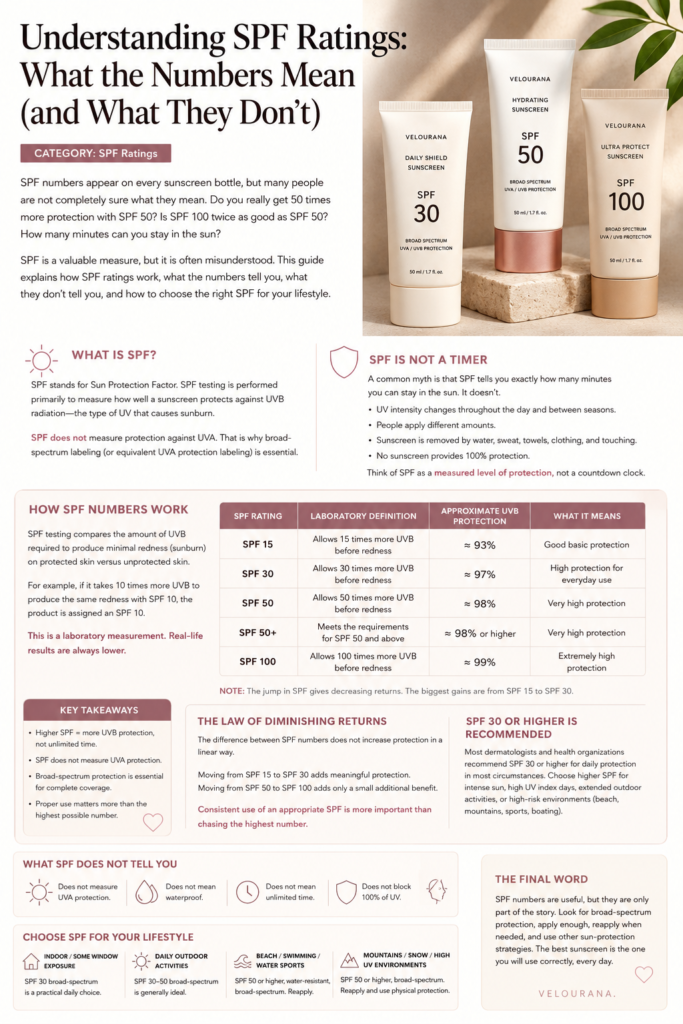
CATEGORY: SPF Ratings
SPF ratings are useful because they give consumers a standardized way to compare the UVB protection offered by different sunscreens.
But the number on the bottle is only part of the protection story.
An SPF 50 sunscreen can perform extremely well in standardized testing, yet provide much less protection in everyday life if it is applied too thinly, distributed unevenly, rubbed away, washed off, or forgotten on commonly exposed areas.
This is one of the most important ideas in sunscreen education.
The labeled SPF describes how the sunscreen performs when used under defined testing conditions.
Real-world protection depends on how the product is actually used.
SPF Is a Tested Rating
SPF stands for Sun Protection Factor.
It primarily describes protection against UVB radiation and sunburn.
A sunscreen receives its SPF rating after standardized testing.
This allows products to be compared according to a consistent system.
However, the test assumes a specified application amount.
It does not assume the tiny amount many people use in daily life.
Application Quantity Changes Protection
Applying sunscreen too sparingly can significantly reduce the protection achieved.
This is why someone using SPF 50 very thinly may not receive anything close to the level of protection expected from the label.
The exact reduction cannot be calculated reliably at home with simple arithmetic.
Using half the recommended amount does not automatically turn SPF 50 into SPF 25.
The relationship is more complex.
Why People Commonly Underapply
There are many practical reasons people use too little sunscreen.
The product may feel heavy.
It may leave a white cast.
It may feel greasy.
It may be expensive.
It may pill beneath makeup.
The person may simply underestimate how much is needed.
The solution is not to rely on the high SPF number as compensation.
The better solution is finding a sunscreen texture that can be applied comfortably in an adequate amount.
Texture Has a Direct Impact on Real-World Protection
Texture may sound like a cosmetic preference.
In practice, it can influence protection.
If a sunscreen feels unpleasant, people often use less of it.
If it spreads easily and feels comfortable, adequate application becomes more realistic.
This is why lightweight fluids, gels, lotions, creams, and tinted formulas all have a place.
The ideal sunscreen is not simply the one with the highest SPF.
It is the one whose protection and texture work together.
SPF 50 Applied Properly
A properly applied broad-spectrum SPF 50 sunscreen provides very high UVB protection.
It can be an excellent choice for everyday wear or stronger exposure.
But the product still needs enough quantity.
It still needs even distribution.
It still needs reapplication when circumstances require it.
The number cannot replace correct technique.
SPF 30 Applied Properly
SPF 30 also provides high UVB protection when applied correctly.
A properly applied broad-spectrum SPF 30 can be a strong everyday choice.
The same practical rules apply.
Enough product.
Even coverage.
Appropriate reapplication.
Protection of all exposed areas.
Application Can Matter More Than the Difference Between Ratings
Consumers often spend considerable time deciding whether SPF 30 or SPF 50 is better.
That comparison matters.
But there is little value in choosing SPF 50 if it is consistently applied inadequately.
Correct use can have a greater practical impact than obsessing over a moderate difference in SPF while ignoring application.
Uniform Coverage Is Essential
Even a generous total quantity can provide incomplete protection if the sunscreen is distributed unevenly.
Imagine applying plenty of sunscreen to the cheeks and forehead while missing the nose, hairline, ears, and jaw.
The average amount may look impressive.
The uncovered areas still receive little or no protection.
Commonly Missed Areas
The hairline is easily forgotten.
The ears are frequently missed.
The sides of the neck can be neglected.
The upper chest may remain exposed.
Hands are often forgotten.
The lips and scalp may receive no protection at all.
A reliable routine should include these areas deliberately.
Use a Consistent Application Sequence
One way to reduce missed areas is to apply sunscreen in the same order every day.
Face.
Hairline.
Ears.
Neck.
Upper chest.
Hands.
Then exposed body areas.
A consistent sequence can become automatic over time.
Do Not Stop at the Jawline
Facial skincare culture often creates an artificial boundary at the jaw.
Ultraviolet radiation does not respect that boundary.
If the neck is exposed, sunscreen should continue downward.
If the upper chest is exposed, that area needs attention too.
The Ears Are Especially Easy to Forget
Hair may cover the ears in the morning and expose them later.
Tied-back hair can suddenly leave them uncovered.
When the ears are exposed, include them in the sunscreen application.
A high SPF on the face cannot protect untreated ears.
Hands Require Repeated Attention
Hands are exposed frequently and washed repeatedly.
Even a careful morning application may be removed after hand washing.
If significant outdoor exposure continues, reapplication can be important.
The Scalp Can Receive Significant UV
People with thinning hair, shaved heads, or exposed hair parts can receive considerable scalp exposure.
A hat is an excellent protective tool.
Suitable sunscreen products can also be used on exposed scalp areas according to their directions.
Lips Need Their Own Protection
Ordinary facial sunscreen may not be practical on the lips.
Use a lip product designed to provide appropriate SPF protection.
Eating, drinking, swimming, and wiping the mouth can remove it.
Reapply as needed.
Layering Sunscreen Correctly
Sunscreen generally belongs near the end of the morning skincare routine.
Cleanser if needed.
Serum.
Moisturizer if needed.
Then sunscreen.
Makeup can follow after the sunscreen has had time to settle.
Too Many Products Under Sunscreen Can Cause Problems
A complicated morning routine can interfere with sunscreen application.
Several wet serums, a rich cream, facial oil, and primer may create a slippery surface.
Sunscreen can pill or move.
If this happens repeatedly, simplify the layers underneath.
Pilling Does Not Mean the SPF Is Bad
Pilling can result from product incompatibility.
The sunscreen may work perfectly well on bare skin but react badly with a particular serum or moisturizer.
Before abandoning the sunscreen, experiment with fewer layers or smaller amounts of the products underneath.
Do Not Mix Sunscreen Into Moisturizer
Some people mix sunscreen and moisturizer together in their hand to save time.
This creates an untested mixture.
It can interfere with the even film the sunscreen was designed to form.
Apply the products separately.
Do Not Mix Sunscreen Into Foundation
The same rule applies to makeup.
Mixing foundation and sunscreen can alter coverage and film formation.
Apply sunscreen first.
Allow it to settle.
Then apply makeup.
Layering Is Different From Mixing
Applying moisturizer first and sunscreen second is layering.
Combining the two into one mixture before application is different.
Layering preserves the individual formulations more effectively.
Mixing changes them.
SPF Values Do Not Add Together
SPF 30 sunscreen plus SPF 20 foundation does not equal SPF 50.
SPF values cannot be added mathematically.
Treat the dedicated sunscreen as the primary protective layer.
Any SPF from makeup can be considered supplementary.
Reapplication Is Part of Real-World SPF
The sunscreen layer changes throughout the day.
Perspiration.
Swimming.
Towels.
Clothing.
Touching the face.
Makeup adjustments.
Phone contact.
Normal movement.
All can disturb coverage.
This is why reapplication is part of sunscreen use.
SPF 50 Does Not Mean Less Reapplication
A higher SPF does not automatically last longer.
SPF measures protection level.
It does not measure durability.
An SPF 50 sunscreen can still be rubbed away quickly.
SPF 30 Does Not Automatically Need More Frequent Reapplication
The lower number does not mean the product disappears faster.
Reapplication depends on wear conditions and product instructions.
Water resistance, perspiration, rubbing, and activity matter more.
Water Resistance Is a Separate Claim
An SPF 50 sunscreen is not automatically water resistant.
An SPF 30 sport sunscreen may be more suitable for swimming than a non-water-resistant SPF 50 facial cream.
Look at both the SPF and water-resistance information.
Swimming Changes the Sunscreen Layer
Water can reduce sunscreen coverage.
Use an appropriate water-resistant product for swimming.
Reapply according to the instructions.
Do not assume the original layer remains perfect after repeated time in the water.
Towel Drying Removes Sunscreen
A towel physically rubs against the skin.
This can remove sunscreen even when the product is water resistant.
Restore protection before continuing prolonged exposure.
Perspiration Matters
Exercise and hot weather increase perspiration.
Sweat can affect the sunscreen film.
Wiping sweat away can remove even more.
Outdoor exercise often requires more attention to reapplication.
Everyday Touching Matters Too
People touch their faces constantly.
Adjusting glasses.
Wiping the nose.
Resting the chin on the hand.
Using a phone.
Brushing hair away.
Each contact can disturb sunscreen to some degree.
This does not mean you need to reapply after every touch.
It means sunscreen should not be imagined as a permanently fixed layer.
Makeup Reapplication Is More Complicated
Reapplying sunscreen over makeup can be difficult.
Some people use sticks.
Others use cushions, sprays, or carefully reapplied fluids.
Powder products may provide supplementary protection.
The challenge is always achieving enough even product.
Convenience and actual coverage need to be balanced.
Sunscreen Sticks Need Enough Product
A stick can be extremely convenient.
However, one quick swipe may deposit very little product.
Follow the manufacturer's instructions and use enough passes to achieve appropriate coverage.
Spray Sunscreen Requires Care
Sprays can be useful for body application.
They also make underapplication easy.
A quick mist may not cover evenly.
Make sure enough product reaches the skin and is distributed as directed.
Wind Can Interfere With Spray Application
Applying spray sunscreen in strong wind can send much of the product into the air.
Choose a sheltered area when practical.
Follow the product's application instructions carefully.
Powder SPF Has Limitations
Powder sunscreen can be convenient for touch-ups.
However, achieving the amount required for the labeled SPF may be difficult.
It should not automatically replace a properly applied lotion, fluid, or cream base layer.
Real-World Protection Depends on Behavior
Even perfect sunscreen application does not remove the influence of behavior.
Someone wearing SPF 50 but intentionally remaining in intense sunlight for many hours may receive more total UV exposure than someone wearing SPF 30 who spends much of the time in shade.
Sunscreen should be part of a larger protective strategy.
Shade Reduces Direct Exposure
Shade is one of the most effective ways to reduce direct sunlight.
Trees.
Umbrellas.
Buildings.
Canopies.
Covered terraces.
Shade reduces the burden placed on sunscreen.
Reflected UV Still Matters
Shade is not an absolute barrier.
Water, sand, snow, and bright surfaces can reflect ultraviolet radiation.
This is why exposed skin may still benefit from sunscreen while sitting under an umbrella.
Clothing Can Provide Reliable Coverage
Clothing is highly practical because it does not need to be reapplied.
Long sleeves, trousers, and appropriate fabrics can reduce exposed surface area.
Purpose-designed UPF clothing provides more predictable UV protection.
Hats Protect Difficult Areas
A broad-brimmed hat can shade the scalp, forehead, ears, face, and neck.
These are areas that are frequently missed with sunscreen.
Using a hat reduces dependence on perfect sunscreen application alone.
Sunglasses Matter
Ultraviolet protection includes the eyes.
Choose sunglasses designed to provide suitable UV protection.
The skin around the eyes also benefits from the shade created by larger frames.
The UV Index Provides Environmental Context
The SPF number describes the sunscreen.
The UV Index describes expected ultraviolet intensity in the environment.
Both pieces of information are useful.
High UV conditions demand greater care.
Temperature Is Not a Substitute for the UV Index
A cool day can have high UV.
A hot day can have lower UV at certain times.
Temperature and ultraviolet radiation are different.
Do not decide whether sunscreen matters solely based on how warm the weather feels.
Wind Can Hide UV Exposure
Wind cools the skin and makes strong sunlight feel more comfortable.
This is particularly relevant at beaches, on boats, while cycling, and in the mountains.
The cooling sensation can encourage longer exposure.
Water Can Hide UV Exposure
Swimming also makes the body feel cool.
This can create a false sense of safety.
Ultraviolet exposure continues while you are in the water.
Cloud Cover Can Be Misleading
Clouds may reduce some UV but do not necessarily eliminate it.
A cloudy day should not automatically be treated as UV-free.
Check the actual conditions.
Altitude Changes Exposure
UV exposure can increase at higher altitude.
This is relevant for hiking, skiing, climbing, and mountain travel.
Cold temperatures can make people forget sunscreen even when UV exposure is significant.
Snow Reflects UV
Snow can reflect ultraviolet radiation.
Winter sports therefore require serious sun protection.
SPF ratings matter outside summer.
Sand Reflects UV
Beach environments create exposure from direct sunlight and reflection.
This makes generous sunscreen application and reapplication especially important.
Water Reflects UV
Lakes, pools, and the sea can also contribute to reflected exposure.
Combine sunscreen with shade, clothing, and other protective measures.
Daily Exposure Can Accumulate
Not all ultraviolet exposure happens during holidays.
Walking.
Driving.
Outdoor lunches.
Gardening.
Commuting.
Watching sports.
Small repeated exposures accumulate over time.
This is why everyday broad-spectrum sunscreen can be valuable.
Driving Creates a Unique Exposure Pattern
Vehicle glass can reduce some UV but may allow more UVA through.
People who drive frequently may receive repeated exposure to the face, hands, and arms.
Broad-spectrum protection can be relevant even when the car interior feels cool.
Windows Do Not Eliminate All UVA
A person sitting directly beside a bright window may receive more UVA than someone working farther inside the room.
The exact exposure depends on the glass.
The important principle is that being indoors does not always mean exposure is zero.
SPF and Skin Tone
Different skin tones have different natural levels of melanin.
This influences how readily skin burns.
It does not make any skin tone immune to ultraviolet damage.
People of all skin tones can benefit from appropriate sun protection.
Darker Skin Can Still Experience UV Damage
People with deeper skin tones may burn less easily.
They can still experience hyperpigmentation, photoaging, and skin cancer.
Cosmetic concerns such as white cast should be solved through better formulation choice rather than by reducing sunscreen quantity.
White Cast Can Encourage Underapplication
If a sunscreen creates an obvious white cast, users may deliberately apply too little.
This can reduce protection.
Tinted or transparent alternatives may improve adherence.
Fair Skin Often Requires Careful Protection
Fair skin may burn relatively quickly.
High SPF can provide an additional margin.
However, shade, clothing, and reapplication remain just as important.
SPF and Hyperpigmentation
People managing pigmentation concerns often prioritize high broad-spectrum protection.
UVA coverage matters strongly in this context.
Tinted sunscreens may also provide useful visible-light protection depending on formulation.
SPF and Photoaging
Cumulative ultraviolet exposure contributes to visible skin aging.
Broad-spectrum sunscreen can help reduce this exposure.
The effectiveness depends on actual use, not simply buying the product.
An Unopened Sunscreen Does Nothing
This sounds obvious but captures an important truth.
Protection exists only when the sunscreen reaches the skin.
A technically excellent product sitting in a bathroom drawer provides no benefit.
Consistency is essential.
Expiration Matters
SPF ratings apply to products used within their intended shelf life.
Check expiration dates.
Follow period-after-opening information.
Do not assume an old sunscreen remains reliable indefinitely.
Storage Matters
Sunscreen should be stored according to manufacturer instructions.
Extreme heat can be problematic.
Avoid leaving sunscreen in very hot cars or direct sunlight for prolonged periods when possible.
Product Authenticity Matters
Counterfeit sunscreen can create false confidence.
A fake bottle may display SPF 50 without providing reliable protection.
Purchase from reputable retailers and suppliers.
DIY Sunscreen Cannot Provide Reliable SPF
Homemade sunscreen is not equivalent to professionally formulated and tested sunscreen.
SPF depends on filter concentration, dispersion, film formation, stability, and standardized testing.
You cannot reliably calculate it in a kitchen.
Adding Zinc Oxide Does Not Create Predictable SPF
Simply adding a sunscreen filter to moisturizer does not guarantee uniform distribution or known protection.
Use properly tested sunscreen formulations.
More Expensive Does Not Necessarily Mean More Protective
Price can reflect packaging, branding, texture, fragrance, or formulation elegance.
An affordable SPF 50 can provide excellent tested protection.
A luxury SPF 30 is not automatically stronger.
Cosmetic Elegance Still Has Value
Although price does not determine SPF, cosmetic elegance can influence how much sunscreen people actually use.
A sunscreen that feels beautiful may encourage consistent application.
That practical benefit matters.
Higher SPF Is Not an Excuse for Smaller Amounts
Buying SPF 50 and deliberately applying half as much is not a reliable strategy.
High SPF should supplement correct use, not replace it.
Lower SPF Does Not Mean You Should Give Up
If SPF 30 is the highest comfortable broad-spectrum sunscreen you can use consistently, it can still provide strong protection when applied correctly.
Sun protection does not need to become an all-or-nothing decision.
Reapplication Should Match Exposure
A person working indoors all day has different needs from someone spending eight hours at the beach.
The sunscreen routine should reflect actual exposure.
The same product can require different reapplication behavior in different circumstances.
Beach-Day Real-World Protection
A strong beach routine includes several steps.
Apply broad-spectrum sunscreen before exposure according to directions.
Use enough.
Cover all exposed areas.
Reapply after swimming.
Reapply after towel drying.
Use shade.
Wear hats and protective clothing where practical.
Pool-Day Protection
Choose a suitable water-resistant sunscreen.
Apply adequately.
Reapply.
Do not let the cooling sensation of the water create false confidence.
Outdoor Sport Protection
Choose a sunscreen compatible with perspiration.
Use water resistance where appropriate.
Take the product with you.
Reapply after heavy sweating or wiping according to directions.
Everyday City Protection
A comfortable morning sunscreen provides a useful baseline.
If the day becomes unexpectedly outdoor-heavy, reapply.
A hat or shade can provide additional help.
Travel Protection
Travel often combines unfamiliar UV conditions, long walks, driving, and changing climates.
Carry sunscreen rather than assuming the morning application will always be enough.
Make Reapplication Easy
Keep a practical sunscreen format in your bag.
If the product is difficult to access, reapplication becomes less likely.
Convenience is part of good real-world protection.
Build a Routine Around Your Own Weak Points
If you always forget your ears, make them part of the application sequence.
If you dislike greasy products, find a lighter texture.
If you forget reapplication, carry sunscreen with you.
If white cast causes underapplication, use a better-matching formula.
A personalized solution is more useful than repeating the same mistake.
Do Not Let Perfect Become the Enemy of Good
Sun protection does not need to be flawless to provide value.
If you miss an application, resume the habit.
If a product does not work, replace it.
If your routine is too complicated, simplify it.
Consistency matters more than perfection.
SPF Ratings Work Only When the Sunscreen Is Used
The number on the bottle represents the potential protection of the product under defined conditions.
Real-world protection depends on behavior.
Adequate quantity.
Even coverage.
Reapplication.
Correct storage.
Product authenticity.
Appropriate activity selection.
These factors determine whether the labeled SPF becomes meaningful in practice.
The Best SPF Is the One Used Correctly
A properly used broad-spectrum SPF 30 can provide excellent protection.
A properly used broad-spectrum SPF 50 provides greater UVB protection.
Neither can protect uncovered skin.
Neither can survive unlimited swimming and toweling.
Neither can compensate for extreme underapplication.
Neither replaces shade, clothing, hats, or sunglasses.
The Final Lesson
SPF ratings matter, but they are not self-executing.
SPF 30, SPF 50, and SPF 50+ describe tested levels of UVB protection.
They do not guarantee that the same protection automatically appears on the skin after a casual application.
Real-world protection depends on how much sunscreen is used, whether it is spread evenly, whether exposed areas are missed, how long the person remains outdoors, whether the sunscreen is disturbed by swimming or perspiration, and whether it is reapplied appropriately.
This is why sunscreen education should never stop at the number on the label.
Choose an appropriate broad-spectrum SPF.
Apply it generously enough.
Cover every exposed area.
Reapply when needed.
Use shade, clothing, hats, and sunglasses.
And choose a formula whose texture makes these habits realistic.
The SPF rating tells you what the sunscreen is capable of providing.
Your application determines how much of that protection reaches your skin.
The End
Velourana.
 Discover More From Our Family of Websites
 ZodiacBearing (Astrology, Tarot, Numerology, Angel Numbers & Spiritual Guidance)
 Velourana (Beauty, Makeup, Hair Care, Skincare & Beauty Tips)
 HavenBearing (Home, Living, Organization, Décor & Everyday Inspiration)
 PawBearing (Pet Care, Dog Breeds, Animal Health, Training & Pet Products)
 PsyCatherine (Notes From the Journal of a Psychologist on Real Life)

