
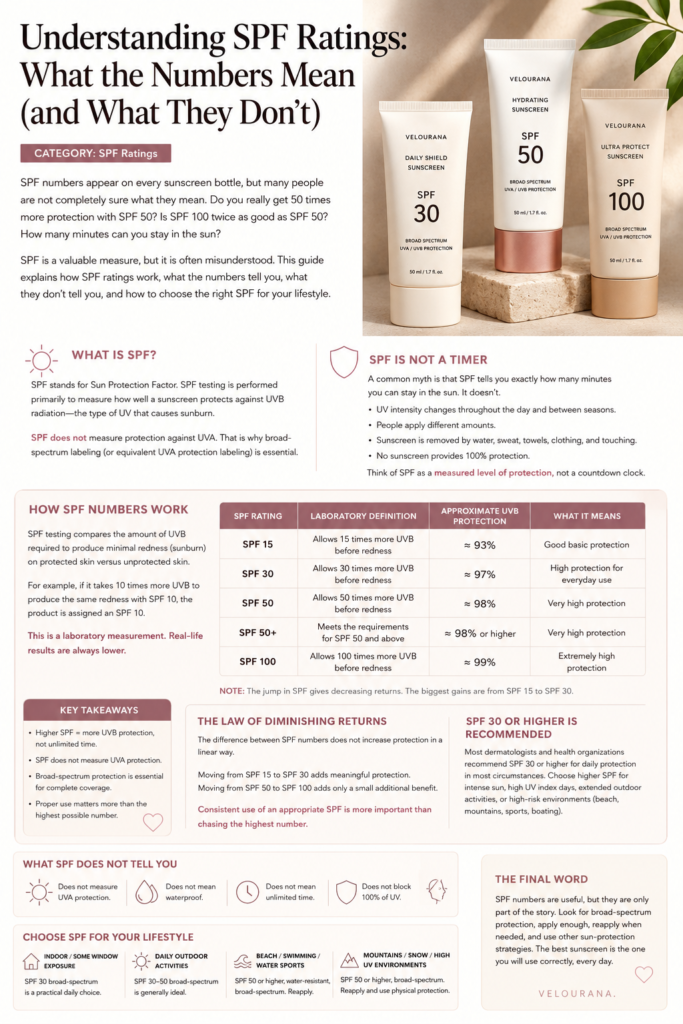
CATEGORY: SPF Ratings
Choosing between SPF 30 and SPF 50 can seem unnecessarily complicated.
Both numbers appear on thousands of sunscreens. Both are widely used for facial and body protection. Both can provide high levels of UVB protection when applied correctly. Yet SPF 50 is clearly a higher rating, which naturally raises an important question.
How much better is it?
The answer requires more than comparing the two numbers directly.
SPF 50 does not provide almost twice the ultraviolet protection of SPF 30. At the same time, the difference between the two should not simply be dismissed as insignificant because their commonly quoted UVB-filtering percentages appear close together.
Understanding the difference becomes much easier when you examine what SPF measures, how much UVB can still reach the skin, and how sunscreen is actually used outside laboratory conditions.
Start With What SPF Measures
SPF stands for Sun Protection Factor.
It primarily describes protection against UVB radiation and the development of sunburn under standardized testing conditions.
UVB is only one component of ultraviolet radiation relevant to skin.
UVA also contributes to skin damage and photoaging.
For this reason, whether you choose SPF 30 or SPF 50, broad-spectrum or appropriate UVA protection remains important.
SPF 30 Provides High UVB Protection
When correctly applied under standardized testing conditions, SPF 30 filters approximately 97 percent of UVB radiation.
This is already a high level of protection.
It explains why SPF 30 is commonly recommended as a practical level of sunscreen protection.
However, the percentage alone does not tell the entire story.
SPF 50 Provides Greater UVB Protection
SPF 50 filters approximately 98 percent of UVB radiation when correctly applied under standardized conditions.
At first glance, comparing approximately 97 percent with approximately 98 percent can make the difference look almost irrelevant.
That interpretation is too simplistic.
Look at the UVB That Gets Through
Another way to understand the difference is to consider the amount of UVB that is not filtered.
In simplified terms, SPF 30 allows approximately one-thirtieth of the relevant UVB to reach the skin under test conditions.
SPF 50 allows approximately one-fiftieth.
This perspective shows why the difference is more meaningful than saying there is "only about one percentage point" between them.
The Numbers Are Not Linear
SPF 50 is not almost twice as protective simply because 50 is much larger than 30.
SPF ratings do not work as a simple percentage scale.
The relationship between SPF values and the amount of UVB transmitted is different.
This is one of the most important concepts to understand when comparing sunscreen.
SPF 30 Is Not Weak Sunscreen
The existence of SPF 50 should not make SPF 30 appear inadequate.
Properly applied broad-spectrum SPF 30 provides substantial protection.
For many everyday situations, it can be an appropriate choice.
Correct application remains essential.
SPF 50 Is Not Excessive Sunscreen
The opposite misconception also exists.
Some people assume SPF 50 is unnecessary because SPF 30 already filters a high percentage of UVB.
SPF 50 provides greater protection.
For many people and circumstances, that additional margin is useful.
Which One Should You Choose for Everyday Facial Sunscreen?
For routine facial protection, both broad-spectrum SPF 30 and SPF 50 can be reasonable choices.
The decision should consider more than the SPF number.
How much outdoor exposure do you receive?
How easily do you burn?
What is the UV environment?
Do you have pigmentation concerns?
Do you spend substantial time driving or outdoors?
Most importantly, which sunscreen can you apply correctly and consistently?
Cosmetic Texture Can Influence the Decision
Suppose you own two sunscreens.
One is SPF 30 and feels comfortable, spreads easily, works under makeup, and encourages you to apply an adequate amount.
The other is SPF 50 but feels extremely greasy, so you use only a tiny quantity.
The SPF 50 label cannot compensate completely for inadequate application.
A sunscreen needs to work in real life.
Ideally, You Do Not Have to Compromise
Modern sunscreen formulations make it increasingly possible to find high-SPF products with elegant textures.
SPF 50 can come as a lightweight fluid.
It can come as a gel.
It can come as a moisturizing cream.
It can be tinted.
It can have a matte or luminous finish.
If you prefer SPF 50, there is no reason to assume you must tolerate a heavy traditional sunscreen texture.
When SPF 50 Makes Particular Sense
SPF 50 can be particularly attractive when significant exposure is expected.
A beach holiday.
A long outdoor walk.
Hiking.
Cycling.
Boating.
Outdoor sports.
Sightseeing.
Gardening for several hours.
High-altitude activities.
These situations increase the importance of careful protection.
SPF 50 for People Who Burn Easily
People with skin that burns readily may prefer the additional protection of SPF 50.
This should still be combined with shade, clothing, hats, and appropriate reapplication.
Higher SPF does not make highly sun-sensitive skin invulnerable.
SPF 50 and Pigmentation Concerns
People managing hyperpigmentation or trying to minimize UV-related pigmentation changes may prefer high broad-spectrum protection.
However, UVA protection becomes especially important here.
Choosing SPF 50 without considering UVA coverage would be incomplete.
SPF 50 and Photoaging
People whose main skincare concern is preventing premature visible aging often choose high broad-spectrum protection.
This is reasonable because cumulative ultraviolet exposure contributes significantly to photoaging.
Again, the word broad-spectrum is important.
SPF alone primarily describes UVB protection.
SPF 30 for Ordinary Daily Exposure
SPF 30 can work very well for everyday use when properly applied.
Someone who spends much of the day indoors with limited outdoor exposure may find a comfortable broad-spectrum SPF 30 entirely practical.
The routine should still reflect actual exposure rather than a rigid rule.
Your Plans Can Change During the Day
An ordinary workday can unexpectedly become an outdoor afternoon.
A quick lunch can become a long walk.
A short errand can become several hours outside.
When exposure increases, reapplication and additional protection become more important regardless of whether the morning sunscreen was SPF 30 or SPF 50.
SPF 50 Does Not Last Longer Than SPF 30 Because of the Number
This misconception is extremely common.
The higher SPF indicates greater UVB protection.
It does not automatically indicate longer wear.
An SPF 50 sunscreen can still be affected by perspiration, swimming, towels, rubbing, and ordinary activity.
SPF 30 Does Not Need Reapplication More Often Simply Because It Is Lower
Reapplication is influenced by exposure, activity, water resistance, and product instructions.
Do not create an arbitrary rule that SPF 30 must always be reapplied sooner than SPF 50.
Follow the sunscreen directions and circumstances.
Water Resistance Is a Separate Property
An SPF 50 facial sunscreen is not automatically more suitable for swimming than an SPF 30 sport sunscreen.
If swimming is expected, water resistance matters.
Look for a sunscreen designed for water exposure.
SPF 30 at the Beach
Can SPF 30 be used at the beach?
Yes, provided it offers appropriate broad-spectrum protection, is suitable for the activity, is applied adequately, and is reapplied correctly.
However, many people choose SPF 50 for intense or prolonged exposure because of the additional protection it provides.
SPF 50 at the Beach
SPF 50 can provide an excellent high-protection option.
It still needs to be applied before exposure according to directions.
It still needs reapplication.
It still benefits from shade, hats, protective clothing, and sunglasses.
Neither SPF Makes Sunbathing Risk-Free
Applying SPF 30 or SPF 50 should not be interpreted as permission to deliberately remain in direct sunlight indefinitely.
No sunscreen blocks all ultraviolet radiation.
The objective is reducing exposure.
What Happens When You Apply Too Little?
The labeled SPF assumes standardized application.
If substantially less sunscreen is applied, protection can be significantly reduced.
The relationship is not simple enough to calculate precisely at home.
You cannot safely assume that half the recommended amount of SPF 50 simply becomes SPF 25.
Do Not Use SPF 50 as an Excuse to Underapply
Some people deliberately buy SPF 50 and then apply a very thin layer, assuming the higher number compensates.
This is not a reliable strategy.
Apply the sunscreen according to directions.
Properly Applied SPF 30 Can Beat Poorly Applied SPF 50
Coverage matters.
Imagine SPF 30 applied evenly across the entire face.
Now imagine SPF 50 applied thinly, with the ears, hairline, and sides of the face missed.
The higher number does not magically protect uncovered skin.
Uniform Application Is Essential
Sunscreen should cover exposed areas consistently.
Pay particular attention to edges.
The hairline.
The jaw.
The ears.
The neck.
These areas are frequently missed regardless of SPF.
How Much Sunscreen Should You Use?
Follow the manufacturer's application instructions.
Sunscreen testing relies on standardized application quantities, and inadequate application is one of the main reasons real-world protection may fall below the labeled SPF.
The exact practical amount can depend on the area being covered and the product format.
The Two-Finger Rule
You may encounter the popular "two-finger rule" for facial sunscreen, where product is dispensed along two fingers.
This can provide a useful practical reminder for some products, but it should not be treated as a universally exact measurement for every formulation, nozzle, finger size, and area being covered.
Manufacturer directions remain important.
SPF for the Face and Neck
If sunscreen is being used on both face and neck, make sure enough product is available for both areas.
Do not stretch a quantity intended for the face across the entire neck and chest.
SPF for the Ears
Whether you choose SPF 30 or SPF 50, uncovered ears require protection.
A high SPF on the face does nothing for ears where no sunscreen was applied.
SPF for the Hands
Hands receive frequent exposure and frequent washing.
Reapply sunscreen to exposed hands when necessary.
The higher SPF does not prevent the product from being washed away.
SPF for the Lips
Use an appropriate SPF lip product during outdoor exposure.
Eating, drinking, swimming, and wiping the mouth can remove it.
Reapplication matters.
SPF for the Scalp
An exposed scalp can receive substantial UV.
People with thinning hair, shaved heads, or prominent hair parts should consider hats and suitable sunscreen.
SPF 30 or SPF 50 can be used according to the product's intended application.
SPF 30 Under Makeup
A broad-spectrum SPF 30 sunscreen can work very well beneath makeup.
Allow it to settle before applying cosmetics.
Try to avoid excessive rubbing that disturbs the sunscreen layer.
SPF 50 Under Makeup
Modern SPF 50 facial sunscreens can also work extremely well beneath makeup.
If a particular product pills, the problem may involve incompatibility with underlying skincare or makeup rather than the SPF rating itself.
SPF Does Not Determine Whether Sunscreen Pills
Pilling is influenced by formulation, application quantity, underlying skincare, makeup, and application technique.
SPF 50 does not inherently pill more than SPF 30.
SPF Does Not Determine Greasiness
A high SPF does not automatically mean a greasy product.
Likewise, SPF 30 is not automatically lightweight.
Texture depends on the complete formulation.
SPF Does Not Determine White Cast
White cast is influenced particularly by formulation and filter system.
Both SPF 30 and SPF 50 products can leave visible residue.
Both can also be formulated to appear nearly invisible.
SPF 30 for Oily Skin
Oily skin can choose lightweight broad-spectrum SPF 30 formulations if they provide suitable protection and cosmetic comfort.
Fluids and gels can be particularly attractive.
SPF 50 for Oily Skin
Oily skin does not need to avoid SPF 50.
Many high-SPF sunscreens are specifically designed for oily or acne-prone complexions.
Look for a texture that allows adequate application without excessive discomfort.
SPF 30 for Dry Skin
Dry skin may enjoy a moisturizing SPF 30 cream or lotion.
A separate moisturizer can be used underneath if necessary.
SPF 50 for Dry Skin
High-SPF moisturizing sunscreens can work particularly well for dry skin.
Some provide enough emollience to function as both daytime moisturizer and sunscreen.
SPF for Sensitive Skin
Sensitive skin should prioritize tolerability alongside protection.
An SPF 30 formula that causes no irritation may be preferable to an SPF 50 formula that causes persistent discomfort.
However, many gentle SPF 50 options also exist.
Individual formulation matters more than the number alone.
SPF and Acne-Prone Skin
Acne-prone skin often benefits from lightweight, non-heavy formulations.
The goal is still adequate protection.
Do not avoid high SPF simply because you assume it will clog pores.
Choose according to the complete formulation and personal tolerance.
SPF and Mature Skin
Mature skin may benefit from moisturizing sunscreen textures.
Because photoaging is associated with cumulative UV exposure, consistent broad-spectrum protection can be particularly relevant.
Both SPF 30 and SPF 50 can be appropriate.
SPF and Darker Skin Tones
Darker skin may experience less visible burning but remains susceptible to UV-related damage.
Cosmetic appearance can strongly influence sunscreen adherence.
A sunscreen that leaves severe white cast may be used too sparingly.
Transparent or tinted formulations can make correct application easier.
SPF and Very Fair Skin
People with very fair skin may burn rapidly.
SPF 50 can provide an additional protective margin.
Physical protection and avoiding unnecessary intense exposure remain important.
SPF and Children
Children require careful sun protection appropriate to their age.
Parents and caregivers should follow pediatric and public-health guidance regarding SPF, sunscreen use, shade, hats, and clothing.
High SPF does not replace careful exposure management.
SPF 30 and UVA Protection
SPF 30 does not automatically tell you how strong the UVA protection is.
Check the appropriate UVA or broad-spectrum labeling.
SPF 50 and UVA Protection
The same rule applies to SPF 50.
A larger SPF number primarily tells you more about UVB protection.
Look separately for evidence of appropriate UVA coverage.
Broad-Spectrum SPF 30 vs Non-Broad-Spectrum SPF 50
For balanced ultraviolet protection, UVA coverage is essential.
Comparing products only by SPF can therefore lead to poor decisions.
A sunscreen should provide appropriate protection against both UVA and UVB.
European UVA Protection
European sunscreens may display the UVA letters inside a circle.
This communicates compliance with the applicable UVA protection requirement relative to the labeled SPF.
Look for this information alongside the SPF number.
PA Ratings
Many Asian sunscreens use PA ratings to communicate UVA protection.
You may see PA+, PA++, PA+++, or PA++++.
This rating should be considered alongside SPF.
SPF 30 PA++++
A sunscreen displaying SPF 30 PA++++ communicates two different pieces of protection information.
SPF describes UVB protection.
PA communicates UVA protection according to that rating system.
SPF 50+ PA++++
This combination indicates very high UVB protection together with high UVA protection under the relevant testing and labeling systems.
It is a common choice for people seeking comprehensive daily protection.
Different Countries Use Different Ratings
Do not become confused if imported sunscreen looks different.
Europe, the United States, Australia, Japan, Korea, and other markets use different regulatory terminology.
Learn what the label means within the product's market.
Is SPF 50 Always More Expensive?
No.
SPF rating alone does not determine price.
Affordable SPF 50 sunscreens exist.
Luxury SPF 30 sunscreens also exist.
Price can reflect branding, packaging, texture, ingredients, distribution, and marketing.
More Expensive Does Not Mean More UV Protection
A luxury SPF 30 does not automatically protect better than an affordable SPF 30.
The labeled rating and applicable testing determine the protection claim.
Cosmetic elegance may differ considerably, however.
Cosmetic Elegance Can Be Worth Paying For
If a more expensive sunscreen has a texture that encourages you to use it properly every day, the additional cost may have practical value.
But protection should never be judged from price alone.
SPF and Sunscreen Format
SPF 30 and SPF 50 are available in many formats.
Creams.
Lotions.
Fluids.
Sprays.
Sticks.
Gels.
The format influences application.
SPF Sprays
Sprays can make body application convenient.
The main risk is applying too little or missing areas.
Make sure coverage is adequate.
SPF Sticks
Sticks are convenient for targeted areas and reapplication.
Several passes may be necessary according to product instructions.
One quick swipe may not provide enough product.
SPF Powders
Powder SPF can be convenient for touch-ups.
However, achieving a uniform layer sufficient to reproduce the labeled protection can be difficult.
Powders are often better considered supplementary rather than the sole sunscreen layer.
SPF Moisturizers
A moisturizer with properly tested broad-spectrum SPF can provide sun protection when used in adequate quantity.
The word moisturizer does not make the SPF less real.
Application is what matters.
SPF Foundations
Foundation with SPF can contribute additional protection.
The challenge is that makeup is usually applied in smaller amounts than sunscreen.
A dedicated sunscreen underneath provides a more reliable base.
Do SPF Values Add Together?
No.
SPF 30 sunscreen plus SPF 20 foundation does not equal SPF 50.
Do not add the numbers.
Can You Layer SPF 30 and SPF 50?
You can layer cosmetic products that contain SPF, but the result should not be calculated by adding or averaging the numbers.
Your dedicated sunscreen should provide the primary protection.
Never Mix Them Together to Create a New SPF
Mixing two sunscreens can alter their film formation.
Unless specifically instructed by the manufacturer, use one primary sunscreen as formulated rather than creating homemade combinations.
Never Dilute SPF 50 With Moisturizer
If SPF 50 feels too heavy, choose another sunscreen.
Diluting it produces an untested mixture.
Reapplication Matters More Than Chasing Extreme SPF
A properly applied and appropriately reapplied sunscreen is far more useful than an extremely high-SPF sunscreen that is applied once and then substantially removed during the day.
Swimming Changes the Equation
For swimming, water resistance becomes essential.
Use a suitable sunscreen.
Reapply according to directions after swimming.
Toweling Changes the Equation
Towel drying can physically remove either SPF 30 or SPF 50.
Restore protection before returning to prolonged exposure.
Exercise Changes the Equation
Perspiration and wiping can affect either rating.
Choose water-resistant sunscreen where appropriate and reapply.
Long Outdoor Days Need a Strategy
For a full day outdoors, take the sunscreen with you.
Do not rely solely on the morning application.
Use shade.
Wear a hat.
Use protective clothing.
Wear sunglasses.
SPF 50 Cannot Replace Shade
Shade reduces direct exposure regardless of sunscreen rating.
Combining strategies provides more reliable protection.
SPF 30 Cannot Replace Clothing Either
The same applies to SPF 30.
Sunscreen is one protective layer.
Clothing can cover large areas continuously without requiring reapplication.
High SPF Should Not Encourage Riskier Behavior
There is a potential psychological problem with very high SPF.
People may feel so protected that they remain outside longer, skip shade, or forget reapplication.
This can reduce the benefit of choosing the higher rating.
SPF Should Reduce Exposure, Not Extend It
The purpose of sunscreen is protection during exposure that occurs as part of normal life and outdoor activity.
It should not be used as a license for deliberately maximizing UV exposure.
Cloudy Days Still Matter
Clouds do not necessarily eliminate UV.
Either SPF 30 or SPF 50 can remain relevant depending on the UV Index and exposure.
Winter Still Matters
Cold temperatures do not eliminate UV.
Snow can reflect ultraviolet radiation.
SPF 50 can be particularly useful during prolonged high-altitude snow activities.
Wind Does Not Reduce UV
Wind cools the skin and can hide the sensation of intense sunlight.
The same sunscreen protection is still needed.
Water Does Not Reduce the Need for SPF
Swimming may feel cool, but UV exposure continues.
Reflection from water can also contribute to exposure.
The UV Index Can Help You Decide
Rather than choosing sunscreen according to temperature, consider the UV Index.
Higher UV conditions justify more careful protection.
This may influence whether you prefer SPF 30 or SPF 50 for a particular day.
Skin Type Can Help You Decide
People who burn easily may prefer SPF 50.
People with pigmentation concerns may prefer higher protection.
People with certain medical conditions may need individualized professional recommendations.
For ordinary daily use, broad-spectrum SPF 30 or higher is a common practical approach.
Lifestyle Can Help You Decide
An outdoor worker has different needs from someone who spends nearly all day indoors.
A cyclist has different needs from someone commuting underground.
A beach holiday requires different planning from an office day.
Choose sunscreen for the actual exposure.
Climate Can Help You Choose the Formula
Hot humid weather may make a lightweight SPF 50 fluid more comfortable.
Cold dry weather may make a richer SPF 30 or SPF 50 cream more appropriate.
Protection and texture are separate decisions.
Do Not Forget Authenticity
Whether choosing SPF 30 or SPF 50, buy legitimate products from reputable sources.
Counterfeit sunscreen can create false confidence.
The SPF printed on fake packaging provides no reliable guarantee of protection.
Check Expiration
An expired SPF 50 should not automatically be trusted more than a fresh SPF 30.
Use sunscreen within its recommended shelf life.
Follow Storage Instructions
Protect sunscreen from inappropriate storage conditions.
Avoid prolonged extreme heat where possible.
The formulation needs to remain stable to perform as intended.
Do Not Make Homemade SPF
DIY sunscreen cannot provide a reliable SPF rating.
SPF requires standardized testing.
You cannot determine protection simply from the amount of zinc oxide or another ingredient added to a homemade mixture.
The Practical Choice for Most People
If you are deciding between two equally comfortable broad-spectrum sunscreens and one is SPF 30 while the other is SPF 50, SPF 50 provides greater UVB protection.
There is no need to avoid it simply because SPF 30 is already good.
However, if the SPF 30 product is significantly easier for you to apply adequately and consistently, usability deserves consideration.
The Ideal Situation
The ideal sunscreen provides high broad-spectrum protection and a texture you enjoy.
It fits your budget.
It works with your skincare.
It works with makeup if necessary.
It does not create unacceptable white cast.
You can apply enough.
You are willing to reapply it when needed.
That combination is more important than obsessing over one number.
SPF 30 Is a Strong Option
SPF 30 should not be described as poor protection.
Properly applied broad-spectrum SPF 30 provides high UVB protection and can be appropriate for many everyday circumstances.
SPF 50 Provides an Additional Margin
SPF 50 provides greater UVB protection.
For substantial exposure or people wanting additional protection, this makes it an attractive choice.
Neither Is Complete Protection
This is the point that should never disappear from an SPF comparison.
Neither SPF 30 nor SPF 50 blocks 100 percent of UV radiation.
Neither eliminates UVA concerns.
Neither eliminates reapplication.
Neither makes intentional prolonged exposure harmless.
The Final Choice
Choosing between SPF 30 and SPF 50 does not need to become a complicated mathematical exercise.
Both can provide strong UVB protection.
SPF 50 provides greater protection than SPF 30, even though the commonly quoted percentages may initially make the difference appear small.
The higher number does not mean longer-lasting sunscreen.
It does not mean you can apply less.
It does not replace broad-spectrum UVA protection.
It does not remove the need for reapplication.
And it does not replace shade, clothing, hats, or sunglasses.
For everyday use, choose an appropriate broad-spectrum sunscreen of SPF 30 or higher that you can apply correctly and consistently. For stronger or prolonged exposure, SPF 50 can provide a useful additional margin of protection.
Whichever rating you choose, the most important sunscreen is the one that actually reaches your skin in an adequate, even layer and remains part of a sensible sun-protection routine.
The difference between SPF 30 and SPF 50 matters.
But correct use matters even more.
The End
Velourana.
 Discover More From Our Family of Websites
 ZodiacBearing (Astrology, Tarot, Numerology, Angel Numbers & Spiritual Guidance)
 Velourana (Beauty, Makeup, Hair Care, Skincare & Beauty Tips)
 HavenBearing (Home, Living, Organization, Décor & Everyday Inspiration)
 PawBearing (Pet Care, Dog Breeds, Animal Health, Training & Pet Products)
 PsyCatherine (Notes From the Journal of a Psychologist on Real Life)

