
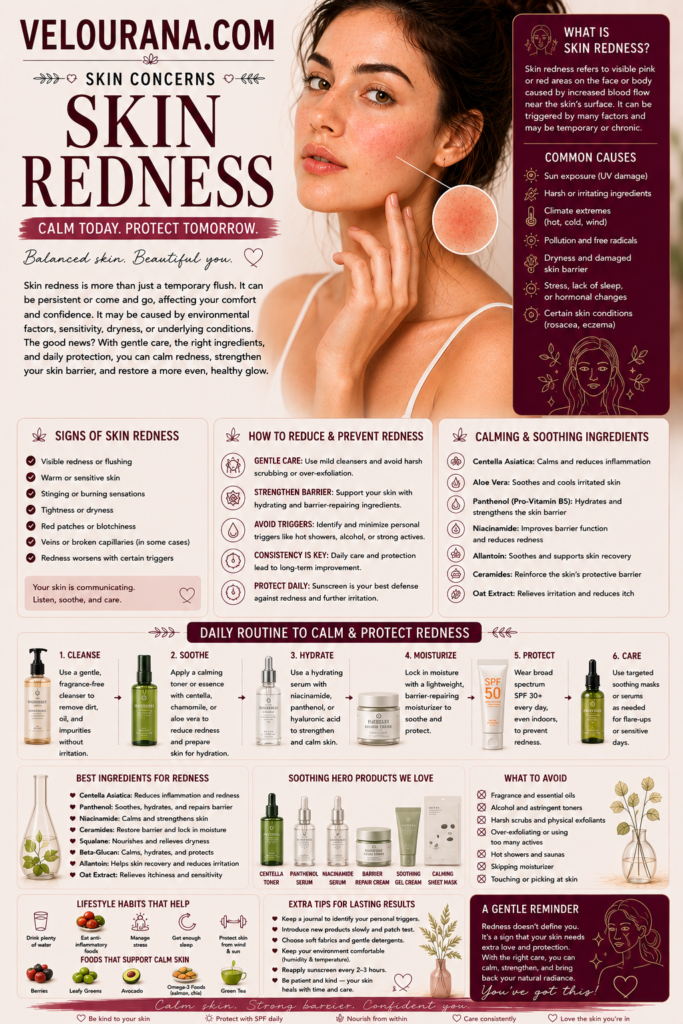
CATEGORY: Skin Redness
Skin redness is one of the skin’s most visible forms of communication. It can appear suddenly after a hot shower, emerge gradually during a stressful afternoon, linger around the nose and cheeks for months, or become noticeable only after applying a product that once seemed perfectly comfortable. Sometimes it is little more than a temporary flush. At other times, persistent redness reflects irritation, barrier disruption, vascular reactivity, inflammation, or a skin condition that deserves professional attention.
What makes redness particularly confusing is that it describes an appearance rather than a single biological problem. Two people may look similarly flushed while experiencing completely different processes beneath the surface. Even within the same person, redness can have several causes at different times. Heat may trigger one episode, over-exfoliation another, while an underlying tendency toward sensitivity may determine how strongly the skin responds to both.
For this reason, approaching redness as something that simply needs to be concealed or immediately “calmed” can miss the more important question: why has the skin become red in the first place?
Healthy skin is not necessarily perfectly uniform in color. Blood vessels continuously adjust to temperature, activity, emotion, environmental conditions, and the needs of the tissue. A temporary pinkness after exercise is therefore fundamentally different from skin that remains inflamed after an aggressive skincare routine. Understanding that distinction changes the way redness should be managed.
The goal is rarely to force the complexion into permanent visual stillness. It is to help the skin return to a state in which its reactions are proportionate, temporary, and comfortable.
Redness Is a Response, Not a Diagnosis
The color we recognize as redness often develops because more blood becomes visible near the surface of the skin. Tiny vessels expand, circulation increases locally, and the complexion takes on a pink, red, or flushed appearance. In lighter skin tones this vascular change may be immediately obvious. In deeper skin tones, inflammation may appear less distinctly red and instead present as warmth, tenderness, swelling, deeper discoloration, or a subtle change in tone.
This vascular response is not inherently harmful. It is part of the body's normal regulatory and inflammatory systems. During exercise, for example, blood vessels near the skin can widen as the body attempts to release heat. A warm room, spicy meal, embarrassment, excitement, or rapid change in temperature may produce a similar visible flush.
The interpretation changes when redness becomes unusually intense, lasts much longer than the trigger itself, repeatedly occurs without an obvious explanation, or appears alongside burning, itching, scaling, swelling, bumps, or persistent discomfort.
Inflammation is another major contributor. When the skin detects injury or irritation, chemical signals help coordinate a protective response. Blood flow can increase, immune activity may rise, and the affected area may become warmer and more reactive. This is useful when the skin genuinely needs protection, but repeated irritation can keep the system activated unnecessarily.
A disrupted skin barrier can make the situation worse. The outermost layers of the skin normally reduce water loss while limiting penetration of substances from the environment. When that protective structure becomes compromised, ingredients and environmental exposures that were previously tolerated may suddenly provoke discomfort.
Redness can therefore sit at the intersection of circulation, inflammation, barrier function, immune activity, and individual sensitivity.
This explains why there is no universal anti-redness solution. The appearance may be similar while the underlying mechanism is not.
The Difference Between a Flush and Persistent Redness
One of the most useful distinctions is duration.
A short-lived flush that appears after exercise and fades as body temperature normalizes is usually behaving as expected. The skin reacts to a stimulus and subsequently returns toward baseline. The same can occur after stepping from cold winter air into a heated room.
Persistent redness behaves differently. It may remain visible throughout the day, repeatedly occupy the same areas, or become progressively easier to trigger. Someone may notice that the cheeks no longer return completely to their previous tone after flushing. Fine surface vessels may become more apparent. Products may sting more frequently, and environmental conditions that once caused little difficulty may suddenly feel uncomfortable.
There is also episodic redness that occupies the space between these two patterns. The complexion may appear normal much of the time but react dramatically to particular triggers. Alcohol, spicy food, emotional stress, sunlight, heat, cold, exercise, or certain cosmetics can provoke episodes.
Observing the pattern often provides more useful information than simply judging the intensity of the color.
Where does the redness appear? How quickly does it develop? Does it feel hot? Does it itch? Does the skin become tight afterward? Are there bumps or visible vessels? Does it occur after cleansing? Does it become worse after sun exposure? Does it disappear within minutes, hours, or not at all?
These details help transform “my skin is red” into a much more informative description of what the skin is actually doing.
A photograph taken under consistent lighting can sometimes help reveal patterns that are difficult to notice from day to day. The purpose is not to scrutinize every minor change, but to distinguish transient reactions from a developing persistent pattern.
When the Skin Barrier Becomes Part of the Problem
Modern skincare can unintentionally create redness through excessive intervention.
The skin barrier depends heavily on the organization of cells and lipids in the outermost layer of the epidermis. This structure helps retain water and limits the penetration of potential irritants. It is remarkably effective, but it is not indestructible.
Repeated exfoliation, aggressive cleansing, frequent use of strong active ingredients, harsh scrubbing, very hot water, or constant experimentation with new products can interfere with this protective system. The result may not initially look dramatic. Skin can simply begin feeling slightly tighter after cleansing or become unusually sensitive around the nose.
If the stress continues, however, the complexion may become increasingly reactive.
Water escapes more easily from compromised skin, contributing to dehydration and tightness. At the same time, substances from cosmetics and the environment may penetrate more readily. Ingredients that previously caused no difficulty can begin to sting. Even water or a familiar moisturizer may feel uncomfortable when the barrier is sufficiently disturbed.
This can create a frustrating cycle. Redness appears, so more products are introduced to treat it. Those products contain additional active ingredients, botanical extracts, acids, fragrances, or other components. The already stressed skin is exposed to even more variables, redness increases, and the routine becomes increasingly complicated.
In such circumstances, restraint can be more useful than escalation.
A simplified routine built around gentle cleansing, adequate moisturization, and appropriate sun protection gives the skin fewer potential sources of irritation while supporting its normal recovery processes. This does not mean every case of redness can be solved by “repairing the barrier,” nor does the skin barrier function as a magical explanation for every concern. It means barrier disruption is a common and modifiable contributor that deserves consideration.
Skin sometimes needs fewer instructions, not more.
Why Skincare Ingredients Can Suddenly Begin to Sting
One of the most unsettling experiences for someone with redness is applying a familiar product and discovering that it suddenly burns.
The instinctive conclusion is often that the product has somehow become bad or that an allergy has developed overnight. Both are possible in particular circumstances, but neither is the only explanation.
Skin tolerance is dynamic.
A product used comfortably during one period may become irritating when the skin has been exposed to strong sun, dry weather, over-exfoliation, retinoids, repeated cleansing, illness, friction, or another source of stress. The formula has not necessarily changed; the condition of the skin receiving it has.
This distinction matters because repeatedly searching for an entirely new collection of products can make troubleshooting more difficult.
When redness appears after introducing a new product, timing deserves attention. Immediate burning does not automatically prove allergy, and delayed reactions do not automatically prove irritation. Contact dermatitis, sensitivity, and other inflammatory reactions can overlap in appearance. Persistent or severe reactions require appropriate medical assessment rather than home experimentation.
For ordinary cosmetic irritation, however, the practical principle is straightforward: discomfort should not routinely be treated as evidence that a product is “working.”
Some active ingredients can produce predictable temporary sensations under appropriate circumstances, but significant burning, prolonged redness, swelling, or worsening irritation should not be normalized.
The beauty industry has sometimes encouraged an endurance mentality around potent skincare. Consumers may assume that peeling, stinging, and redness are necessary stages on the way to better skin.
They are not reliable measures of effectiveness.
A treatment can be biologically active without making the face feel injured.
The Hidden Influence of Cleansing
Cleansing seems so ordinary that it is often overlooked when redness develops.
Yet cleansing is one of the few skincare actions repeated almost every day, sometimes several times a day. Small amounts of unnecessary irritation can therefore accumulate.
The purpose of a facial cleanser is not to make the skin feel stripped of every trace of oil. It is to remove unwanted material while preserving as much of the skin’s normal protective environment as reasonably possible.
A squeaky, extremely tight feeling after washing may be interpreted as exceptional cleanliness, but it can indicate that cleansing has been more aggressive than necessary.
Technique matters as much as the cleanser itself.
Hot water can intensify flushing in reactive skin. Vigorous rubbing introduces friction. Cleansing brushes, rough washcloths, scrubs, and repeated passes over the same area can mechanically aggravate already sensitive tissue. Long cleansing sessions increase exposure to surfactants.
For someone experiencing unexplained redness, examining this mundane part of the routine can be surprisingly revealing.
Gentle does not mean ineffective. Sunscreen, makeup, excess sebum, and environmental debris can be removed without treating the face as a surface that needs to be polished.
Double cleansing may be useful when heavier makeup or resistant sunscreen needs removal, but it is not a universal requirement. Someone wearing little on the skin may gain nothing from two complete cleansing steps every evening. Similarly, a morning cleanse with a surfactant-based product may be unnecessary for some people, while others prefer it because of oiliness or overnight products.
The appropriate routine is the one that cleans adequately without repeatedly leaving the skin uncomfortable.
Redness often improves not through the addition of an impressive new serum but through correcting small sources of irritation that were hiding inside ordinary habits.
Heat, Cold, Sunlight, and the Environment
The environment continuously interacts with the skin, and redness-prone complexions often make that interaction particularly visible.
Heat is a classic trigger because blood vessels expand as part of thermoregulation. Hot showers, saunas, warm rooms, cooking over a hot stove, intense exercise, and summer weather can all increase flushing. The reaction does not necessarily indicate damage, but frequent or prolonged flushing can be troublesome for people who already experience vascular reactivity.
Cold presents a different challenge. Low temperatures, dry air, and wind can increase discomfort and contribute to barrier stress. Moving rapidly from cold outdoor conditions into heavily heated indoor spaces creates another vascular adjustment.
The result can be the familiar winter pattern of cheeks that feel simultaneously dry, hot, and red.
Sunlight deserves particular attention. Ultraviolet radiation can contribute to inflammation, visible vascular changes, premature skin aging, and worsening of several conditions associated with redness. A person focusing entirely on soothing products while neglecting sun protection may therefore be addressing only part of the problem.
Sunscreen selection can be complicated when the skin is reactive. A formula that is excellent for one person may sting another, particularly when the barrier is already compromised. Comfort matters because sunscreen only provides practical benefit when it is applied adequately and consistently.
Environmental protection is not limited to sunscreen. Shade, hats, avoiding unnecessary exposure during intense sunlight, and reducing extreme heat can complement topical protection.
The objective is not to create a life in which the skin never encounters weather. It is to reduce avoidable extremes and understand which conditions reliably provoke a disproportionate response.
This perspective also prevents skincare from receiving blame for every fluctuation. Sometimes a routine has remained unchanged while the environment has changed dramatically.
The Problem With Treating Redness Too Aggressively
Redness creates urgency because it is immediately visible.
A blemish can be covered. Fine lines may be noticed mainly at close range. A flushed face, however, can alter the appearance of the entire complexion within minutes. This visibility encourages intervention.
The danger is that aggressive treatment can amplify the very problem it is intended to solve.
Exfoliating acids are a common example. They can be useful for particular concerns when chosen and used appropriately. But someone seeing rough, red skin may assume that removing more surface cells will reveal smoother skin underneath. If the roughness is actually associated with irritation or barrier disruption, additional exfoliation may intensify the problem.
The same principle applies to scrubs, cleansing devices, strong masks, frequent peels, and stacking multiple active products.
Retinoids present a more nuanced situation. They have substantial applications in skincare and dermatology, but irritation can occur, especially during initiation or when combined with other potentially irritating products. Increasing strength or frequency before the skin has adapted can turn a carefully designed routine into a persistent source of inflammation.
More is not automatically more effective.
Frequency, concentration, formulation, combination, and individual tolerance all matter.
The temptation to rapidly eliminate redness also fuels constant product switching. A serum is used for three days, abandoned, replaced with a cream, supplemented with a mask, and then combined with another treatment. Eventually it becomes almost impossible to determine what the skin tolerates.
Consistency is diagnostically useful. A stable, simple routine creates a clearer baseline from which changes can be evaluated.
When the complexion is already protesting, experimentation should generally become more deliberate rather than more ambitious.
What “Soothing” Skincare Can and Cannot Do
The language of soothing skincare is appealing because it promises relief rather than correction through force.
Moisturizers and carefully formulated products can indeed improve comfort, support hydration, reduce dryness, and help maintain barrier function. Certain ingredients commonly used in sensitive-skin formulations may also contribute to a more comfortable skin environment.
But “soothing” is a cosmetic description, not a diagnosis.
No ingredient can be expected to solve every cause of redness because redness is not one condition.
A moisturizer may dramatically improve redness caused primarily by dryness and irritation while doing relatively little for persistent visible blood vessels. A gentle routine may reduce product-induced inflammation but cannot substitute for medical treatment when a chronic inflammatory disorder is present.
This is where expectations become important.
Skincare is particularly useful when the factors maintaining redness are within the routine itself: excessive cleansing, insufficient moisturization, overuse of active ingredients, inadequate sun protection, or repeated exposure to irritating products.
It can also support skin comfort alongside professional management of diagnosed conditions.
What it should not do is encourage endless self-treatment when symptoms suggest something more complicated.
Ingredient lists can provide useful information, but they should not become an obsession. A formula cannot be judged entirely by the presence or absence of one fashionable ingredient. Concentration, formulation, vehicle, combination of ingredients, and the condition of the individual skin all influence the experience.
Even ingredients celebrated for sensitive skin can cause problems for a particular person.
The meaningful question is therefore not simply, “Is this a soothing ingredient?”
It is, “Does this complete product work comfortably and appropriately for this skin?”
Fragrance, Botanicals, and the Myth of the Automatically Gentle Product
Redness-prone consumers are frequently drawn toward products described as natural, botanical, clean, calming, or gentle.
These descriptions can create an intuitive sense of safety, but nature does not divide ingredients into harmless plants and dangerous laboratory chemicals.
Botanical extracts contain chemical compounds just as synthetic ingredients do. Some may be useful components of well-formulated skincare. Others may be irritating or sensitizing for certain individuals. Essential oils and fragrant plant extracts can be particularly problematic for some reactive complexions.
Fragrance is similarly individual. Many people use fragranced cosmetics without difficulty, while others find fragrance contributes to irritation or allergic contact reactions.
When skin is persistently reactive, reducing unnecessary fragrance exposure can be a reasonable troubleshooting strategy. This is especially relevant when multiple fragranced products are layered across cleansing, treatment, moisturizing, and makeup steps.
The important point is not to turn fragrance-free skincare into another rigid ideology. It is to reduce variables when the skin is behaving unpredictably.
Marketing language should also be interpreted cautiously. Terms suggesting purity, detoxification, chemical avoidance, or toxin removal often have little relationship to the biological causes of redness.
A sophisticated approach to sensitive skin is usually less dramatic.
It asks whether the formulation cleans, hydrates, protects, or treats effectively while remaining tolerable.
The skin does not read the front of the bottle.
Building a Routine Around Stability
When redness is associated with irritation or unexplained sensitivity, a useful routine often begins with stability rather than sophistication.
That means establishing a small number of products that perform essential functions reliably.
Cleansing should be adequate but comfortable. Moisturization should reduce dryness and support the skin barrier without introducing unnecessary irritation. Daytime protection should include an appropriate broad-spectrum sunscreen and sensible management of sun exposure.
Everything beyond those foundations should have a reason for being present.
This approach can feel surprisingly difficult in a beauty culture built around novelty. New launches appear constantly. Social media encourages rotating routines. Ingredients become trends, and consumers are taught to view unused steps as missed opportunities.
Reactive skin often benefits from the opposite philosophy.
A product does not become more valuable because it contains a longer list of actives. A routine does not become more sophisticated because it has nine steps.
The best routine may be relatively uneventful.
Once the skin is comfortable and stable, additional products can be introduced deliberately if another concern genuinely requires them. Introducing one meaningful change at a time makes tolerance easier to evaluate.
Patch testing can sometimes help identify obvious reactions before widespread use, although a small patch cannot perfectly predict how a product will behave across the entire face with repeated application.
Patience is also necessary because irritated skin does not always normalize immediately after the offending behavior stops. Visible redness may improve before sensations of sensitivity completely settle, or comfort may return before the complexion looks entirely even.
Recovery is not a contest.
The objective is to establish a sustainable baseline from which the skin can behave more predictably.
Makeup and the Desire to Neutralize Redness
Redness exists at the intersection of skincare and appearance, which means many people understandably want immediate cosmetic improvement while working on the underlying cause.
Makeup can provide that without pretending to be treatment.
Green-toned color correctors are sometimes used because green visually counterbalances red tones. The effect can be useful when applied carefully, but excessive green correction may make the complexion appear unnatural. Often a thin layer placed only where redness is strongest works better than covering the entire face.
Foundation and concealer can then even the complexion further.
For reactive skin, however, the application method matters. Repeated buffing with stiff brushes or aggressive rubbing with sponges may intensify temporary flushing. Gentle application reduces unnecessary mechanical stimulation.
Removing makeup at the end of the day is equally important, but removal does not require harsh cleansing. Long-wearing formulas may need an effective first cleansing step, followed when necessary by a gentle cleanser, rather than repeated scrubbing.
There is also a psychological distinction worth preserving: covering redness is optional.
Visible redness does not represent failure to care for the skin. Makeup is an aesthetic tool, not an obligation to disguise normal human variation.
Some days the priority may be treatment and comfort. On others, someone may simply want the complexion to appear more even for a meeting, photograph, dinner, or ordinary day.
Both choices are legitimate.
Lifestyle Triggers and the Importance of Patterns
Skincare receives enormous attention because it is tangible. A bottle can be changed immediately. Lifestyle triggers are more complicated because they involve environments, habits, and physiological responses that cannot always be controlled.
Exercise, emotional stress, hot beverages, spicy foods, alcohol, temperature changes, and sunlight are among the factors that some people associate with flushing.
The mistake is to assume that everyone with redness should avoid everything that has ever triggered redness in someone else.
That can turn skincare management into unnecessary restriction.
Individual pattern recognition is more useful.
If a particular trigger repeatedly produces a strong reaction, knowing this allows practical decisions. Someone who flushes intensely in overheated rooms may choose cooler environments when possible. A person whose face reacts strongly to very hot showers can reduce the water temperature. Someone who consistently notices worsening after substantial sun exposure has additional reason to strengthen protective habits.
This is different from constructing an elaborate lifestyle around fear of redness.
Exercise, for instance, naturally increases circulation and body temperature. Temporary flushing during physical activity is not automatically a reason to avoid exercise.
Context matters.
The question is whether the reaction is expected and temporary or unusually severe, painful, persistent, or associated with other symptoms.
A simple record can sometimes reveal relationships that memory misses. Product changes, weather, sun exposure, unusual meals, stress, and episodes of redness can be noted without turning daily life into a laboratory experiment.
Patterns become particularly valuable when professional evaluation is eventually needed because they provide more information than a single snapshot of the skin on the day of an appointment.
When Redness May Be More Than Cosmetic Sensitivity
Persistent facial redness should not automatically be attributed to “sensitive skin.”
Several dermatological conditions can involve redness, inflammation, scaling, bumps, visible vessels, itching, or burning. Rosacea is one well-known example, but it is not the only possibility. Contact dermatitis, eczema, seborrheic dermatitis, acne-related inflammation, allergic reactions, infections, and other conditions can produce overlapping appearances.
Trying to diagnose them from appearance alone is unreliable.
This is particularly important because treatments appropriate for one condition may aggravate another. An exfoliating routine chosen for presumed clogged pores may worsen irritated dermatitis. A rich occlusive product selected for dryness may not address another underlying cause. Repeatedly applying cosmetic “calming” products can delay appropriate evaluation.
Certain patterns deserve more attention.
Redness that persists or progressively worsens, recurrent flushing accompanied by significant burning, visible changes around the eyes, substantial swelling, crusting, pain, widespread rash, or reactions that interfere with daily life should not simply be managed through increasingly elaborate cosmetic experimentation.
Sudden severe reactions, particularly those associated with breathing difficulty or significant facial or throat swelling, require urgent medical attention.
For less urgent but persistent concerns, a dermatologist can examine the distribution and character of the redness, consider symptoms that are not visible in photographs, review possible triggers and products, and determine whether treatment is appropriate.
Seeking professional assessment does not mean skincare has failed.
It means the concern has moved beyond what cosmetics are designed to diagnose.
Why Perfectly Colorless Skin Is the Wrong Goal
The beauty industry has historically encouraged an unusually narrow image of what healthy skin should look like: smooth, poreless, evenly colored, matte where convenient, luminous where fashionable, and almost completely unchanged by temperature, emotion, or movement.
Real skin does not behave this way.
Faces flush.
Cheeks become pink in the cold. Exercise changes circulation. A hot room can alter complexion color. Blood vessels exist beneath the surface because living tissue requires blood.
Trying to eliminate every visible trace of vascular activity can create unnecessary anxiety and encourage overtreatment.
The more useful goal is comfortable, resilient skin whose reactions make sense.
If redness appears after a run and disappears afterward, the skin has responded to physiology. If the face becomes red and painful every evening after a complex sequence of exfoliating products, the routine deserves examination. If persistent central facial redness and recurrent flushing continue regardless of routine simplification, professional assessment may be appropriate.
These are very different situations even though all three can be described with the same word.
“Redness” is therefore most useful as the beginning of an investigation rather than the conclusion.
Learning to Read the Skin Before Trying to Correct It
Skin communicates through changes in texture, color, temperature, comfort, oil production, dryness, and sensitivity. Redness is among the easiest of these changes to see, but visibility does not necessarily make it easy to interpret.
The most productive response begins with observation.
Is the redness temporary or persistent? Is it linked to heat, exercise, weather, skincare, makeup, or sun exposure? Does it occur with itching, burning, scaling, bumps, swelling, or pain? Has the routine recently become more aggressive? Has a new product been introduced? Is the skin feeling unusually tight after cleansing?
From those questions, a rational strategy can emerge.
Sometimes the answer is remarkably simple: cooler water, gentler cleansing, fewer exfoliating steps, consistent moisturization, and better sun protection.
Sometimes the skin needs time after a period of over-treatment.
Sometimes a particular product is simply not well tolerated.
And sometimes the pattern indicates that cosmetic troubleshooting has reached its limit and professional evaluation is the more appropriate next step.
What matters is resisting the impulse to treat all redness as one problem.
The skin is not merely changing color. It is responding to something.
Understanding that response is far more valuable than chasing an artificially flawless complexion. A well-managed complexion is not one that never flushes, never reacts, and never reveals the circulation beneath it. It is one whose protective barrier is respected, whose triggers are understood where possible, whose treatments are proportionate, and whose persistent problems are recognized rather than disguised indefinitely.
Redness becomes easier to navigate when the objective changes from suppression to understanding.
The face does not need to remain visually motionless to be healthy. It needs the conditions that allow temporary reactions to remain temporary, irritation to resolve rather than accumulate, and genuine skin disorders to receive the attention they deserve.
That distinction is the foundation of intelligent care for redness-prone skin.
The End Velourana
 Discover More From Our Family of Websites
 ZodiacBearing (Astrology, Tarot, Numerology, Angel Numbers & Spiritual Guidance)
 Velourana (Beauty, Makeup, Hair Care, Skincare & Beauty Tips)
 HavenBearing (Home, Living, Organization, Décor & Everyday Inspiration)
 PawBearing (Pet Care, Dog Breeds, Animal Health, Training & Pet Products)
 PsyCatherine (Notes From the Journal of a Psychologist on Real Life)

