
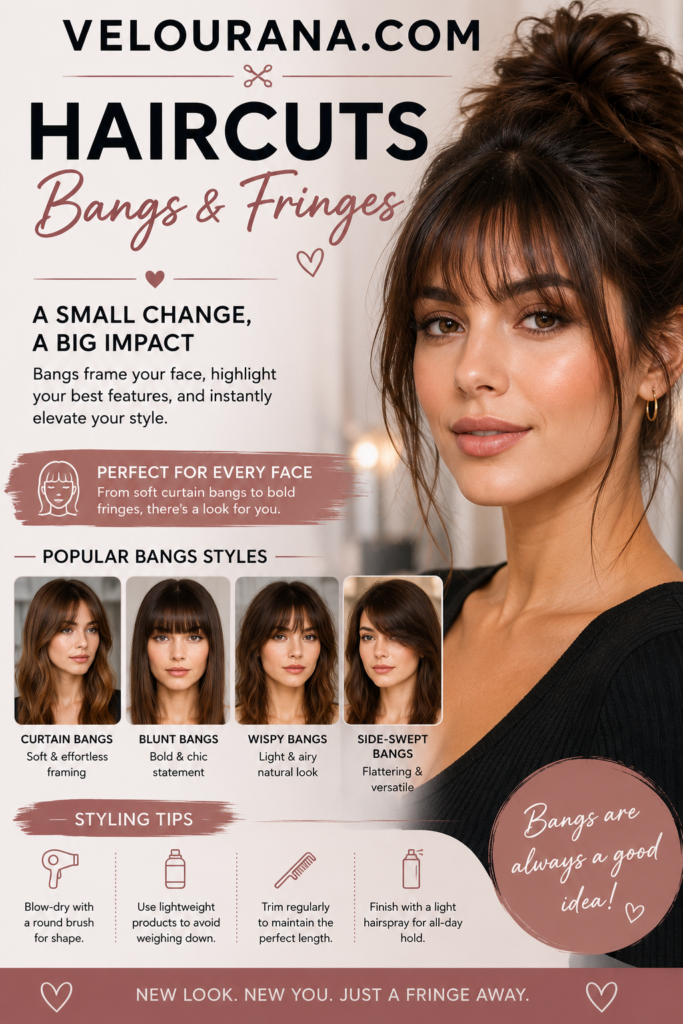
CATEGORY: Bangs & Fringes
Side-swept bangs have survived decades of changing hair trends for a simple reason: they are remarkably adaptable. Their exact appearance may change from one era to another, becoming shorter, softer, fuller or more dramatically swept, but the underlying idea remains useful. Hair moves across part of the forehead and gradually blends into the side of the haircut, creating asymmetry and movement around the face.
Unlike a full fringe, side-swept bangs do not usually create a solid horizontal boundary. Unlike curtain bangs, they do not depend on a central opening or symmetrical movement toward both sides. Their character comes from direction. The hair travels across the forehead rather than simply falling straight down, and that diagonal movement can alter the entire impression of a haircut.
A subtle side fringe can be almost indistinguishable from face-framing layers. A stronger version can sweep across much of the forehead and become one of the most noticeable elements of the hairstyle. Shorter versions can emphasize the eyes, while longer pieces can draw attention toward the cheekbones and jaw.
This range is what makes the style difficult to define through a single photograph. Two people can both have side-swept bangs while wearing completely different haircuts.
The most successful version depends on much more than choosing a side. Length, density, parting position, natural growth patterns and the way the fringe connects with the rest of the hair all determine whether the finished shape feels effortless or requires constant correction.
Why Asymmetry Changes the Appearance of a Haircut
The human face is naturally slightly asymmetric, and hairstyles can either emphasize or soften those differences. A side fringe introduces another deliberate asymmetry by placing more visual weight on one side of the forehead.
This can create movement even when the rest of the haircut is relatively simple.
Long straight hair, for example, can sometimes appear very vertical when worn with a centered part and few layers. Introducing a side-swept fringe creates a diagonal line across the upper face, immediately changing that geometry without sacrificing the overall length.
The same principle works with shorter hair.
A bob with a side fringe can feel softer and more fluid than the same bob with a perfectly central part. A pixie cut can use a longer sweeping front section to create contrast against shorter sides. Layered shoulder-length hair can connect the fringe into movement around the cheekbones and jaw.
The amount of forehead left visible also affects the result.
A deep side part with a substantial fringe may cover much of the forehead before the hair moves toward the temple. A lighter fringe beginning closer to the center can leave considerably more skin visible.
Neither is automatically more flattering.
The important question is what kind of visual balance you want the haircut to create.
The Parting Is Part of the Haircut
With side-swept bangs, the parting is not simply where you happen to separate the hair after styling. It is part of the architecture of the fringe.
A deep side part creates greater distance for the hair to travel across the forehead. This can produce a dramatic sweep, particularly when the fringe is relatively long and dense.
A softer off-center part creates a more relaxed effect. The fringe may move only slightly across the forehead before blending into the side.
The natural parting should be considered before deciding where the new one will sit.
Some hair moves willingly in either direction. Other hair has a strong preference created by its growth pattern. Attempting to force a deep part against a powerful cowlick can turn a seemingly simple fringe into a daily styling battle.
This does not mean the natural part can never be changed.
Hair can often be redirected through consistent styling, particularly when the roots are controlled while damp. But the amount of work required should be understood before the cut is made.
For someone who wants minimal styling, working with the natural direction usually produces the easiest result.
Someone comfortable using a blow-dryer every morning has more freedom to create a parting that differs from the natural growth pattern.
Short Side Bangs Create a More Defined Fringe
When side-swept bangs are relatively short, they remain clearly identifiable as bangs.
The shortest pieces may sit around eyebrow level before travelling diagonally toward the temple. This brings the fringe close to the eyes and makes it an obvious feature of the haircut.
The cutting line should still allow movement.
If the section is cut too bluntly without considering the direction in which it will be worn, the fringe can appear heavy or form an awkward step when swept aside.
The transition toward the longer side is therefore important.
A gradual increase in length allows the hair to travel naturally toward the temple and eventually connect with the surrounding haircut.
Short side bangs usually require more frequent maintenance because growth quickly changes their position. A fringe that initially sits comfortably above the eye may begin falling directly into it several weeks later.
That can be particularly irritating with side bangs because the longest portion may repeatedly cross the field of vision.
Regular reshaping keeps the intended diagonal line intact rather than allowing the entire section to become a single awkward length.
Longer Side Bangs Offer Greater Flexibility
Long side-swept bangs create a very different experience.
The shortest point may begin around the eyes, cheekbones or even lower. Instead of looking like a traditional fringe, the section becomes a strong face frame that happens to move predominantly toward one side.
This is often an appealing option for someone who wants visible movement without committing to short bangs.
Longer pieces can be tucked behind the ear.
They can be incorporated more easily into tied hairstyles.
They can be swept farther away from the face when desired.
As they grow, they transition naturally into ordinary layers.
The trade-off is that extremely long side bangs may not create the dramatic transformation someone expects from adding a fringe. If the shortest pieces begin around the jaw, the result may feel more like layering than bangs.
This is why the desired level of change should be discussed before cutting.
A conservative first fringe can be kept relatively long and shortened gradually once the wearer sees how the hair behaves.
Fine Hair Can Benefit From Direction Without Losing Too Much Density
Fine hair requires careful management whenever a fringe is introduced because the hair used for the bangs must come from somewhere.
Taking a deep section from the front can reduce fullness around the sides.
A lighter side fringe can avoid this problem.
Because the hair is directed diagonally rather than required to create dense coverage across the entire forehead, a relatively modest amount of hair can produce noticeable movement.
The fringe can also create the impression of volume when the roots are given a little lift.
Fine hair should generally not be overloaded with heavy styling products. Oils, thick creams and excessive wax can cause short pieces to collapse and separate.
Lightweight styling and controlled blow-drying are often enough.
The connection into the rest of the haircut also matters. If the side fringe ends abruptly beside very long one-length hair, the difference in density may become obvious. A few longer face-framing pieces can create a smoother transition while preserving most of the overall fullness.
Thick Hair Can Create a Luxurious Sweep
Thick hair provides enough density to create a substantial side fringe, and the result can be particularly dramatic.
The challenge is preventing that density from becoming a heavy block across the forehead.
A deep section combined with thick strands can create considerable weight. If the hair is also straight, the fringe may fall forward rather than sweeping naturally toward the side.
The cut needs to establish direction.
Weight can be managed internally where appropriate, while the perimeter maintains enough substance to look intentional.
The stylist may also connect the fringe into longer layers so that the volume gradually disperses toward the side of the haircut.
When this is done well, thick side-swept bangs can create beautiful movement because there is enough hair to form a visible sweeping shape.
The result can be polished and glamorous without requiring the rigid appearance of a blunt fringe.
Natural Texture Changes the Meaning of “Swept”
Side-swept bangs do not need to be straight.
Wavy hair can create an especially relaxed version because the natural bends add movement as the fringe crosses the forehead. Rather than forming one smooth curve, the hair may separate into softer sections.
Curly hair creates an even more individual interpretation.
A few curls can move diagonally across the forehead while others frame the temple and cheek. The overall direction remains side-swept even though individual strands follow their natural curl pattern.
Shrinkage must be considered when determining length. A curl that appears long enough while stretched can sit much higher once dry.
For textured hair, the fringe should ideally be designed around the way it is normally worn.
If someone wears their curls naturally almost every day, there is little value in creating a fringe that only achieves its intended shape after straightening.
The natural texture should become part of the design.
Straight hair offers a cleaner and often more graphic sweep, but it may require root direction to prevent the fringe from simply falling forward.
Every texture can support the style. The technique simply changes.
Cowlicks Can Help or Complicate the Shape
A cowlick at the front hairline can strongly influence side bangs.
Sometimes it is useful.
If the hair naturally lifts and moves toward one side, that direction can become the foundation of the fringe. Instead of fighting the growth pattern, the haircut exaggerates something the hair already wants to do.
A cowlick moving in the opposite direction can require more work.
The roots may need to be redirected during drying each time the hair is washed. Allowing the fringe to dry naturally in its preferred direction and attempting to correct it afterward can be frustrating.
This is why the natural hairline should be examined before the stylist commits to a particular side.
The side that looks most attractive in an inspiration photograph may not be the easiest side for your own hair.
Sometimes reversing the photograph mentally and wearing the fringe in the opposite direction produces essentially the same aesthetic with far less maintenance.
Styling Is Primarily About Direction
Side-swept bangs do not necessarily require complicated styling.
What they do require is direction.
The roots determine whether the fringe crosses the forehead smoothly or falls into an unwanted part.
Working while the hair is damp gives greater control.
A blow-dryer can be used to guide the roots before the lengths are shaped toward the chosen side. Depending on the hair and desired finish, a brush can introduce a gentle bend and movement.
Too much volume can create an exaggerated shape.
A side fringe usually looks more contemporary when it flows rather than appearing like a single inflated section sitting above the forehead.
The ends should connect naturally with the surrounding hair.
If the rest of the hairstyle is loose and textured, the fringe does not need to be perfectly smooth. If the overall style is polished, a cleaner sweep may feel more cohesive.
The goal is not to make the fringe identical every day.
It is to establish enough direction that the hair falls attractively without constant adjustment.
Side Bangs Can Change How a Ponytail or Updo Looks
One of the advantages of a side fringe is that it continues to contribute to the hairstyle when the rest of the hair is tied back.
A ponytail without face-framing pieces can create a very open, clean appearance.
Adding side-swept bangs changes that immediately.
The diagonal section around the forehead introduces softness and can connect with longer pieces around the ear or jaw. A bun or formal updo can similarly use the fringe to create movement at the front while the rest of the hair remains controlled.
This versatility is particularly useful for people who frequently alternate between wearing their hair loose and tied.
The appropriate fringe length depends on how much flexibility is wanted.
Very short side bangs will remain outside almost every tied hairstyle.
Longer versions may be pinned, tucked behind the ear or incorporated into the style when an open face is preferred.
This is worth considering before the cut, especially for someone who needs to secure all their hair for work, sport or other activities.
Keeping the Fringe Fresh
Like other bangs, side-swept fringes can become oily faster than the rest of the hair.
They encounter the forehead, skincare, sunscreen and hands throughout the day.
Because the fringe often relies on volume and movement, oil can make it collapse.
A separate fringe wash can solve this without requiring a full shampoo.
The small front section can be washed, dried and restyled relatively quickly while the rest of the hair remains untouched.
Dry shampoo can provide another option when used appropriately.
The amount and placement matter. Applying excessive product can make the fringe dull or stiff, particularly on dark or fine hair.
Skincare products should also be allowed to settle where practical before the fringe is placed against the forehead.
The solution is not to reduce necessary skincare or sun protection. It is simply to allow the hair and skincare routines to coexist without unnecessarily transferring large amounts of product into the bangs.
Side-Swept Bangs Can Be Especially Forgiving While Growing
One of the strongest practical advantages of side bangs is the growing-out process.
As the fringe becomes longer, it does not necessarily reach a stage where it suddenly stops working.
It simply becomes a longer sweep.
Eventually the shortest pieces reach the cheekbones and begin resembling face-framing layers. Later they can move toward the jaw and blend more completely into the surrounding hair.
During this transition, the part can be adjusted.
A deeper side part can keep longer pieces moving away from the eyes. An off-center part can allow some of the fringe to join the opposite side. Clips and pins provide additional control.
A stylist can also reshape the surrounding layers so the growing fringe looks intentional.
For someone who worries about regretting bangs, this relatively gentle exit route can make a side fringe particularly attractive.
Face Shape Can Guide the Design Without Dictating It
Side-swept bangs are often recommended according to face shape because diagonal lines can alter visual proportions.
A longer sweep can introduce movement across a rounder face.
A softer fringe can contrast with an angular jaw.
A substantial side bang can reduce the amount of visible forehead on a longer face.
These ideas can be useful when they correspond with what the wearer actually wants.
They should not become rigid rules.
A person with a round face may love emphasizing its softness rather than trying to create the illusion of length. Someone with a strong jaw may want a graphic haircut that reinforces that structure instead of softening it.
The haircut should serve the person rather than an abstract geometry lesson.
The width of the forehead, brow position, cheekbones, hairline and density can also change the effect substantially.
The most useful approach is to look at the entire relationship between the hair and face and decide where movement would be visually interesting.
Modern Side Bangs Do Not Need to Recreate an Earlier Decade
Because side-swept bangs have been particularly prominent during certain periods, people sometimes associate them with a specific era.
The difference between a dated-looking fringe and a contemporary one is usually not simply the fact that it moves sideways.
It is how the fringe relates to the rest of the haircut.
A modern interpretation may have softer texture, less rigid volume and a more gradual transition into surrounding layers. The part may be less extreme, or the fringe may be longer and more relaxed.
Alternatively, someone may deliberately choose a dramatic retro interpretation because that is exactly the aesthetic they enjoy.
Hair trends do not erase useful shapes.
They change the way those shapes are combined and styled.
A diagonal fringe remains a fundamental haircut technique regardless of which decade currently claims it.
Choosing the Side That Works for You
People sometimes choose which direction their fringe should sweep based purely on facial appearance.
The hair itself deserves an equal vote.
Observe where your natural part forms.
Notice whether one side of the hairline lifts more than the other.
Look at the direction of any cowlicks.
Consider which side you naturally tuck behind your ear.
Think about how you normally photograph or style your hair, but do not allow those habits to override a direction that would make the fringe dramatically easier to maintain.
A stylist can test how the front section moves before cutting.
Sometimes the answer is immediately obvious: the hair falls naturally into a beautiful sweep toward one side.
When both directions work, appearance and preference can make the final decision.
A Fringe That Can Evolve With the Haircut
The lasting strength of side-swept bangs is not that they belong to one particular trend.
It is that they can evolve.
A short side fringe can grow into a longer sweep.
A longer sweep can become cheekbone framing.
Cheekbone pieces can become layers.
A dramatic deep part can later become a softer off-center part.
The fringe can accompany a bob, long layers, a pixie, waves, curls or an updo without needing to perform exactly the same role in every hairstyle.
That flexibility makes side-swept bangs particularly useful for someone who enjoys changing their hair but does not necessarily want every change to require starting again.
The most successful version begins with the natural characteristics of the hair. It respects density, texture and growth direction. Its length fits the amount of maintenance the wearer is prepared to accept, and its shape connects naturally with the rest of the haircut.
When those elements come together, a side fringe does more than cover part of the forehead.
It introduces direction.
And sometimes a new direction is all a familiar haircut needs.
The End
Velourana.
 Discover More From Our Family of Websites
 ZodiacBearing (Astrology, Tarot, Numerology, Angel Numbers & Spiritual Guidance)
 Velourana (Beauty, Makeup, Hair Care, Skincare & Beauty Tips)
 HavenBearing (Home, Living, Organization, Décor & Everyday Inspiration)
 PawBearing (Pet Care, Dog Breeds, Animal Health, Training & Pet Products)
 PsyCatherine (Notes From the Journal of a Psychologist on Real Life)

