
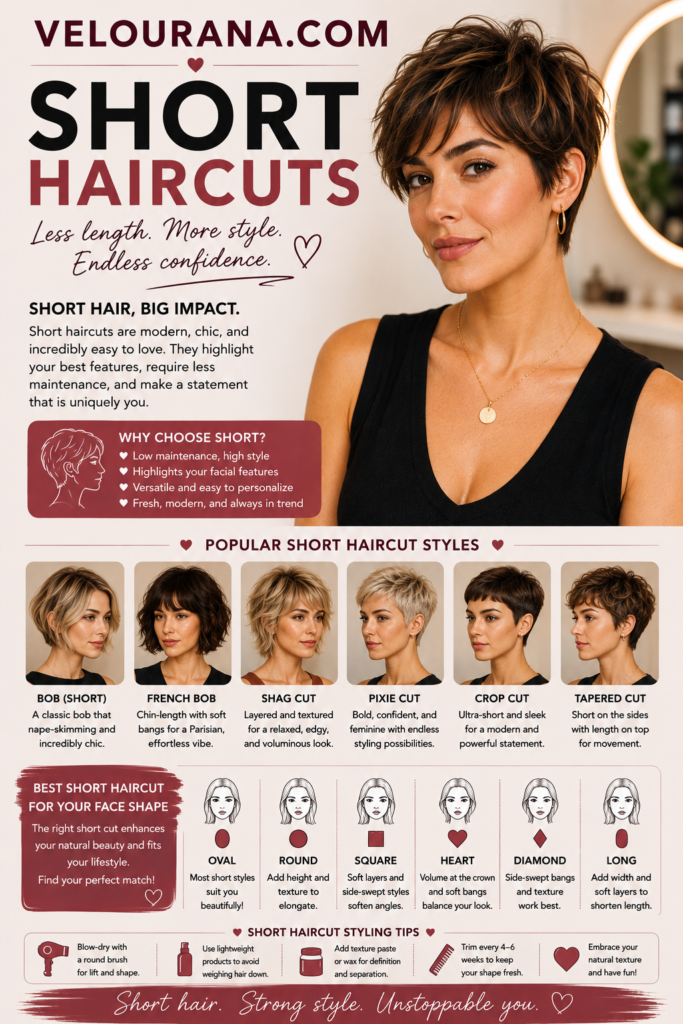
CATEGORY: Short Haircuts
A short haircut can look beautifully simple when most of the hair finishes at one strong perimeter, but short hair does not have to depend on a single line. Layers can change the way the entire shape behaves, introducing movement through the crown, softness around the face and a lighter relationship between the ends.
The important question is not whether short hair should be layered.
It is how much layering the haircut actually needs.
Because the overall length is limited, every layer represents a meaningful proportion of the haircut. On long hair, a difference of several centimeters can disappear inside the lengths. On hair sitting around the jaw or above it, the same difference can dramatically change the silhouette.
This is why short layering works best when it has a clear purpose.
Perhaps the objective is to release natural waves that become weighed down in a blunt bob. Perhaps thick hair needs some of its density redistributed so that the shape does not become excessively triangular. Fine hair may need only subtle movement through the crown while preserving as much density as possible around the perimeter. Curly hair may require layers to distribute volume vertically instead of allowing all of it to accumulate at one level.
A layered short haircut can therefore range from almost imperceptibly shaped to deliberately textured.
Some versions maintain a strong bob perimeter while hiding subtle layers inside it. Others make the layers obvious, allowing individual sections to move independently. A short shag takes the concept further, making the changing lengths central to the appearance. A layered bixie moves even closer to pixie territory, where the crown and fringe become more important than the lower perimeter.
The best result is not necessarily the haircut with the greatest number of layers.
It is the one in which every change of length contributes something useful.
Why Layers Have More Impact on Short Hair
The shorter the haircut becomes, the more visible its internal structure tends to be.
Imagine a shoulder-length haircut with a layer beginning around the chin. There is still considerable length beneath that layer, so the transition can appear gradual.
Move the overall perimeter to the jaw while keeping a significantly shorter layer through the crown and the difference becomes much more obvious.
The upper hair gains freedom.
The crown can lift.
The sides may develop greater volume.
The ends no longer fall together in one uninterrupted surface.
This can completely change the personality of the haircut.
A blunt short bob often communicates weight and precision. A layered version can feel lighter and more fluid even when the perimeter remains in exactly the same position.
Layers do not necessarily make the haircut shorter.
They change how the existing length is distributed.
A Strong Perimeter Can Still Exist Beneath Layers
Layered does not automatically mean wispy.
One of the most useful approaches to short hair is preserving a substantial lower perimeter while introducing movement above it.
The ends still create a recognizable baseline.
Enough strands reach that baseline to give it visual strength.
Meanwhile, shorter internal sections reduce some of the heaviness and allow the upper hair to move more freely.
This combination can work particularly well for someone who wants the fullness of a bob without the rigidity of a completely one-length structure.
The haircut retains definition when worn smooth.
When waves or texture are introduced, the layers become more apparent.
The same structure can therefore support several different finishes.
Fine Hair Requires Restraint
Fine hair is frequently given layers in an attempt to create volume.
Sometimes that works beautifully.
Sometimes it produces exactly the opposite result.
Every layer removes strands from the lower perimeter. If too many sections are shortened, the ends may begin looking thin even though the crown has gained some movement.
This is why the density of the hair matters as much as the diameter of each strand.
Someone can have fine individual strands but a great many of them. Another person may have fine hair with relatively low overall density.
Those two heads of hair should not automatically receive the same layering.
For lower-density hair, preserving a substantial perimeter can create the impression of greater fullness. A small amount of shaping through the crown or around the face may provide enough movement without compromising that strength.
The objective is not maximum volume at every level.
It is balance.
Thick Hair Can Use Layers to Redistribute Weight
Dense hair creates a different challenge.
When thick hair is cut into a short blunt shape, a large amount of material can accumulate around the lower perimeter.
This can be visually striking.
A substantial geometric bob may be exactly what the wearer wants.
But when a softer or more mobile result is desired, layers can help redistribute some of that weight.
The crown can gain movement.
The sides can become less solid.
Natural texture can emerge.
The ends may move more independently rather than forming one heavy block.
The key is preserving enough density for the haircut to retain its richness.
Thick hair does not need to be aggressively reduced simply because there is a lot of it.
Good layering organizes the volume rather than attempting to eliminate it.
Straight Hair Makes Layer Placement Visible
Straight hair reveals differences in length clearly.
When the haircut is smooth, the transition between the upper and lower sections can often be seen directly.
This makes subtle layering particularly valuable.
A softly layered bob can maintain an almost blunt appearance while gaining movement around the crown and ends.
More pronounced layers create a visibly textured shape.
The desired finish should determine which approach is used.
Someone who wants to alternate between sleek and tousled styles may benefit from layers subtle enough to disappear when the hair is smoothed but active enough to separate when texture is encouraged.
This creates versatility without requiring two different haircuts.
Waves Often Become Stronger When Layers Remove Weight
Wavy hair can change significantly after layering.
Longer sections pull the pattern downward.
Shorter sections have less weight and may develop stronger bends.
On a short haircut, this can create natural volume through the crown and sides.
A bob that appeared almost straight when heavily weighted may become visibly wavy once the internal structure is released.
This makes conservative cutting important, particularly during a major transformation from long to short hair.
The final dry texture may occupy more space and sit higher than expected.
The haircut should be designed for the way the waves actually settle rather than for the stretched position of the strands.
Curly Hair Uses Layers to Build the Silhouette
Curly short hair is shaped through volume as much as through length.
Without layering, curls of similar length may accumulate around one level and create a broad lower silhouette.
That can be beautiful when intentionally chosen.
Layers provide another possibility.
Shorter curls through the crown can create height.
Intermediate sections distribute volume through the sides.
Longer curls preserve the lower structure.
The result can become rounder and more balanced rather than concentrating all of the fullness near the perimeter.
Shrinkage makes the process particularly individual.
Two curls cut to the same stretched length may settle at different heights.
The finished shape therefore matters more than mathematical uniformity.
Crown Layers Can Change the Entire Profile
The crown is one of the most influential areas in a short layered haircut.
Keeping it relatively long creates weight and a smoother upper surface.
Shortening selected sections can introduce lift.
The profile changes immediately.
From the side, the haircut may appear rounder.
From the front, additional crown volume can make the sides seem more compact.
The effect should be proportionate.
Extremely short crown layers combined with a much longer perimeter create a strong contrast and may move the haircut toward shag territory.
More moderate layering produces a softer transition.
Neither is inherently better.
They create different identities.
Face-Framing Layers Can Change the Front Without Altering the Back
Not every layered short haircut needs extensive layering throughout the entire head.
Sometimes the most effective change occurs only around the face.
A bob can retain a strong perimeter through the back while shorter pieces appear around the cheekbones, jaw or temples.
These sections create movement when the hair is tucked behind the ears or swept away from the face.
They can also connect naturally with bangs.
This approach preserves density through most of the haircut while making the front feel softer.
For someone cautious about layering, it can provide a useful middle ground between a completely blunt shape and a fully layered one.
Bangs Can Become the Beginning of the Layers
A fringe does not need to exist independently from the rest of the haircut.
Curtain bangs can gradually become longer toward the temples and flow directly into face-framing layers.
A side-swept fringe can connect with shorter sections around one side of the face.
Wispy bangs can echo light texture through the rest of the haircut.
When these transitions are designed deliberately, the haircut feels continuous.
The front does not look as though bangs were simply added to an unrelated bob.
Instead, the fringe establishes the first level of movement and the layers continue that movement toward the perimeter.
A Layered Bob Can Still Look Polished
Layers are often associated with casual or tousled styling, but they do not prevent a refined finish.
When straightened or blow-dried smoothly, subtle layers can blend into the overall surface.
The perimeter remains visible.
The crown gains shape without appearing heavily separated.
The ends can curve naturally rather than sitting as one rigid line.
This can create a softer form of polish than a completely blunt bob.
The haircut still looks controlled, but there is movement within the structure.
Air-Drying Reveals What the Layers Really Do
A professional blowout can temporarily alter the natural behavior of almost any haircut.
Air-drying reveals the underlying relationship between the layers and texture.
Straight hair may show subtle bends.
Waves become more visible.
Curls contract into their actual positions.
The crown settles according to its natural growth pattern.
For someone who usually air-dries, this version of the haircut should be considered during the design process.
The layers should create an attractive natural silhouette without requiring daily correction.
Styling can then become an option rather than a necessity.
Short Layers Can Create Volume Without Traditional Teasing
Volume in short hair often comes from removing enough weight for the roots and upper sections to lift naturally.
A well-positioned crown layer may rise more easily than a long section.
Waves and curls can expand once they are released.
Even straight hair can gain more movement.
This does not mean every section should be shortened in pursuit of volume.
Excessive layering can reduce density and create an unnecessarily fragmented shape.
The strongest results usually come from identifying where volume would improve the silhouette and concentrating the layering there.
Layers Can Also Reduce Width
It may sound contradictory that layers can create volume and reduce bulk at the same time, but both effects are possible.
The outcome depends on where the weight is removed.
Shorter crown sections can increase height.
Removing excess density from the sides can reduce width.
A heavy lower perimeter can be softened so that it no longer expands outward as strongly.
The haircut becomes more vertically distributed.
This is particularly useful with dense or textured hair where a completely one-length short cut may create more horizontal volume than desired.
The Short Shag Takes Layering Further
A short shag makes the internal lengths much more visible.
The crown is typically shorter.
Movement continues through the sides.
The perimeter is softer.
A fringe often becomes part of the overall structure.
Instead of using layers quietly to support a bob, the shag celebrates them.
This can work beautifully with wavy and curly textures because the changing lengths allow the natural pattern to appear at multiple levels.
Straight hair can create a more feathered interpretation.
The shag demonstrates how far short layering can move away from the traditional blunt bob while remaining within the same general length category.
A Bixie Uses Layers to Bridge Two Haircut Families
The bixie occupies the space between a bob and a pixie.
It usually contains enough length around the ears and front to avoid the very close silhouette of a traditional pixie, but it is more layered and compact than many bobs.
The crown plays an important role.
The sides remain mobile.
The nape may be shorter than the front.
This makes the bixie a naturally layered haircut.
It can be particularly effective for someone who wants short hair but dislikes the solid perimeter of a conventional bob.
It also provides enough length to show waves and curls while remaining light around the neck.
Layers Change How the Hair Moves When Tucked Behind the Ears
A blunt bob tucked behind the ears often creates a smooth, compact side.
A layered haircut behaves differently.
Shorter pieces may remain around the face.
Some sections tuck while others fall naturally forward.
This can create a softer and more casual frame.
The effect can be deliberately incorporated into the haircut.
Face-framing pieces can remain free while the longer side sections move behind the ears.
This creates variation without requiring additional styling.
Short Layered Hair Can Look Different Every Day
One of the appealing qualities of layered short hair is that small changes in direction can alter the silhouette.
A side part creates additional volume on one side.
A center part redistributes the layers more evenly.
The crown can be lifted or smoothed.
The ends can be turned inward or outward.
Natural texture can be emphasized or reduced.
Because the haircut is compact, these apparently minor adjustments have a strong visual effect.
There is less length, but the existing hair can occupy several different positions.
Humidity Can Reveal More Texture Than Expected
Short layered hair is particularly responsive to atmospheric moisture when natural wave or curl is present.
Sections that appeared relatively smooth after blow-drying may begin developing bends.
The crown can gain volume.
The ends may move in different directions.
A haircut designed to tolerate some natural movement will usually handle this transition more gracefully than one dependent on every strand remaining perfectly smooth.
For someone living in a humid climate, embracing a degree of natural texture can make the haircut considerably easier to maintain.
Layers Can Make Color More Dimensional
When different lengths overlap, variations in color become more visible.
Highlights through the upper layers can sit over darker sections beneath.
Natural tonal variation can create depth.
Gray and silver strands may become more noticeable as individual pieces move separately.
On a blunt haircut, color can appear as a relatively continuous surface.
Layering breaks that surface into levels.
This does not mean layered hair requires complicated coloring.
Even natural color can appear more dimensional once the structure creates movement.
The Haircut Should Still Have an Overall Shape
A layered haircut is not simply a collection of shorter pieces.
From a distance, the silhouette should still make sense.
Perhaps the crown carries gentle volume while the perimeter remains strong.
Perhaps the shape is rounded.
Perhaps the sides remain narrow while the top has greater movement.
Perhaps the haircut deliberately expands through natural curls.
The layers serve that larger structure.
Without an overall plan, the hair can become fragmented.
With one, even highly textured layers can look cohesive.
Growth Softens the Layering Gradually
As a short layered haircut grows, the internal differences become less dramatic.
The crown gains weight.
Shorter pieces begin approaching the perimeter.
The overall shape becomes longer and smoother.
This can make layered short hair relatively forgiving for someone who does not want to preserve one precise silhouette indefinitely.
The haircut evolves naturally toward medium length.
Occasional reshaping can maintain proportion while allowing the total length to increase.
A Layered Bob Can Grow Into Medium Hair Gracefully
When the perimeter moves from the jaw toward the neck and shoulders, the layers simply become part of the longer haircut.
Face framing remains.
Crown layers become less pronounced.
The lower sections establish a longer baseline.
There is no need to remove the layers before growing.
They can gradually become longer until the desired balance is reached.
This makes a short layered haircut less restrictive than someone considering a major cut may initially imagine.
Maintenance Depends on How Precise the Shape Is
A highly sculpted short layered cut can change noticeably after relatively little growth.
The crown becomes heavier.
The nape lengthens.
The sides may lose their intended relationship with the top.
A softer layered bob can tolerate growth for longer because its boundaries are less exact.
Someone who enjoys frequent salon maintenance may choose a highly defined structure.
Someone who prefers longer intervals can select a shape designed to evolve.
The best haircut is not simply the one that looks best on the day it is cut.
It should remain workable during the weeks that follow.
Layering Should Reflect the Daily Routine
Someone who enjoys blow-drying may want layers designed to create sweeping movement and volume.
Someone who air-dries needs layers that support natural texture.
A person who frequently tucks the hair behind the ears may want the front shaped to accommodate that habit.
Someone who wants a sleek finish should avoid a structure that requires constant effort to suppress its natural volume.
The routine is part of the haircut.
Ignoring it can turn an attractive salon result into an inconvenient everyday style.
There Is No Universal Number of Layers
Haircut terminology can sometimes make layering sound standardized, as though there were a correct amount that should be applied to every short style.
There is not.
A fine jaw-length bob may need almost none.
Dense wavy hair may benefit from considerable internal movement.
Curly hair may require several levels to create the intended silhouette.
A shag deliberately exposes dramatic differences in length.
The right amount is determined by what the haircut is trying to accomplish.
Short Layers Should Create Freedom, Not Confusion
The purpose of layering is ultimately to change how the hair behaves.
It can release movement.
It can redistribute weight.
It can introduce volume.
It can soften a perimeter.
It can connect bangs with the rest of the haircut.
It can allow waves and curls to express themselves more clearly.
When layers are added without a purpose, they can simply reduce density and make the haircut harder to control.
When they are placed thoughtfully, they give short hair an extraordinary amount of flexibility.
When Movement Becomes Part of the Structure
A successful short layered haircut does not look like a blunt haircut that has simply had pieces removed from it.
The movement feels built into the shape.
The crown relates naturally to the sides. The face-framing sections connect with the perimeter. The fringe, when present, becomes part of the progression. Natural texture occupies the spaces the haircut has created for it.
This is why layered short hair can feel so different from a one-length cut even when both finish at exactly the same point.
The perimeter tells only part of the story.
Inside that perimeter, the hair can be dense or airy, smooth or separated, controlled or naturally expansive.
Layers determine how those qualities are distributed.
And when that distribution suits the actual texture, density and routine of the person wearing the haircut, short hair gains something that length alone cannot provide: movement that begins at the crown, travels through the sides and remains visible all the way to the ends.
The End
Velourana.
 Discover More From Our Family of Websites
 ZodiacBearing (Astrology, Tarot, Numerology, Angel Numbers & Spiritual Guidance)
 Velourana (Beauty, Makeup, Hair Care, Skincare & Beauty Tips)
 HavenBearing (Home, Living, Organization, Décor & Everyday Inspiration)
 PawBearing (Pet Care, Dog Breeds, Animal Health, Training & Pet Products)
 PsyCatherine (Notes From the Journal of a Psychologist on Real Life)

