CATEGORY: Bridal Hairstyles
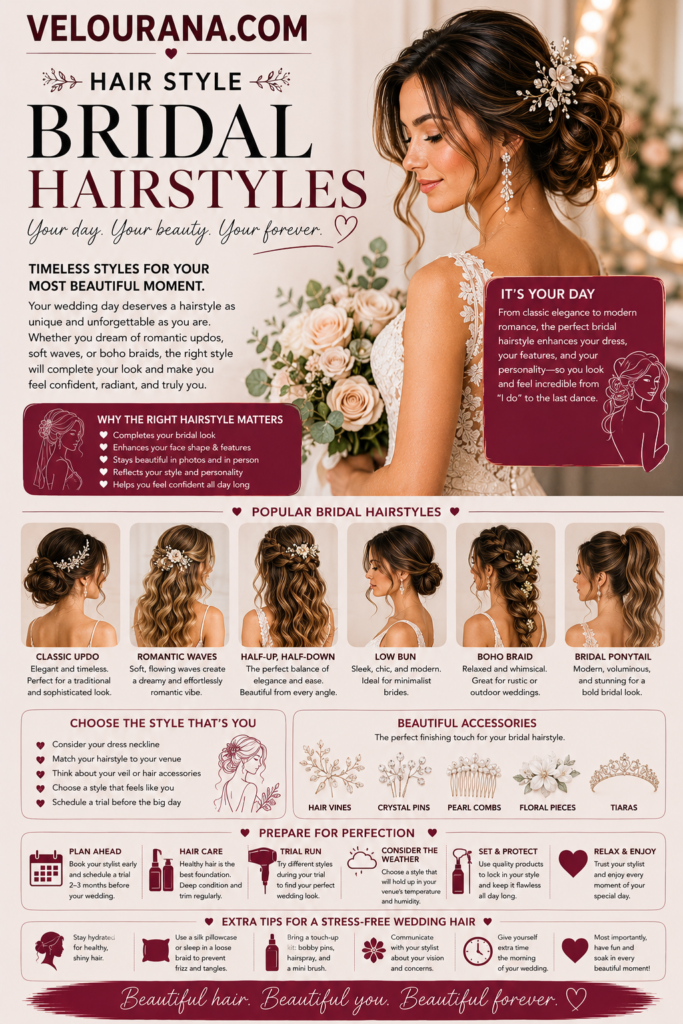
Romantic bridal hair has a distinctive quality that is difficult to define by a single hairstyle. It can appear in loose waves falling over the shoulders, a softly constructed low bun, a textured half-up style or an elegant ponytail with movement through the lengths. What connects these different looks is not one particular technique but a feeling of softness.
The hair appears styled without looking rigid.
Movement remains visible.
The face is framed rather than enclosed.
Texture creates dimension.
Even when the structure underneath is carefully planned, the finished result often looks as though it has settled naturally into place.
That apparent effortlessness is one of the reasons romantic bridal hairstyles remain so enduring. They complement many styles of wedding dress, work across different hair lengths and can be adapted to natural straight, wavy, curly and coily textures.
Romantic does not necessarily mean deliberately messy.
A hairstyle can be smooth and polished while still feeling soft. A sleek low bun can become more romantic through gently shaped front sections. Glossy waves can feel romantic even when every curve is controlled. Natural curls can create softness through their own movement without requiring an intentionally undone finish.
The distinction is important because bridal styling needs enough structure to function throughout a long day.
A hairstyle that has simply been loosened until it looks effortless may continue loosening.
A well-designed romantic style creates the visual impression of softness while maintaining an underlying structure appropriate to the hair, accessories and wedding conditions.
The best versions balance those two qualities.
They look relaxed.
They are not accidental.
Romantic Bridal Hair Begins With Movement
Movement is central to romantic hairstyling because it prevents the hair from appearing overly severe.
That movement can take many forms.
Long waves can create broad curves through the lengths.
Shorter layers can sweep backward from the face.
A bun can contain visible twists rather than a completely uniform surface.
Natural curls can create variation throughout an updo.
A ponytail can move freely behind the shoulders.
The important quality is that the hair does not appear visually frozen.
Even a highly polished hairstyle can retain movement if its sections have direction.
This is why romantic bridal styling should be considered three-dimensionally.
From the front, the hair frames the face.
From the side, the crown and front sections create the profile.
From the back, the waves, twists or bun provide structure.
The hairstyle should remain interesting as the bride moves rather than depending entirely on one perfect camera angle.
Movement also allows the hair to interact naturally with the dress.
Loose lengths can travel over bare shoulders.
An updo can expose a detailed neckline.
A half-up style can create movement behind the bride without completely hiding the back of the gown.
These relationships make the complete bridal look feel connected.
Soft Waves Can Be Romantic Without Looking Casual
Loose waves are one of the most recognizable romantic bridal styles.
Their appeal comes from the combination of polish and movement.
The hair remains visibly styled, but it does not have the rigidity of a sculpted updo. The lengths move naturally, and the curves create dimension as light travels across the hair.
The exact shape of the wave changes the character of the style.
Large, organized waves can feel glamorous.
Looser separated waves create a softer contemporary finish.
Movement concentrated primarily through the lower lengths can look understated and elegant.
More volume through the entire hairstyle creates greater drama.
The choice should reflect both the hair and the complete bridal aesthetic.
Very long hair can create beautiful cascading movement, although its weight can gradually soften the wave pattern.
Medium hair often holds broad curves particularly well because it has enough length for movement without the same amount of weight.
Shorter bobs can use softer bends rather than attempting to imitate long cascading waves.
The front should be integrated carefully.
Face-framing pieces can move away from the cheeks, creating openness without losing softness.
A center part can create symmetry.
A side part can introduce a more sweeping, glamorous character.
The finished waves should appear to belong to one hairstyle rather than looking like a collection of individually curled strands.
That cohesion is what separates sophisticated bridal waves from ordinary curled hair.
The Soft Low Bun Is Romantic Because It Combines Control With Texture
A low bun can be extremely structured underneath while appearing gentle on the surface.
This makes it ideal for romantic bridal styling.
The hair is secured away from the shoulders, allowing the neckline and dress to remain visible. At the same time, texture can prevent the style from looking severe.
The bun itself may be formed from twists, overlapping sections or softly arranged loops.
The crown can remain smooth or contain subtle volume.
The sides can be gently swept backward.
A few carefully chosen pieces can soften the hairline.
The word “carefully” matters.
There is a difference between intentional softness and random looseness.
Pulling many strands out of a finished updo can eventually make the hairstyle look unfinished rather than romantic. A smaller number of pieces positioned according to the haircut and face shape usually creates a more sophisticated result.
The bun should also remain proportional.
A very large bun can become the dominant element of the entire bridal look. A smaller shape may suit a minimalist dress or delicate features better.
The appropriate scale depends on hair density, head shape, accessories and the visual weight of the gown.
Romance comes from the relationship between these elements, not from making the hairstyle as elaborate as possible.
Face-Framing Pieces Should Look Deliberate
Soft strands around the face are frequently associated with romantic bridal hair, but their success depends heavily on placement.
Too many loose pieces can obscure the hairstyle.
Pieces that are too long may continually fall into the face.
Sections that are strongly curled while the rest of the hair is softly waved can look disconnected.
The front should be designed as part of the hairstyle from the beginning.
If the bride has curtain bangs, they can become the natural starting point. They may be shaped outward and allowed to connect visually with the longer side sections.
Long face-framing layers can be given broad movement rather than tight curls.
Shorter pieces can remain soft without becoming overly separated from the secured hair.
The amount of hair left around the face should also reflect what feels comfortable.
A bride who constantly tucks her hair behind her ears may not enjoy several loose sections falling forward throughout the ceremony.
Romantic styling should not require constant correction.
The softness should remain wearable.
Half-Up Hairstyles Naturally Suit Romantic Bridal Styling
Half-up hair already contains the basic contrast that defines many romantic styles.
The upper sections provide control.
The lower lengths provide movement.
This makes the silhouette particularly adaptable.
The crown can contain gentle volume.
The sides can be twisted backward.
A braid can provide subtle texture.
The lower hair can fall in waves, curls or natural texture.
A decorative comb or collection of pins can sit where the secured sections meet.
The hairstyle also keeps much of the hair away from the face without creating the exposed feeling of a complete updo.
This can be ideal for brides who normally wear their hair down but want more security for the wedding.
The amount of hair gathered upward determines the balance.
A small secured section creates a mostly loose style.
A larger section gives more control and can make the hairstyle feel closer to an updo.
Neither is inherently better.
The proportion should suit the hair density and desired appearance.
Very dense hair may benefit from securing more of the upper volume.
Fine hair may look fuller when more of the lengths remain loose.
The design should respond to the actual hair rather than to a photograph created on a completely different texture or density.
Braids Can Add Romance Without Turning the Hairstyle Rustic
Braids are strongly associated with romantic bridal hair, but their effect depends on how prominently they are used.
A small braid incorporated into a half-up style can add texture almost invisibly.
A braid can travel along one side before disappearing into a low bun.
Two small sections can meet behind the head and become part of a larger arrangement.
A more substantial braid can become the central feature of the hairstyle.
The surrounding finish determines whether the result feels polished, bohemian, rustic or formal.
A braid combined with glossy waves and a refined accessory can feel sophisticated.
The same braid combined with deliberately loose texture and flowers may create a more natural, garden-inspired aesthetic.
The braid should therefore support the visual story of the wedding.
It does not automatically make a hairstyle romantic simply by being present.
Scale matters too.
Very large pulled-apart braids can dominate fine hair.
Small intricate braids may disappear inside very dense or highly textured hair.
The detail should remain visible without overwhelming the complete shape.
Natural Waves Can Become Part of the Bridal Design
Not every romantic bridal wave needs to be created from straightened hair.
Naturally wavy hair already contains movement.
The styling process can refine that movement rather than replacing it completely.
Some sections may need more definition.
The crown may need more deliberate shape.
The front can be directed.
Areas with irregular texture can be blended into the overall pattern.
The result can preserve the individuality of the natural wave while making the complete hairstyle feel intentional.
This approach can be especially attractive for outdoor, coastal or relaxed weddings because the style already accepts a certain amount of natural variation.
If humidity encourages some of the original texture to become more visible during the day, the change may integrate naturally rather than appearing as though a perfectly rigid style is breaking down.
This is one of the advantages of designing with the hair rather than against it.
The hairstyle can evolve without losing its character.
Natural Curls Can Create Romance Without Being Loosened Into Waves
Curly hair naturally contains many of the qualities associated with romantic bridal styling.
Movement.
Dimension.
Softness.
Volume.
The curls can therefore remain central to the design.
A loose bridal style can showcase the natural pattern around the shoulders.
A half-up arrangement can control the crown while allowing curls to remain visible through the lengths.
An updo can gather the curls into a textured shape without hiding their identity.
A ponytail can create dramatic movement.
The front can retain selected curls around the face.
The objective is not necessarily to make every curl identical.
Natural variation can contribute to the softness of the finished result.
The overall silhouette matters more than perfect uniformity.
Accessories can also work beautifully with curls because the texture creates depth around them.
Small decorative pins can appear between curls.
Flowers can be positioned within a textured updo.
A comb can create a focal point without requiring the surrounding hair to become completely smooth.
The accessory should complement the texture rather than compete with it.
Coily Hair Can Create Sculptural Romance
Romantic styling does not have to mean loose waves.
Coily hair demonstrates this particularly well.
Natural volume can create sculptural bridal shapes that still feel soft and elegant.
Coils can be gathered upward while remaining visible.
Twists can form part of an updo.
A low arrangement can combine structure with natural texture.
A high style can create dramatic height while the edges and front are finished according to the bride's preference.
Protective styles can also become sophisticated bridal designs.
Braids and twists can be arranged into buns, ponytails or sculptural forms.
Decorative pins and accessories can become part of the architecture.
The result can feel romantic because of shape, detail and movement rather than because the hair has been transformed into a traditionally loose texture.
This expands the meaning of bridal softness.
Romance is not one hair pattern.
It is an aesthetic relationship between the hairstyle and the person wearing it.
A Romantic Bridal Ponytail Can Feel Luxurious Rather Than Everyday
The ponytail is one of the simplest everyday hairstyles, yet it can become remarkably elegant when the proportions and finish are changed.
A low bridal ponytail can sit softly at the nape with movement through the lengths.
A mid-height version can create more bounce.
A higher ponytail can introduce energy and glamour.
The base can be polished while the ponytail itself remains textured.
A section of hair can conceal the fastening.
The crown can have gentle volume.
Face-framing pieces can soften the front.
The lengths can carry broad waves rather than tight curls.
This combination creates a hairstyle that feels familiar but clearly elevated.
It can be particularly suitable for a bride who rarely wears traditional updos.
The hair remains tied back, which may feel comfortable and recognizable, but the finish has enough detail for the occasion.
The ponytail can also work beautifully with dresses that expose the shoulders or have strong necklines.
Its movement remains visible without covering the entire upper body with loose hair.
Short Romantic Bridal Hair Depends on Shape and Detail
Short hair can create romantic softness without additional length.
A bob can carry broad waves.
A shorter bob can use gentle bends and a side part.
A pixie can develop soft directional texture through the top.
A cropped style can become more decorative through carefully chosen accessories.
The face becomes particularly important because there is less hair surrounding it.
The part, fringe and front direction can dramatically change the bridal effect.
A soft side sweep may create romance.
A polished center part may feel more modern.
A small amount of volume can change the profile.
Accessories become especially visible on short hair.
A delicate headband can become a major design element.
Small pins can create light without overwhelming the haircut.
A veil can interact strongly with the silhouette because there is less hair around it.
Short hair should therefore be designed with confidence.
It does not need to simulate an updo or imitate long waves.
The existing haircut can be elevated into bridal styling through precision and thoughtful detail.
Romantic Does Not Have to Mean Messy
The popularity of relaxed bridal hair has sometimes blurred the distinction between softness and disorder.
A romantic hairstyle can be extremely polished.
The surface can be smooth.
The part can be precise.
The bun can be secure.
The waves can be consistent.
What makes it romantic may simply be the curvature of the hair, the movement around the face or the balance between structure and softness.
This distinction matters because intentional looseness requires control.
If every section is pulled apart simply to make the hairstyle look less formal, the structure can weaken.
If too many pieces are released around the face, they can become distracting.
If the crown is excessively loosened, the silhouette can become uneven.
Softness should be placed where it contributes.
Perhaps the bun contains texture while the crown remains polished.
Perhaps the hairstyle is sleek except for two gently curved front pieces.
Perhaps the upper hair is controlled while the lower lengths move freely.
Contrast often creates more romance than making every part equally loose.
Flowers Can Become Part of the Hairstyle Rather Than Decoration Added Afterwards
Fresh or artificial flowers can be beautiful in romantic bridal hair, particularly when the wedding has a garden, countryside, coastal or natural aesthetic.
Their placement should be considered as part of the hairstyle.
A few small flowers can sit within a textured bun.
A single larger bloom can create an asymmetric focal point.
Tiny floral elements can be distributed through a braid.
A half-up style can use flowers where the secured sections meet.
Scale is important.
Large flowers occupy considerable visual space.
A collection of small flowers can create detail without dominating.
The colors should also relate to the complete bridal palette.
Flowers do not necessarily need to match the bouquet exactly, but they should feel connected to the overall design.
Practical considerations matter as well.
The florist and hairstylist may need to coordinate when fresh flowers are involved so that suitable varieties and preparation methods are used.
The final arrangement should remain secure without damaging the hairstyle underneath.
Pearls and Pins Can Add Light Without Adding Excessive Detail
Small bridal accessories can have an outsized effect because they catch light as the bride moves.
Pearls can create a soft, classic quality.
Crystal pins can add more sparkle.
Metallic elements can connect with jewelry.
A decorative comb can create one clear focal point.
Romantic styling often benefits from accessories that appear integrated rather than placed heavily on top.
Pins can follow the line of a twist.
Pearls can be scattered selectively through a bun.
A comb can sit where a half-up style joins.
The accessory becomes part of the movement of the hair.
The amount of decoration should still be balanced against the dress and veil.
A heavily embellished gown may require very little additional detail.
A minimalist dress can support a stronger hair accessory if the bride wants a decorative focal point.
There is no requirement for bridal hair to contain ornamentation.
Sometimes the texture itself provides enough visual interest.
The Veil Can Change the Entire Romantic Silhouette
A veil introduces movement of its own.
When combined with soft hair, the effect can be exceptionally romantic.
The relationship between the two should be planned.
A veil positioned above a low bun creates a different shape from one secured underneath.
A half-up hairstyle can provide a natural placement point.
Loose hair may require a secure attachment strategy that does not disturb the waves or texture.
The length and weight of the veil matter too.
A cathedral veil can create considerable visual drama and may interact differently with the hairstyle than a short, lightweight veil.
The veil should ideally be included in the hair trial so that placement can be evaluated realistically.
The bride can see whether the hairstyle remains visible.
She can judge the profile.
The stylist can assess the attachment.
If the veil will be removed after the ceremony, the hairstyle should also look complete without it.
This is important because the reception may continue for many hours after the veil is gone.
The hair should never appear as though something essential is missing once it has been removed.
Romantic Hair Must Still Survive a Real Wedding Day
The visual softness of the hairstyle should not come at the expense of functionality.
A wedding involves movement.
The bride may spend time outdoors.
She will hug people.
She may dance.
The veil may be attached and removed.
Photographers may adjust positioning repeatedly.
The hairstyle has to tolerate all of this.
A secure internal structure allows the visible surface to remain soft.
This is one of the reasons professional bridal styling can look effortless while requiring considerable technical preparation underneath.
The guest sees the movement.
The structure remains largely invisible.
Comfort is equally important.
A romantic updo should not feel painfully tight.
Pins should not become increasingly uncomfortable.
Heavy accessories should be tested.
The bride should be able to move her head naturally.
If a hairstyle becomes physically distracting, its beauty matters less as the day progresses.
The strongest bridal hair can largely be forgotten once the ceremony begins.
Weather Should Be Allowed Into the Design
Romantic hairstyles can work beautifully outdoors, but the environment should be acknowledged during planning.
Humidity can encourage natural texture to return.
Wind can move loose pieces.
Heat can affect comfort.
Rather than choosing a hairstyle that depends on conditions remaining perfectly controlled, the design can allow some flexibility.
Naturally wavy hair can be styled in a way that tolerates a little additional texture.
A textured bun can accommodate small changes without losing its identity.
A half-up style can control the front while allowing the lower hair to move.
A ponytail can keep the hair organized while retaining softness through the lengths.
This does not mean avoiding loose romantic hair outdoors.
It means deciding how much change the hairstyle can tolerate while still looking intentional.
A style that becomes slightly softer and more textured over time may remain beautiful.
A style that requires every strand to stay perfectly fixed may be less forgiving.
The Hair Trial Reveals Whether Effortless Really Works
Romantic hairstyles can be deceptive in photographs.
A seemingly simple low bun may contain complex internal structure.
Loose waves may depend on a particular hair density or extensions.
A half-up style may look very different on another length.
The bridal trial allows the idea to meet the actual hair.
Perhaps the waves need to be broader.
Perhaps the crown needs less volume.
Perhaps the front looks better with fewer loose pieces.
Perhaps the bun should sit slightly lower.
Perhaps the accessory needs to move.
These adjustments are not failures of the original idea.
They are the design process.
The bride should also observe how the style behaves after leaving the salon or styling session.
How does it look several hours later?
Are the front sections still comfortable?
Has the wave softened attractively?
Does the bun still feel secure?
Does the accessory remain stable?
A romantic style should become softer gracefully rather than simply deteriorating.
The Most Romantic Bridal Hair Often Looks Like an Elevated Version of the Bride
Romance in bridal styling does not come from a formula.
It does not require loose curls, flowers, braids or a particular kind of bun.
It comes from softness, movement and harmony.
For one bride, that may mean long waves flowing over the shoulders.
For another, it may be a polished low chignon with two carefully shaped pieces around the face.
Another may wear natural curls gathered loosely at the crown.
Another may choose a sleek ponytail with broad movement through the lengths.
Another may wear a short bob with a delicate wave and a pearl accessory.
The hairstyle succeeds when it feels connected to the bride.
The wedding day can elevate familiar elements without replacing them.
A woman who loves wearing her hair down can still look unmistakably bridal with more deliberate movement and finish.
Someone who always wears her hair tied back can choose a sophisticated ponytail or bun rather than feeling obligated to wear loose curls.
Natural texture can remain natural.
Short hair can remain short.
Straight hair can remain sleek.
Romance does not demand transformation for the sake of transformation.
It asks for intention.
The hair should complement the dress without disappearing behind it.
The accessory should contribute without overwhelming.
The veil should interact with the hairstyle rather than simply being attached to it.
The front should flatter the face.
The back should remain beautiful during the ceremony.
The structure should be strong enough for the wedding day while the visible finish remains soft enough to move.
That combination is what creates the effortless quality people associate with romantic bridal hair.
The effort is there.
It simply does not announce itself.
What remains visible is movement, softness and a hairstyle that seems entirely natural for the person wearing it.
Years later, when the wedding photographs are viewed again, that is likely to matter far more than whether every detail followed the trend of the moment.
The hairstyle should still look like the bride.
Only on one of the most extraordinary days of her life.
The End
Velourana.
 Discover More From Our Family of Websites
 ZodiacBearing (Astrology, Tarot, Numerology, Angel Numbers & Spiritual Guidance)
 Velourana (Beauty, Makeup, Hair Care, Skincare & Beauty Tips)
 HavenBearing (Home, Living, Organization, Décor & Everyday Inspiration)
 PawBearing (Pet Care, Dog Breeds, Animal Health, Training & Pet Products)
 PsyCatherine (Notes From the Journal of a Psychologist on Real Life)