
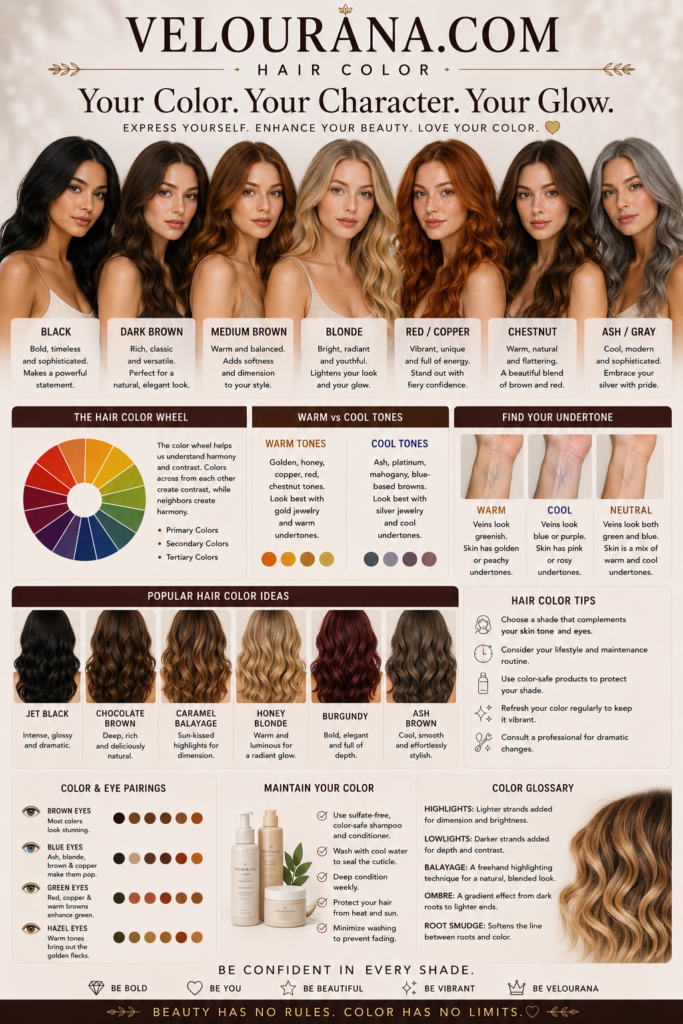
CATEGORY: Red Hair
Choosing red hair can be deceptively complicated. A photograph of luminous copper or rich auburn may create an immediate attraction, yet reproducing the emotional effect of that photograph involves much more than identifying a dye labeled red. The underlying hair color, skin undertone, depth of the chosen shade, previous chemical history, texture, porosity, and even everyday lighting all influence the finished result.
Red is particularly sensitive to these variables because it sits within a broad territory between yellow, orange, true red, brown, and violet. Move the balance slightly toward gold and a shade becomes more coppery. Add brown and it becomes auburn. Increase violet and it begins moving toward mahogany, wine, or burgundy. Reduce saturation and the same family becomes softer, earthier, and more naturalistic.
This flexibility is what makes red hair extraordinarily adaptable. There is no single complexion, age, texture, or personal style that owns it. The challenge is not determining whether someone "can wear red," but discovering which interpretation creates the desired relationship between the hair and the person.
Red Is a Direction, Not a Single Destination
Hair-color language can create the illusion that shades exist in neat boxes. In reality, red shades overlap constantly. One colorist's warm auburn may resemble another's deep copper-brown. Strawberry blonde can move almost imperceptibly into light ginger. Dark copper can sit extremely close to warm auburn, while red-brown and mahogany can differ mainly in the balance of orange and violet.
Understanding red as a direction rather than a fixed shade makes choosing it easier. The first major decision is depth. Should the hair remain close to its existing darkness, become significantly lighter, or move deeper? The second is temperature within the red family. Should the result glow with gold and orange, remain balanced and earthy, or lean toward cooler red-violet territory? The third is saturation. Should people immediately identify the hair as red, or should the warmth emerge subtly?
These decisions create a far more precise picture than a shade name alone.
A person with medium brown hair, for example, might want a red that remains sophisticated and believable in professional environments. A medium auburn that preserves brunette depth could satisfy that intention beautifully. Another person with the same starting color might want luminous copper that is unmistakably transformative. Achieving that result could require significantly more lightening and maintenance even though both people technically requested red hair.
The distinction matters because maintenance begins with the design of the color itself. The farther the final shade travels from the natural base, the more visible regrowth and tonal change generally become.
Finding Harmony Between Red Hair and Skin
Complexion analysis can guide red selection, but it should expand possibilities rather than impose simplistic restrictions. The idea that only people with warm skin can wear warm red hair ignores the importance of contrast and the enormous diversity within human coloring.
Warm skin often responds beautifully to golden copper, ginger, cinnamon, rust, and warm auburn. These shades can echo peach, yellow, or golden undertones and create a continuous warmth from complexion to hair. When the saturation is carefully balanced, the result can look remarkably integrated.
Cool skin may harmonize naturally with cooler red directions such as berry-toned auburn, mahogany, cherry-brown, or burgundy. Yet cool skin beside bright copper can also produce striking contrast. The hair appears warmer precisely because the complexion is cooler. For someone who wants the color to become a statement, that contrast can be an advantage rather than a problem.
Neutral complexions frequently allow movement in either direction. Here, eye color and natural hair depth can become useful secondary considerations. Copper may intensify blue or green eyes through contrast, while auburn can emphasize brown, amber, or hazel dimensions without overwhelming them.
Olive skin presents an especially interesting relationship with red. Olive complexions can contain combinations of green, yellow, golden, or neutral undertones that react differently to orange-heavy color. Extremely bright orange copper can sometimes emphasize sallowness, while muted copper, cinnamon, chestnut-red, and sophisticated auburn may create greater balance. Deeper mahogany can also be striking against olive skin because it introduces red without relying entirely on orange.
Deep complexions can support some of the richest red transformations. Saturated copper can create extraordinary luminosity against dark skin, while auburn, red-brown, burgundy, and mahogany offer depth without disappearing into naturally dark hair. The choice depends less on whether the shade is permitted and more on how much contrast and brightness the wearer wants.
This is why skin analysis should never be reduced to a prohibition. Color theory explains relationships; it does not dictate taste.
The Difference Between Natural-Looking and Deliberate Red
Some red hair appears so integrated that it could plausibly have grown naturally. Other reds are intentionally artificial and make no attempt to imitate nature. Both approaches can be sophisticated, but they rely on different color strategies.
Natural-looking red generally contains complexity. Rather than presenting exactly the same pigment from root to tip, it often incorporates subtle variations in depth and warmth. The root may be slightly deeper. Fine lighter pieces may appear through the lengths. Copper may coexist with gold, brown, or muted strawberry tones.
This variation reflects natural pigmentation and environmental exposure. Hair around the hairline may appear lighter, while protected interior sections remain deeper. Sun exposure can soften the ends. Individual strands catch light differently according to their thickness and texture.
A deliberately vivid red can reject this subtlety. Clear crimson, intense copper, cherry red, or saturated burgundy may be designed for visual impact rather than biological plausibility. Uniformity can become part of the aesthetic, especially on sleek haircuts where a strong uninterrupted color surface appears graphic and modern.
The difference is important during consultation because a person asking for "natural red" may actually mean several things. They may want muted color, believable dimension, a shade compatible with their complexion, or simply a red that does not look neon. Clarifying the desired impression matters as much as choosing the pigment.
Hair Texture Changes the Experience of Red
The same red formula can look dramatically different across straight, wavy, curly, and coily textures because color is perceived through reflected light.
Straight hair tends to create continuous reflective surfaces. On healthy, smooth strands, copper can produce almost metallic bands of shine. Dark auburn may look exceptionally polished because the smooth surface allows light to reveal its red undertone evenly. Uneven color can also become more visible on straight hair for the same reason.
Wavy hair breaks those reflective surfaces into movement. Peaks catch the light while curves create shadow, giving even a relatively uniform red greater dimensionality. Balayage, subtle highlights, and tonal variations can become especially visible as the hair moves.
Curly hair creates a more complex landscape. Individual curls face different directions, so copper, gold, and auburn reflections appear at different points throughout the shape. Carefully placed lighter sections can emphasize curl patterns and create the impression of greater depth.
Coily hair can display extraordinary tonal richness because its architecture creates many small changes in light and shadow. However, maintaining fiber condition is especially important when significant lightening is involved. A bright red that requires aggressive lifting may not be worth sacrificing elasticity, strength, or definition.
Texture therefore belongs in the color decision from the beginning. Hair color is not viewed on a flat surface; it lives on a three-dimensional structure.
The Technical Reality Behind a Major Red Transformation
Red is often described as an easy direction because dark hair naturally exposes warm pigments during lightening. There is some truth to this, but it can be misleading.
When dark natural hair is lightened, underlying warm pigments become visible. Depending on the starting level and amount of lift, the hair may reveal red, red-orange, orange, gold, or yellow. If the desired final shade is warm copper or auburn, some of this underlying warmth can contribute to the result.
That does not mean every dark-haired person can simply lighten slightly and obtain a clean copper. The final shade still depends on how evenly the hair lifts, what artificial pigments are already present, and how much brightness is required.
Previously dyed dark hair can be particularly challenging. Artificial pigment may resist removal or lift unevenly. Repeated applications can create heavily saturated lengths while newer sections contain less buildup. Attempting to create a lighter red across this uneven canvas can expose bands of different warmth.
Professional color correction often addresses these differences before the final red is established. The objective is not merely to make everything lighter but to create an adequately even foundation for the desired tone.
Virgin hair behaves more predictably, although natural variation still exists. Roots process differently because of heat from the scalp, while mid-lengths and ends may have different porosity due to environmental or mechanical wear.
This technical background explains why two people using the same color formula can obtain very different outcomes. Hair color is an interaction between the applied pigments and everything already present in the fiber.
Why Shine Is Essential to Beautiful Red Hair
Red hair is closely associated with luminosity, and shine plays a major role in creating that impression. A copper shade on rough, highly damaged hair can appear dull even when the pigment itself is intense. Conversely, a relatively muted auburn can look luxurious when the surface of the hair is smooth and reflective.
The cuticle influences this effect. When the outer structure lies relatively smoothly, light reflects more consistently from the surface. When the hair is severely weathered or damaged, light scatters irregularly, reducing the polished appearance.
This makes conditioning particularly important for red hair, not simply as a matter of softness but as part of color presentation. Treatments cannot permanently reconstruct severely damaged hair, but appropriate conditioning can improve manageability, reduce friction, and enhance surface appearance.
Heat styling should also be approached intelligently. Red hair does not require the elimination of dryers, irons, or curling tools, but repeated unnecessary exposure to extreme temperatures can compromise condition. Thermal protection and appropriate temperature selection help preserve the qualities that make the color look vibrant.
Gloss treatments are popular with red hair partly because they address both tone and surface appearance. Depending on the product or professional service, a gloss can refresh fading pigment while enhancing shine, giving the impression that the entire color has been renewed.
The visual relationship between color and condition is particularly strong with warm shades. Copper is expected to glow. Auburn is expected to gleam when light reaches it. Preserving the reflective quality of the fiber therefore becomes part of preserving the identity of the shade.
Living With the Fade
Every artificial hair color changes, but red makes its evolution especially visible. Freshly applied pigment can possess a richness that gradually softens as the hair is washed and exposed to the environment.
The first change is often a reduction in saturation. A vivid copper becomes less fiery. Auburn may become browner. Burgundy can lose some of its wine-like intensity. Depending on the formula and underlying base, faded red may reveal more gold, orange, brown, or previously lightened hair.
This evolution can be managed more successfully when it is anticipated rather than treated as an unexpected failure.
Gentle cleansing can help reduce unnecessary pigment loss. Washing only as often as the scalp and lifestyle genuinely require can also make a difference, although there is no universal ideal schedule. Someone with an oily scalp, frequent exercise, or heavy product use may need more frequent cleansing than someone with a dry scalp and minimal styling.
Water temperature, sun exposure, swimming, and repeated thermal styling all influence the broader maintenance environment. Chlorinated pools and mineral-rich water can introduce additional challenges to both tone and condition.
Pigment-depositing products can be useful when selected carefully. A copper conditioner can restore warmth to a fading copper base, while an auburn or red-brown treatment may reinforce deeper shades. The pigment should correspond reasonably closely with the intended direction because repeated use of an unsuitable tone can gradually shift the color.
Professional glossing provides another route. Rather than repeatedly performing a complete permanent-color service through already colored lengths, a colorist may refresh faded areas with a more appropriate deposit-focused formula while addressing regrowth separately.
This distinction can help protect the hair from unnecessary repeated processing while keeping the overall result coherent.
Roots, Regrowth, and the Maintenance Question
The visibility of regrowth depends heavily on the relationship between natural and artificial color. Someone with naturally light warm hair wearing strawberry blonde may experience relatively soft regrowth. Someone with naturally black hair wearing bright copper will see a much stronger contrast.
Root maintenance is therefore not merely a schedule; it is part of the original design decision.
A deeper root can intentionally reduce this contrast. Rooted copper, dimensional auburn, and red balayage preserve some natural depth near the scalp, allowing the color to grow with less obvious demarcation. These techniques can be particularly useful for people who love red but do not want frequent full-root appointments.
An all-over red creates a different aesthetic. The uniformity can be powerful and polished, but regrowth generally becomes more obvious when the natural shade differs substantially.
Gray hair introduces another dimension. Gray strands lack the same natural pigment as neighboring hair and can accept artificial color differently. Depending on the formula, they may appear brighter or more translucent. This can create beautiful natural-looking variation, but reliable gray coverage may require a formulation designed specifically for that purpose.
As the proportion of gray increases, red can be adapted rather than abandoned. Soft strawberry, copper-gold, warm auburn, and dimensional red-brown can blend beautifully with lighter strands when the formulation is designed around them.
The best maintenance strategy is ultimately the one that fits real life. A technically beautiful color requiring appointments or home care that the wearer cannot realistically maintain may become frustrating. Designing around the person's preferred level of commitment creates a more sustainable result.
Red Hair, Makeup, and the Colors Around the Face
Changing to red hair can alter the way familiar makeup appears. Foundation has not changed, eye color has not changed, and the complexion itself remains the same, yet the new mass of warm color surrounding the face changes visual relationships.
With bright copper, very warm makeup can create a monochromatic effect. Peach blush, bronze eyeshadow, and warm nude lips may blend beautifully into the overall palette. The effect can feel sunlit and cohesive.
Introducing cooler makeup changes the relationship. Mauve, plum, berry, cool rose, charcoal, or blue-red lipstick can stand apart from copper and create stronger contrast. With mahogany or burgundy hair, those same colors may instead feel harmonious because the hair itself contains cooler red influences.
Brows deserve restraint. Matching them exactly to the hair is rarely necessary. Natural redheads themselves frequently have brows that are less saturated than their hair. Soft warm brown, taupe, neutral auburn, or slightly deeper tones can frame the face without creating an artificial block of orange or red.
Eye color can become unexpectedly prominent after a red transformation. Green and blue eyes often appear brighter beside copper because warm orange-red tones provide strong contrast. Hazel eyes can reveal gold and green variations, while brown eyes may appear warmer beside cinnamon, auburn, and mahogany.
These interactions are not rules for selecting a shade, but they explain why red can feel like a broader beauty transformation rather than a simple hair-color change.
When Red Becomes Part of Personal Style
Hair color can be decorative, practical, expressive, or all three. Red has an unusual ability to move between these roles.
A muted auburn can function almost like an enhanced brunette, bringing warmth and depth without dominating a person's appearance. Copper can become a signature, particularly when its brightness is reinforced by a distinctive haircut or strong personal wardrobe. Burgundy and mahogany can introduce drama while retaining enough darkness to feel sophisticated.
The emotional associations surrounding red are powerful, but they should not dictate who wears it. Red hair has historically been romanticized, stereotyped, celebrated, and mythologized in ways few other hair colors have. Contemporary beauty offers the opportunity to separate the color from those clichés.
A person can choose red simply because its warmth is beautiful.
That simplicity is worth preserving because hair-color advice can become unnecessarily restrictive. Age does not automatically require red to become darker or more conservative. Dark skin does not require burgundy instead of copper. Fair skin does not automatically demand strawberry blonde. Curly hair does not need highlights, and straight hair does not need uniform color.
The technical principles of color remain useful, but they should serve the desired aesthetic rather than replace it.
Creating a Red That Still Looks Beautiful Months Later
The strongest red-hair decisions account for the future from the beginning. The question is not only what the color will look like immediately after application, but how it will fade, how the roots will grow, how often the wearer wants maintenance, and whether the hair can tolerate the processing required.
Someone beginning with dark virgin hair and wanting pale copper may need a significant transformation. If maintaining light roots and refreshing copper regularly sounds enjoyable, that may be entirely appropriate. If the same person wants minimal salon involvement, a deep copper-brown or auburn could deliver the warmth they love with far less contrast at the roots.
Similarly, someone with fragile pre-lightened hair may already possess the lightness required for brilliant red but lack the structural condition for repeated aggressive services. A deposit-focused transformation may be more appropriate than further lightening.
Color longevity also improves when expectations are realistic. No vivid red remains permanently identical to its freshly colored state. Maintenance is not evidence that the color has failed; it is part of wearing a pigment family whose brilliance naturally changes over time.
What matters is whether that maintenance has been designed intelligently.
Red hair at its best combines artistry with practicality. The shade should complement or deliberately contrast the complexion, respect the existing condition of the hair, work with its texture, and remain manageable within the wearer's routine.
When those elements align, red becomes far more than an eye-catching color. It develops depth in shadow, flashes of warmth in movement, and luminous variations under sunlight. It can change from restrained to dramatic within seconds simply because the light has changed.
That responsiveness is the enduring fascination of red hair. It refuses to remain visually static. Copper glows, auburn smolders, strawberry catches gold, and mahogany reveals hidden red beneath its depth. Every version tells a slightly different color story, and the most successful one is the shade that feels intentional from the first application through every stage that follows.
THE END VELOURANA
 Discover More From Our Family of Websites
 ZodiacBearing (Astrology, Tarot, Numerology, Angel Numbers & Spiritual Guidance)
 Velourana (Beauty, Makeup, Hair Care, Skincare & Beauty Tips)
 HavenBearing (Home, Living, Organization, Décor & Everyday Inspiration)
 PawBearing (Pet Care, Dog Breeds, Animal Health, Training & Pet Products)
 PsyCatherine (Notes From the Journal of a Psychologist on Real Life)

