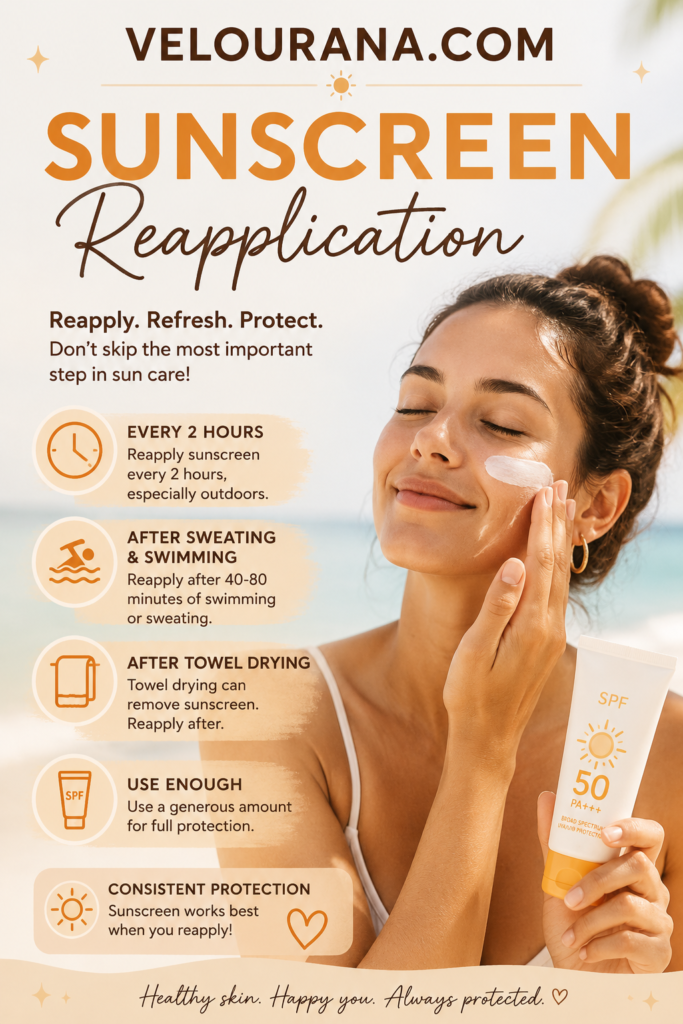
CATEGORY: Sunscreen Reapplication
Swimming, exercise, outdoor sports, and hot summer weather create some of the most demanding conditions for sunscreen.
A sunscreen may be applied perfectly before leaving home, yet the protective layer can face water, perspiration, towels, clothing, sand, repeated touching, and hours of physical movement once activity begins.
This is why sunscreen reapplication becomes especially important during active days.
The issue is not that sunscreen suddenly stops working at an exact moment. The problem is that the protective film can become less complete as it is exposed to water and friction.
A water-resistant sunscreen can provide valuable additional durability, but water resistance should never be interpreted as permanent protection.
Similarly, a high SPF does not mean that sunscreen cannot be removed.
Understanding what happens to sunscreen during swimming and sweating makes it much easier to maintain reliable protection without turning an enjoyable outdoor day into a complicated routine.
Why Active Days Are Different
An ordinary indoor day may involve relatively little physical disruption of sunscreen.
An active outdoor day can involve constant disruption.
You perspire.
You wipe your forehead.
You swim.
You dry yourself.
You sit on towels.
Clothing rubs against your shoulders.
Sand sticks to your legs.
You wash your hands.
Each event can affect sunscreen coverage.
Sunscreen Works Only Where It Remains on the Skin
The SPF printed on the bottle describes the tested performance of the sunscreen when it is applied appropriately.
If part of the sunscreen layer is removed, that area no longer has the same reliable coverage.
This is the fundamental reason reapplication matters.
Choose Water-Resistant Sunscreen for Swimming
When swimming is planned, select sunscreen specifically labeled as water resistant.
These products are formulated and tested to maintain protection during a defined period of water exposure.
The label should provide the relevant information.
Water Resistant Does Not Mean Waterproof
This distinction is extremely important.
Water resistance indicates tested durability under particular conditions.
It does not mean the sunscreen survives unlimited swimming.
No sunscreen should be treated as a permanent waterproof coating.
Read the Water-Resistance Claim
Different sunscreens may provide different water-resistance periods according to the standards of the market where they are sold.
Check the label.
This tells you considerably more than simply assuming that a sport sunscreen will last indefinitely.
Apply Before Entering the Water
Do not wait until you are already swimming to think about sunscreen.
Apply thoroughly according to the manufacturer's instructions before exposure.
This gives you the opportunity to achieve complete coverage while the skin is easier to work with.
Applying at Home Can Be Easier
For a beach or pool day, sunscreen application is often easier before leaving home or accommodation.
The environment is controlled.
There is no sand.
The skin is not already wet.
You are less likely to rush because everyone wants to enter the water.
Cover the Entire Exposed Body
Swimming exposes areas that everyday clothing normally covers.
Shoulders.
Upper back.
Chest.
Abdomen.
Legs.
Feet.
These areas need deliberate protection.
Pay Particular Attention to the Shoulders
Shoulders can receive strong direct exposure while swimming or standing near water.
Swimsuit straps can also rub against sunscreen.
Apply carefully around them.
Protect the Upper Back
The upper back can be difficult to reach.
Ask another person to help when necessary.
Incomplete back coverage is common simply because people cannot comfortably reach the area.
Protect the Chest
Apply sunscreen across the exposed chest and around swimwear boundaries.
Remember that swimwear can shift while swimming.
Protect the Legs Completely
Do not apply only to the fronts of the legs.
Cover the thighs.
Cover the knees.
Cover the calves.
Cover the sides.
Cover the backs.
Protect the Feet
Bare feet are easily forgotten.
Apply sunscreen to the tops of the feet and exposed toes.
Protect the Ears
The ears remain exposed during swimming and can be overlooked.
Include them every time you apply facial sunscreen.
Protect the Back of the Neck
Wet hair may initially cover the neck and then move aside.
Apply sunscreen rather than relying on hair for predictable protection.
Protect the Scalp
Exposed hair parts and thinning areas can receive substantial sunlight.
Use an appropriate sunscreen format or wear a suitable hat when out of the water.
Protect the Lips
Use an appropriate SPF lip product.
Swimming, drinking, eating, and wiping the mouth can remove it quickly.
Reapply when necessary.
Use Enough Sunscreen Before Swimming
A water-resistant SPF 50 applied too thinly is still an underapplied sunscreen.
Water resistance does not correct inadequate quantity.
Begin with sufficient coverage.
Allow Sunscreen to Set
Follow the manufacturer's directions regarding how long the product should be applied before water exposure.
Jumping into the water immediately after application may not follow the intended use of the product.
What Happens While You Swim
Water surrounds the skin.
The body moves continuously.
Swimwear shifts.
Hands touch the face.
The skin may rub against flotation equipment, surfboards, pool edges, or other surfaces.
The sunscreen film is therefore exposed to more than water alone.
Water Resistance Helps Manage This Environment
A suitable water-resistant sunscreen is designed for these conditions.
It provides greater confidence than an ordinary daily sunscreen when swimming.
But its durability has limits.
Reapply According to the Label
Once the specified conditions have been reached, restore protection.
Do not attempt to invent your own water-resistance period based on SPF.
Reapply After Leaving the Water When Directed
Swimming is an obvious point at which sunscreen coverage deserves attention.
Follow the product-specific reapplication instructions rather than assuming the original layer remains complete.
Towel Drying Is Particularly Important
After swimming, most people dry themselves.
A towel creates friction against the skin.
This can physically remove sunscreen.
Vigorous Rubbing Removes More Than Water
If you rub the skin repeatedly with a towel, you should expect the sunscreen layer to be disturbed.
Reapply before returning to significant exposure.
Patting the Skin Can Reduce Friction
Gently patting away excess water may be preferable to aggressive rubbing.
Nevertheless, continue following the sunscreen's reapplication directions.
Dry Skin Before Reapplication When Appropriate
Applying sunscreen to dripping wet skin can make even coverage difficult unless the product is specifically designed for wet-skin application.
Follow the product instructions.
Allow the skin to become suitable for reapplication.
Wet-Skin Sunscreens Exist
Some sunscreens are specifically formulated for application to wet skin.
These can be convenient for families, swimmers, and beach activities.
Use them exactly as directed.
Do Not Assume Every Sunscreen Works on Wet Skin
A conventional lotion may become diluted, streaky, or difficult to distribute when applied to very wet skin.
Product design matters.
Sand Creates Another Challenge
At the beach, wet sunscreen attracts sand.
People then brush or rub the sand away.
This can remove sunscreen with it.
Avoid Aggressive Sand Removal
When possible, allow the skin to dry and remove sand gently.
If sunscreen has been substantially disturbed, restore protection.
Sitting on a Beach Towel Creates Friction
The backs of the legs, buttocks, and other exposed areas can rub repeatedly against towels.
This can disturb sunscreen even without swimming.
Beach Chairs Can Also Create Friction
Shoulders, backs of the arms, and legs may rub against chairs.
Check these areas during long periods outdoors.
Reapply Before Returning to Direct Sun
If you have finished swimming, dried yourself, and plan to remain outdoors, this is a logical time to restore protection.
Do not wait until the skin begins feeling hot.
Sunburn Is a Late Warning
By the time redness becomes visible, excessive UV exposure has already occurred.
Reapplication should be preventive.
Swimming Can Hide the Strength of the Sun
Water cools the skin.
This can make intense sunlight feel harmless.
Skin temperature is not a reliable indicator of ultraviolet exposure.
Wind Has the Same Effect
A sea breeze can make a very sunny beach feel comfortable.
The UV exposure can still be substantial.
Use the UV Index
Checking the UV Index provides useful context for outdoor activities.
High or very high UV conditions require particular attention to protection.
Sweating Creates a Similar Problem
Exercise can challenge sunscreen even without water immersion.
Perspiration spreads across the skin.
People repeatedly wipe it away.
Clothing moves against the body.
These factors can disrupt coverage.
Choose Water Resistance for Heavy Exercise
If you expect substantial perspiration, a water-resistant sunscreen is generally more appropriate than a delicate everyday facial formula.
Look for products intended for sport or active use.
Running Requires Durable Sunscreen
Running can involve continuous perspiration.
The forehead, temples, neck, arms, and legs may remain exposed for extended periods.
Apply Before the Run
Do not wait until you are already sweating.
Apply sunscreen beforehand according to product directions.
Protect the Forehead Carefully
Perspiration from the forehead can carry sunscreen toward the eyes.
Choose a formula you tolerate well.
Sunscreen Sticks Can Be Useful Around the Eyes
Some runners prefer a suitable sunscreen stick around the forehead and eye area because it may migrate less than certain fluid formulas.
Individual experience varies.
Wear a Hat or Cap
A hat can reduce direct exposure to the scalp and parts of the face.
It does not eliminate the need for sunscreen on exposed areas.
Do Not Forget the Ears
Running caps frequently leave the ears completely exposed.
Apply sunscreen deliberately.
Protect the Neck
The back and sides of the neck can receive sustained sunlight during outdoor exercise.
Include them.
Protect the Arms
Sleeveless running clothing can expose the shoulders and entire arms.
Apply sunscreen around the complete exposed surface.
Protect the Legs
Shorts expose a substantial area.
Cover thighs, knees, calves, and exposed areas around socks.
Reapply During Long Runs
A short exercise session and a multi-hour endurance event are different situations.
During prolonged activity, carry sunscreen and restore protection according to the conditions and product instructions.
Portable Sunscreen Makes This Easier
A small tube or stick can fit into a running belt or pocket.
Convenience increases the likelihood that sunscreen will actually be reapplied.
Cycling Can Produce Heavy Exposure
Cyclists may spend several hours outdoors.
Wind keeps the skin cool.
Sweat develops gradually.
The same areas remain exposed continuously.
Protect the Face and Neck
Apply carefully before riding.
Pay attention to the ears and back of the neck.
Protect the Hands
Cycling gloves may cover part of the hands.
Apply sunscreen to remaining exposed areas.
Protect the Arms and Legs
Short cycling clothing can leave large surfaces exposed.
Apply evenly around the limbs.
Reapply During Long Rides
Rest stops provide a practical opportunity.
Restore sunscreen to exposed areas before continuing.
Hiking Combines Sweat and Duration
Hiking may involve several hours outdoors.
Heat, altitude, backpacks, and physical effort create additional challenges.
Backpack Straps Can Rub Sunscreen Away
Straps can repeatedly move across the shoulders and upper chest.
If these areas remain exposed, check their coverage.
Protect the Back of the Neck While Hiking
This is one of the most exposed areas during long walks.
A broad-brimmed hat can provide additional protection.
Higher Altitude Can Increase UV Exposure
Mountain environments deserve particular attention.
Do not assume cool air means low UV.
Carry Sunscreen Where You Can Reach It
A sunscreen hidden beneath everything in the backpack is inconvenient.
Keep it in an accessible compartment.
Team Sports Require Similar Planning
Football, tennis, volleyball, athletics, and other outdoor sports can involve prolonged exposure and heavy perspiration.
Apply sunscreen before activity.
Use a suitable water-resistant formula.
Reapply during extended events when appropriate.
Tennis Players Should Remember the Shoulders
Sleeveless clothing can expose the shoulders and upper arms continuously.
Apply generously.
Golf Can Involve Hours Outdoors
Golfers may spend much of the day outside.
Face, ears, neck, arms, hands, and legs can receive prolonged exposure.
Carry Sunscreen in the Golf Bag
Making sunscreen easily available removes one barrier to reapplication.
Gardening Can Produce Unexpected Sweating
Gardening may not feel like sport, but physical work in warm weather can produce significant perspiration.
It can also extend for hours.
Gardening Gloves Help Protect the Hands
They provide physical coverage while reducing the need for sunscreen on covered areas.
Remember exposed wrists and forearms.
Outdoor Workers Need Repeatable Systems
For people working outside every day, sunscreen must fit into the working routine.
A complicated process is unlikely to remain consistent.
Use Work Breaks as Reapplication Opportunities
Scheduled breaks can provide natural times to check sunscreen.
Keep sunscreen somewhere accessible.
Protective Clothing Is Extremely Valuable
Long sleeves, appropriate trousers, hats, and other protective garments can dramatically reduce the amount of exposed skin requiring sunscreen.
UPF Clothing Can Simplify Active Days
Purpose-designed UPF clothing can be particularly useful for water sports, hiking, cycling, and outdoor work.
Unlike sunscreen, clothing does not wash away through perspiration.
Clothing Still Needs to Cover the Skin
Loose or shifting garments can expose areas unexpectedly.
Pay attention to necklines, sleeves, waistbands, and other boundaries.
Rash Guards Are Excellent for Water Activities
A rash guard can cover much of the torso, shoulders, and arms.
This greatly reduces the amount of sunscreen that must be repeatedly applied after swimming.
Children Benefit From Physical Protection
Children may swim, run, roll in sand, and dry themselves repeatedly.
Protective swimwear can make sunscreen management much easier.
Reapply Children's Sunscreen Carefully
Follow age-appropriate public-health guidance and the product instructions.
Do not assume children's sunscreen is permanently water resistant.
Make Reapplication Routine for Children
Instead of negotiating every exposed area individually, create a predictable routine after swimming.
Dry appropriately.
Move to shade.
Restore sunscreen.
Put on a hat.
Return to activity when appropriate.
Shade Makes Reapplication Easier
Trying to apply sunscreen in direct intense sunlight is uncomfortable.
Move into shade when possible.
This also reduces ongoing exposure while sunscreen is being reapplied.
Use an Umbrella or Beach Shelter
Physical shade provides another layer of protection and creates a convenient place for sunscreen maintenance.
Reapplication Is Not Only About the Face
Beauty discussions often focus almost entirely on facial sunscreen.
During swimming and exercise, the body can have far more exposed surface area than the face.
Shoulders Need Reapplication
Water and towels can remove sunscreen.
Restore coverage.
Arms Need Reapplication
Cover all exposed surfaces, not only the outer arms.
Hands Need Reapplication
Swimming and washing can remove sunscreen quickly.
Chest and Back Need Reapplication
These areas can remain exposed for hours in swimwear.
Legs Need Reapplication
Remember the backs as well as the fronts.
Feet Need Reapplication
Water, sand, and towels can remove sunscreen from the feet repeatedly.
Do Not Forget Clothing Edges
Swimwear and sports clothing can shift.
Apply carefully around boundaries.
Sunscreen Spray Can Be Convenient for Body Reapplication
Sprays can make large-area coverage quicker.
They can be particularly useful for legs, arms, and difficult-to-reach areas.
Spray Generously
A brief mist is not necessarily sufficient.
Follow the application directions.
Spread When Directed
Some sprays should be rubbed into the skin after application.
Follow the manufacturer's instructions.
Avoid Spraying in Strong Wind
Wind can carry sunscreen away.
Apply in a sheltered area.
Avoid Inhaling Spray
Use aerosol sunscreen carefully.
Do not spray unnecessarily around the face.
Sunscreen Sticks Can Be Useful for Small Areas
Sticks are convenient for the nose, ears, cheeks, hands, and other targeted locations.
Multiple Passes May Be Necessary
One quick swipe may deposit too little product.
Follow the directions.
Lotion Remains Practical for Large Areas
Traditional sunscreen lotion makes it easier to see where product has been applied across large body surfaces.
It can be economical for families and frequent swimmers.
Choose a Formula You Can Afford to Use Generously
If sunscreen is so expensive that you ration every application, it may not be practical for full-body active use.
An affordable tested body sunscreen can be an excellent choice.
Separate Facial and Body Sunscreen
A cosmetically elegant facial sunscreen can be used on the face.
A larger, more affordable water-resistant lotion can cover the body.
This approach combines comfort with practicality.
Do Not Use High SPF as an Excuse to Reapply Less Often
High SPF provides greater UVB protection when used correctly.
It does not make the product impossible to remove.
SPF 50 Can Be Rubbed Off
So can SPF 100.
Physical removal is independent of the number printed on the bottle.
Reapplication Does Not Stack SPF
Applying SPF 50 twice does not create SPF 100.
It restores coverage.
Do Not Mix Sunscreen With Body Lotion
Mixing sunscreen with moisturizer can alter the sunscreen formulation.
Apply products separately.
Do Not Dilute Sunscreen to Make It Spread Further
If you need more product, use more sunscreen.
Do not add water or moisturizer.
Do Not Depend on After-Sun Products
After-sun lotions can moisturize the skin.
They do not replace sunscreen during continued exposure.
Reapply Before Exposure Continues
Do not wait until the end of the beach day to realize sunscreen disappeared hours earlier.
Maintain coverage throughout the activity.
Reapplication Does Not Undo Earlier Exposure
If sunscreen was removed and the skin remained exposed for an hour, applying more sunscreen afterward cannot erase that previous UV exposure.
It protects against what happens next.
Do Not Deliberately Tan Between Applications
Reapplication should not be treated as a system for controlling how much tanning occurs.
There is no completely safe intentional UV tan.
Use Self-Tanner for Cosmetic Color
If you want bronzed skin without intentional UV tanning, self-tanning products provide an alternative.
Remember that self-tanner usually does not replace sunscreen.
Drink Water During Active Days
Hydration is important during exercise and hot weather.
However, drinking water does not protect the skin from UV.
It complements general wellbeing rather than replacing sun protection.
Sunscreen Does Not Prevent Heat Illness
Sun protection and heat protection are related outdoor concerns but not identical.
Sunscreen does not prevent overheating.
Use shade, appropriate clothing, hydration, and sensible activity planning in hot conditions.
Plan Activities Around Intense Sun When Practical
Avoiding unnecessary exposure during periods of very strong UV can reduce the burden on sunscreen.
Early or later outdoor activity may sometimes be more comfortable.
Check the UV Index Before Long Activities
This can help determine how demanding the day's sun-protection strategy needs to be.
Create an Active-Day Sunscreen Kit
A useful kit can include body sunscreen, facial sunscreen, SPF lip protection, a hat, sunglasses, and protective clothing.
Keep everything together so preparation becomes automatic.
Keep Backup Sunscreen
For long beach days or family outings, a second bottle can prevent accidental rationing if the first runs out.
Check Expiration Dates Before the Trip
Do not discover at the beach that the only sunscreen available expired long ago.
Store Sunscreen Appropriately
Follow the manufacturer's storage instructions.
Avoid leaving sunscreen unnecessarily in extreme heat or direct sunlight.
Do Not Leave It Baking on the Dashboard
Vehicles can become extremely hot.
Choose a more appropriate storage location.
Buy From Reputable Sources
Sunscreen protection depends on authentic, properly manufactured products.
Counterfeit sunscreen can provide unknown protection.
A Simple Swimming Routine
Apply water-resistant sunscreen thoroughly before exposure according to directions.
Cover all exposed areas.
Allow the sunscreen to settle as instructed.
Swim.
After water exposure, follow the product's reapplication instructions.
After towel drying, restore protection as appropriate.
Use shade and protective clothing between swimming sessions.
A Simple Running Routine
Apply suitable water-resistant sunscreen before running.
Protect the face, ears, neck, arms, hands, and legs.
Wear a hat when practical.
Carry sunscreen during long sessions.
Restore protection after heavy sweating and wiping according to directions.
A Simple Hiking Routine
Apply sunscreen before starting.
Wear protective clothing.
Use a hat and sunglasses.
Keep sunscreen accessible.
Check exposed areas during breaks.
Reapply when necessary.
A Simple Beach Routine
Apply generously before significant exposure.
Use water resistance.
Bring enough sunscreen.
Use shade.
Wear sunglasses and a hat.
Reapply after swimming and towel drying according to directions.
Protect the lips.
Do not forget the feet.
A Simple Family Routine
Apply sunscreen before leaving.
Use protective swimwear.
Bring enough sunscreen for everyone.
Keep children in shade when appropriate.
Restore sunscreen after water activities according to product directions.
Make reapplication part of the normal beach routine rather than waiting until someone begins turning red.
The Biggest Mistake During Swimming
The biggest mistake is assuming that water-resistant sunscreen means no further action is necessary.
Water resistance improves durability.
It does not create permanent protection.
The Biggest Mistake During Exercise
The biggest mistake is forgetting how much sunscreen can be removed through perspiration and wiping.
A runner who repeatedly wipes the forehead may disturb protection long before the activity ends.
The Biggest Mistake at the Beach
The biggest mistake is often relying on one application for an entire day involving water, towels, sand, and hours of exposure.
The Most Useful Habit
Connect sunscreen reapplication to events.
After swimming.
After towel drying.
After heavy perspiration.
After repeated wiping.
During breaks in prolonged outdoor activity.
This is often easier than trying to remember sunscreen through the clock alone.
The Final Principle
Swimming and sweating place sunscreen under unusually demanding conditions.
The solution is not to avoid outdoor activity.
It is to use sunscreen appropriately for the activity.
Choose water-resistant protection when water or heavy perspiration is expected.
Apply enough before exposure.
Cover every exposed area.
Allow the product to settle according to its directions.
Understand that water resistance has limits.
Restore protection after swimming and towel drying as directed.
During prolonged exercise, pay attention to perspiration and repeated wiping.
Carry sunscreen when the activity lasts long enough to require reapplication.
Use protective clothing to reduce exposed surface area.
Wear a hat.
Protect the eyes with sunglasses.
Use shade whenever practical.
Most importantly, remember that SPF measures protection under tested conditions; it does not make sunscreen permanently attached to your skin.
Swimming, sweating, rubbing, and toweling can change the protective layer.
Reapplication restores it.
Once this becomes part of the normal rhythm of an active day, reliable sun protection becomes much easier to maintain from the first application until the outdoor activity is finished.
The End
Velourana.
 Discover More From Our Family of Websites
 ZodiacBearing (Astrology, Tarot, Numerology, Angel Numbers & Spiritual Guidance)
 Velourana (Beauty, Makeup, Hair Care, Skincare & Beauty Tips)
 HavenBearing (Home, Living, Organization, Décor & Everyday Inspiration)
 PawBearing (Pet Care, Dog Breeds, Animal Health, Training & Pet Products)
 PsyCatherine (Notes From the Journal of a Psychologist on Real Life)