
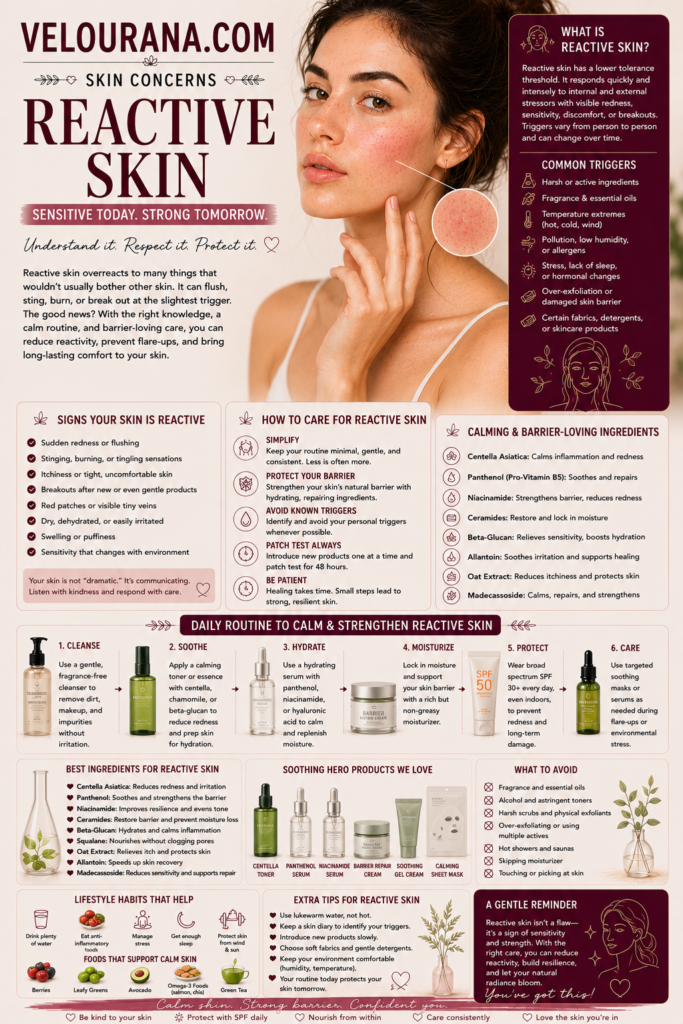
CATEGORY: Reactive Skin
Reactive skin often attracts more skincare, not less.
The logic seems reasonable. If skin is red, it needs calming products. If it feels rough, perhaps it needs exfoliation. If it looks dull, maybe it needs a brightening serum. If breakouts appear at the same time, an acne treatment is added. If the barrier feels compromised, another cream arrives. Before long, the bathroom shelf contains a collection of products designed to solve every visible problem separately.
Yet reactive skin does not experience those products as separate intentions.
It experiences the entire routine at once.
This distinction is crucial because one of the most common causes of ongoing sensitivity is not necessarily one dramatically unsuitable product. It can be the accumulated effect of too many otherwise reasonable interventions.
Over-treatment does not always produce the spectacular irritation people expect. Sometimes there is no obvious peeling, swelling or severe inflammation. Instead, the complexion slowly becomes less tolerant. Cleansing begins to sting. Moisturizer feels warm. Sunscreen suddenly seems uncomfortable. Makeup catches on dry patches. The cheeks flush more easily. Products that once felt neutral become noticeable.
At that point, the instinct is often to treat the new sensitivity.
Another product is added.
And the cycle continues.
Reactive skin can therefore become trapped in a paradox: the more intensely someone tries to correct it, the less opportunity the skin has to regain stability.
Understanding over-treatment means looking beyond individual ingredients and examining the total demands being placed on the complexion. It requires asking not only whether a product is effective, but whether the skin currently has the capacity to tolerate everything being asked of it.
That question is less glamorous than searching for the next breakthrough serum.
For reactive skin, it is often far more important.
When Skincare Becomes a Continuous Intervention
Modern skincare routines can resemble treatment programs.
Morning begins with cleansing, followed by antioxidant protection, pigmentation treatments, hydrating products, eye care, moisturizer and sunscreen. Evening may include makeup removal, a second cleanse, exfoliation, retinoids, blemish treatment and recovery products.
Each step may have a rational purpose.
The problem appears when the skin is never allowed to experience a neutral period.
This is particularly relevant when several products alter exfoliation, cellular turnover or barrier behaviour. Acids may be used to smooth texture. Retinoids may be used for acne or signs of ageing. Benzoyl peroxide may be introduced for blemishes. Vitamin C may be added for pigmentation and antioxidant support.
Again, none of these ingredients is automatically problematic.
The issue is cumulative exposure.
Reactive skin frequently has a lower margin for error. A routine that another person tolerates without difficulty may become excessive for someone whose skin responds quickly to chemical, physical or environmental stress.
The first signs can be subtle.
The face may feel slightly tighter after cleansing.
A serum may begin to tingle longer than usual.
The skin may appear shinier despite feeling dry.
The sides of the nose may become flaky.
Foundation may suddenly emphasize texture.
Redness may last longer after washing.
These signs are often dismissed because they are not dramatic.
But they can represent declining tolerance.
The mistake is waiting for obvious irritation before adjusting the routine.
By the time significant burning or peeling appears, the skin has often been signalling discomfort for days.
The Difference Between Effective Treatment and Excessive Treatment
Skincare works through biological interaction.
That interaction is precisely why active ingredients can produce results.
Exfoliating acids loosen connections among surface cells. Retinoids influence cellular behaviour. Benzoyl peroxide has antimicrobial and keratolytic effects useful in acne management. Other ingredients influence pigmentation, hydration or inflammation.
Effectiveness therefore cannot be separated entirely from biological activity.
The challenge is finding the level at which useful activity occurs without creating unnecessary irritation.
More frequent application does not always produce proportionally better results.
Higher concentration is not automatically superior.
Using multiple products that target the same pathway does not guarantee faster improvement.
Reactive skin makes these limitations particularly visible.
A person might tolerate a gentle exfoliant once weekly but become irritated when using it every other night. The conclusion should not necessarily be that the ingredient is unsuitable. The frequency may simply exceed the skin's tolerance.
The same principle applies to combinations.
One exfoliating product may be comfortable.
One retinoid may be comfortable.
Using both frequently within the same routine may become uncomfortable.
The skin is responding to the total intervention.
This is where skincare often becomes distorted by marketing.
Products are sold individually, so consumers naturally evaluate them individually. But the face receives the complete routine.
Ten individually excellent products can still create an excessive regimen.
The quality of the components does not guarantee the suitability of the combination.
Why Reactive Skin Can Become More Reactive
Repeated irritation can create a frustrating feedback pattern.
Once the skin becomes uncomfortable, ordinary products may begin to feel increasingly noticeable. This can make it seem as though sensitivity is spreading from one ingredient to another.
Someone begins with irritation from over-exfoliation.
Then cleanser stings.
A different cleanser is purchased.
Moisturizer stings.
A different moisturizer is purchased.
Sunscreen becomes uncomfortable.
Another sunscreen is introduced.
Soon the person believes they have developed intolerance to nearly everything.
Sometimes there may genuinely be individual ingredient sensitivities.
But sometimes the broader issue is that the skin is being evaluated while already irritated.
Testing products on compromised skin produces unreliable conclusions.
A formula that feels uncomfortable during a reactive episode may be perfectly tolerable after the complexion stabilizes.
This is why reactive skin benefits from establishing a baseline before introducing new treatments.
Without a baseline, every reaction becomes difficult to interpret.
The Illusion of the Perfect Recovery Product
When irritation develops, the beauty market offers an enormous category of rescue products.
Barrier creams.
Repair serums.
Recovery masks.
Cica treatments.
Ceramide products.
Soothing essences.
These products can be useful.
The mistake is assuming that recovery requires adding several of them simultaneously.
If the skin is reacting because the routine has become too complicated, adding three new calming products may increase complexity at exactly the wrong moment.
The labels may say “soothing,” but the skin still encounters additional formulas, preservatives, humectants, emollients, botanical extracts and other ingredients.
A recovery routine should therefore prioritize familiarity.
Products that have already demonstrated consistent tolerance are often more useful than exciting new formulations purchased in response to irritation.
This is one of the least glamorous but most reliable principles of reactive skincare:
When skin becomes unstable, experimentation should decrease.
The goal is not to build the most impressive recovery routine.
The goal is to create the most predictable one.
Why Exfoliation Is Easy to Overdo
Exfoliation has become deeply integrated into modern skincare.
It promises smoother texture, brighter appearance and improved treatment of clogged pores and pigmentation.
Those benefits can be real.
But exfoliation also presents a particular risk for reactive skin because its effects can accumulate before the person realizes the routine has become excessive.
There are multiple forms of exfoliation.
Chemical exfoliants may use alpha hydroxy acids, beta hydroxy acids or related ingredients.
Physical exfoliation may involve scrubs, brushes or abrasive tools.
Retinoids are not technically exfoliants in the same sense, but they can increase irritation when combined with exfoliating routines.
Cleansers may also contain acids.
Toners may contain acids.
Masks may contain acids.
Spot treatments may contain acids.
The result is that someone can be exfoliating far more frequently than they realize.
They may think they use an “exfoliating product” only twice weekly while unknowingly exposing the skin to exfoliating ingredients in several other steps.
Reactive skin often responds poorly to this hidden accumulation.
The symptoms may include burning, increased redness, tightness, flaking and unusual sensitivity to otherwise familiar products.
The solution is not necessarily permanent avoidance.
It may simply require reducing frequency and eliminating overlap.
The Problem with Treating Texture While the Skin Is Inflamed
When reactive skin becomes rough, the texture can be visually frustrating.
Tiny flakes appear.
Makeup applies unevenly.
The surface may feel bumpy.
The immediate temptation is exfoliation.
But roughness does not always mean excess dead skin requiring removal.
Sometimes rough texture reflects irritation and dehydration.
Scrubbing or chemically exfoliating already irritated skin can intensify the problem.
This distinction is particularly important because both situations can look similar in the mirror.
A rough patch caused by surface buildup and a rough patch caused by barrier disruption may both appear flaky.
Their needs are different.
Reactive skin therefore benefits from asking why texture has changed before treating it automatically.
If the roughness appeared alongside burning, stinging, tightness or sudden redness, aggressive exfoliation should be approached cautiously.
The skin may need stabilization rather than resurfacing.
When Acne and Reactivity Exist Together
One of the hardest situations is reactive skin that is also acne-prone.
The person cannot simply abandon all treatment because breakouts continue.
At the same time, aggressive acne routines may provoke sensitivity.
This creates a genuine balancing problem.
Acne treatments often involve ingredients that can be drying or irritating, particularly when introduced too quickly or combined aggressively.
Someone may respond to breakouts by using stronger cleansers, more frequent exfoliation and multiple spot treatments.
The complexion becomes dry and reactive.
The resulting irritation can then make acne treatment harder to tolerate.
The answer is not choosing between acne management and skin comfort.
It is finding a level of treatment the skin can sustain.
Consistency is usually more useful than cycles of aggressive treatment followed by forced recovery.
A product used comfortably for months can accomplish more than a stronger routine that must be abandoned after several days.
This principle applies across skincare.
The best treatment is not the most intense one.
It is the one that can be used appropriately and consistently without repeatedly destabilizing the skin.
The Quiet Damage of Mechanical Over-Treatment
Over-treatment is not only chemical.
Mechanical aggression is often overlooked because it does not come in a bottle.
Cleansing brushes.
Scrubs.
Washcloths.
Makeup wipes.
Exfoliating pads.
Facial devices.
Repeated towel rubbing.
Even excessive massage can contribute to irritation when performed frequently on sensitive skin.
People often associate physical exfoliation with visible granules, but friction can occur through ordinary habits.
Removing long-wearing makeup with repeated wiping is friction.
Rubbing the nose with tissues is friction.
Frequently touching irritated areas is friction.
Drying the face aggressively is friction.
Reactive skin may tolerate some of these behaviours individually.
The problem appears when several occur daily.
Mechanical stress can also amplify the effects of chemical actives.
An exfoliating routine combined with frequent rubbing may produce more irritation than either factor alone.
Again, cumulative load matters.
Why Hot Water Can Undermine an Otherwise Gentle Routine
Temperature is another hidden variable.
A person may carefully purchase fragrance-free skincare, use a gentle cleanser and avoid obvious irritants, yet consistently wash with very hot water.
For reactive skin, that can be counterproductive.
Very hot water may increase flushing and contribute to dryness and discomfort.
The sensation can even feel pleasant initially, particularly during cold weather.
But skin comfort after cleansing matters more than the immediate sensory experience.
Lukewarm water is generally a safer default for sensitive complexions.
This is a simple intervention, but it illustrates an important principle: not every improvement requires another product.
Sometimes technique produces more benefit than purchasing.
The Addiction to Visible Activity
Skincare culture often teaches people to expect sensation.
Tingling feels active.
Tightness feels cleansing.
Peeling feels transformative.
Warmth feels stimulating.
These sensations can become psychologically associated with effectiveness.
Reactive skin challenges that assumption.
A product does not need to announce itself physically in order to work.
Sunscreen does not need to tingle to protect.
Moisturizer does not need to feel medicinal to support hydration.
A retinoid does not need to make the skin peel dramatically in order to be useful.
The idea that visible irritation proves effectiveness can encourage unnecessary damage.
This is particularly dangerous when people push through persistent burning because they believe their skin needs to “adjust.”
Some treatments can produce temporary adaptation periods.
But persistent or worsening irritation should not automatically be celebrated.
There is a difference between carefully introducing an active and repeatedly overwhelming the complexion.
How Social Media Encourages Over-Treatment
Skincare routines are highly visible online.
People demonstrate ten-step routines in short videos.
Actives are layered together for dramatic transformations.
Weekly exfoliation schedules become complicated calendars.
Before-and-after images create pressure for rapid improvement.
What social media rarely captures is tolerance.
A routine that looks sophisticated on camera may be completely unsuitable for someone else's skin.
The viewer also rarely sees the weeks of adjustment, discontinued products or irritation that may occur behind the scenes.
Reactive skin is particularly vulnerable to trend-driven experimentation because frequent changes prevent the establishment of a stable baseline.
Every viral product becomes another variable.
Every new routine becomes another test.
Eventually, the complexion is constantly adapting to novelty.
For reactive skin, boredom can be protective.
A routine that looks unimpressive online may be exactly what the complexion needs.
The Importance of Recovery Periods
Athletes understand recovery intuitively.
Training creates stress.
Recovery allows adaptation.
Skincare does not operate identically, but the analogy is useful.
Repeated treatment without consideration of tolerance can create cumulative irritation.
Reactive skin often benefits from periods in which optional active treatments are reduced.
These periods do not need to follow a rigid schedule.
They can respond to skin signals.
If the complexion feels unusually tight, active products may be reduced.
If sunscreen begins to sting, the routine may need simplification.
If redness appears after several treatment nights, frequency may need reassessment.
The objective is to respond before the skin reaches severe irritation.
Recovery becomes part of the routine rather than an emergency response.
Simplifying Without Abandoning Skincare
People sometimes interpret simplification as using nothing.
That is not necessary.
Reactive skin still benefits from essential care.
Cleansing when needed.
Moisturizing.
Sun protection.
The exact products depend on individual tolerance.
The key is reducing unnecessary variables.
During a reactive period, this might mean temporarily removing exfoliating products, strong actives, fragranced formulas and optional masks.
Once stability returns, products can be reintroduced gradually.
This process provides information.
If the skin remains comfortable after one product returns, that product may be compatible.
If irritation reappears consistently after another, the pattern becomes clearer.
Simplification is therefore not only therapeutic.
It is diagnostic.
Why Product Hopping Makes the Problem Harder
Reactive skin encourages frequent switching.
A cleanser stings once, so it is replaced.
The replacement feels dry, so another is purchased.
A moisturizer causes redness, so another formula arrives.
Within several weeks, the entire routine has changed.
This makes it nearly impossible to identify what actually helped or harmed.
Skin also needs time to reveal patterns.
Immediate reactions are easy to notice.
Cumulative effects are slower.
A product may feel comfortable for several applications but become irritating after repeated use.
Another may feel slightly unusual at first but become perfectly acceptable.
Constant switching prevents meaningful observation.
A stable routine provides a reference point.
Without reference points, every change becomes guesswork.
Reading Early Warning Signs
Reactive skin often signals declining tolerance before significant irritation appears.
These warnings deserve attention.
A cleanser that suddenly feels stronger.
A moisturizer that produces brief warmth.
Sunscreen that feels more noticeable around the eyes.
A slight increase in flushing after washing.
Unusual tightness by afternoon.
Small patches of flaking around the mouth.
Makeup that no longer applies smoothly.
None of these signs proves that a flare is inevitable.
But together they may indicate that the skin's tolerance is narrowing.
Responding early can prevent escalation.
The response might be as simple as skipping exfoliation for several days.
Reducing active frequency.
Using gentler cleansing.
Avoiding unnecessary friction.
Returning to familiar products.
Reactive skin often becomes easier to manage when early signals are treated as information rather than ignored until discomfort becomes severe.
A More Intelligent Way to Use Active Ingredients
Active skincare does not need to disappear from a reactive routine.
It needs to become strategic.
The first principle is priority.
What is the main concern?
Acne?
Pigmentation?
Fine lines?
Texture?
Trying to address every concern simultaneously creates unnecessary complexity.
Choose the highest priority and introduce treatment around that goal.
The second principle is frequency.
Many products do not need daily use to provide benefit.
Starting less frequently can reveal tolerance before the routine becomes intensive.
The third principle is separation.
Potentially irritating products may be easier to tolerate when not layered together.
The fourth principle is observation.
If the skin becomes increasingly uncomfortable, reducing frequency is often more sensible than pushing through automatically.
The fifth principle is patience.
Skincare results frequently require weeks or months.
Attempting to accelerate them by increasing intensity can create setbacks.
Reactive skin rewards discipline more than aggression.
When a Dermatologist Becomes More Useful Than Another Product
There is a point where continued experimentation stops being productive.
Persistent facial redness.
Repeated swelling.
Painful burning.
Severe itching.
Crusting.
Oozing.
Recurrent rashes.
Eye irritation.
Symptoms that continue despite simplification.
These situations deserve professional evaluation.
Underlying conditions such as rosacea, eczema or contact dermatitis may require diagnosis and treatment.
Allergic contact dermatitis may require patch testing.
Persistent acne may need prescription therapy that can be managed more carefully than repeated over-the-counter experimentation.
Seeing a dermatologist is not an admission that skincare failed.
It is recognizing that some problems are medical rather than cosmetic.
The Economics of Over-Treatment
Reactive skin can become expensive.
Every reaction seems to justify another purchase.
A new cleanser.
A calming toner.
A repair serum.
A barrier cream.
A mineral sunscreen.
A mask.
A facial mist.
Most of these products may be used only briefly before another reaction causes them to be abandoned.
The financial cost accumulates quickly.
Simplification can therefore save more than the skin.
It reduces waste.
It reduces the temptation to purchase solutions before understanding the problem.
It encourages finishing products that work rather than constantly replacing them.
In this sense, reactive skincare can become more sustainable when it becomes more deliberate.
Building a Routine with a Margin of Safety
A good reactive-skin routine should not operate permanently at the edge of tolerance.
If the skin can barely tolerate the normal routine under ideal conditions, any additional stress may create irritation.
A better routine leaves a margin.
There should be room for weather changes.
Room for occasional makeup.
Room for sun exposure.
Room for hormonal changes.
Room for travel.
Room for an imperfect night's sleep followed by less-than-perfect skincare habits.
This margin of safety comes from moderation.
Fewer overlapping actives.
Reasonable frequency.
Gentle technique.
Consistent moisturization.
Appropriate sun protection.
A routine that allows adaptation rather than demanding maximum performance every day.
Stability Is a Result
Skincare marketing emphasizes visible transformation.
But for reactive skin, stability itself is a meaningful outcome.
A complexion that no longer stings after cleansing has improved.
Skin that tolerates sunscreen consistently has improved.
Redness that appears less frequently has improved.
The ability to use one targeted treatment without destabilizing the entire routine is progress.
These changes may not produce dramatic before-and-after photographs.
They produce something more practical: a complexion that requires less attention.
That is often the real goal.
Skin should not need to dominate the day.
The Discipline of Doing Less
Doing less can feel strangely difficult.
Purchasing a product feels active.
Applying a treatment feels productive.
Waiting feels passive.
But reactive skin often improves through restraint.
Not every rough patch needs exfoliation.
Not every blemish needs three treatments.
Not every episode of redness needs a new calming serum.
Not every skincare trend deserves experimentation.
The discipline lies in distinguishing between intervention that serves the skin and intervention that satisfies the desire to intervene.
That distinction becomes clearer with experience.
When the Skin Becomes Quiet Again
The most telling sign of improvement is often not visual.
It is silence.
The skin no longer demands attention.
Products apply without stinging.
There is no constant urge to inspect redness.
Cleansing feels uneventful.
The face does not feel tight by midday.
This quietness is valuable.
It provides a baseline from which targeted skincare can be built more intelligently.
Once the complexion is stable, treatment becomes easier to evaluate.
If a new product causes repeated discomfort, the relationship is clearer.
If the skin remains comfortable, confidence grows.
Reactive skin becomes manageable not because it stops reacting entirely, but because reactions become easier to understand.
A Better Definition of Progress
Progress with reactive skin is not measured by how many treatments the complexion can tolerate.
It is measured by how well the routine supports the skin's actual needs.
Sometimes that will include sophisticated active ingredients.
Sometimes it will include only the essentials.
The routine may change with seasons, age, environment and priorities.
That flexibility is not a weakness.
It is evidence of responsive skincare.
The central question should always remain the same:
Is the routine improving the skin without repeatedly overwhelming it?
If the answer is no, more treatment may not be the solution.
The solution may be fewer products, lower frequency, gentler technique and more patience.
Reactive Skin Does Not Need to Be Conquered
The language surrounding sensitive skin is often combative.
Fix the barrier.
Fight redness.
Eliminate sensitivity.
Resurface texture.
Correct imperfections.
Reactive skin does not always respond well to warfare.
It responds better to understanding.
The complexion is not failing because it cannot tolerate every product.
It is communicating its limits.
Those limits may change.
They may expand when the skin is stable.
They may contract during cold weather, illness, over-exfoliation or environmental stress.
Learning those limits is far more useful than trying to force the skin beyond them.
A successful routine therefore becomes a negotiation.
Treat what needs treatment.
Protect what needs protection.
Remove what creates unnecessary stress.
Observe what changes.
And when the skin becomes uncomfortable, do not automatically add more.
Sometimes the most advanced skincare decision is knowing what not to use.
The End
Velourana
 Discover More From Our Family of Websites
 ZodiacBearing (Astrology, Tarot, Numerology, Angel Numbers & Spiritual Guidance)
 Velourana (Beauty, Makeup, Hair Care, Skincare & Beauty Tips)
 HavenBearing (Home, Living, Organization, Décor & Everyday Inspiration)
 PawBearing (Pet Care, Dog Breeds, Animal Health, Training & Pet Products)
 PsyCatherine (Notes From the Journal of a Psychologist on Real Life)

