
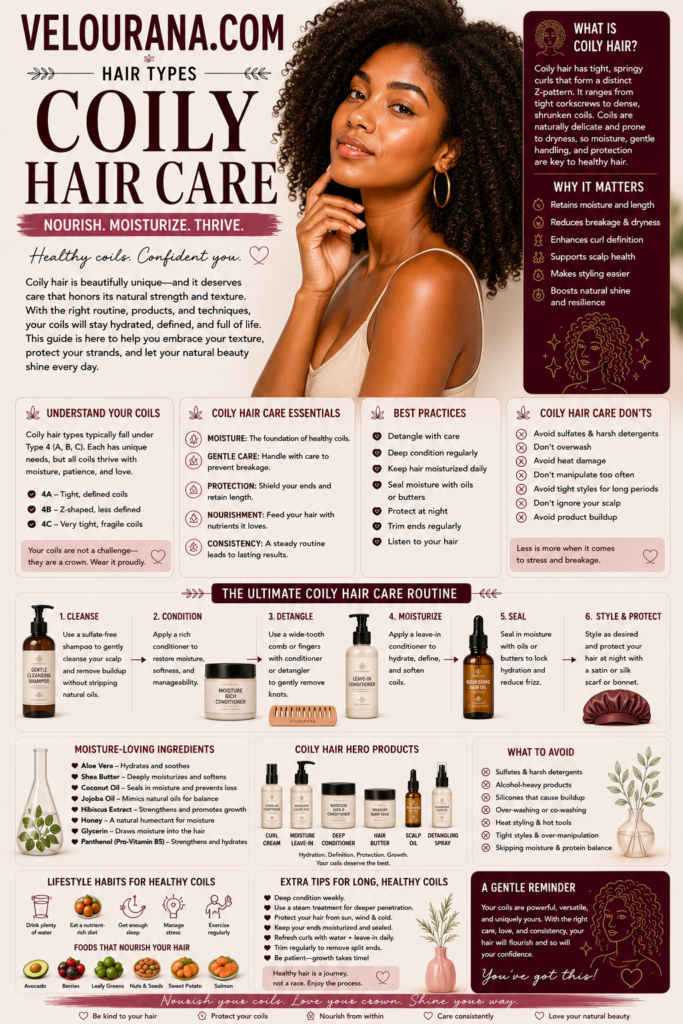
CATEGORY: Coily Hair Care
Protective styling occupies an unusual place in coily hair care. It is simultaneously a practical technique, an aesthetic tradition, a time-saving strategy, and, for many people, an essential part of maintaining length. Braids, twists, cornrows, wigs, tucked styles, buns, flat twists, and numerous variations can allow tightly textured hair to remain relatively undisturbed for days or weeks.
Yet the word protective is powerful enough to hide an important contradiction.
A hairstyle can be called protective while placing considerable tension on the scalp. It can conceal the ends while allowing severe tangling underneath. It can reduce daily combing but introduce weight, friction, buildup, or difficult removal. It can remain visually beautiful long after the hair beneath it would benefit from attention.
The name of the style therefore tells us very little about whether it is actually protecting the hair.
Protection is an outcome.
A genuinely protective style should reduce damaging manipulation, limit unnecessary friction, help preserve vulnerable ends where appropriate, and remain comfortable enough that the scalp and hair are not paying an invisible price for the convenience of the finished look.
Understanding this distinction transforms protective styling from a catalogue of hairstyles into something more useful: a strategy for controlling mechanical stress.
Why Manipulation Matters So Much for Coily Hair
Every hair texture experiences mechanical wear, but coily hair presents a particularly complex environment.
Strands repeatedly bend and change direction. Neighboring fibers can wrap around one another. Shed hairs may remain trapped inside the texture rather than falling away naturally. Tight contraction can bring many strands into close contact.
Every attempt to reorganize that structure introduces force.
Brushing, combing, finger detangling, twisting, smoothing, stretching, sectioning, braiding, and restyling all require the hair to move. None of these actions is inherently damaging when performed appropriately, but their effects accumulate.
This is the fundamental logic behind protective styling.
If the hair can be arranged once and then left relatively undisturbed for several days, it may experience less cumulative manipulation than hair that is completely reconstructed every morning.
The benefit does not come from the braid itself possessing special protective properties.
It comes from what does not happen afterward.
The hair is not repeatedly detangled. Ends may not brush continuously against clothing. Strands are not constantly separated and rearranged. Morning routines may require only minimal adjustment.
This is why low manipulation is the real principle beneath protective styling.
Protection Begins Before the Style Is Installed
A protective style cannot correct poor preparation.
If hair enters a long-term style severely tangled, coated with excessive buildup, or inadequately conditioned, those problems do not disappear because the strands have been braided.
They wait.
Preparation should create a manageable foundation.
For many people this means cleansing the scalp and hair appropriately, conditioning thoroughly, removing accumulated shed strands, and detangling carefully before installation.
The objective is not to make the hair unnaturally slippery or overloaded with product. It is to ensure that strands can be separated and arranged without unnecessary resistance.
Hair may also be stretched before certain styles.
This can be accomplished through braiding, twisting, banding, threading, blow-drying, or other techniques depending on preference. Stretching can make sectioning easier and may reduce some forms of tangling during installation.
Heat is not automatically required.
If heat is used, the same principles that apply elsewhere remain relevant: reasonable temperature, thoughtful technique, and avoidance of unnecessary repeated exposure.
Preparation also provides an opportunity to inspect the scalp.
Installing a long-lasting style over an already irritated scalp is unlikely to improve the situation.
Tension Is the Boundary Between Protection and Damage
A protective hairstyle should not require pain.
This statement sounds obvious, yet discomfort is sometimes normalized during braiding and other tightly controlled styles. Tenderness is interpreted as evidence that the style is secure. A headache is treated as something that will pass. Small bumps around the hairline are tolerated because the finished result looks exceptionally neat.
These are poor standards for protection.
Tension can act on both the hair fiber and the follicle.
A strand pulled tightly is placed under mechanical stress. When many hairs are held under persistent tension, particularly around vulnerable areas such as the hairline, the consequences can become more significant.
The sensation of pain is information.
A style that hurts immediately after installation deserves attention rather than endurance.
Neatness does not require maximum tightness. Braids can be secure without pulling the scalp aggressively. Cornrows can lie close to the head without producing persistent soreness. Extensions can be installed without making every follicle carry unnecessary weight.
The best protective style is not the one that remains absolutely motionless for the longest possible period.
It is the one that achieves useful longevity without demanding excessive stress in exchange.
The Hairline Deserves Special Protection
Edges often experience more styling pressure than almost any other area.
They are brushed, smoothed, gelled, braided, pulled into ponytails, pressed, and manipulated repeatedly because they influence the polished appearance of the finished style.
The irony is that a protective style can therefore protect the bulk of the hair while subjecting the perimeter to intensive treatment.
This defeats part of its purpose.
Hair around the temples and front hairline can be finer and more vulnerable to repeated tension. Tiny braids placed under significant force may look precise but create a poor mechanical environment.
Leaving delicate hairs out of high-tension sections, reducing repeated brushing, varying the location of tension, and accepting a slightly softer hairline can all contribute to preservation.
Edges do not need to be perfectly immobilized for a hairstyle to look intentional.
The cultural preference for an exceptionally sleek perimeter should remain an aesthetic choice, not a requirement imposed at the expense of hair health.
Extensions Change the Mechanical Equation
Added hair allows remarkable creative freedom.
Length, volume, color, and texture can be transformed without permanently altering the natural hair. For many people, extension styles are convenient and beautiful.
But added hair also adds mass.
That weight is ultimately supported by the natural hair and scalp.
The effect depends on how much extension hair is used, how it is distributed, the size of the sections, the installation technique, and the condition of the natural hair.
Very small sections carrying relatively heavy extensions can create concentrated stress.
Long extensions may also become heavier when wet. Movement during exercise or daily activity can introduce additional pulling. Styles that initially feel comfortable may become tiring after prolonged wear.
This does not make extensions inherently damaging.
It means their weight should be considered part of the design rather than an afterthought.
A spectacular style that is too heavy to wear comfortably is not protective simply because the natural ends are hidden.
Braids and Twists Protect Through Organization
Braids and twists are effective partly because they organize individual strands into stable groups.
Loose coily hair allows fibers to move relatively independently. They can intersect, contract, knot, and tangle.
Braiding or twisting restricts some of that movement.
This can dramatically simplify maintenance.
The hair remains stretched to some degree, individual strands are less able to knot around themselves, and daily detangling becomes unnecessary.
But even these styles require sensible installation.
If sections are pulled too tightly, the mechanical advantage is compromised. If the hair is twisted aggressively at the root, discomfort can develop. If the ends are handled roughly or secured with damaging materials, protection becomes incomplete.
The style should make the hair easier to maintain, not merely change where the damage occurs.
Wigs Can Be Protective—or Merely Concealing
Wigs are often described as ideal protective styles because the natural hair can remain braided or otherwise contained underneath.
They can indeed reduce daily manipulation dramatically.
But concealment is not synonymous with care.
The condition of the hair beneath the wig still matters.
Braids underneath should not be unnecessarily tight. The scalp should remain reasonably clean and comfortable. Friction between the wig, wig cap, hairline, and natural hair should be considered.
Adhesives and repeated removal techniques can create additional concerns around the perimeter if used carelessly.
A person can wear wigs continuously while maintaining excellent natural hair underneath.
Another can experience breakage despite rarely seeing their natural hair.
The difference lies in what happens beneath the visible style.
Protective Styling Does Not Cancel Scalp Care
One of the great conveniences of long-lasting styles is reduced daily maintenance.
That convenience can gradually become neglect if the scalp is treated as inaccessible until removal day.
The scalp continues functioning regardless of the hairstyle.
Sebum is produced. Sweat accumulates. Skin cells are shed. Styling products may be applied repeatedly. Environmental debris can collect.
How frequently cleansing is practical depends on the style, individual scalp, activity level, and intended duration.
Some braided styles can be cleansed carefully while installed. Others may be more difficult to maintain without disrupting the appearance.
The cosmetic desire to preserve perfect neatness should not automatically outweigh scalp comfort.
Persistent itching, significant flaking, soreness, inflammation, or unusual scalp changes should not simply be endured until the planned removal date.
A style is temporary.
The scalp is not.
Oil Is Not a Substitute for Cleansing
Scalp oiling is deeply embedded in many textured-hair routines.
For some people, small amounts of appropriate oils feel comfortable and help reduce sensations of dryness.
Problems arise when every itch or flake is interpreted as a request for more oil.
An irritated scalp may not be asking to be coated.
Product buildup, sweat, skin conditions, or sensitivity to ingredients can all create discomfort. Adding repeated layers of oil may complicate the environment rather than resolve it.
Protective styling can make this cycle particularly easy because applying oil between braids feels like active maintenance even when the scalp actually needs cleansing or professional assessment.
Observation should guide intervention.
If a product consistently improves comfort without causing buildup, it may fit the routine. If symptoms worsen despite repeated oiling, the assumption behind the practice deserves reconsideration.
Moisturizing Hair Inside a Protective Style
Hair does not become biologically inactive when braided.
The fiber can still interact with water, products, humidity, and friction.
However, moisturizing a protective style can become unnecessarily complicated.
Heavy creams applied repeatedly to tightly braided hair may be difficult to distribute evenly and difficult to remove later. Thick layers can collect near roots or between sections. Excessive wetting may cause some styles to swell, frizz, or remain damp for prolonged periods.
The goal is not to keep the hair continuously wet.
It is to prevent the routine from leaving the fiber excessively dry and difficult to manage when the style is removed.
The ideal approach depends heavily on the style.
Natural twists may tolerate product application differently from extension braids. Hair beneath a wig can be accessed differently from hair inside intricate cornrows.
Rather than following a universal moisturizing schedule, attention should be paid to how the hair feels and how much buildup the maintenance routine creates.
The Myth of Maximum Duration
Protective styles are sometimes judged by longevity.
If braids can remain installed for another week, removing them earlier can feel wasteful. The longer the style lasts, the greater the apparent return on the time and money invested.
But the longest possible duration is not necessarily the healthiest duration.
As weeks pass, new growth emerges. Shed hairs remain trapped within the style. Products and scalp debris accumulate. Sections become looser. Strands can begin matting near the roots.
Eventually the convenience of leaving the style in place is exchanged for greater difficulty during removal.
There is no universal expiration date.
A simple natural twist style worn for a relatively short period presents different conditions from extension braids intended to last several weeks.
The appropriate removal point is the moment at which continued wear begins creating more management problems than it solves.
Waiting until the style is visibly deteriorating everywhere is not a requirement.
Removal Is Part of Protective Styling
A beautifully installed style can still produce unnecessary breakage during removal.
After weeks of low manipulation, shed hairs have accumulated. New growth may have intertwined. Product residue may be present. The desire to finish quickly can lead to aggressive pulling.
This is precisely when patience matters.
Extensions should be removed carefully without accidentally cutting natural hair. Braids and twists should be unraveled rather than ripped apart. Shed strands should be released progressively.
The hair may appear extremely full of loose strands during the process.
This does not automatically mean the style caused severe hair loss.
Normal shedding that would otherwise have fallen away daily has been trapped inside the hairstyle and is now being released at once.
Detangling immediately after removal can require considerable lubrication and systematic sectioning.
If the hair has been contained for weeks, expecting a comb to pass through effortlessly without preparation is unrealistic.
The removal process should therefore be considered part of the original hairstyle—not an inconvenient event that begins after the style is finished.
The Temptation to Reinstall Immediately
Protective styles are convenient enough that one can be removed in the morning and replaced that afternoon.
For some hair and styles, rapid reinstallation may be manageable.
But repeated identical tension patterns deserve consideration.
If the same sections are braided tightly in the same direction over and over, the same areas repeatedly absorb the mechanical load.
Changing the style, altering parting patterns, reducing extension weight, or spending some time in a lower-tension arrangement can redistribute stress.
A break between styles does not need to follow an arbitrary number of days to be meaningful.
The important question is whether the hair and scalp appear comfortable enough for the next installation.
Tenderness, irritation, significant tangling, or visible stress around the perimeter are reasons to reconsider immediate repetition.
Protective Does Not Have to Mean Hidden
The concept of protection is sometimes interpreted so narrowly that coily hair seems safest only when concealed.
That is unnecessary.
A wash-and-go can be relatively low manipulation if it lasts comfortably for several days.
A twist-out can be maintained with minimal daily handling.
A puff, bun, or other simple style can reduce manipulation when tension is controlled.
Natural twists can protect without added hair. Braids can remain visible expressions of the natural texture rather than mechanisms for hiding it.
Protection is a principle, not an aesthetic category.
If a hairstyle reduces unnecessary handling and does not introduce damaging stress, it can serve a protective function even when every coil remains visible.
Low Manipulation May Be the Better Term
For many people, low-manipulation styling is a more useful concept than protective styling.
It shifts attention away from whether a hairstyle belongs to an approved category and toward what actually happens to the hair.
How often does the style need to be reconstructed?
How much force is required?
Are the ends rubbing against clothing?
Is the hairline under tension?
Can the scalp be maintained comfortably?
Will removal be straightforward?
These questions evaluate the style functionally.
A loose style that requires almost no daily manipulation may be more protective than extremely tight braids left untouched for weeks.
The label becomes less important than the mechanics.
Protective Styling and Length Retention
Protective styling is particularly attractive to people pursuing length because reduced manipulation can support retention.
But it does not accelerate follicular growth.
Hair continues growing according to its biological cycle whether it is loose, braided, twisted, or covered.
What changes is the probability that existing length remains intact.
If protective styling reduces detangling damage, prevents ends from rubbing constantly against clothing, and decreases daily manipulation, more of the hair produced at the scalp may remain attached over time.
That can create the appearance of dramatically improved growth.
The distinction is important because it prevents unrealistic expectations.
A protective style is not a growth treatment.
It is a preservation strategy.
When Protective Styling Is Not Working
The consequences of a poorly suited routine are not always dramatic.
Sometimes the signs are subtle.
The hairline seems slightly thinner. Certain sections break more frequently. Removal becomes increasingly difficult. The scalp remains itchy throughout each style. The hair feels extremely dry when finally released. Small broken hairs appear repeatedly.
These patterns deserve attention.
A hairstyle that looks excellent externally but consistently leaves the natural hair in worse condition is not fulfilling its supposed purpose.
The solution may be lower tension, lighter extensions, shorter duration, different preparation, more appropriate cleansing, gentler removal, or an entirely different style.
Tradition and popularity do not override individual response.
Convenience Is a Legitimate Hair Goal
Protective styling does not need to be justified exclusively through hair growth.
Convenience matters.
Reducing morning styling time can make exercise easier, simplify travel, accommodate demanding work schedules, and remove one daily decision from an already crowded life.
A hairstyle can be worthwhile because someone enjoys it.
The important point is simply to separate aesthetic and practical value from claims about protection.
If a style is chosen primarily because it is beautiful, that is sufficient reason to wear it.
If it is chosen specifically to protect the hair, then its effect on the hair should be evaluated honestly.
Protection Without Fear
The strongest protective routine is not one that treats coily hair as too fragile to be touched.
Hair exists to be lived with.
It can be styled, stretched, braided, colored, displayed, changed, and enjoyed.
Protection becomes useful when it reduces unnecessary damage without turning hair care into constant anxiety.
That requires balance.
Enough cleansing to maintain comfort, but not obsessive washing.
Enough conditioning to reduce friction, without endless product layering.
Enough tension to create a secure style, without pain.
Enough longevity to enjoy convenience, without waiting for severe matting.
Enough care during removal to preserve the benefits created by weeks of reduced manipulation.
The goal is not to place coily hair permanently beyond reach.
It is to choose periods of intentional organization in which the fiber experiences less mechanical disturbance.
The Style Should Serve the Hair
The most sophisticated protective styling routine begins with a simple reversal of priorities.
The hair should not be sacrificed to preserve the hairstyle.
If the scalp hurts, the style is too demanding.
If the hairline is thinning, neatness has become too expensive.
If buildup is severe, longevity has been prioritized too heavily.
If removal causes extensive breakage, the protective process was incomplete.
A successful style should leave the hair reasonably prepared for whatever comes next.
When the braids are removed, when the twists are unraveled, when the wig comes off, the natural hair underneath should not reveal that weeks of apparent protection were actually weeks of accumulated stress.
That is the real test.
Protective styling works not because the hair disappears from daily view, but because manipulation becomes deliberate rather than constant.
For coily hair, that distinction can preserve length, simplify maintenance, and expand styling freedom at the same time.
The most protective style is therefore not necessarily the tightest, longest-lasting, most elaborate, or most carefully concealed.
It is the style that allows the hair to emerge afterward with the least unnecessary story of damage to tell.
The End
Velourana.
 Discover More From Our Family of Websites
 ZodiacBearing (Astrology, Tarot, Numerology, Angel Numbers & Spiritual Guidance)
 Velourana (Beauty, Makeup, Hair Care, Skincare & Beauty Tips)
 HavenBearing (Home, Living, Organization, Décor & Everyday Inspiration)
 PawBearing (Pet Care, Dog Breeds, Animal Health, Training & Pet Products)
 PsyCatherine (Notes From the Journal of a Psychologist on Real Life)

