
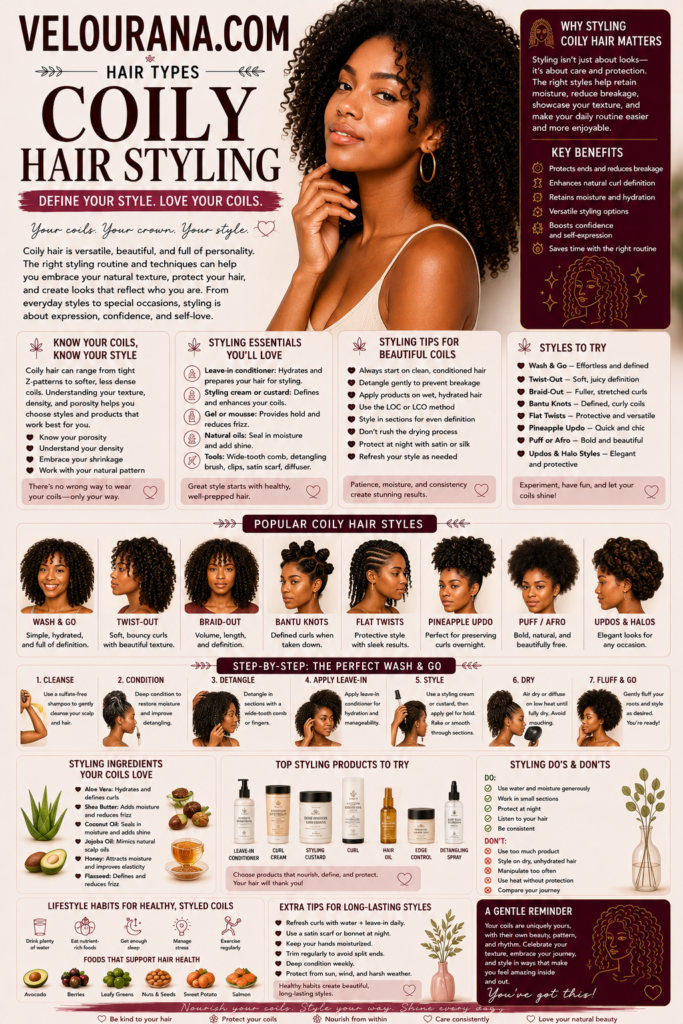
CATEGORY: Coily Hair Styling
Protective styling is one of the most widely discussed ideas in coily hair care, yet the phrase is often used so broadly that it can lose its meaning. Braids are described as protective. Twists are protective. Wigs, buns, tucked styles, cornrows and updos are protective. Sometimes almost any hairstyle that lasts more than a day receives the label.
But a hairstyle does not become protective simply because it is called one.
Protection is an outcome.
A protective style should reduce some of the forces that repeatedly stress coily hair: frequent detangling, friction, manipulation, environmental exposure, excessive tension and constant rearrangement. It should make the hair easier to live with while preserving the condition of the strands underneath. If the style creates persistent pain, pulls aggressively at the hairline, traps serious tangles, encourages neglect or causes significant breakage during removal, its protective value becomes questionable regardless of how long it lasted.
This distinction matters particularly for coily hair because the structure of the fiber creates both extraordinary styling possibilities and distinctive mechanical challenges.
Coils naturally curve back toward themselves and neighboring strands. Shed hairs can remain trapped within dense sections. Ends can become intertwined. Daily manipulation can therefore involve considerably more friction than it might appear from the outside. A well-designed low-manipulation style can provide meaningful relief from this cycle.
Yet protection does not mean imprisoning the hair.
The most successful approach respects the scalp, preserves access to the hair when necessary, controls tension, prepares the strands properly before installation and treats removal with as much care as installation.
Protective styling is therefore not primarily about hiding coily hair.
It is about managing mechanical exposure intelligently.
Protection Begins With Understanding What the Hair Is Being Protected From
The concept becomes clearer when the source of risk is identified.
Coily hair experiences ordinary mechanical stress every day. Clothing rubs against the ends. Fingers pass through the strands. Hair is gathered, separated, twisted, brushed, stretched and released. During sleep, it presses against fabric. During washing, swollen fibers move against one another. Environmental conditions alter the way the strands behave.
None of these activities is automatically damaging.
Hair is designed to tolerate normal handling. Problems tend to develop when stress becomes excessive, repetitive or concentrated in vulnerable areas.
Daily restyling can be particularly demanding.
A person may detangle in the morning, create a style, manipulate it throughout the day, undo it at night and begin again the following morning. Over weeks, the same strands experience repeated friction and tension.
A low-manipulation style interrupts that cycle.
Once installed, the hair may remain relatively undisturbed for several days or longer. The ends can be tucked away. Repeated combing can be reduced. The wearer can focus on preserving the arrangement rather than reconstructing it constantly.
This is the real protective mechanism.
The style changes how frequently and intensely the hair must be handled.
Seen this way, even a relatively simple two-strand twist style can be highly protective if it substantially reduces daily manipulation. Conversely, an elaborate braided style that is adjusted, pulled tightly into new arrangements and restyled continuously may not provide the same benefit.
Protection depends on behavior, not appearance.
The Ends Often Benefit Most From Protective Styling
The ends of coily hair deserve particular attention because they are the oldest section of every strand.
Hair near the scalp is relatively new. The ends may have existed for years.
During that time they have experienced repeated washing, drying, friction, weather, detangling, styling and contact with clothing. Even when the hair is generally healthy, the ends have accumulated more mechanical history than the roots.
This is one reason retaining visible length can be difficult even when the hair continues growing normally.
Growth occurs at the scalp, but apparent length depends partly on whether the oldest portions remain intact.
Protective styles can help by reducing the amount of contact the ends experience.
A tucked bun, pinned twist or carefully constructed updo can keep the tips away from rough clothing and repeated handling. Twists or braids can organize the ends so that they are less likely to become individually tangled within the surrounding hair.
But merely hiding the ends does not guarantee protection.
If they are folded aggressively, secured beneath rough accessories or allowed to become dry and severely tangled inside a style, concealment alone offers little advantage.
The goal is not invisibility.
It is reduced unnecessary friction and manipulation.
Preparation Determines What Goes Into the Style
A long-lasting style magnifies the importance of preparation because the hair may remain in that arrangement for days or weeks.
Installing a protective style over heavily tangled hair does not remove the tangles. It simply postpones the problem.
Shed hairs that remain trapped can become woven more deeply into the surrounding strands. Small knots may tighten. Product buildup can become more difficult to manage.
A strong preparation process therefore begins with an honest assessment of the hair's condition.
Cleansing removes accumulated residue from the scalp and strands. Conditioning improves manageability. Detangling clears trapped shed hairs and significant knots before the hair is organized into a longer-term configuration.
The exact routine varies.
Some protective styles are easier to install on stretched hair. Others work beautifully on damp or naturally shrunken hair. Some require substantial definition, while others depend primarily on smooth sectioning.
What matters is that the starting condition supports the installation rather than complicating it.
The hair should also be dry enough for the chosen style.
Keeping dense coily hair enclosed for extended periods while still significantly damp can be uncomfortable and may create an undesirable scalp environment. Styles that begin on wet hair should be given enough airflow and drying time for moisture to leave completely.
The installation should never be used to hide an unresolved problem.
If the scalp is irritated, the hair is severely tangled or the strands feel unusually fragile, addressing those conditions first is more protective than covering them immediately.
Tension Is the Boundary Between Control and Stress
Protective styling often requires tension.
Braids need enough control to remain neat. Twists must be secure enough not to unravel immediately. Updos rely on pins, bands or directional styling. Cornrows depend on controlled positioning close to the scalp.
The issue is not whether tension exists.
It is how much, where it is concentrated and how long it persists.
Pain is one of the clearest warning signs.
A freshly installed style should not require several days of discomfort before it becomes tolerable. Persistent throbbing, tenderness, headaches or difficulty moving the scalp comfortably suggest that the styling tension is excessive.
The hairline deserves particular caution.
The hairs around the temples and perimeter are often finer than those in denser central areas. Repeatedly attaching heavy extensions or pulling these strands tightly into sleek styles can place disproportionate stress on them.
The nape can be vulnerable as well, especially when small sections are asked to support substantial tension.
The most polished appearance should therefore not automatically be pursued at the cost of comfort.
Slightly softer roots can still produce a beautiful style.
In protective styling, neatness and tightness are not synonyms.
Section Size Changes How Stress Is Distributed
The size of each section is not merely an aesthetic decision.
It affects how mechanical force is distributed across the hair.
Very small sections concentrate styling tension on fewer strands. If substantial weight is attached to those sections, the load per hair can become considerable.
Larger sections distribute force across more strands, although they may create a different visual effect and may not suit every style.
This principle becomes especially important when extensions are involved.
A tiny base supporting a long, heavy braid experiences a very different mechanical demand from a larger base supporting a lighter section.
The visual preference for extremely small, precise braids can therefore conflict with the goal of minimizing tension.
Coily hair styling benefits from proportion.
The thickness and weight of the finished section should make sense relative to the amount of natural hair supporting it.
This does not require calculating exact forces.
It requires observing whether the style feels balanced.
If individual sections feel heavy, pull visibly at the root or swing with uncomfortable force during movement, the design may be demanding too much from too little hair.
Two-Strand Twists Are Protective Because They Simplify the Hair
One of the most effective protective styles can also be one of the simplest.
Two-strand twists organize coily hair into manageable units without necessarily requiring high tension or extensions.
Their usefulness lies partly in accessibility.
Individual twists can be washed or refreshed more easily than some highly structured styles. A section can be redone without dismantling the entire hairstyle. The scalp remains relatively accessible. The hair can also be rearranged into buns, pinned shapes or other configurations without being completely detangled each time.
Twists reduce the number of loose strands interacting across the head.
Instead of thousands of individual hairs moving independently and catching against one another, the fibers are grouped into larger controlled sections.
This can make nighttime preservation easier and reduce the need for repeated combing.
The size of the twists changes their character.
Smaller twists may last longer and offer greater styling versatility. Larger twists install and remove more quickly and can reduce the total amount of manipulation involved.
Neither is inherently more protective.
The better option is the one that provides adequate stability without creating an unrealistic installation and takedown burden.
A style that requires hours of detailed manipulation every few days may defeat part of the low-manipulation objective.
Braids Provide Strong Organization but Require Respect for Tension
Braiding can organize coily hair more firmly than twisting because the interwoven structure is less likely to unravel.
This makes braids useful for longer-lasting styles.
The hair remains divided into stable sections, tangling between neighboring areas is reduced and daily styling can become minimal.
But the strength of the structure can encourage excessive tightening.
Because braids look neater when the base is highly controlled, there can be pressure to pull strongly at the roots. The use of extensions can amplify this problem.
Protective value therefore depends heavily on installation technique.
The braid should be secure without creating persistent discomfort. The size and weight should remain proportionate to the section of natural hair.
The hairline should not be forced into sections simply because every strand must visually participate.
Leaving delicate perimeter hairs out of high-tension structures can sometimes be the more protective choice.
The braid itself is neutral.
Its effect depends on how it is designed and worn.
Cornrows Can Protect While Creating Directional Structure
Cornrows offer a different kind of control because the hair is braided close to the scalp.
They can reduce loose-hair manipulation substantially and provide a compact foundation beneath wigs or other styles.
Their directional nature also makes them visually versatile.
Patterns can be simple or highly elaborate, but the protective principle remains the same: organized hair experiences less independent movement.
However, scalp-level braiding makes tension especially important.
Because the braid is anchored continuously along the scalp, excessive tightness can create discomfort across an extended area rather than only at a single base.
The edges again require restraint.
A visually flawless perimeter is not worth unnecessary traction.
Cornrows used beneath wigs also introduce additional considerations.
The foundation should be comfortable and not so tight that the wig adds pressure on top of an already stressed scalp. The hair underneath still needs reasonable access to cleansing and drying according to the duration and routine.
A hidden style remains part of the hair-care system even when nobody sees it.
Tucked Styles Can Protect Without Long-Term Installation
Protective styling does not have to mean committing to a style for several weeks.
A simple tucked style can reduce exposure immediately.
The hair might be gathered into a low-tension bun with the ends folded inward. Twists can be pinned upward. Longer sections can be arranged so that the ends do not rub repeatedly against clothing.
These styles are particularly useful for people who prefer regular access to their hair.
They can be installed quickly and removed without an extended takedown process.
Because the hair is not locked into an arrangement for a long period, cleansing and conditioning schedules can remain relatively flexible.
The potential problem is repetition.
A low bun worn in exactly the same position every day can place friction and tension on the same areas repeatedly. The style may be protective for the ends while demanding too much from the hair around the band or pins.
Variation helps.
Changing placement, loosening tension and using smooth accessories can reduce repeated stress on one location.
This illustrates an important point: even simple protective styling is about distribution of mechanical exposure.
Wigs Can Reduce Daily Styling, but the Hair Underneath Still Exists
Wigs can be exceptionally useful for reducing daily manipulation.
The natural hair can remain braided, twisted or otherwise organized while the visible hairstyle changes without repeated direct styling.
For someone seeking versatility, this can be valuable.
But the protective benefit depends on what happens underneath.
A wig does not eliminate the need for scalp care, cleansing, detangling or appropriate drying. It simply creates a covering over the natural hair.
The foundation matters.
Braids installed too tightly beneath a wig can experience additional pressure from caps, clips, combs or adhesives. Repeated friction at the hairline can become an issue if the wig shifts or if securing methods concentrate stress in the same areas.
The scalp also needs reasonable airflow.
A wig worn continuously without appropriate breaks or maintenance may become uncomfortable, particularly in warm conditions.
Protective styling should make hair management easier, not make the natural hair inaccessible to the point that its condition is ignored.
The wig is the visible style.
The protective system includes everything underneath it.
Extensions Change the Mechanical Equation
Adding synthetic or human hair can transform coily protective styling.
Extensions create length, thickness, color and design possibilities that natural hair alone may not provide.
But they also add weight.
This is the most important mechanical difference.
The natural strands must support material that did not originate from the scalp.
A modest amount of lightweight extension hair distributed across appropriately sized sections may feel comfortable. Long, dense extensions attached to very small sections can create substantial pull.
Length also changes leverage.
A long braid moves more during walking, sleeping and styling. Its weight acts farther from the root and can create more noticeable tension during movement.
This does not mean extensions should be avoided.
It means the visual design should be considered together with physical load.
Extremely long, extremely dense and extremely small-section styles combine several demanding variables at once.
Reducing one of them can significantly improve comfort.
Larger sections, lighter extension amounts or shorter finished lengths can preserve the overall aesthetic while reducing mechanical burden.
Protective styling should not require the natural hair to carry more than it reasonably can.
The Scalp Must Remain Part of the Routine
A protective style can create the temptation to stop interacting with the scalp entirely.
After all, the hair is finished.
But the scalp continues functioning.
Sebum is produced. Sweat accumulates. Skin cells shed. Styling products can reach the scalp. Environmental residue collects.
How frequently cleansing is needed varies according to the person, activity level, climate and style.
The important principle is responsiveness.
Persistent itching, discomfort, odor or heavy buildup should not be ignored simply because washing might disturb the hairstyle.
A style that can survive only by preventing necessary scalp care may be lasting longer than is useful.
Cleansing in a protective style can require a gentler technique than washing loose hair.
The goal is to clean effectively without roughening or dismantling the arrangement unnecessarily.
Thorough drying afterward is equally important, especially when braids or twists are dense.
A clean scalp beneath a damp, enclosed style is not an ideal outcome.
Maintenance includes both cleansing and complete drying.
Product Accumulation Can Turn Protection Into Buildup
Because protective styles remain in place for longer periods, product can accumulate gradually.
Oils, sprays, gels, creams and scalp products may be applied repeatedly without the full cleansing that would normally accompany loose-hair styling.
At first, the hair may appear moisturized and polished.
Over time, layers can build.
The scalp may feel coated. Dust can adhere to oily surfaces. The roots may become sticky. Flaking can develop where styling gels were used during installation.
This is why adding product automatically every day is rarely necessary.
Maintenance should respond to actual condition.
If the hair feels comfortable and flexible, additional layers may provide little benefit. If exposed sections feel dry, targeted application may be enough.
The language of "feeding" or "moisturizing" a protective style can sometimes encourage constant product use.
Hair does not need to be saturated continuously to remain protected.
The goal is manageable condition, not maximal coating.
Moisture Management Should Account for the Style's Structure
Coily hair often benefits from maintaining enough flexibility that strands do not become excessively brittle-feeling during a long-term style.
But introducing moisture into a complex protective style requires balance.
Too little attention can leave exposed hair feeling dry and rough.
Too much repeated wetting can cause swelling, frizz, buildup and long drying periods.
The design of the style matters.
Loose twists can often tolerate more direct refreshing because air circulates relatively easily. Dense extension braids may take considerably longer to dry after being saturated.
Sprays can provide light moisture without soaking the entire style, but even lightweight products can accumulate if layered repeatedly.
There is no universal daily schedule.
The condition of the hair, the product used and the duration of the style should guide maintenance.
Protective styling works best when care remains responsive rather than ritualized.
Sleep Can Either Preserve the Style or Increase Friction
Protective styles still encounter hours of friction during sleep.
Braids rub against bedding. Twists become compressed. Updos can pull if positioned awkwardly against the pillow.
Smooth fabrics can reduce surface friction and help preserve both the hairstyle and the strands within it.
But the way longer styles are positioned also matters.
Very long braids trapped beneath the body can tug at the roots during sleep. Gathering them loosely or positioning them so that their weight is supported can improve comfort.
Heavy styles should not require the scalp to resist their full weight throughout the night.
The objective is to reduce movement and friction without introducing new tension.
Nighttime preservation therefore remains part of protective styling even when the hair itself is not loose.
Long Wear Is Not Automatically Better Protection
One of the most persistent misconceptions is that the longer a protective style remains installed, the more beneficial it becomes.
The logic seems reasonable.
If manipulation is reduced for four weeks, eight weeks should reduce it even more.
But wear time introduces other variables.
Shed hairs accumulate within the style. New growth changes the relationship between the scalp and the original installation. Product buildup increases. The roots may begin matting. The style loosens, causing weight to shift differently.
A point eventually arrives where extending the style provides diminishing returns.
The exact timing varies too much for a universal rule.
A simple natural twist style may behave differently from extension braids. Fast-growing hair may require earlier attention. A scalp that develops significant buildup may need cleansing or removal sooner.
The useful question is not "How long can this style stay in?"
It is "Is this style still functioning protectively?"
When access, cleanliness, comfort or detangling risk begins deteriorating, longevity is no longer the only priority.
New Growth Changes the Mechanics of an Older Style
As hair grows, the original base of a braid or twist moves farther away from the scalp.
This creates a loose zone of new growth.
The section may begin twisting around itself, especially during washing. Shed hairs accumulate at the base. Neighboring sections can start interlocking.
If extensions remain attached, their weight is now supported through a different mechanical arrangement than when the style was freshly installed.
This is one reason very old protective styles can become difficult to remove.
The problem is not simply that the hairstyle looks less neat.
The roots have become structurally more complicated.
Manipulation during maintenance should therefore be gentle. Aggressively retightening the base repeatedly may introduce additional tension.
Sometimes the more protective choice is removal and reinstallation after the hair has been properly cleansed, detangled and rested.
Takedown Is Where Much of the Length Can Be Lost
A protective style can reduce manipulation for weeks and then lose much of that advantage during thirty rushed minutes of removal.
Takedown deserves the same patience as installation.
The hair has accumulated shed strands. Product may have dried around the roots. Individual fibers may be wound tightly through twists or braids.
Pulling sections apart quickly creates unnecessary friction.
Extensions should be removed carefully. The natural hair must be distinguished clearly from added length before any cutting occurs.
Once each section is released, the instinct may be to comb immediately.
But the combination of shed hairs and accumulated tangling requires preparation.
Finger separation can remove obvious loose hair first. Lubrication or conditioner can provide slip. Working gradually from the ends upward helps prevent knots from being forced tighter.
The amount of shed hair can look alarming after a long-term style because hairs that would normally have fallen away daily have remained trapped.
A large visible quantity therefore does not automatically mean the protective style caused sudden massive shedding.
What matters more is whether the remaining hair feels intact and whether unusual breakage is present.
The Hair May Need Time Between Demanding Styles
Moving directly from one high-tension style into another can create cumulative stress.
The hairline, scalp and roots have just spent an extended period supporting a particular arrangement. Immediate reinstallation may place pressure on many of the same areas again.
A period of lower manipulation can be useful.
The hair can be cleansed thoroughly, conditioned, detangled and assessed while loose or placed into a simpler low-tension style.
This provides an opportunity to notice changes that were hidden during the previous installation.
Are the edges maintaining density? Are certain sections breaking more than others? Does the scalp feel comfortable? Are the ends in reasonable condition?
Protective styling should include these moments of evaluation.
Otherwise, a series of long-term styles can conceal gradual problems until they become pronounced.
Protective Styling Does Not Automatically Cause Hair Growth
Protective styles are often credited with making hair grow faster.
The more accurate explanation is usually retention.
Hair growth originates within follicles in the scalp. Styling the visible fiber does not normally accelerate that biological process.
What protective styling can influence is how much of the newly produced length remains intact.
If reduced daily manipulation leads to less breakage, the hair may become visibly longer over time.
This difference is important because it creates realistic expectations.
A successful protective routine does not need to produce extraordinary growth rates.
Its value may simply be that the ends survive long enough for normal growth to become increasingly visible.
Length retention is less dramatic than promises of accelerated growth, but it is a much more useful way to understand what styling can genuinely accomplish.
Not Everyone Needs Long-Term Protective Styles
Some people find protective styling transformative.
Others discover that their hair behaves better when washed, conditioned and styled more frequently.
A dense head of hair that tangles severely when left untouched for long periods may not benefit from extended installations. Someone with a sensitive scalp may prefer shorter wear times. Another person may simply dislike keeping the same hairstyle for weeks.
Protective styling is therefore not a mandatory stage of coily hair care.
Low manipulation can be achieved in many ways.
A wash-and-go that remains intact for several days may reduce handling. Large twists worn for a week may be sufficient. A simple bun can protect the ends without creating a long-term commitment.
The method should fit the hair and the person.
A Protective Style Should Make Life Easier
Hair care occurs within a real schedule.
A theoretically perfect protective style that requires an exhausting installation, uncomfortable maintenance and a lengthy takedown may not be practical enough to remain genuinely protective.
Convenience matters.
One of the greatest benefits of low-manipulation styling is the reduction of daily decision-making.
The hair is already organized. Morning preparation becomes simpler. Weather may be less disruptive. Repeated detangling is postponed.
This reduction in workload is a valid styling goal.
The best protective style is often not the most elaborate one.
It is the one that preserves the hair while fitting comfortably into ordinary life.
Protective Styling Can Still Celebrate Coily Texture
Protection is sometimes visually associated with concealment.
The hair is hidden beneath extensions, tucked into a bun or covered by a wig.
But coily texture itself can remain central to protective styling.
Chunky twists reveal the natural density and pattern. Flat twists create sculptural designs. Soft updos use the hair's volume rather than suppressing it. Stretched textured styles can expose length while keeping the ends secured.
The idea that protective styling must disguise natural texture unnecessarily narrows its possibilities.
Coily hair has unusual structural capacity.
It can hold itself away from the scalp, maintain twisted forms, support dimensional shapes and create volume without extensive external structure.
Protection and expression can coexist.
The Most Protective Style Is Often the One That Respects Change
Hair changes during a style.
Roots grow. Products accumulate. edges respond to tension. Sections loosen. Weather affects the surface.
A protective routine becomes safer when it responds to those changes instead of insisting that the original plan must continue unchanged.
A braid that becomes uncomfortable can be removed.
An irritated scalp deserves attention even if the style still looks beautiful.
A section pulling too strongly can be adjusted.
A style planned for six weeks does not have to remain installed for six weeks simply because that was the original intention.
Protection is responsive.
The hair does not owe the hairstyle a predetermined lifespan.
True Protection Is Measured After the Style Comes Out
A newly installed protective style can look immaculate.
That does not reveal whether it was successful.
The more meaningful assessment comes after removal.
Does the hair detangle reasonably?
Do the ends feel intact?
Has the hairline maintained its density?
Is the scalp comfortable?
Does the retained length reflect reduced breakage?
If the answer is generally yes, the style probably achieved its purpose.
If every removal reveals severe knots, obvious breakage or stressed edges, the protective strategy needs to be reconsidered.
This is the difference between styling for appearance and styling for preservation.
Coily Hair Does Not Need to Be Hidden to Be Protected
The deepest misunderstanding around protective styling is the idea that coily hair is inherently too fragile to remain visible.
That is not the point.
Coily hair can be worn loose, defined, stretched, voluminous, twisted, braided, pinned or covered according to preference.
Protection is simply one strategy for managing the repeated mechanical demands placed on the fiber.
Used thoughtfully, it creates breathing room.
The hair spends less time being combed, separated and reconstructed. Ends can remain away from friction. Daily styling pressure decreases. Length that would otherwise be lost through breakage may be retained more effectively.
But protection becomes meaningful only when the style itself remains gentle enough to justify the name.
It should not hurt.
It should not demand excessive weight from small sections.
It should not make essential scalp care impossible.
It should not be worn beyond the point where tangling, buildup or discomfort becomes significant.
And it should be removed with the same patience used to create it.
Once those principles are understood, protective styling becomes less about following a catalogue of approved hairstyles and more about designing a relationship between the hair and its daily environment.
That relationship can look different from one person to another.
For one person, it may mean two-strand twists for a week. For another, carefully installed braids. For another, a rotating collection of tucked updos. Someone else may use wigs as a practical way to reduce manipulation while maintaining easy style versatility.
The external form can change.
The underlying purpose remains consistent.
A truly protective style leaves the hair with less unnecessary stress than it would otherwise have experienced.
That is the standard that matters.
The End Velourana
 Discover More From Our Family of Websites
 ZodiacBearing (Astrology, Tarot, Numerology, Angel Numbers & Spiritual Guidance)
 Velourana (Beauty, Makeup, Hair Care, Skincare & Beauty Tips)
 HavenBearing (Home, Living, Organization, Décor & Everyday Inspiration)
 PawBearing (Pet Care, Dog Breeds, Animal Health, Training & Pet Products)
 PsyCatherine (Notes From the Journal of a Psychologist on Real Life)

