
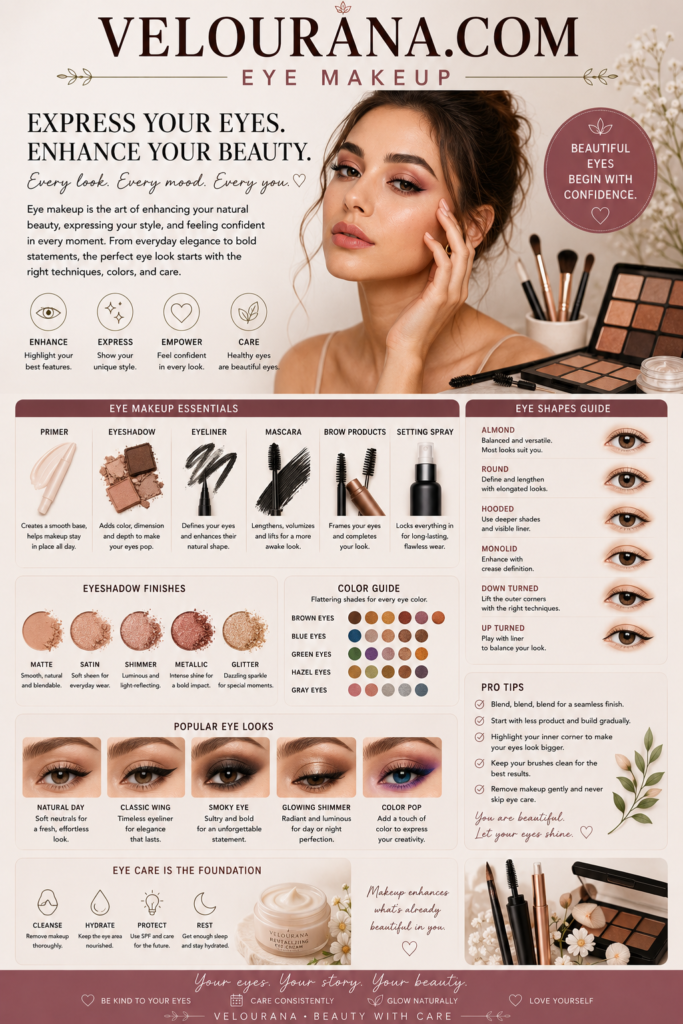
CATEGORY: Powder Eyeshadow
Powder eyeshadow remains one of the most familiar and enduring forms of eye makeup, yet its apparent simplicity hides a remarkable amount of technical sophistication. A pressed pan of color may look straightforward, but the way that powder releases from the surface, adheres to a brush, transfers to the eyelid, blends into neighboring shades, responds to skin oils, and maintains its finish over time depends on a carefully balanced formula.
Its longevity as a category is not accidental. Powder eyeshadow offers a degree of flexibility that few other formats can match. It can produce barely perceptible shading, dense color, smoky depth, delicate gradients, graphic intensity, or layered combinations of matte, satin, shimmer, metallic, and sparkling finishes. It can be softened until it appears almost like natural shadow or intensified until it becomes the dominant feature of the entire face.
The format also encourages experimentation. A single powder may be used lightly through the crease, concentrated at the outer corner, pressed near the lash line, diffused beneath the eye, or layered over another color. Palettes allow several tones to interact, but even one carefully chosen powder can create considerable dimension when its opacity is controlled.
Modern powder eyeshadow has also evolved significantly. The category includes formulas that feel dry and firm, extraordinarily silky powders, rich pressed pigments, soft textures that almost resemble creams, and reflective shadows whose smoothness would have been difficult to achieve in earlier generations of makeup.
Despite the arrival of creams, liquids, sticks, and hybrid textures, powder eyeshadow remains central because it gives the wearer something extremely valuable: control. Color can be placed, built, blended, corrected, expanded, or softened gradually. That freedom makes powder eyeshadow suitable for both beginners learning basic placement and experienced makeup users creating highly detailed work.
Why Powder Eyeshadow Behaves Differently From Other Formats
The defining characteristic of powder eyeshadow is not merely that it feels dry. Its structure fundamentally changes how pigment is delivered to the eyelid.
In a cream or liquid formula, pigments are suspended within a more fluid medium. That medium affects spread, drying time, movement, and adhesion. Powder eyeshadow behaves differently because the product is usually transferred from a pressed or loose powder state onto the skin through friction, pressure, and brush movement.
This creates considerable freedom.
A brush can collect a small amount and distribute it as a translucent veil. More product can then be layered gradually. A denser tool can increase opacity, while a softer brush can stretch a small amount of pigment across a broad area.
The same pan can therefore behave almost like several products depending on application.
This adjustability is particularly useful for creating gradients. Eye makeup often depends on gradual changes rather than hard divisions. A deep shade may begin intensely at the lash line and slowly disappear as it travels upward. A medium tone can create a transition between dark pigment and surrounding skin. Powder makes this kind of controlled fading relatively intuitive because the wearer can manipulate how much color reaches each area.
The format also allows neighboring shades to overlap.
Rather than placing one color beside another with a sharp boundary, powder can be worked into the edge of the existing shade. When compatible formulas are used thoughtfully, this overlap creates complex intermediate tones that make the gradient appear seamless.
Yet this freedom also introduces potential difficulties.
Powder can become patchy if it encounters an uneven or excessively tacky base. Too much loose product on a brush can fall beneath the eye. Overworking several colors together can remove definition and create muddiness. Very dry textures can emphasize dehydration, while very soft formulations can produce excess loose powder in the pan.
The strengths and weaknesses are closely connected. Powder eyeshadow offers extensive control precisely because it remains movable for longer than many fast-setting liquid or cream formulas. The challenge is knowing how much movement is beneficial and when the makeup should be left alone.
The Anatomy of a Pressed Powder Formula
A pressed powder eyeshadow is not simply raw pigment compressed into a pan. Cosmetic formulas usually combine several types of ingredients, each contributing to texture and performance.
Pigments create the visible color. Fillers and texturizing materials influence softness, slip, opacity, and how the powder feels on the skin. Binders help hold the pressed product together and support adhesion when the shadow is applied. Depending on the finish, reflective materials may be incorporated to create satin, shimmer, metallic, or other luminous effects.
The relationship between these components determines much of the experience.
A powder with excellent slip can glide smoothly across the eyelid. One with stronger adhesion may grip quickly and offer impressive longevity but require more deliberate blending. A very soft shadow may release significant color with minimal brush pressure. A firmer formula may require several passes before the brush collects enough product.
None of these qualities automatically indicate superiority.
A highly pigmented formula can be extraordinary for intense color work but less forgiving when subtle shading is desired. A more buildable powder may appear modest in a swatch yet perform beautifully when creating a gradual crease or natural contour.
Pressed density also matters. A powder that is compressed too softly may become fragile and produce excessive kick-up. A very hard press can reduce pickup and make the surface seem almost sealed.
Repeated use can also change the surface. Oils transferred from fingers or brushes can sometimes create a hardened area on certain powder products, affecting how easily pigment is picked up. Keeping tools reasonably clean can help maintain performance.
Formula preferences therefore become personal. Some users want shadows that deliver dramatic color immediately. Others prefer powders that reveal their intensity gradually. The ideal texture is the one that supports the way the wearer actually applies makeup.
Matte, Satin, Shimmer and Metallic Powders
Powder eyeshadow is not one finish. The format can support an enormous variety of surface effects, and each behaves differently on the eyelid.
Matte powder creates color with little or no obvious reflection. It is exceptionally useful for producing depth, contour, and visual recession. Because matte formulas do not rely on reflective particles to soften their appearance, uneven blending can be particularly noticeable.
Satin finishes introduce a restrained level of luminosity. They may appear mostly smooth with a subtle sheen rather than obvious sparkle. Satin powder can be useful when a completely flat matte seems too severe but a strong shimmer would dominate the look.
Shimmer powders contain more visible reflective material. Depending on particle size and concentration, they can create anything from gentle radiance to pronounced sparkle.
Metallic powders aim for stronger, more continuous reflection. Pressed densely onto the lid, they may appear almost foiled. Their performance often improves when they are deposited with a flat brush or fingertip rather than dispersed through extensive sweeping.
Some modern palettes deliberately blur these traditional categories. A shadow may be described as a luminous matte, pearl, foil, wet-look shimmer, topper, or hybrid finish.
The terminology is less important than the behavior.
Understanding how each powder interacts with light makes it easier to build dimension. Matte can create apparent recession, while shimmer or metallic finishes can visually bring an area forward. Satin can bridge the two.
This contrast between finishes is one of the reasons powder palettes remain so effective. They allow not only color transitions but changes in reflected light across the eye.
Preparing the Eyelid for Powder
Powder eyeshadow performs best when the surface beneath it supports even adhesion.
The eyelid does not need to be completely dry, but excess emollient product can make powder grab unpredictably or encourage later movement. Heavy skincare immediately beneath makeup can also influence wear, particularly on naturally oily lids.
Allowing eye-area skincare to settle before applying makeup can create a more stable surface.
Primer is useful when additional longevity, color intensity, or surface uniformity is required. Different primers behave differently. Some dry to a relatively smooth finish and allow powders to glide freely. Others remain tackier and increase pigment adhesion.
A tackier base can make certain colors appear significantly stronger, but it can also cause the first brush placement to become very intense. This is especially noticeable with deep matte powders.
If the goal is a soft gradient, the base may need to be treated more lightly. If maximum color saturation is desired, stronger adhesion can be an advantage.
Concealer is sometimes used as an alternative base, although its texture varies significantly. A very emollient concealer may crease or change how powders adhere, while a thinner formula can provide a more uniform tone.
The key is not the name of the product beneath the eyeshadow. It is the surface it creates.
Powder should have enough grip to remain in place but enough freedom to blend where transitions are needed.
Brush Choice and the Way Powder Moves
Brush design dramatically influences powder eyeshadow.
A large fluffy brush spreads product over a broad area and is well suited to soft transitions. A smaller tapered brush provides greater control and can concentrate shade within the crease or outer corner. A flat brush presses powder more densely against the lid, increasing opacity.
Dense brushes generally deposit more. Airier brushes diffuse more.
This simple distinction explains why changing brushes can alter the appearance of the same eyeshadow.
Pressure matters equally.
Using strong pressure pushes the bristles more firmly against the skin and can move large amounts of pigment. Light pressure allows the tips of the bristles to soften an edge without disturbing everything beneath.
This becomes particularly important during blending.
The objective is rarely to move all the pigment equally. Usually the deepest area should remain concentrated while its edge becomes progressively softer.
When the entire brush is pressed heavily across the application, depth can spread farther than intended. The eye may become darker overall but less dimensional.
Using less pressure as the brush approaches the outer edge of the shadow preserves a gradient.
Brush cleanliness also influences color. A tool containing remnants of a previous shade can alter the next color before it even reaches the eye. This is particularly noticeable with pale or vivid powders.
Perfectly clean brushes are not required between every tiny stage, but awareness matters when maintaining distinct hues is important.
Building Color Without Creating Mud
Powder eyeshadow encourages layering, but layering does not mean repeatedly adding colors without considering their relationship.
Muddiness occurs when different shades become so thoroughly mixed that their individual roles disappear. Instead of a controlled gradient, the eye can become one indistinct medium tone.
This often happens when every shadow is blended through the same area repeatedly.
A more deliberate approach preserves zones of intensity.
The deepest shade can remain anchored where maximum definition is wanted. A medium shade can overlap only the edge of that depth. A softer transition can extend farther outward.
Each layer interacts, but not every layer occupies the entire eye.
This creates visual hierarchy.
The same principle applies to colorful makeup. Blue, purple, green, pink, and other vivid powders can blend beautifully, but if several strongly pigmented colors are worked together too aggressively, they may produce dull intermediate tones.
Sometimes a clean transition shade is useful. Other times, allowing a narrow boundary between contrasting colors preserves greater clarity.
Powder gives the wearer time to make these decisions because it usually remains workable.
The mistake is assuming that every visible transition must disappear completely. A polished eye can contain controlled distinctions between shades. Smooth does not have to mean homogeneous.
Fallout, Kick-Up and What They Actually Mean
Powder eyeshadow inevitably raises questions about loose product.
Kick-up refers to powder disturbed within the pan when a brush touches the surface. Fallout refers to particles that fall away from the intended area during application or wear.
Neither automatically means that a product is poor quality.
Very soft, highly pigmented powders can produce significant kick-up because little pressure is required to loosen material from the pan. Reflective shadows may create fallout when their particles do not fully adhere during application.
The important question is whether the behavior can be controlled and whether the finished performance is satisfactory.
Pressing a brush more gently into a soft pan can reduce excess disturbance. Tapping away surplus product before approaching the eye can limit fallout. Applying highly reflective powders with pressing motions can improve adhesion.
Some people prefer completing eye makeup before foundation when working with dark or sparkling shadows. This allows any fallen powder to be removed without disturbing finished base makeup.
Others prefer foundation first and simply control the application more carefully.
Neither sequence is inherently correct.
What matters is understanding the formula sufficiently to anticipate its behavior.
Powder Eyeshadow and Different Eyelid Types
Powder formulas interact differently with different eyelids.
Oily eyelids can cause some powders to fade, crease, or change color as natural oils emerge. Primer or another suitable base may improve stability.
Dry eyelids present a different challenge. Very absorbent or powdery formulas can emphasize dehydration, particularly if excessive product is applied.
Textured eyelids can make highly dry formulas look less smooth. This does not mean powder should be avoided. It means thinner layers and more refined textures may create a finish the wearer prefers.
Hooded lids can cause powder to transfer where skin folds repeatedly touch. Long-wearing preparation and thoughtful placement can help maintain the design.
Deep-set eyes naturally contain stronger shadows, which may influence where additional powder depth is needed. Monolids provide broad possibilities for gradients that are not dependent on a traditional visible crease.
The central principle remains observation.
Powder eyeshadow is adaptable precisely because its placement can be customized to individual anatomy.
Using Powder as Liner and Soft Definition
One of the most useful qualities of powder eyeshadow is its ability to replace or supplement traditional eyeliner.
A deep powder pressed close to the lashes can create definition without the sharpness of liquid or gel liner.
Black produces strong contrast. Dark brown gives a softer effect. Charcoal, plum, navy, forest green, and other deep shades can provide subtle color while still defining the eye.
The finish can remain diffused or be sharpened with a small angled brush.
Powder liner is particularly effective when the goal is softness. The edge can be smudged into the surrounding shadow, creating continuity rather than a separate line.
For greater intensity, some suitable powders may perform differently with a dampened brush, although the product should be used according to its intended directions because not every formula is designed for wet application.
Even without added moisture, pressing several thin layers near the lash roots can produce substantial depth.
This illustrates the versatility of powder. A pan designed as eyeshadow can create contour, transition, lid color, smoky definition, and liner within the same look.
The Continuing Appeal of Powder Palettes
The powder eyeshadow palette remains one of beauty's most recognizable formats because it organizes possibilities into a compact visual system.
A well-designed palette allows colors to interact.
Pale shades establish lightness. Medium tones define shape. Deep shades create contrast. Reflective finishes introduce brightness.
The usefulness of a palette depends less on the sheer number of pans than on whether the shades work together.
A small palette with carefully chosen depth levels may support more complete looks than a very large collection containing many colors with similar values.
Depth is often overlooked when people evaluate palettes. Two shades can be completely different in hue yet produce nearly identical visual depth on the eye.
Successful combinations usually include enough variation to create structure.
The same principle explains why enormous palettes are not necessary for sophisticated makeup. A handful of well-selected powders can create extraordinary diversity when intensity and placement are varied.
The palette is not the look. It is simply a collection of materials from which the look is built.
Why Powder Eyeshadow Continues to Matter
Cosmetic technology continues to produce new textures. Liquid shadows offer speed and intensity. Cream sticks provide convenience. Hybrid formulas combine powder-like finishes with creamy sensations.
Yet powder eyeshadow remains foundational because its strengths are difficult to replace.
It is adjustable.
It can be subtle or opaque.
It can remain soft or become graphic.
It can create believable shadow or obvious decoration.
Most importantly, powder allows the wearer to build gradually.
That gradual process makes correction easier and customization almost limitless. A color can stop at the faintest haze or continue toward dramatic saturation. Edges can remain sharp, become softly diffused, or disappear almost entirely.
Powder eyeshadow therefore remains less a single makeup product than a flexible medium.
The formula may evolve, pigments may become smoother, reflective finishes may become more sophisticated, and palettes may follow changing aesthetic trends, but the fundamental appeal remains unchanged.
Powder gives color structure while preserving movement.
It allows the eye to be sculpted through depth, illuminated through reflection, elongated through placement, softened through diffusion, and transformed through color.
That combination of precision and freedom explains why the classic powder pan continues to sit at the center of eye makeup.
THE END VELOURANA
 Discover More From Our Family of Websites
 ZodiacBearing (Astrology, Tarot, Numerology, Angel Numbers & Spiritual Guidance)
 Velourana (Beauty, Makeup, Hair Care, Skincare & Beauty Tips)
 HavenBearing (Home, Living, Organization, Décor & Everyday Inspiration)
 PawBearing (Pet Care, Dog Breeds, Animal Health, Training & Pet Products)
 PsyCatherine (Notes From the Journal of a Psychologist on Real Life)

